Software
Houzz Logo Print
webuser_240980602

New brick wall mortar crumbling easily – bad mix or workmanship issue?

last month
last modified: last month

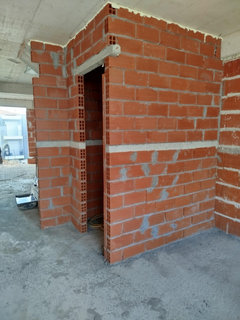
I recently had a brick wall built by a professional, but I’ve noticed a problem with the mortar. When I touch or scrape the joints, the cement between the bricks crumbles very easily — I can crush some of it in my hands.

I’m worried this indicates poor-quality mortar or incorrect mixing. Is this a normal curing issue that will improve over time, or is it a sign of bad workmanship/materials that could affect the strength of the wall?

Here is the Video so you can see exactly what’s happening.

  • Should I ask the builder to redo the work?
  • Is there a way to test whether the mortar is structurally sound?
  • Could this be fixed without rebuilding the wall?

Any advice from people with masonry or construction experience would be greatly appreciated.

Comments (17)

  • PRO
    last month

    It looks like typical European masonry construction. Why was the wall added? Is it structural or non-structural?

    You don't judge the condition of the mortar by portions which were squeezed out of the joints, but rather, the condition of mortar in the joints. Can you penetrate the mortar in the joints with a pen knife or a car key?

  • PRO
    last month

    This is nothing close to European masonry, more like sloppy masonry (like to see a larger image of the surface), in the video just too many voids in the mortar.

    Even if you look at extruded, beaded or square joints, none of them have voids.


  • last month

    It could be old stale mortar was used. The Portland cement will absorb moisture from the air which causes it to hydrate and lose its binding strength over time. It could also be the mortar used for the application,

    • type"M" is hard as a rock when cured with 2500 psi strength intended for exterior above and below grade support walls.
    • Type "S" has a 1800 psi strength used the same as type "M".
    • Type N has a750 PSI strength again also used for support walls which I would never use just to save a few dollars a bag.
    • Type "O" has only a 350 PSI strength used for NON load bearing interior walls and restoration . Are these walls NON load bearing interior walls? Outside elements would eat it out in no time it's so soft.

    Type N and O are soft and they could of used one of these two types, so what are the walls used for? Load bearing or non load bearing walls? Exterior walls or exterior walls protected from the elements or interior with no load? Ask the contractor what type of mortar he used, if he tells you Type M or Type S the mortar was old and went stale. Mortar sitting for even less then a year can go bad in a humid environment. If he tells you Type N it's because it's cheaper than M or S, but still could of been used for the right application If it's type O all I can say is what was he thinking! I used two year old type M mortar I had sitting in my damp garage left over from another job and was soft and crumbled between my fingers and would rub out of the joints with A stick. I took it down and did it again with new mortar. Learned my lesson and I'll test old Mortar and concrete first before I use it. Good type M and S mortar will be as hard as a rock 100 years later and will need a chisel or concrete cutting wheel to remove it. I can't comment on what you should do about this without the answers to the questions I asked above, and you should also refrain from jumping on the contractor without the answers to the questions I asked, and yes it can be fixed without rebuilding the wall.

  • last month

    Just wondering, why were clay tile bricks used anyway? What is the purpose of the wall?

  • PRO
    last month
    last modified: last month

    "This is nothing close to European masonry" I beg to differ, Greg. The striations on the brick are uncommon in the U.S., but are typical in many European countries, particularly for interior walls where plaster will be applied or where aesthetics aren't important (e.g., factories.) In those applications, the joints aren't typically struck (nor would the backside of a masonry wall.) Albeit 30 years ago, I saw this type of (hollow clay) brick being used for modern residential and commercial construction in Germany and France. I suspect it's used more widely than in just those two countries. If the wall is an interior, non-structural wall, I wouldn't be too concerned about a void in a head joint, which is why I asked the question of the OP.

    If you'd like more information on hollow clay bricks, you can click on the link below:

    https://www.researchgate.net/figure/Traditional-bricks-in-Southern-European-residential-construction-a-11cm-b-15cm-c_fig1_320736253

    As always, glad to help with your continuing education, Greg.

    HU-240980602 thanked Charles Ross Homes
  • last month
    last modified: last month

    I see a lot of old barns and silos made with hollow clay bricks in Minnesota built by Scandinavian and Germany immigrants from the mid 1850's to the mid 1950's. I bid on some land with two barns up north with one of the barns built with the clay bricks I really wanted. I Missed the winning bid by $3,001.

    I love barns.

    HU-240980602 thanked kevin9408
  • PRO
    last month

    @Charles Ross Homes, Your textbook experiences are always appreciated :-)


    HU-240980602 thanked GN Builders L.L.C
  • PRO
    last month

    @kevin9408 Not sure what that wall is, more likely, it's Terra Cotta block, that's what it looks like, the grooves help mortar, etc, to adhere to the surface. Maybe they're gonna parge the face of it, this is why it's done so sloppily, they will clean it up and plaster over it, who knows.

    HU-240980602 thanked GN Builders L.L.C
  • PRO
    last month

    "Maybe they're gonna parge the face of it, this is why it's done so sloppily, they will clean it up and plaster over it, who knows." Which is why it is better to ask a question than to pronounce it's an "unprofessional" job.

    My experience with European building materials and methods comes from working as an engineer for a large international food manufacturing company and traveling to European factories on numerous occasions, Greg. You might want to stretch your wings beyond 'Jersey. I think it would be good for you.

    HU-240980602 thanked Charles Ross Homes
  • PRO
    last month

    @Charles Ross Homes, "You might want to stretch your wings beyond 'Jersey. I think it would be good for you."

    As my wings go... You have no idea, my friend... You just yap yap yap as usual and probably beyond YouTube travel videos while sitting in your office, you haven't seen anything, not even a job site, so I wouldn't touch that subject.

    By the way, you got me worried last night; you didn't get your last word in before bedtime (but I knew it was coming at some point).

    I hate to see you cry yourself to sleep when that happens lol.

    Keep going, try to entertain me a little more. I miss it.


    HU-240980602 thanked GN Builders L.L.C
  • PRO
    last month
    last modified: last month

    I was digging through my job photos. A while back, we did a job in the development where many houses had brick fronts, and many had the same type of joints.

    I was talking to the homeowner, who was the original buyer. He said many houses built there in the 40s were done with this type of mortar joint.

    I took a few pictures at the time to show it to my mason


    HU-240980602 thanked GN Builders L.L.C
  • last month

    If that is European it must be called European slop ugly. I've seen the slop on houses before and my OCD always wanted me to chisel it all off and repoint the bricks.

    HU-240980602 thanked kevin9408
  • last month

    Thank you for all your answers -- much appreciated.

    These are non–load-bearing walls between rooms. The building is in Greece, and since I’m not local, it feels strange to see such a sloppy job. They don’t use the usual designations like M, S, etc. for mortar quality, and I couldn’t even get a clear answer about the sand-to-cement ratio.

    The walls are built with clay bricks (KEBE N90) and are 10 cm thick. They will be plastered later. This is part of a new house under construction. My concern is that, even if the walls don’t collapse, they might develop cracks after plastering.

  • last month


  • PRO
    last month

    @HU-240980602 Thanks for the picture, what finish will be applied to the surface?

    HU-240980602 thanked GN Builders L.L.C
  • PRO
    last month

    "They will be plastered later." So saith the OP.

    The walls are interior, non-load bearing hollow clay brick which is a typical European construction material and method. They are a good substrate for plaster. Compared with lath over wood frame construction, the potential for cracking is much less.

    HU-240980602 thanked Charles Ross Homes