Software
Houzz Logo Print
ftveer

gas stove top vs induction stove top

10 months ago
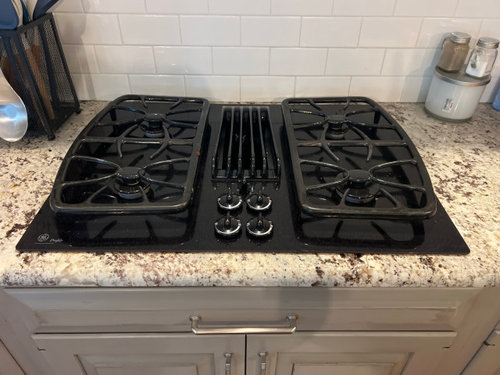
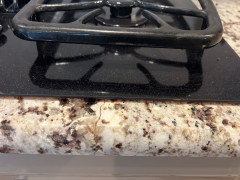
We need to upgrade our stove top. It is gas and down vented. We are also looking to fix an area of the granite in front of current stove that is cracked due to poor installation so an apron style is preferred. We have been told that an induction stove top does not need to be vented and that’s how we got here.

Problem 1: I really don’t like the look of the induction. It looks like an electric stove.
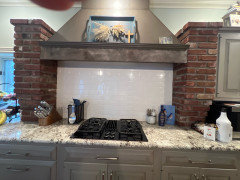
Our kitchen is a bit industrial/rustic and I feel that a gas stove would look better.

Problem 2: we are limited on options due to the down venting and also given that our stove top is on the wall we cannot have a pop up vent.
We could do a whole new stove/oven, but then we would have 3 ovens. (I already have two full wall ovens).

Comments (23)

  • 10 months ago

    Crack in granite

  • 10 months ago

    And it’s starting to chip underneath.

  • 10 months ago

    Rustic design

  • 10 months ago
    last modified: 10 months ago

    "an apron style is preferred"

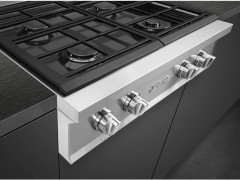
    A rangetop would require you to modify the cabinet and countertop to install it. Are you inclined to do that?

    You could just replace what you have: GE PGP9830SRSS 30 Inch Built-In Gas Cooktop.

  • 10 months ago

    Kendrah when we bought the house it was just a shelf with an overhead light btn the two brick pillars. The stove top is the original down vented cook top. We had the hood made.

  • 10 months ago

    And I agree, our current one is outdated.

  • 10 months ago

    Put an insert into the area you have for a hood. Add an induction cooktop. 36" looks to fit.

    A competent counter person should be called in. The cracked area is an easy repair. Miele or Bosch for the cooktop.

  • 10 months ago

    Why would an induction stove top not need to be vented? Of course it needs to be vented. You still have smoke, steam, grease and odors when using induction.

  • 10 months ago

    Thank you Clyde, I was thinking that too. The sales guy we were working with said it really didn’t need it. But after researching it, I am in agreement with you. We are going to get an estimate on possibly putting in a vent above, but if it’s a big cost, we will stick with a down vented option.

  • 10 months ago

    "The sales guy we were working with said it really didn’t need it. "

    This is basic stuff. You need another sales guy.

  • 10 months ago
    last modified: 10 months ago

    Preferred appearance is obviously based on personal taste but I'd take the appearance of an induction cooktop any day over what you have now. A smooth cooktop isn't going to make or break your rustic look. I'd try to get a 36" cooktop if at all possible. I recently replaced a radiant electric cooktop with induction and since the new cooktop fit the cutout perfectly I stuck with 30 inch but have had 36" in the past and preferred that. I thought I'd never switch from gas but now I'd never go back to gas. I've lived without a decent external exhaust fan but certainly wouldn't do so if there was any reasonable option to have one. I've never had a down vent but I'm sure it's better than nothing. It seems like it would suck the gas flame toward it. If so another benefit of induction.

  • 10 months ago
    last modified: 10 months ago
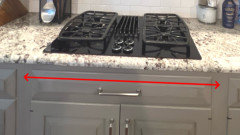
    1. The cabinet below the cooktop looks narrow. If it's less than 33-34" wide, you would need to cut the tops of the cabinets and enlarge the countertop cutout to accommodate a 36" cooktop.
    2. The existing gas cooktop cutout is 28-7/8" W x 20-5/8" D.
    3. One of these KitchenAid 30" induction cooktops should fit with minor enlargement of the cutout.
    4. The KitchenAid KCID930SBL is 30" downdraft induction cooktop. You would need to check to see how difficult it would be to modify the gas downdraft ducts for the induction cooktop downdraft ducts.
    5. The induction cooktops require a 40-amp 240 volt circuit. You probably have only a 120 volt circuit for the gas cooktop blower.
  • 10 months ago

    All cook tops should be vented even if your local code doesn’t specify so. Especially gas. If your home cannot easily accommodate an overhead vented hood then downdraft is the next best thing. Down draft works better with induction. And a telescoping down draft would be an improvement for you in either case.

  • 10 months ago

    Thank you everyone! Here’s another thought to consider…
    We have considered just putting in a full appliance with cooktop and Oven. Which might make the granite situation go away and might be easier to make alterations. My concern is that we already have two wall ovens, would that be overkill?

  • 10 months ago

    "We have considered just putting in a full appliance with cooktop and Oven"

    What is the width of the cabinet under the cooktop?


  • 10 months ago

    If you were to go with an overhead insert and get ventilation above, there are, thus far, induction rangetops on the
    market in both 30 and 36 inch widths. Unfortunately, your brand choices are the following: Viking, Fulgor, Milano, Bertazonni, and Aga. Many of these will have issues getting timely service, whether in warranty or out of warranty. As for Viking, their reputation for repair issues is still suspect. Hopefully, once the appliance market has introduced more product in the categories of induction, full ranges and induction built-in cooktops, It’s hopefully in the cards that some of the other manufacturers such as Wolf, Thermidor,Miele etc. will introduce their own versions of these. I suspect the reason we haven’t seen that many induction range tops as of yet is because, although they will have a certain market appeal, I can only guess but wonder if the number of rangetops that iare sold in North America is historically lower than the sale of ranges and built-in cooktops generally.

    If you decide to go with a downdraft, KitchenAid as well as its much more expensive cousin brand Jenn air, offer downdraft versions of their induction cooktops as was just mentioned. In addition to the 30 inch width that WD cruise mentioned, they also offer downdraft induction cooktops in a 36 inch width as well. As was also mentioned, if you are moving up to a 36 inch width, which would be fantastic, I agree with WD cruise you will have cabinet issues to deal with which will be another factor in your overall project costs. Perhaps you can price out all of these potential pathways, but it cannot be overstated that there has to be at least some form of ventilation. It may be that the sales person is poorly trained, or they may have misinterpreted what some have said regarding induction cooking in that you may not have to install make up air if you were able to use a 400 CFM ventilation source due to the much lower heat that is generated by induction cooking. I would personally want make up air, but others here may have better information on that decision. That old idiom, “the devil is in the details“ has a reason for being.

  • 10 months ago

    Wdc: the width inside the cabinet is 34.5 inches. We might be able expand it out. I would love to have a 36 in. But it will all depend on the extent of the cabinet work that will need to be done. We will do our research. Fortunately we are not in a hurry to get it done right away.

  • 10 months ago

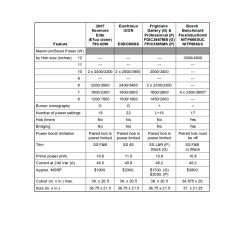
    Attached is a table of parameters I constructed in 2015 to help me decide what I would buy to replace a Kenmore (Electrolux) that had failed. I ended up with the Frigidaire (Electrolux) Gallery. I submit this to suggest that when you (the OP) do your research, you construct a table that allows direct comparison of parameters.


    For example, it may be seen that whittling out the interior sides of the center cabinet (assuming the cabinets have their own 3/4 inch sides) would allow any of these 2015 examples to fit.

    My cooktop (not rangetop) is set into soapstone. I applied extra reinforcement at the rear and front to aid resistance to fracture. Stone is good in compression, but not in tension, so any part of it supporting weight (the gas cooktop or just someone leaning on the stone) needs reinforcement.

    Is that a real (not very deep) drawer or a fake drawer? Does it have a vertical cabinet member behind the door gap rising from the cabinet base to a horizontal support under the granite that should be of the order of the drawer face in height to provide stiffness? If not, a horizontal metal L or square section should be used. This is a case where the marginal cost of granite support "over-design" is less than the cost of failure times the probability (risk) of failure.

    And on the subject of ventilation, please understand that the achieved air velocity of a pop-up side draft vent, or a down draft vent, drops very rapidly with distance in proportion to the smallest dimension of the vent intake port. As a result, the vent air flow cannot deflect hot rising cooking plumes to the vent intake, even those from induction (perhaps only 0.6 m/s vs. 1.2 m/s for gas). If one is forced to use such configurations, pan screens or covers need to be used to kill the upward plume velocities. This will be only partially successful, as the covers need to be removed at various intervals.


  • 10 months ago

    With a 34-1/2" interior cabinet width, the KitchenAid KCID936SBL 36 Inch Induction Downdraft Cooktop which requires a 34 9/16 ± 0.08 in. W x 21 5/32 ± 0.08 in. D cutout should fit. You would have to add a 240-volt 40-amp circuit to support the cooktop.

    If the exterior cabinet width is 36" and you could remove it and cut back the countertop, you could replace it with, say, a Frigidaire PCFI3670AF or Electrolux ECFI3668AS induction range after adding a 240-volt, 50-amp circuit.

  • 10 months ago

    As you do your research on 36" induction ranges. you can add two models from Miele and a Wolf. One from Miele includes a water hookup for steam baking. Link.

  • 10 months ago

    It all depends on if you can get it vented properly. People that cook and bake a lot would love 3 ovens. Those that don’t may wish they had the lost storage space if the cabinet goes away.

  • 10 months ago
    last modified: 10 months ago

    Since it appears the overhead vent surround is just for looks and it used to have shelves there, should we assume there is no duct work inside the surround, in the walls or ceiling? Does the downdraft vent into the house (e.g., basement) or does it vent to the outside? If outside, I assume below the current hood's level - which won't be of much use for an overhead vent.

    Ideally, you should see about fixing the overhead vent to fix the whole issue. However, that will mean not just purchasing an insert, but also installing the duct work and exterior vent. Is it worth it? I would say absolutely, but this is your decision.


    Venting is less about the fuel used for cooking and more about the cooking itself. While gas ranges/cooktops/rangetops do have fumes that need to be removed, the rest have no bearing on the fuel. Effective venting removes what we call FOGSS - Fumes, Odors, Grease, Smoke, Steam. Downdrafts - whether center or back - are very poor vents. Non-telescoping are the worst. To be effective, they would have to have very strong "sucking" power to counteract the laws of physics (and, maybe, atmospheric physics?). FOGSS naturally rise and expand as they are created. Downdrafts have to counteract that rising. Overhead vents accept the rising, capture the FOGSS, and hold them to exhaust them out. With gas and downdrafts (especially non-telescoping), you run the risk of diverting the flame or even putting it out entirely with gas now pouring into the room unchecked.


    [Your appliance salesperson has no idea what he's talking about - go elsewhere and consider letting the owner know why you are not purchasing from them. The owner may or may not care, but at least you will have given them a heads up as to the deficiencies in their sales staff.]