Software
Houzz Logo Print
jyl_gw

Design the Teeny Cafe Kitchen

last month
last modified: last month

Hello KF, I wonder if we’d like to noodle on a small commercial kitchen design?

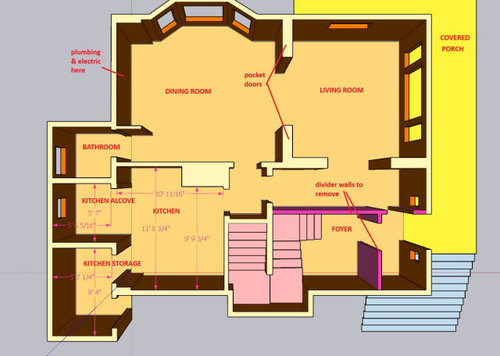
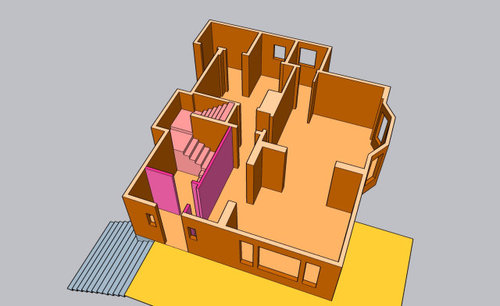
Below is a to-scale CAD model of the first floor of the 1908 Portland four-square I have bought. “Four-square” is a type of house with two levels; the lower being divided into four rooms (foyer, living, dining, kitchen) and the upper being usually four bedrooms and a bathroom. It was a common style here in the early 1900s. My own house is a four-square.

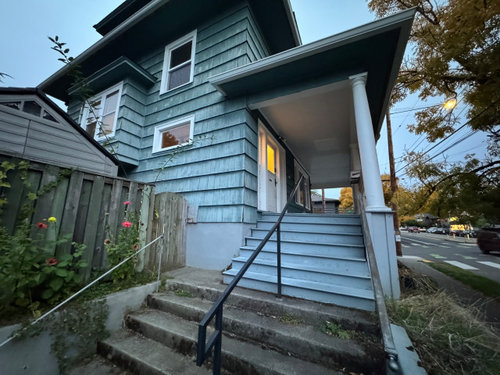
This building started life as a single-family house on a corner lot fronting a main street with a streetcar line, two floors of about 920 sf each, a basement plus small basement garage, and an attic. That made it a pretty substantial house for the time.

Sometime between the world wars it was converted to “flats and a store”, then during WW2 the store was converted to a third flat to make a triplex. It was later owned by, coincidentally, the Portland “Four-Square Church”, who used it as a rooming house for youths in their stone mason program. The pastor lived in the small house next door, which still has crosses under the gable eaves, and the church also owned the third house on the adjacent corner. In the 1980s, all three houses were bought by a young contractor, who rented out the triplex and the other two houses. When I moved to the neighborhood twenty years ago, the first floor was a funky barbershop-bar.

Fast forward to April 2025, when I walked by - I live three blocks away - I noticed the For Sale sign, and learned the house was zoned commercial. Interesting. A long process ensued and we closed escrow this week.

I plan to convert the house from residential to commercial use, use the second floor as my office, and my daughter will open a cafe-bookshop in the first floor, and possibly expand to the basement if the book business merits.

In the model below, the skinny purple walls are non-load-bearing divider walls installed in the between-war years to separate the original foyer into entrances for the second floor unit and the first floor unit. Those can be easily removed. The other walls can be modified, maybe reduced to a couple columns and a header, but can't easily be entirely removed. One of the large windows may be converted to French doors to the porch. The porch is covered, and may eventually be wholly/partly enclosed since we do have six months of foul weather a year.


The annotated floorplan shows the original room designations, and dimensions for the kitchen. The original kitchen was just 10' x 11'8". At some point, a bumpout was added that house the bathroom and "kitchen alcove"; that bumpout is single story with a roof directly above. The "kitchen storage" was a little deck, that was later enclosed. The existing kitchen is how you might picture a kitchen last remodeled in the 1940s or 50s. The solid mass in the top-right of the kitchen may possibly be removable. Half if it is a gas wall heater I will remove. I’m not sure what is in the other half, probably ducting for the long-gone oil furnace.


We have not figured out where the coffee counter will go. The back wall of the (former) dining room is where the barber chairs and sink were, so it has plumbing. The stairs, which will be to my office, may get modified to hug the exterior wall, so as to take up less space. Eventually the second floor may get its own entrance.

The cafe will start as a “coffee shop” with some baked goods, breakfast wraps, etc. More food will be added to be a ”cafe”, but it will never be a ”restaurant” with a full menu, cooks preparing dishes to order. and waitstaff. Seating capacity only about 15 inside with more on the porch. Daily menu will have about 6-10 items, prepared ahead for quick assembly and heating - for example a salade Nicoise, a Chef's salad, quiches and tartines, a few sandwiches, a couple soups, baked goods, etc. More vegetarian and vegan than meat-heavy. And, of course coffee, espresso, lattes, iced coffee, and so on.

The menu will be designed for the kitchen’s limitations. Cooking will be with ovens (speed, steam, etc) and a couple of induction hobs. If we do meat - say, confit de canard - it'll be mostly done sous vide with browning by oven or hob. But as I say, it will open as just a coffee shop.

My initial thoughts are that one or two countertop half-size ovens and two induction hobs would go in the "kitchen alcove" where a hood can vent directly through the bump-out roof. Storage, refrigerator/freezer, mop sink in the "kitchen storage" space. Local code does not require a three basin sink if we have a dishwasher, and does not require a vent hood if the dishwasher is undercounter, so the dishpit can be a two basin or smaller three basin sink with undercounter dishwasher, under-sink grease trap, and shelves for ware above. Code does require mop sink and handwashing sink, floor drains, washable surfaces, etc.

The bathroom entrance can be modified - moving the bathroom is maybe possible, but expensive. Given the small occupancy, only one bathroom is required. It is not large enough to be fully ADA compliant but I’ll do my best. A wheelchair lift to porch will eat up most of the ADA budget.

Not gotten much farther in thinking than that.

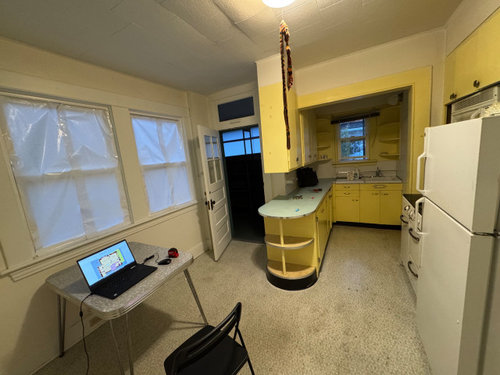
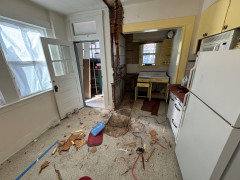
Here is the existing kitchen. Has a nice old Wedgewood range, which sadly I’ll get rid of. The kitchen alcove and kitchen storage are both shown. Everything you see will be removed and gutted.


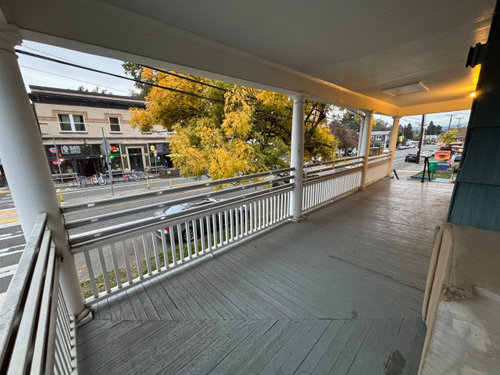
The porch is possibly my favorite part of the house. A popular pub is across the street, more pubs and restaurants down the block. That is an active main street, and the cross street is a bike route, so plenty of foot traffic.


Cosmetics need work, bones and systems are good.


Comments (10)

  • last month

    I don't have the chops to give design advice, but I'm chiming in to say what a great building and project! I love that you know some of the history of the building. I think any old documents or pictures you find would make interesting 'art' if framed and hung on the walls somewhere.


    We have a small cafe in our little town that does a hopping business. They have a main kitchen in back, with a window through to the front counter where some sandwiches and salads are displayed and where people order and pay. They have an old sideboard / hutch with teas, jams, and other things for sale. Then on another wall there are a few large glass fronted refrigerators with pre-made items for sale, such as soups or take and bake meals. Those seem to be popular. There's a video on their website (here) that goes pretty quickly but gives you a few glimpses of the cafe, just in case you're interested.

  • last month
    last modified: last month

    Thanks! I love finding out the history of odl buildings. It is usually possible to find old photos, copies of old documents, learn who lived there and what they did, etc. People like seeing that stuff too.

    That cafe in your town looks really nice. Their space looks larger than ours, so we really need to make the most use of the porch - hence the idea to semi-enclose that porch so it is usable for more of the year.

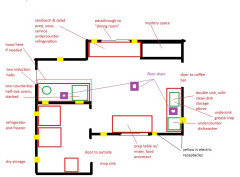
    For the kitchen, I was noodling something like this. The sketch shows just the kitchen area.

    Cut a passthrough to "dining room" at top (of image), have sandwich and salad prep there. Put ovens and induction hobs in the kitchen alcove to left, with hood above if needed. Dishpit on the right, with clean dish storage on shelves immediately above. A general purpose prep table at the bottom with storage above and storage or refrigeration undercounter. Hoping I can squeeze a mop sink into the storage room where the refrigerator, freezer, dry storage will be. If the "mystery space" can be cleared out, that would be helpful. I need to lay things out with blue tape, then mock up with cardboard boxes. The good thing is that not much will be "built in", so things can be changed around as needed.

    There are some reasons to open with as little equipment as possible and add most of the equipment after the space is in service. Tax reasons . . . think difference between amortizing startup costs over 15 years vs 100% bonus depreciation. So we might be pretty minimalist initially, while putting a whole bunch of not-currently-needed electric circuits and plumbing. For example, water and drain in the alcove for possible future steam oven. When walls and floor are open is the best time to add all that stuff.


    EDIT: DD and I taped out the kitchen floor. The plan shown above seems broadly workable. I’ll start demo’ing the cabinetry and we will see how things develop.

  • last month

    Actually the places that first started this kind of thing where I live, particularly those started in the 1970s and 80s, left a lot of the "house" intact as separate rooms lined with books, the cafe area, and mostly modified the food prep area. Your designed food prep area might be a bit large for the concept. There are full cafe/restaurants (albeit with limited menus) that cook in more compact spaces here. But really my experience is kind of limited to places who have existed as such for a long time.


    (One of them had to close eventually because the customer restroom was only accessible through the kitchen and it could not feasibly be changed without reworking the entire building. What this meant was that virtually nobody who ate there used the restroom. Eventually, after Years apparently, a customer complained to L and I, and that was it.)

  • last month
    last modified: last month

    That is basically the concept. A small, cozy, neighborhood cafe-bookshop in a house.

    I think there is a swing back to cozy coffee shops, away from trendy spaces that are all hard surfaces and sleek walls. I also think physical books are making a comeback; small independent booksellers here are doing well.

    My daughter’s plans for the limited menu are, as I described above, designed for a one-person operation with food prep/cooking done in off-hours. She wants to be able to run the whole thing by herself with very low cost structure, if need be. Therefore, plans for kitchen equipment have been scaled down.

    I suspect she will be more successful and busier than she thinks. The location is very good. She’ll be the only coffeeshop in the immediate area. Our Starbucks just closed; there is a church coffeeshop with odd hours - not open Sunday etc - and hidden away not on the main street.

    I’ve been checking out local coffeeshops and their business seems largely dependent on location and “vibe”. Honestly the extent and quality of coffee and food seems secondary. This weekend we visited a very successful coffeeshop that was started by a friend and has become a neighborhood pillar; the food was mediocre (baked goods bought in, some looked like Costco), the “kitchen” was only a sandwich prep room, and the coffee was b-a-d. Most coffee here is bad. Few customers notice, because they are basically drinking warm sugared milk, but 90% of the time, the coffee itself sucks. Daughter’s food will be better and her coffee will be actually good.

    So I am trying to design a coffeeshop kitchen that will have some “headroom”. If she expands the coffeeshop to a ”cafe” with a larger menu and a larger staff, I want the infrastructure to be there and ready for more equipment. We can get equipment installed in a day; re-opening walls or floor will be more disruptive.

    The basement will also be waiting if she wants to expand from “books in a cafe” to a ”bookshop”. For that, we’d need to build a stairwell, the original stairs to the basement was been removed and were too narrow/steep anyway. In a couple years, maybe.

    The other thing I’ve been thinking about is how to get maximum utilization of the space. Daughter intends to close at 4 pm ish, does not want to work 18 hours/day seven days a week. However, she has friends who might be interested in running the business in the evenings, and for that a more robust cooking facility might eventually be helpful. I would, of course, charge them additional rent . . .

  • last month

    The requirements here on accessibility for an existing building are interesting. You are not required to achieve full ADA compliance. Instead , you are required to spend 25% of construction budget on attempting to reach compliance. The order of priority is 1) parking, 2) route to entrance, 3) entrance, 4) restroom. The property has a small parking area which is currently dirt/weeds. I’ll concrete that. The path from there to the porch is unimproved. I’ll concrete that. An exterior-rated wheelchair lift will be required to get up to the porch. The required ADA spend will be exhausted before we ever get to the restroom. I’ll gut the bathroom and make it as accessible as possible, but am not going to move walls.

  • last month

    I like this post. Can’t wait to see what you decide to do and finish design. I like this stairs going along wall.

    But was going to suggest keeping long wall putting it right to door so your entrance is separate. Can
    Bathroom be moved to under the stairs? Then kitchen and counter be along back half

  • last month

    I agree with @halberta - great project and I hope you post progress pictures!

  • last month

    I also think this is an interesting post! Please update it as the project moves along!

  • last month
    last modified: last month

    Sigh, playing with CAD is one thing, actually standing in the space is another, we are going to have to get big cardboard boxes and mock everything up. Is there room to open the oven door and pull out a hot sheet pan, will a sink that fits there have basins big enough for a 20 qt mixer bowl, how skinny do you have to be to squeeze past the barista, where does the $!&#%?>£ mop sink go.

    First you have to rip everything out so that the mocking up can be done.


    Then rip it out more so that your $200/hr electrician and plumber will be able to get in and out in minimum time. That will all be down to studs and joists.

    DD is supremely confident that she can make any kitchen work. Inspiration from tiny kitchen establishments like those profiled here

    https://www.nytimes.com/2025/04/29/dining/restaurants-with-no-kitchen.html?unlocked_article_code=1.yk8.Jn4i.syYAOWKukY1W&smid=nytcore-ios-share&referringSource=articleShare

    I, the beady-eyed worst-caser, am thinking that if her cafe doesn’t work, I’ll have to rent the space out to someone who may not be as optimistically flexible. So it has to be a fairly complete if small kitchen, or at least have the infrastructure in place.

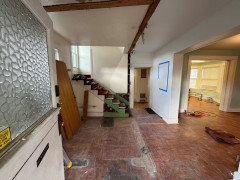
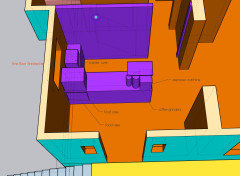
    The stair plans have changed. Turns out my original plan requires one’s upper body to pass ghost-like through part of the second floor. Oops. Not being dead yet, that won’t work. So I’m restoring the original straight run which will allow an 8’ coffee bar plus a bit more.


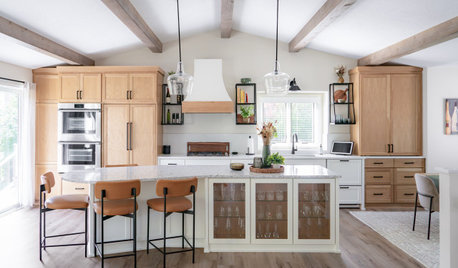
    Like this but with an additional counter closing off access to back of house


Sponsored
Elegant Kitchen and Bath
Average rating: 5 out of 5 stars13 Reviews
VA & DC's Finest General Contractor