Software
Houzz Logo Print
rebekah_eastep

Paint pallet for connecting rooms

last month

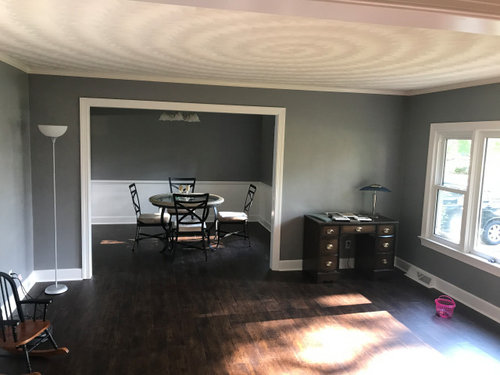
In our area these great rooms with a cased doorway betwern a formal living room and dining room are very popular but i struggle to find many design concepts with this look. Its a 1970s brick rancher.


I’m over the the BM Storm paint we chose for these rooms. I’m looking to repaint and add some coastal color. Question is do I need to carry the same paint color through both rooms or could i pick coordinating colors and do different shades of a similar color in the dining room. For main colors I’m considering SW colors - tradewind, sea salt, or moody blue but open to suggestions. The room faces west so the house is overall lacking in natural light.


Comments (18)

  • PRO
    last month

    Lack of light is easily fixed with better lighting for both spaces What the heck is going on on the ceiling ? The size of the spaces always a good thing to share and IMO wall color last thing to choose since I see very little furniture in the LR for sure. Both spaces look pretty bare . The more info you give us the easier it is to help but SW not great paint BTW so do not get stuck with their colors either .

    Rebekah Eastep thanked Patricia Colwell Consulting
  • last month

    I have same situation with the cased opening. My DR is BM Abyss (navy) and Family Room is BM Elmira White. I also have a smaller opening from DR to LR which is BM Camouflage (bone with green undertone).


    So no they don't have to match just flow together

    Rebekah Eastep thanked jck910
  • last month

    They could be the same or different complementary colors, just personal preference I think - i’d focus on find the main living room paint first. Once you have it you can think whether you also want the same paint in the dining room - if not, there are tons of resources online that can provide options that complement the living room color


    I’d also want a lighter color so there’s not high contrast with the ceiling which seems to being down the height of the room -


    for west facing rooms https://www.kylieminteriors.ca/the-best-paint-colors-for-west-facing-rooms/

    Rebekah Eastep thanked la_la Girl
  • last month
    last modified: last month

    No right or wrong, but there needs to be a connection if not painted the same color (accessories will help tie rooms). Look up complementary colors to your paint choice on Pinterest and you could use it in DR say on the lower half and the lighter shade on the upper/and in LR. You can also cut a paint color in half and use in other room.


    BUT….be sure to consider adjacent spaces and your furniture/accessories. Think big picture.

    Rebekah Eastep thanked Maureen
  • last month

    With the right art and furniture, you can make anything work. I have a red dining room with a half-wall that opens to my yellow LR with green furniture. I have a great floral sofa that brings in the red and yellow and some green under the half wall. A picture of a red house in green countryside on the yellow wall next to the DR finishes the transition. The red house is the one where my grandmother was born.

    Rebekah Eastep thanked Sigrid
  • last month

    Visit your local Sherwin Williams store and take a gander at their many brochures that show paint color ideas, especially in rooms that adjoin such as yours. You'll get lots of ideas there. But more importantly is that you've first made furnishing selections for your spaces so paint choices can be made to best compliment.

    Rebekah Eastep thanked bearbev
  • PRO
    last month

    Paint the same color and simply change the accessory items in each room to change the color.

    You can make a room look 'coastal' without being so literal as to place blue paint on the walls.


    Rebekah Eastep thanked BeverlyFLADeziner
  • last month

    Thanks all! I probably shouldn't have mentioned the colors because my core question was just is it a best practice to paint it all one color or am I being crazy for thinking about two-tones! To everyone's point - yes I posted the empty box! We are starting pretty much from scratch with all new everything in these rooms except the dining table (different from the original pic). So the sky really is the limit! Everything is leftover from our old house and we're just getting to design these rooms.


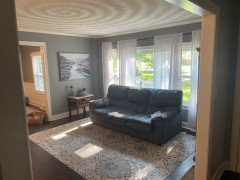
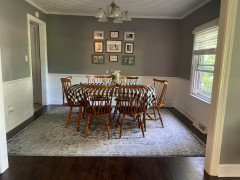
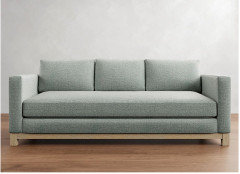
    I have attached the current pictures but I don't really want to design around anything here. Couch is being replaced with something neutral (beige or light gray), area rugs are old and need to be replaced, dining chandelier is in my cart as we speak to be ordered, etc.


    For the person asking about the ceiling...it's plaster swirl. This room and all the bedrooms have it. It is very common in homes of this era where I live but sounds like maybe not in your location. The walls are also skimmed with plaster swirl so no wall paper :(


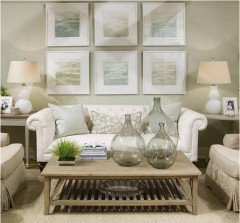
    Formal living areas - couch and rug leftover from our old home and being replaced:


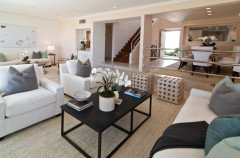
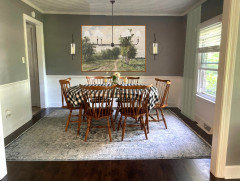
    Dining room (chandelier to be replaced, but table will stay)


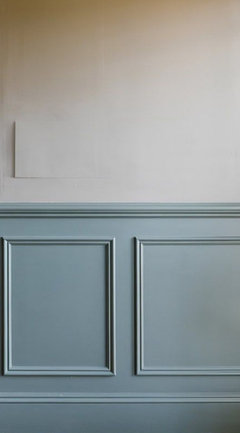
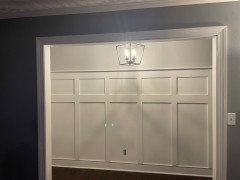
    Hallway outside the two rooms just got new board and batten. Main wall color in hallway and throughout house is BM Silver Chain:


    SW Tradewind mock up (one color): I love the lighter, fresher vibe


    Two tone SW Tidewater + Riverway mock up (two tone)


  • last month
    last modified: last month

    I'd leave the Storm as is and spend money on furniture, lighting and rugs.

    For your accent color, go greener rather than blue.


    Rebekah Eastep thanked JUDY GRAHAM
  • PRO
    last month
    last modified: last month

    You could keep what you have an just add what's needed for the rooms.

    You cannot paint and then keep the light fixtures and accessories because they're not working for the space, so there's that additional expense.

    Rebekah Eastep thanked BeverlyFLADeziner
  • last month
    last modified: last month

    Your house is great. Leave the current color for now and choose a cream neutral, no grays, for long, low sofa. Add same white/cream drapes to dining room. Get one very large art work for dining room--no bitty art works. At some point, you could do a very pale green and all suggestions for furnishings and art would still work.


    Rebekah Eastep thanked housegal200
  • last month

    I love that I came here to hate on my own paint choices and the professionals are like ”nah, girl you’re good” 😂 I’m feeling much better about just embracing the color it is and working in those coastal colors in other ways!

  • PRO
    last month

    The coastal need NOT suggest a summer beach, and the "fresh" color you're "loving" on? Uhhhh no. ...

    You will end with baby blue little boy spaces and there is not more difficult color around which to design.

    From the dining table and chairs? You seem to favor a bit of tradition.

    I'd add lots of frothy white, warm crunchy neutral rugs. I DON'T see the coastal thing at all. .....unless....via lots of paler wood tones, texture. Think pebbles, sand, rocks, wood, twigs, moss, .....not the Florida BEACH and keep the walls.


    Rebekah Eastep thanked JAN MOYER
  • last month

    Yes, we live in the mid-atlantic beach region so not palm trees and tropical. My coastal idea is more like water and earth tone inspired. We actually live on the water so its not gimmicky. Most of our furniture is heirloom antiques passed down from family. Hard to replace with modern ”junk” when you have antique Ethan Allen and pieces handmade by my grandfather! so definitely trying to meld old and new.

  • PRO
    last month

    I love your home and your vintage Ethan Allen furniture. But rooms start with a PLAN, not a paint color. How do you decide on a palette? You could start with a rug, or a pillow, or curtains, or upholstery fabric. Pick something with a variety of colors and work from there. You might find that you like the way your wall colors work, but then again, maybe you'll need to repaint. And no the colors in the two rooms don't need to match, but they should relate.

  • PRO
    last month

    A cohesive palette works best when you use one anchor neutral throughout shared areas, then shift to complementary hues—soft greiges, muted greens, gentle blues, with matching undertones to maintain visual flow. Because lighting conditions vary by room, test large samples on actual walls at different times of day. Keep trims and ceilings consistent to unify the spaces even if wall colors differ slightly.


    Think of the palette as a gradient, where each room transitions naturally into the next without abrupt jumps. This creates a connected atmosphere while still letting individual spaces express their own personality.

  • PRO
    last month

    AI is very!!!! busy this morning: )