Software
Houzz Logo Print
upperbaygardener

Crazy root barrier idea - the reverse root barrier

2 months ago
last modified: 2 months ago

We are all aware of using root barrier for things like running bamboos to keep them from spreading outwards.

Has anybody done the reverse? Put in a barrier to keep something from spreading in?

Now that I've had a couple gingers survive last winter, which I'm calling a "mini polar vortex", I've gone ginger crazy and ordered a couple from Almost Eden. The problem is finding spots with the required light shade.

I've shifted a large clump of Toona 'Flamingo' away from a mixed bed, because it took over everything else planted there. It is now being re-established in an area that will be 25 ft from any other plantings...the bare minimum, probably. Any suckers in the 25 ft. border of lawn, of course, will just be persistently cut down by the mower. I think I will just zap any suckers, over 25 ft away, with a selective or roundup, and I can safely assume that it won't transfer back to damage the main clump. Obviously if I have to do this, I'll be very cautious at first.

But now that I gotta find spots for the gingers, the clump of Toona is looking mighty damn useful for shade. Because of their gangly habit, they seem to cast a consistent medium shade. But then I would go back to the problem of it overwhelming a 'mixed bed', the whole reason I moved it. (Well, really killed off the old clump with glyphosate - covering the poor stuff that was being overwhelmed with black plastic trash bags - and transferred some divisions 60 ft away. It worked - everything the Toona was engulfing survived!)

What I'm thinking of doing is buying some 2 ft. deep plastic bamboo barrier, and putting it on the northeast corner of the intended Toona clump. It will be easy to dig w/my backhoe. It would be maybe 4-5' ft in diameter. Then plant the ginger(s) inside this, protecting them from being overwhelmed by the Toona! It will also have the added benefit of partly keeping my mongrel, patchy lawn, that does contain some Poa trivialis, from invading the gingers, too.

Open to thoughts on why this might not work. As shadows lengthen during the hottest part of the day, the Toonas will shade them. (Gingers due north might cause them to be too shaded - I discovered this can be a problem with my 'Pink V' that are under Taxodium 'Banita'. I had to cut down some big branches to give it more sun. OTOH, they clearly can't quite deal with full sun, even "up" here. And, FWIW, I believe evergreen shade is mostly out of the question, cuz the rhizomes needs the warmth of sun in winter, given they are of borderline root hardiness.)

Comments (13)

  • 2 months ago
    last modified: 2 months ago

    BTW - the Toona needs another couple years of growing before I can do this, so, I have plenty of time to think about it. It's about 10' now, but also needs to send up a few more stems. The shade will be very spindly until 2028. But once it's settled in, it grows pretty fast. The old clump was maybe 20-25' at the tallest where I first planted it in 2017, with smaller suckers around that.

  • last month
    last modified: last month

    2 ft deep should stop alot of roots -- shallow ones at least. An aggressive tree/shrub might get underneath tho.

    PS. You're into things that I would barely imagine, like ginger or 'Toona'. Next you'll be trying cinnamon. Since you're upper Bay, maybe you could try to grow some "Old Bay" for your crabs. :)

    UpperBayGardener (zone 7) thanked bengz6westmd
  • last month
    last modified: last month

    'One knows nothing unless on experiments' Roger Bacon.

    I've used lawn edging to keep Rhizomatous grasses out from some of my mulched shrubs and flower beds.

    But root barriers work in both directions.

    I had a spot that I planted a peony that was gifted to me, the spot was annual flowers and had lawn edging around it (32" dia,). The peony died and was removed.

    It just so happened that the next shrub I had to plant was a smaller Hydrangea p. and here was this nice empty spot that I thought would benefit from the protection against grasses moving in, so it got planted there.

    After a season or two, for whatever reason, I don't remember now, I was working around that shrub and decided to remove the lawn edging (5" deep).

    I was surprised to see circling roots, from the paniculata, feet in length, following the inside of the lawn edging.

    I thought any roots growing out that far would've grown under the lawn edging but no.

    2 ft deep root barrier would be somewhat different in function, I'm sure but the confined area around the plant would have to be large enough so mature roots could continue to grow in a healthy manner for the sake of the plant.

    But any larger, mature full-sized trees in the area would have no trouble going under the root barrier and filling that with roots, even more so if it finds the nutritional and moisture value of the soil inside the barrier preferential.

    UpperBayGardener (zone 7) thanked BillMN-z4a
  • last month

    For David/UBG.


    UpperBayGardener (zone 7) thanked bengz6westmd
  • last month

    "Has anybody done the reverse? Put in a barrier to keep something from spreading in?"


    Yes. It worked well to keep some hostas going under mature maples. I used a root bag which had the exterior coated in cooper fibers of some sort for that purpose -- can't remember the name of that product, it was a long time ago. Still have the hostas, too -- took them with me when I moved to this house.

    UpperBayGardener (zone 7) thanked porkchop_z5b_MI
  • last month
    last modified: last month

    Thanks porkchop. Some pictures are worth a thousand words, this one might just be worth 10 or so!


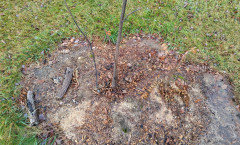
    Here's the relocated Toona 'Flamingo' bed at the moment. I moved a bigger division/digging with two 'nodes', and a small one just to be on the safe side, both took although the smaller branch of the bigger division withered...that's seen all the way to the left. One of the only bad things about these as ornamentals is they get covered with sooty mold.

    The very eagle eyed could notice a bit of sharp course C33 sand. This is not for 'drainage' and isn't mixed in. It is something I've started doing though: after I plant something and move some of the initial clods of soil back into place, rather than take the time to tediously break them up (they had turf roots that had been killed by glyphosate) I just fill the gaps between the clods with a bit of sand. It's so much easier than trying to get wet clay to fill in. I've done it for years now to transplants and it hasn't caused any problems...it's never more than 2-3 shovelfuls of C33.

    I need to remulch this, which I will do so eventually; some of the mulch ran off in heavy rains, that's what the branch trimmings were intended for, to form a very minor dam to stop that! Hard to see from this angle but the branch/trunk collars are maybe 10" higher than the green turf.

  • last month

    'Maybe safer to go for 36'.


    If nothing else, it will take longer before it gives you trouble.

    I know we've had many discussion comments here about how feeder roots will only go so deep, into the soil, but in my opinion, BIG trees can have deep roots, several feet at least.

    Otherwise, why would they even make 96" high/deep root barrier?

    UpperBayGardener (zone 7) thanked BillMN-z4a
  • last month

    Yep Bill - it's what I've said before about products like Turface et al. If they didn't work, professional, ag or hort degree-carrying turf managers would spend big bucks to till them into athletic fields.

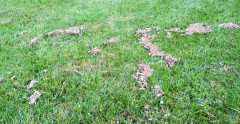
    While this got bumped, I was looking for some other pics yesterday and stumbled upon this pic I took in July, after a heavy, very fast rainfall event of well over 1 inch. It shows how much mulch ran off from this bed!


  • last month
    last modified: last month

    IME: I had huge oak trees that were tipped then bulldozed out of the ground as a whole tree, roots and all, and I had the privilege to block them up with a chain saw into firewood (some trunks over 3ft. diameter). These were on a fairly rich, deep, clay loam soil with clay underneath.

    Edit: The huge oaks above, were cut off ~ 6ft off the ground first, then 'tipped' with the large bulldozer. That made it possible to then position the blade on one side, under the exposed roots and push the entire stump and 6 ft. of trunk, out of the ground (it was a farmer clearing a field).

    Those root systems were massive and deep.


    The comments from this site linked below are more credible and compare closely with my experiences.

    Quote below sourced here:

    https://treenewal.com/the-root-system-of-oak-trees-explained:.

    Quote:

    ' Root Subsystems

    Within an oak tree’s root system, there are 2 basic types of root subsystems.

    Lateral Roots

    From that first singular taproot comes several massive roots known as lateral roots which eventually replace the taproot altogether. On mature trees, each branch of this critical system on can reach out to twice the dripline of the canopy and at a depth of up to 4 feet below ground. These lateral roots will be the primary source of support as the oak tree develops.

    Fine Roots

    As these enormous lateral roots branch out, they taper down to a fine root system, which becomes a wiry, tightly packed bundle. Housed within the 4 feet of depth between the lateral roots and the topsoil, the fine roots soak up the necessary nutrients and moisture in the upper soil to nurture the fast-maturing oak tree.'

    /////

  • last month
    last modified: last month

    Looks like we overlapped posting. ;-)

    'While this got bumped, I was looking for some other pics yesterday and stumbled upon this pic I took in July, after a heavy, very fast rainfall event of well over 1 inch. It shows how much mulch ran off from this bed!'

    That's the same thing that happens at my place and sometimes on a grander scale.

    When I lived out on my old 'sandy sand' soil in the country.

    I saw phenomena that I considered nature's way of slowing water down.

    Our soil was slightly rolling and after a rain, you could see these narrow bands of organic matter, about an inch wide and many feet long, that floated along, then collected, every foot or so, all along the sidehills (mostly bare sand), creating shallow 'dams'.

    And you could see the water puddle behind them while it was still raining, slowing the runoff.

    I know david, you're talking about the ability of soil being able to soak in but in my dry sand, water will initially run off during heavy rain, sometimes taking soil with it, and these little dams forming helped that from happening.

    ETA: Even if your soil would drain faster using additives mentioned above, david, a hard pouring rain would still most likely wash away mulch, because even with my 'fastest draining soil in the world', if the rain comes heavy and fast, the much will float and move.

    UpperBayGardener (zone 7) thanked BillMN-z4a
  • last month
    last modified: last month

    Bill, natures way of slowing down the force of heavy rains is a forest canopy to break the force combined w/a floor of leaf-duff to absorb it. Much of urban flooding is caused by the lack of these attributes.

    UpperBayGardener (zone 7) thanked bengz6westmd
  • last month

    Yup, water has remarkable power and force when unabated.

    And I've noticed some types of wood mulch, tends to 'float up' and relocate more than others.

    And the tendency to float is magnified when the mulch dries out.

Sponsored
Outdoor Spaces
Average rating: 5 out of 5 stars19 Reviews
Experienced Full Service Landscape Design Firm Serving Loudoun County