Software
Houzz Logo Print
abqconiglio

Pruning broomsticks

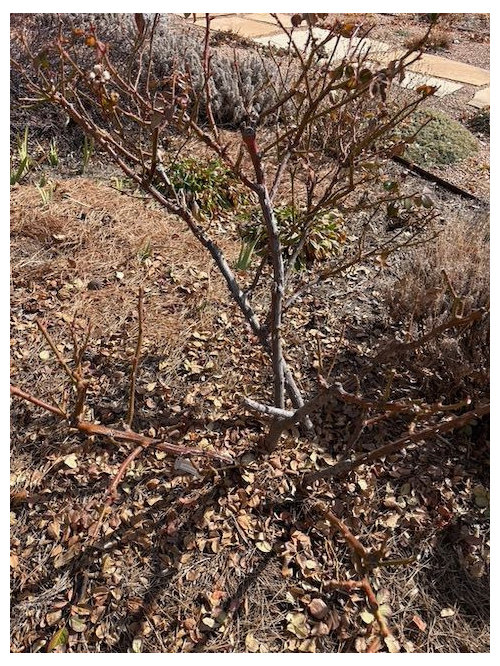
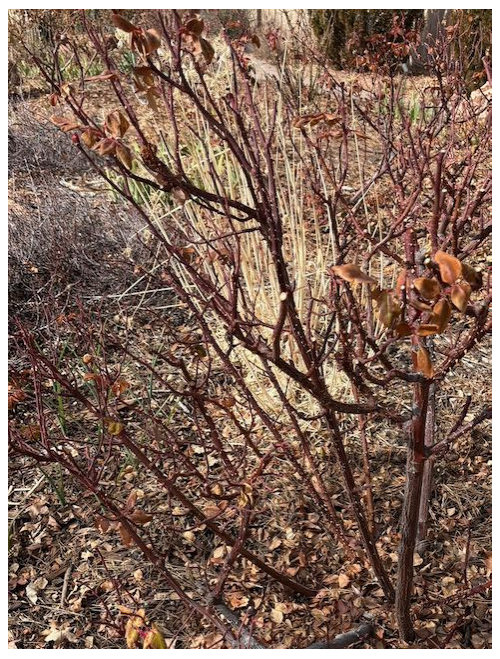
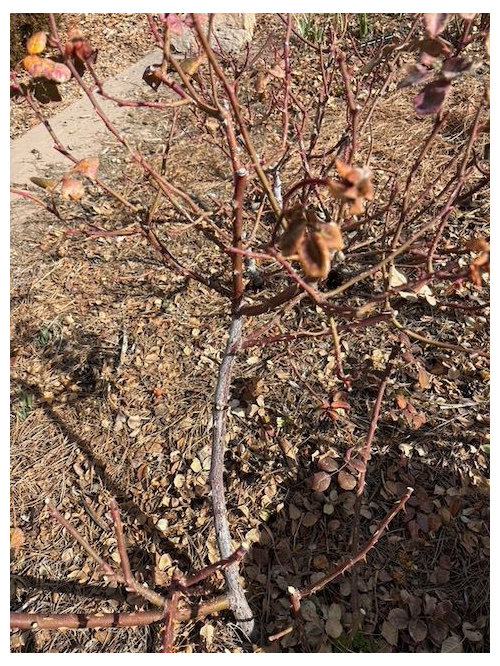
This is an issue that has annoyed me for years and I'd like to see how other people handle it. Some of my roses don't grow like roses "should" and they makes pruning confusing. These are the roses that grow a thick (like 1-1/2 inch thick) cane, which grows tall and then produces a mass of twigs at the top (1/8 inch thick or less on Bishop's Castle), like a broom with the bristles upward. They also don't like to make basal canes. This has become more prevalent as the bushes have aged and is predominant on my Austin roses with climbers in their background, i.e. Abraham Darby, and Bishop's Castle. I used to get 20-50 blooms on a single cane of Bishop's Castle, but I haven't had that in the last few years no matter what pruning technique I use.


I've tried three options, but have not been satisfied with the results of any.

1. Thin out the twiggy growth at the top but leave them. The result is small flowers on small twiggy growth at the tops of the canes, and a very short bloom season. I've also tried cutting off most of the twiggy stuff until it is down to pencil thickness and leaving the broomstick trunk. I'm left with a broomstick with a tuft on top.

2. Cut half way down, into thick wood that seems to have no buds. David Austin Roses pruning advice says to prune anywhere. The result is small twiggy growth on the stumps of the thick stumps of canes, and the flowers are small.

3. Cut the entire cane out. I've been cutting out some of the older canes entirely, and removing the twiggy stuff off the tops of the remaining canes. This also has not been a great result. I could also cut out all the broomstick canes to the ground. If I did this, I'd have to cut all or nearly all the canes to the ground (maybe two or three canes left). Maybe that's just what I have to do?


How do you handle this? Thank you for your thoughts.


Hard to show in photographs.

Abe


BC


PAoK


Comments (16)

  • 22 days ago

    I agree, Sheila. I'm pretty casual about pruning. Diane

    noseometer...(7A, SZ10, Albuquerque) thanked Diane Brakefield
  • 21 days ago
    last modified: 21 days ago

    They want to be large bushes. Just go with the flow, and let them do their own thing. You're not going to be able to make Julia Childs out of them. The only way you could successfully alter their innate growth habit is if you pegged them. That would force their energy into blooming rather than shooting skyward and only blooming at their upper regions. Pegging is a lot of work and needs lots of horizontal ground space all around the bush.

    You might try this. Any new, still flexible growth that is just about as extended as it gets, and is not sending forth flower buds yet, is arched with its tip fastened (tied to a stake, pounded into the ground near the bush's crown), as close to the center of the bush and as low down to the ground as possible. It is not trained horizontal to the ground as in pegging.

    It will look somewhat like an arching rose bush, but with the arch exaggerated into a semi-hooped shape. This may look weird, but as the bush fills in with foliage, it could look relatively normal. This method will definitely reduce the width and height of the bush, and force the flowers to emerge lower down on a cane.

    To be successful with pegging or looping, you have to start with only supple new growth, or the bush has to have extremely flexible growth. This may mean that your AD, BC, and PA o' K will have to be pruned back hard, to ~6" from the ground this coming spring. AND, the big question is.....do you have the time to peg or loop a bush? Perhaps experiment with your most likely to succeed candidate.

    Moses.

    noseometer...(7A, SZ10, Albuquerque) thanked Moses, Pitt PA, cold W & hot-humid S, z6
  • 21 days ago

    There is an alternative course of action if you are unhappy with the current growth pattern and don’t want to just let them be. However, to encourage more compact, bushier shrubs with bigger and better blooms requires the courage to be drastic. I can see knobbly bulges, what appears to be dead bud nodes, quite low down most of your canes. They are not dead, just dormant and have remained so because all the energy is currently going to the top of the canes. But they can be encouraged to break if you..


    1. Hard prune all canes down to between 6-12”, ideally to just above one of those bud nodes

    2. Lightly rake and clear around each shrub in a circle of about 2ft then deeply water this area

    3. Generously spread composted manure and/or alfalfa pellets in the cleared circle in a donut shape, avoiding direct contact with the canes and water again

    4. Mulch heavily with compost, right up to and even an inch or two up the canes

    5. When the bud nodes start breaking into leaf, feed with a weak solution of fish emulsion weekly, then switch to your usual, balanced fertiliser regime when they start to put on decent growth.


    Basically, this is starting from scratch and feeding for renewed green growth to begin with. To maintain bushy growth in future, when you do your annual prune, DA recommend you remove a third to a half of the height of all their shrub roses. At least thats what they used to say, their pruning advice seems to change every year now.


    I have done this before to rejuvenate roses and it does work. In saying that, I had a recent wobble about doing so to a mature DA rose, ’The Prince’, which had quite thick canes. But I needn’t have worried..


    https://www.houzz.com/discussions/6519004/does-the-prince-resent-hard-pruning#n=12

    noseometer...(7A, SZ10, Albuquerque) thanked NollieSpainZ9
  • 21 days ago

    I’m also in in favor of a hard prune to let the plant regenerate to a more pleasant shape. The thorny broomstick remnants may be repurposed as scary Halloween decor to frighten off those greedy kids who grab too much candy.👻

    noseometer...(7A, SZ10, Albuquerque) thanked BenT (NorCal 9B Sunset 14)
  • 21 days ago

    Thanks all, for your input!


    My biggest concern is that the flowers have lost size and form. This happens if I don't prune on my other Austins hard enough (such as Winchester Cathedral) . They then do much better after I prune harder, so I'm assuming that the small flower size is due to pruning technique (I may be wrong, but I can't imagine those tiny twigs at the top making sizable flowers).


    Roses such as Winchester Cathedral and Alnwick Castle are much easier to prune lower because they don't make those big thick canes with a tuft on top, and are very happy to produce basals. I can truly prune them anywhere. Bishop's Castle in particular will, if I cut back to the middle of the thick trunk, produce a tuft of twigs at the top of the stump which doesn't help.


    Sheila and Diane - are you lucky enough to be able to just let your plants go (i.e. not prune them at all) and they do well?


    Moses - thanks for the idea of pegging. I've done this with Evelyn and it works okay, but I don't like the resulting appearance. Also, BC, AD and PAoK don't produce long flexible wands for pegging, at least not for me.


    I think I'm going to do what NollieSpain and BenT suggest. Previously I have cut the cane down all the way to the base, but maybe I'll try leaving a small stump. Maybe that will do it.


  • 21 days ago

    As soon as I saw the first picture of Abe, it brought my POAK to mind. Then I scrolled down and saw you posted of pic of that one too! I have taken both approaches: l let Abe grow into a short climber in the back of a border where its bare legs don't show as much. I know you can't do that as yours is in front of climbers.


    If I don't have space to let them get big, I hard prune them. But exactly like Nollie describes, I hard prune and then lavish them with fertilzer, horse manure, and lots of water. The bush still doesn't have the *ideal* bushiness, but with the foliage and blooms it's not so noticeable.


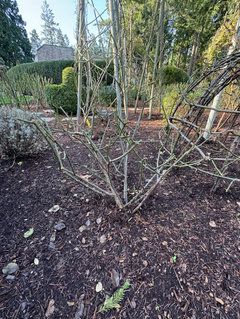
    Here is POAK today. It's been pruned quite low....down to about 2 feet.


    Here it is last June. It stays low and bushy. Of course, I have a completely different climate...so that may affect things too.


    noseometer...(7A, SZ10, Albuquerque) thanked Rosylady (PNW zone 8)
  • 21 days ago

    Also forgot to add, I don't know if you use alfalfa, but it really works for getting new basals. If you got some new basals you could cut out some of the older canes and start fresh.

    noseometer...(7A, SZ10, Albuquerque) thanked Rosylady (PNW zone 8)
  • 21 days ago

    Thanks, Rosylady. Your PAoK looks great. Looks like all the canes are vigorous, with good branching. I wonder how much is climate. I do use alfalfa, but I haven't really noticed much of a difference with or without. They don't act like they want to get big (Huntington Rose does, growing long stems from the top AND bottom), but AD, BC and PAoK just want to grow the long stem with a tuft of spindly twigs at the top. Boscobel, Alnwick Castle, Munstead Wood, Desdemona, Olivia Rose Austin, don't act like this.

  • 21 days ago

    Nose, some of my roses need a good pruning, some need just a light trim, and some I don't need to prune at all. It's not necessarily the same roses every year. And I don't always luck out by not pruning if the plant grows a little wonky. I like my roses big, too. You might want a smaller, more contained look. I've found the roses not pruned, or pruned very little, still produce plenty of large, well formed blooms. I'm sure my answer didn't help at all. Is your beautiful Abe Darby acting up? We had so little winter, my Twig Darby looks like if did in September. All green and covered with leaves. I've never pruned him much, but this year, I doubt I touch him with the pruners. it's been a weird winter. Diane

    noseometer...(7A, SZ10, Albuquerque) thanked Diane Brakefield
  • 21 days ago

    Thank you for sharing, Diane. I'm noticing that my roses are changing as they are getting older, and even though they are on the same care regimen they are responding differently. Yes, Abe is showing his cranky side. I took a cutting of Abe a few years ago, and it is growing just like old Abe used to grow. I did a hard prune on my Marie Pavie a couple of years ago since it was starting to get out of hand, and she hasn't forgiven me, but when she was young, she did better with a hard prune. Go figure. I'm going to leave her alone this year, and see what happens, but if she doesn't recover, I'll take her out. I did a hard prune on Iceberg, and they hated it. If I DON'T hard prune my Winchester Cathedral, it sulks by giving me small flowers for only a couple of weeks in the spring and doesn't rebloom well. Roses are very quirky.


    It's been a weird winter, for sure. Most of my roses kept most of their leaves.

  • 21 days ago

    Diane.....I would much prefer not to prune! Mine get really floppy and start laying all over eachother. I have my roses planted relatively close together in big beds, so I still have to be able to get in and take care of them...hence the pruning. I would LOVE to have big specimens like yours!


    noseometer....there are definitely some years where I hard prune and certain roses don't seem to love it. So then I prune lightly and have some serious naked legs on some roses! I specifically remember this on 'Abbaye de Cluny' and 'Olivia Austin'. I've learned Olivia needs a harder prune and Abbaye could probably be unpruned an be happy.

    noseometer...(7A, SZ10, Albuquerque) thanked Rosylady (PNW zone 8)
  • 21 days ago

    Rosylady, how interesting about your Abbaye de Cluny. She is one of my "must do a hard prune" roses. Mine is old and huge, but very vigorous and a continuous bloomer. She can get really out of hand without a good pruning. I'll never understand roses. I grew Olivia for a number of years before the voles got her several years ago. I don't remember Olivia needing a hard pruning. Oh, boy. Diane

  • 21 days ago

    Noseometer, it could be that those canes are now just too old and unproductive to produce decent blooms. If so, all the more reason to take the drastic option and hope for new basals to replace them.


    I am a big fan of alfalfa, it does seem to induce new basals, even just scattering pellets around the base. I gave up on making the tea because it was too much faff, but it’s possible a properly fermented tea would help you more. I also consider fish emulsion my magic potion for helping to produce healthy growth and good blooming. I do find that roses like Abe, with the potential to produce big, heavily petalled and fragrant blooms, do demand decent soil, good feeding and copious watering to fulfil that potential, so a bit of spoiling might help.


    Of course there is an even more drastic option - dig them up and start again with new plants! That way, you can direct early growth better through formative pruning.

    noseometer...(7A, SZ10, Albuquerque) thanked NollieSpainZ9
  • 20 days ago

    I think my blooms are normal sized on the large natural bushes,noseometer, like Diane says.

    noseometer...(7A, SZ10, Albuquerque) thanked Sheila z8a Rogue Valley OR
  • 20 days ago

    I'd go with NollieSpainZ9's recommendations. The roses will get most everything they need from those comprehensive treatments.


    Since you are in dry Albuquerque, you may also try increasing the amount of water they get, especially after the last frost. Check your sprinklers to see if any are blocked by dirt or earwigs.


    Another idea is to look over the rose garden at several times per day to see if they are getting shaded by nearby trees or tall shrubs that have grown taller over the last few years. Take photos if you like, at 8 am, noon, and 5 pm to see if they are in sunlight most of the time. Repeat monthly through next fall as shadows change.

    noseometer...(7A, SZ10, Albuquerque) thanked apple_pie_order