Software
Houzz Logo Print
upperbaygardener

On the density of woods...

last month
last modified: last month

I've done more chainsawin' this winter and spring than ever before...at least on my own ornamentals vs. junk I inherited with the property like red maples. This means I have to schlep around with yard with the trimmings.

I think it's striking how the density of wood varies. Here's my very informal ranking...from lightest to heaviest.

Taxodium hybrids T406 and T502. Holy mackerel, these are like balsa wood. But surprisingly strong! You have be very careful to undercut when removing a branch, the wood is super stringy and will shred easily...it will start tearing and striping into the bark layer of the trunk.

Larch - very light as well, it's a close call between these, but I think the taxodium has the edge.

Japanese fir - the next lightest conifer. Although the foliage isn't scented like other firs, the branches are quite resinous when you cut them. And the sap does have a bit of a smell.

-----

Magnolias - the lightest hardwood probably goes here.

Thuja 'Green Giant'. Tree had been dead for a year, so this might be heavier with water it in.

Norway spruce - somewhere in here. The ones compared in this section (2 up, 2 down) are all pretty close.

Celtis - had a small weed tree I removed. Better to get them when they're small!

Ulmus parviflora

-----

Red maples are around here, definitely heavier than the previous ones

Pinus taeda or (1/2 P. × sondereggeri) - now we get to the heavy softwoods. I was shocked when I trimmed the first large branch of this and tried to move it. I had to make another cut.

Yew - SUPER heavy. It's hard to compare exactly though, because the thickest branch was only about 2/3 as thick as the Pine.

Quercus bicolor

Quercus variabilis - Lawd have mercy these are heavy! Like picking up steel pipe!

Comments (15)

  • last month

    Ilex are very hard & heavy. I've also found big old Berberis to be pretty dang dense.

    UpperBayGardener (zone 7) thanked artinnaturez8b
  • last month

    I knew there was something I forgot on my list! Yes, I'd put Ilex between the red maples, and the oaks.


  • last month
    last modified: last month

    Osage orange is about the heaviest and hardest, other than some tropical woods. Trouble even w/a chainsaw with this -- forget a handsaw even for a small branch.

    PS Red maples in the mostly-oak forest where I was in southwest VA were the most prone tree to getting broken in ice storms, but they do have sprouting capabilities even if broken halfway down. Literature says the wood is similar to the related silver maple.

  • last month
    last modified: last month

    I don't have as many species of trees here as a lot of you guys have but I use a 'lopping shears' on limbs up to ~5/8" dia. When many branches need to go. I keep them sharp for obvious reasons.

    I also have a small, foldable hand saw in my back pocket handy for small jobs where you can't get larger equiment into where you need to cut.

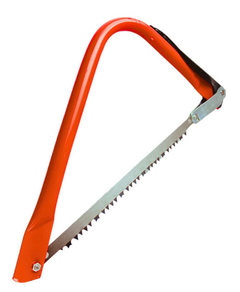
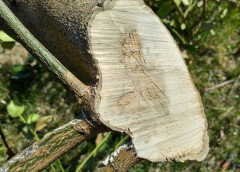
    Anything that size or larger (>5/8" to 1" or so) I use a smaller bow saw (12"). It has stayed very sharp on its own, making cuts on medium diameter branches, very clean (photo for reference).


    I'll use a chain saw on even larger branches, but I can't get a clean enough cut for my liking but the labor saving is worth it.

    The problem is the full-sized wood cutting teeth that can leave the cuts a little ragged if not kept perfectly sharp. A smaller saw with finer teeth may do better.


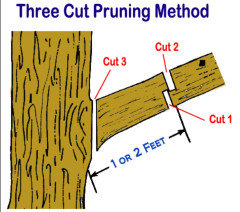
    And if we remember the 3 cut method of pruning branches, we can eliminate the weight that causes the branch to strip connected bark down the side of the tree.


    YMMV. :-)

    UpperBayGardener (zone 7) thanked BillMN-z4a
  • last month
    last modified: last month

    Yes, for the record I usually use the 3 cut method, but years ago for one of the first branches I cut of the hybrid cypresses...I was in a hurry and used the one cut method! Ooops! There's no signs of damage anymore, it quickly 'healed' over the tearing. But I learned my lesson, I will never do that again - except for a tree I'm planning to get rid of. For the Hackberry tree I was certainly using one cuts. 🤣

  • last month

    Yeah, I figured you know what you're doing david but thought I'd mention it for others, possibly newbies, reading this thread. 🙂️

    UpperBayGardener (zone 7) thanked BillMN-z4a
  • last month
    last modified: last month

    Very interesting! I would love to get my hands on some Osage Orange

    UpperBayGardener (zone 7) thanked L Clark (zone 4 WY)
  • last month

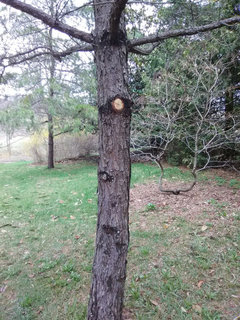
    Removal of a Table Mountain pine long & heavy lower branch. The smell-force was strong in this one. Sourwood to right -- yes, it is strangely branched.


    UpperBayGardener (zone 7) thanked bengz6westmd
  • last month

    How do you guys rate the density of black cherry? Choke cherry seems fairly dense

    UpperBayGardener (zone 7) thanked L Clark (zone 4 WY)
  • last month

    It's been years since I dealt with branches of those, but I'd guess pretty close to the red maple.


    The wonderful thing about cutting black cherry is the cherry-almondly smell of everything, but especially the roots. It's some ester of benzaldehyde, presumably, but I'm not sure if it's the same as the laetrile in almonds. Very early in my garden, mid 2000s, I hacked the roots of a Prunus serotina with an axe try to reduce the amount of competition with some plantings. I couldn't believe how strong it was.

  • last month

    The black cherry around my old place never amounted to much.

    Maybe 3"-4" diameter and 15' tall for a good specimen, and loaded with black knot.

    The only place you find them is in the marginal low land, almost swampy.

    I only cut them when making trails through the woods for wood hauling.

    Guess I never paid much attention to them really.

    UpperBayGardener (zone 7) thanked BillMN-z4a
  • last month
    last modified: last month

    UBG, yes, there's some literature that says black cherry has some deleterious effects on some surrounding plants much like black walnut does, but I haven't noticed it. It certainly has no effect on oaks, hickories, sugar maples, etc, in the forest -- in fact, surrounding trees in an oak forest seem to gradually degrade the black cherries. I know my bur oak has degraded the grass around its root zone so much that all of it has been replaced by moss. And it's not shade -- there's enough light there for grass.

    PS I very much like the taste of VERY ripe black cherries.

    PPS L Clark, cherry wood is pretty hard -- at one time very much valued for furniture, paneling and other uses.

    UpperBayGardener (zone 7) thanked bengz6westmd
  • last month

    An observation about an oddity of hollies. I've noticed this years ago but was just reminded it today as I cleared the trimmings of a Koehne holly 'Ruby' that I've complete removed. Because I'm probably going to have to cut my grass this week. (I still have the clone elsewhere in the garden!)

    The wood starts breaking down extremely quickly. This was cut not two weeks ago and it's already cracking. On American hollies, I've noticed the bark starts flaking off very fast, in addition to the heartwood cracking like this.


  • last month

    OT: The red maple I pruned last Fall, bled like a banshee earlier in March, even though October should've been within proper pruning requirements. It bled for around 2 weeks on the cuts of the branches. Has come to cessation now.

    UpperBayGardener (zone 7) thanked BillMN-z4a