Software
Houzz Logo Print
sputnikous

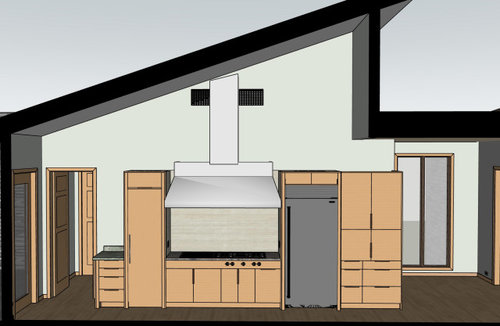
MUA design for possible Accurex hood (opaone inspired)

last month
last modified: last month


We're building a custom home and I am tasked with HVAC and kitchen ventilation choices.

We engaged a mechanical engineer and he moved my MUA location to above the hood. I am placing it as far above the hood as possible in the hopes of preventing a short-circuit into the hood. Is this a bad idea? I will be contacting Accurex regarding the hood itself (following opaone's posts), but any advice on that front is equally welcome.

More specifics:
- Kitchen is on main floor with a "cathedral" ceiling, and no story above.
- The cook-tops are

  • 36" propane Wolf
  • 30" Bosch Induction
  • on a counter which is:
    # against a wall, behind the wall is a mudroom with a small attic above
    # the counter is 81" long
    # flanked by fridge and freezer columns

- The mechanical engineer designed the make up air to:

  • be routed from that small attic behind the cooktops
  • be tempered (inline electric heater)
  • enter the kitchen above the hood (I placed it 9.5' from the cooktop to the center of opening)

- The hood will be powered by a roof mounted blower (hood shown is stock image not actual hood).

Any advice would be greatly appreciated

Comments (11)

  • last month

    I hope you're not saying that the make-up air itself would be sucked out of an attic space. That sounds like a terrible idea, for several reasons.

    I'm also a bit surprised that a makeup air outlet would be placed above a hood - it seems like that would cause a downdraft that would counter the desired upward flow from the cooking surfaces into the hood.

  • last month

    I won't even try to comment on the MUA situation, so I'm hoping @opaone and @kaseki chime in.

    I just want to say that you have an awesome amount of cooktop space, but very little landing space on either side, unless perhaps you don't plan to use the induction and propane cooktops at the same time, and will use one or the other as your landing space?

    Would you be open to hearing ideas for reconfiguring that wall to get you more counter space by your cooktops?

  • PRO
    last month
    last modified: last month

    Thank you all for the responses.

    @Elmer J Fudd, no the MUA is not pulling from the attic. It will be ducted to the outside through an in-line heater/filter/motorized damper/fan assembly housed in the attic. But yes, my concern is the turbulence caused by the placement of the make-up air. My hope is that it will enter into the room with sufficient velocity so it travels some distance before dropping? Does the fact that it is several feet above the hood help at all?

    @chicagoans, yes, adjoining 7.5" of counter space on either side is a compromise. I originally wanted a 24" induction cook-top, but it looks like the choices are limited in that size, and I wanted bridged burners. We could have made that counter longer by shifting that left end cabinet, but that would have meant a wider hood; 81" is already pushing it. We definitely want the fridge and freezer columns to act as lateral constraints to the plume. There is an island directly in front of the cooking area (not pictured) with plenty of landing space, even if it is a suboptimal solution.

  • last month

    " Does the fact that it is several feet above the hood help at all? "

    I'm not an expert but if I were in your shoes, I would think a low placement (like vents at the kickplate level of cabinets) would be ideal. Then the exhaust would truly be drawing in surrounding air from a lower level with no pressure differential or air turbulence to interfere with it.

  • PRO
    last month
    last modified: last month

    Thank you @kaseki. I will look for some "architectural" diffusers.

    Maybe a directional louver like this would act as a diffuser:

    https://www.pacificregister.com/product/directional-louvers/

    As long as the area was large enough and properly directed (up), of course.

    Maybe this:

    https://inviair.com/l245-p-2-slot-linear-diffuser-45-opening/

  • last month

    There are likely many forms of diffuser that can be utilized for this application.

    Two points on toe kick MUA sourcing: It shouldn't be via the toe kick areas on either side of the "isle" proximate to the cooktop location because as we saw in someone's thread of several years ago, there was actually significant turbulence around the cooktop with accompanying mixing of plume effluent into the room. Second, it takes a lot of toe kick length to get enough entry area to keep the velocity down. Toe kick entry proximate to the cooktop might work if the velocity is low enough at the cook's feet and/or bouncing off of whatever structure is opposite the cooktop (island, peninsula, wall counter).

    If I were forced to make a gigantic WAG about the velocity level that would be OK below the cooktop, I would suggest not over 100 ft/min across the toe kick area being used. So, an actual MUA flow of 600 CFM would require six square feet of toe kick, which would require 18 ft of 4-inch toe kick. Even 200 ft/min would require 9 feet of toe kick. So higher velocities from shorter, more practical toe kick areas should be kept away from the cooktop.

    Epsilon thanked kaseki
  • last month

    The toe kick idea was just a suggestion. I'll briefly share my limited experience.

    I'm in an area where make up air can come through an open window. I have a high volume exhaust hood. When I open the kitchen window, besides the inward rush of air easily sensed with a hand near the window gap, some turbulence around under the hood results and disrupts somewhat the upward flow into the hood. If I open a window in an adjacent area of the open floor plan, the same inward rush of air is easily felt by a hand near the open window crack but there's no discernable airflow through the room nor turbulence at the range.

    Maybe my assessment of what's happening at my house is wrong or there's something I'm missing but it suggests putting the makeup air outlet at a distance from the range can resolve any concern about turbulence or disruption of the upward flow under the hood.

    Air flows through the path of least resistence. If there's no proximate air source under or adjacent to the hood, air will flow into the hood from beneath it, assisted by the rising current from the heat of cooking. As desired.

  • last month

    The air at the more distant window becomes less turbulent as it travels to the hood area.

    My attempted point was based on the premise of the OP's question: Is the MUA entry shown OK? and on comments et seq.

    Generally, air flows into the hood from underneath it, and that air is replaced by a flow distribution determined by the geometry of cabinets, counters, walls, cooks, etc. near the hood. Strong MUA from under the cooktop counter would be more turbulent than from an MUA flow directed from the hood area toward the other side of the room or from a distant window as you have observed. My MUA is delivered to the ceiling of a hallway opposite the hallway end near the hood. A 3 x 3 ft diffuser assembly aids flow.

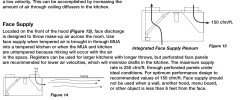
    Excerpt from the Greenheck Guide, page 16, on launching the MUA toward the opposite side of the room from the hood. (Click to enlarge.)


    https://www.tagengineering.ca/wp-content/uploads/2015/02/KVSApplDesign_catalog.pdf

    Epsilon thanked kaseki
  • PRO
    last month

    This is great. Confirms I should be ok with the MUA supply above and pointed up. Thank you all.

  • last month
    last modified: last month

    -----

    *(4, 2) four elements, 2 bridges

    **(7, 1) seven burners/elements total, 1 bridge

    ***N" total width excluding space between cooktops


    Note: all cooktops are 21" deep

Sponsored
RHS Remodeling
Average rating: 4.8 out of 5 stars25 Reviews
Loudoun County, VA's Top Handyman Service | Best of Houzz 2018-2019