

Jacques Cartier/ Marchessa Boccella
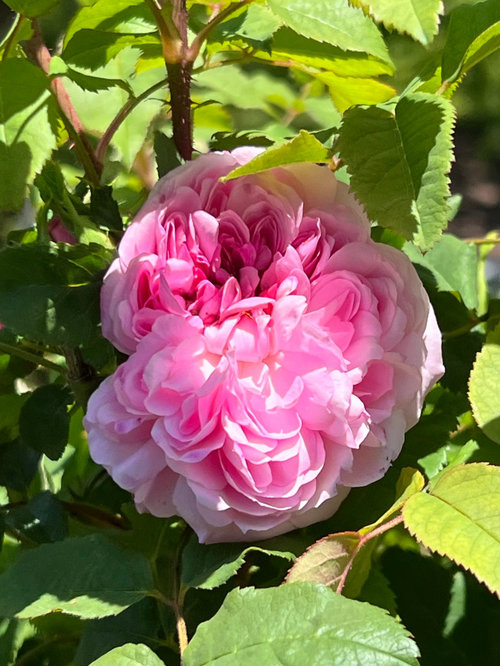
I purchased this rose own-root from Heirloom thinking it would be around 3 ft by 3 ft and tolerate a bit of light shade. Ha! This rose blooms pretty well, but it grows like a climber topping the 6 ft fence and growing around the rose next to it to soak up as much sun as possible. It throws long, flexible canes that put many of my climbers to shame. I would question whether I had the right rose, but the bloom, foliage snd fragrance all match up. After rhus season I will move it to a true full sun spot and see if that changes it’s growth pattern. If not I will train it as a pillar rose. I think I will order a Blush Noisette to replace it in its current spot along the fence.
Comments (42)
 4 months agolast modified: 4 months ago
Markay,
I was affiliated with a large public rose garden many years ago. It was ARS accredited and the head rosarian there was expert in his knowledge base, running a ship shape, very well maintained rose garden. He was pretty much a hybrid tea man, as were the executives of the garden, so the roses were mostly hybrid teas, floribundas, grandifloras, minis and minifloras.
However there were quite a few: hybrid perpetuals, musk roses, and a few other OGRs. There were ~3,000 bushes in the garden then. The best of the old roses, IMHO, was Jacques Cartier. I was there when the six JCs were planted in about 1990. I was there when they, as very healthy, mature bushes, about 15 yrs. old, were dug up and tossed into the dumpster. This occurred after the death of the president of the rose garden, who was an OGR devotee. Room was needed for more, new varieties of hybrid tea types!
The Jacques Cartier were magnificent. They originally came from Pickering Nursery, Canada (outside Toronto), who only grew roses grafted upon multiflora root stocks. Pickering, at great expense, brought in Belgian grafters every grafting season because their grafting skills were superb. Their multiflora root stock bud union grafts were so low on the root stocks that the finished bushes, ready for sale, looked like they were bare root. Appearing to be not grafted at all amazed everyone. The root stock sections were about an inch long from the roots to the location where the scion emerged from it. Incredible skill In grafting is not seen today.
Getting back to Jacques Cartier. They were just about the most vertical, strong stemmed bushes in the garden. Tornado force winds with the accompanying rains, just about had no effect on them. For an OGR, Jacques Cartier repeat bloomed, or I should say, continuously bloomed from spring to fall, nonstop. When they were removed after about 15 years in the garden, they had dwarf tree like trunks at ground level about 4 " in diameter, and only about 4" tall! I attribute the unusual trunk development to harmony between an extremely compatible root stock and scion. I never saw anything like it. All six bushes had identical trunk development. All new basal growth came from above the trunk which made the bush look like an ultra dwarf crab apple tree, except for the rose flowers.
The Jacques Cartier bushes never got taller than 4' and wider than 24" a very columnar bush. Equilibrium was reached at about 6 yrs. age, with minimal yearly dimensional gained thereafter.They were pruned to about 1' every spring. Black spot with JC was not a major issue, and the garden was sprayed with conventional insecticides (Rose Midge Fly being a major issue), and fungicides (elsewhere in the garden, severe black spot pressure reigned), every 2 weeks, religiously.
The fragrance of Jacques Carrier's 2.75" strongly button centered blooms, needs no additional praise heaped upon it by me. It is legendary.
Trying to grow Jacques Cartier here, in my Pittsburgh garden failed miserably. It just sprawled and lacked vigor. After Pickering closed, my only source of JC was own root. I think it was perhaps an isolated incident with that particular bush, but since JC was developed for commerce when only grafted roses were grown, its nature grown own root could be in stark contrast to how it grows grafted, and particularly on Rosa multiflora root stock, and not just any strain of R. multiflora, other than Pickering's strain. Who knows?
Moses.
- 4 months ago
@Moses, Pitt PA, cold W & hot-humid S, z6 and Pickering virus indexed all the roses they sold. They were a magnificent source of clean stock. I've sought out material from original Pickering roses for years.
Related Professionals
Augusta Landscape Architects & Landscape Designers · Flagstaff Landscape Architects & Landscape Designers · St. Louis Landscape Contractors · Gulfport Landscape Contractors · Brooklyn Landscape Contractors · Waycross Home Builders · Toms River Home Builders · Lafayette Landscape Architects & Landscape Designers · Muncie Landscape Architects & Landscape Designers · Salina Landscape Contractors · Green Bay Landscape Contractors · Elizabeth City Home Builders · Dallas Home Builders · Canton Home Builders · Edmonton Home BuildersMarkay MD-Zone 7B
Original Author4 months agoOh wow! So sad that they just tossed those roses! If I can find a rose grafted on multiflora, that is always my first choice!
- 4 months agolast modified: 4 months ago
Markay,
Sometimes it's best to pass on an old garden rose unless it is grafted onto multiflora. The newer, modern rose introductions are judged and trialed own root. They are expected to perform well own root.
Moses.
 4 months ago
Have you seen this thread from @portlandmysteryrose about her climbing Jacques? I wonder if Heirloom is selling it as Jacques Cartier instead of Comte de Chambord now? Heirloom used to have some mixed up identities in their selection of old roses. Hopefully the new owners are trying to correct that.
https://www.gardenweb.com/discussions/6375287/the-apparently-quite-rare-jacques-cartier-cl#n=21
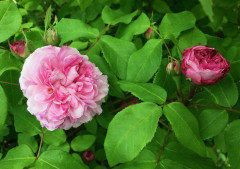
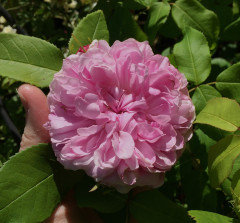
Also, my JC came from Burling and has never been anything but a stellar shrub in my garden - not climbing and blooming well all season.
Markay MD-Zone 7B thanked John (PNW zone 8)- 4 months agolast modified: 4 months ago
John,
Does your Jacques Cartier grow and perform as described in my rundown above?
Moses.
- 4 months agolast modified: 4 months ago
@Moses, Pitt PA, cold W & hot-humid S, z6 yes, your description is spot on, and mine grows on its own roots. The only difference is that I prune mine back to about 2 ft tall in winter and then back by about 1/3 after each flush, and this kept them a bit shorter than 4 ft. In my current garden I grow JC in partial shade (on the heavy side of partial) with a Douglas fir providing root competition, and it still blooms all season but grows less vigorously than it did in full sun and soft, loamy soil with no root competition. It truly is a wonderful rose to be so adaptable!
Markay MD-Zone 7B
Original Author4 months agoSo it sounds like I may have a climbing variant and just need to train it as a climber!
Markay MD-Zone 7B
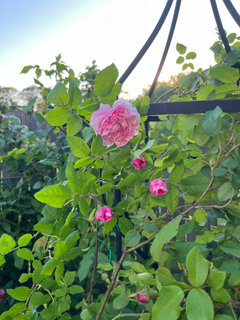
Original Author4 months agoI moved an obelisk to support Jacques Cartier to keep it from smothering his neighbor.
 4 months ago
My Jacques Cartier was enormous also. It wasn't really a climber, since the canes were quite stiff. Just keeping it under 6 ft was a bit of a challenge.
- 4 months agolast modified: 4 months ago
Mad,
Inspired by your report on your Jacques Cartier, I look forward to giving it a second try soon. Is yours grafted and if so, on what? Where'd you get yours?
Moses.
- 4 months ago
Own-root from Royale River, ages ago. We lost it to RRD more than a decade ago. It has been missed, but controlling it was always an issue.
The current, new one is from ARE.
 4 months ago
My Jacques Cartier/Marchesa Boccela is also consistently large though about 4-5' in the part shade I usually plant him/her in. It's a reliably fragrant and hardy rose in my zone. Not one for the small garden IMHO though.
Cynthia
 4 months agolast modified: 4 months ago
I follow roughly the same regime as @John (PNW zone 8) does for my 'Jacques Cartier' (was from Vintage) which has grown in the same spot for at least15 years now and stays around 5' x 5', always blooming well. I prune back to about 3' in the winter and then "deadhead" rather decisively after each flush. Otherwise he does tend to want to shoot straight up.
Markay MD-Zone 7B
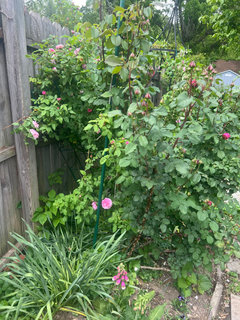
Original Author4 months agolast modified: 4 months agoLol! To illustrate my point, here is Jacques Cartier pushing around abd behind Cathedral Bells. Some of the canes are literally on the ground. Nothing shooting straight up here except in Cathedral Bells!
- 4 months ago
Markay,
I am impressed with your Cathedral Bells. How is its black spot resistance?
Moses.
- 4 months ago
That 'Jacques Cartier' of yours certainly is a sprawler, Markay. Of note is that my JC from Vintage was obtained by them from Pickering, according to their catalogue. Mine, like all plants from Vintage were, is own-root. Thus I found Moses' account of what the Pickering grafted JCs were like very interesting. Also vertically inclined, like mine; different climate, of course, but still. Mine is also not in the sunniest spot, but likely gets 5 to 6 hours of sun a day.
Markay MD-Zone 7B
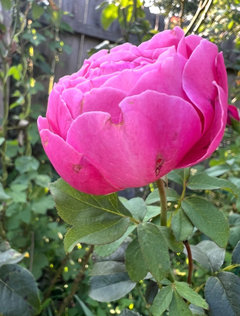
Original Author4 months ago@Moses, Pitt PA, cold W & hot-humid S, z6 Cathedral bells is a favorite of mine. Big blooms that hold well (even in a vase), heavenly fragrance and lovely color. It gets some spotiness - Blackspot spares noone in my garden so it is all a matter of degree. Having Jacques crowding in does ’t help, but even at that blackspot shows up mostly after a flush and Cathedral bell it is so vigorous it just pushes out new leaves and never misses a beat.
Oh, and the blooms are deeply cupped in form and do not nod. I will warn you though that its got some of the grabbiest thorns around.
Markay MD-Zone 7B
Original Author4 months ago@John (PNW zone 8) The botanical garden recently added Enfant de France and I’ll be watching with interest to see how it does in this climate. The picture if Jacques Cartier is lovely!
- 4 months ago
I went on an archaological dig, and this is what I found.
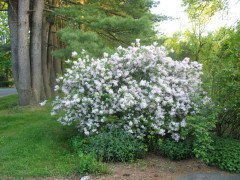
The very large, very upright rose on the right side of the lilac is Jacques Cartier. It is also the cane curtseying towards us.
The lilac is currently blooming, and at least twice that size.
 4 months ago
I’ll second the endorsement of Cathedral Bells. It’s a beautiful, fragrant rose.
 4 months ago
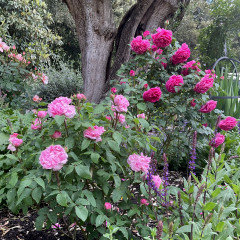
Interesting to hear how differently Jacques Cartier can grow for people. Mine is young yet, but so far forming a small, rounded shrub. I hope to keep it this shape as it grows. Here in the foreground with Mme. de Sévigné behind:
Rose de Rescht is around 4-5yrs old and is very well behaved for me. It keeps to a neatly rounded 3x3ft shrub with only light pruning: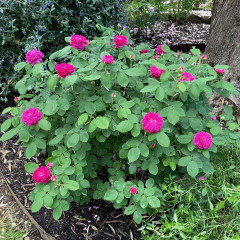
We have had some very heavy rain recently and both of these roses shrug it off whilst many other roses have bowed under the weight of water. Their short, sturdy necks don’t appeal to everyone but they certainly help keep the blooms upright!- 4 months ago
The theory for years now is that 'Jacques Cartier' and 'Marchesa Boccella' are two different roses, and that accounts for the differing growth habits.
- 4 months ago
Mad, this begs the question: which has the compact bush form and which has the sprawling/climbing form? I have the bush form and I call it Jacques Cartier, but is it really?
- 4 months ago
@judijunebugarizonazn8 Burling lists both, but I'm not sure whether she's selling separate plants or just listing the plant she sells under its assumed pseudonym. I bought it from her years ago as Jacques Cartier, and mine is also the compact bush form.
- 4 months ago
Remember that when dealing with OGRs, very little is provably known. Many roses became separated from their names, and 19th century French nurseries were notoriously loosy-goosy with what things were called. Buist was continually calling out the French about sending the same rose under different names or sending different roses under the same name. After WWI, when Bunyard was trying to collect European OGRS, he ran into the same issues. Roses imported under the same name from England and France didn't match, and the English version had invariably better provenance. So trying to figure out what is 'right' will probably require a time machine.
My private opinion is that they are both wrong :-)
- 4 months agolast modified: 4 months ago
Mad, you bring up an important subject, correct names, especially of OGRs which the process of time conspires to obscure their true identity! Intentional in some cases, and hopefully accidental in most, it can get frustrating. to say the least.
The story about the naming of Jacques Cartier, the Canadian (British Colony then, now a Commonwealth nation of GB) explorer, is amusingly interesting. It goes as follows:
The Duchess of Portland went on a grand tour of Europe. When in Italy, she came upon beautiful, repeat blooming roses which she wanted to introduce to England and England's noble, snobbish, aristocratic, gentry/gardeners. Since their foreign names were not proper to the English, one of the Duchess' selections was renamed, 'Jacques Cartier,' to honor the Canadian Explorer by the same name. Presumably, Marchesa Boccella, was renamed by the Duchess to Jacques Cartier. That's why Jacques Cartier is often classed as a Portland rose. The Duchess of Portland honored herself, perhaps self-aggrandisingly, with a class of roses named after herself.
Moses.
- 4 months agolast modified: 4 months ago
@Moses, Pitt PA, cold W & hot-humid S, z6 I think you might be thinking of the story of the original Portland rose, 'Duchess of Portland', that it was said the duchess brought back from Italy and renamed after herself - a rose that went on to form the basis of the Portland class of roses.
According to one of the references in HMF from Peter Beales' "Classic Roses", even that story is possibly a fantasy.
"...according to a biographer, the rose was named after the 2nd Duchess of Portland (1715-85), a keen rosarian who never left England in her lifetime. The rose was listed in an old nursery catalogue of 1782 and appeared in France three years later. This must cast doubt on Italy as its country of origin."
@mad_gallica (z5 Eastern NY) is absolutely right that a time machine is probably the only way to figure out what really happened! Ah, well - that's part of the allure of these old roses: their mysteries!
- 4 months ago
I don’t think it matters much what we call it, so long as we enjoy growing it. DNA testing might confirm if JC/MB are the same rose, but even then probably won’t be able to tell which one it really is. I am sticking with Jacques Cartier, since that’s what it’s sold as here. It must be frustrating, however, to get one that turns into rampant climber if you wanted the neat, shrubby form. It seems many old roses have the potential to climb in the right conditions though, especially if you show them a fence or a tree. I have found that with some modern varieties too.
- 4 months ago
Too true about some roses' penchant for climbing even though they are considered shrubs , @NollieSpainZ9. For example, I am perpetually dragging long canes of 'Lady Ann Kidwell' out of the lemon tree and have had at least two Chinas suddenly decide they were climbers ("Fernadale Red China", described on HMF as "short" - hah! - and 'Miss Lowe's Variety'). I wonder if that sort of thing is in play here?
- 4 months ago
Judging by the magnificently enormous roses you have featured on other threads, catspa, it doesn’t surprise me that so-called shrubs want to conquer the world in your climate! I do have my fair share of octupus canes, especially on some Austins, but non have shown world domination tendencies yet..
 4 months agolast modified: 4 months ago
My ’Marchesa Bocella’ is comically weak own-root, never getting more than 10 inches tall and flowering one flower a year. I haven’t shoveled it out because I’m going to try and chip bud it some day. It is disappointing because it seems fully cold hardy.
- 4 months agolast modified: 4 months ago
Hey, Markay_MD. You said you hoped to move the 'Jacques Cartier' and put a 'Blush Noisette' in the old spot. I thought I'd mention that my 'Blush Noisette' is bigger than I expected - easily 6 feet tall and could be that wide if I didn't prune it some on the sides to keep it from growing into a small path. It is not the most beautiful rose I grow, but I have to say that it is pretty, especially mingling with a 'Gold Flame' honeysuckle I grow next to it. It is by and large the most reliable rose I grow and quite disease resistant, with only occasional blackspot. It has very flexible canes and side shoots. It hits the ground running in early April and blooms until Thanksgiving. (I'm in 7b, on the Tennessee side of the Great Smokey Mountains National Park.)
Markay MD-Zone 7B
Original Author4 months ago@RedBird_7a EastTN, I have changed my mind about moving it. I just need to work on training it as a climber.
- 4 months agolast modified: 4 months ago
Redbird,
Here's my 'Gold flame Honeysuckle,' story.
My house is built on a hill, situated so that my front door is three steps up from the sidewalk. My back door same floor, is 8 steps down to my patio which is 6 steps down to my car pad which is level with the back alley. I have a big back wall with plenty of space for a lattice attached to it, right below my kitchen window. So I built a crisscrossing lattice of 2"x2" pressure treated lumber, and liked the way it looked right below my kitchen window and backing the house side of my patio. On it I started growing a 'Goldflame Honeysuckle.'
The lattice is big, 15' wide and 4' high. Every year the honeysuckle vine got bigger and bigger until its fateful year when it finally covered about half of the lattice. I was thrilled, expecting it to fill the lattice in the coming years.. When it bloomed its first flush in spring it was a spectacle, getting more showy every year. The year before it reached its half way mark in covering the lattice, a neighbor photographed it when in full spring bloom. I was honored.
It's last year, right after finishing its spring flush, it came down with the most unbelievable powdery mildew attack. It looked like heavy powdered sugar was sprinkled all over it. Before I could do anything it 'folded its arms' and died...right to its roots. What an experience.
Moses.
 3 months agolast modified: 3 months ago
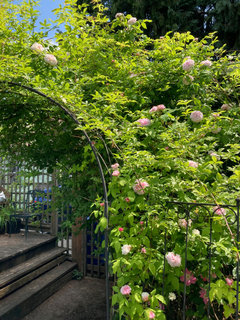
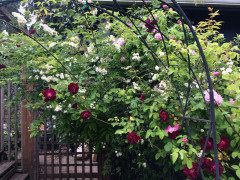
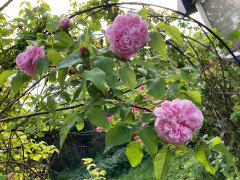
Hi Markay. I spotted your post and John’s mention of my JC climber. It sounds like you may indeed have the climber like I do. Mine was, as John noted, sent years ago as Comte de Chambord from Heirloom. It looked 100% like JC (not Comte) but did not behave like any shrubby JC I had ever grown. It shot up to the heavens, and if I hard pruned it, it sulked and refused to bloom until it was at least 7‘ tall again. Here are some photos of mine on an arch. Mine is 10-12’ tall and easily 6’ wide. It competes within a spaghetti bowl of Nearly Wild, Lady Banks and Dr. Huey. I also grow the officially labeled JC from Heirloom and Marchesa Boccella from Antique Rose Emporium and both are mannerly, modest shrubs that look exactly like each other and look exactly like small versions of my climber. Carol

- 3 months ago
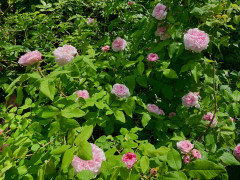
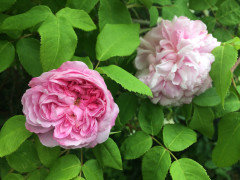
My pleasure! I hope your trained JC gives you lots of lovely blooms! I’d love to hear how your ”climber” is growing as time goes on. If you want to try a nearly-guaranteed-to-be-short plant, look at Antique Rose Emporium’s Marchesa B. Carol






John (PNW zone 8)