Software
Houzz Logo Print
angcando

Is our range hood working normally, or does it need replacement?

2 months ago

We have an old GE 36” range hood, with a rather weak 220 CFM rating (on high). It’s vented to the outside wall, but the duct work subtracts another 20 CFM or so.


I lit a stick of incense, and saw that at cooktop level, the smoke was not going up to the vent. However, about a foot above the cooktop, it appeared to go up there from the middle burner. From the side burners, some seemed to escape, some made its way up.


Is that about normal for a weak range hood? If we replace it with a Zephyr Gust (150-400 CFM), should I expect clearly better results (especially at lower speeds), or it’s not worth bothering changing the GE?

Comments (9)

  • 2 months ago

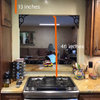
    Cooktop is 36", mounted on a wall cabinet. Hood is 36", installed 29" above the cooktop. Ducting is from the top of the exhaust, using a 3.25" x 10" rectangular transition to 7" round, which is connected to a 7" round 90-degree elbow, which is connected to a 7" round wall cap with damper. According to my old manual, that equates to a 47.5 foot equivalent ductwork length (though I felt the 34-ft equivalent for the 7" round wall cap was a bit much).


    I will note that the hood itself has a lot of air being blown out of it. The manual states that it can be set up as recirculating, which makes me wonder if it isn't in a dual mode of some sort. (I did check outside, and a lof of air is coming from the dampered wall cap, too.)


    I did try to look over past threads, and will do so again. It was just a bit difficult to find relevant information among the many, many posts! Thank you for your reply.

  • 2 months ago
    last modified: 2 months ago

    One would certainly want to block any hood collected effluent that was recirculated into the kitchen.

    Wall caps can be somewhat restrictive if their sectional area is lower than the duct feeding them and the transition from horizontal to downward flow is abrupt.

    Is this hood mesh filtered or baffled?

    For a 400 CFM rated hood to actually move more air, it would have to have a fan curve that was everywhere "above" that of the 200 CFM hood (in the sense of my figure above). Good luck finding the relevant data. An in-line blower or wall blower might at least (via Broan-NuTone or Wolf or whomever) have a fan curve that could be evaluated. Some means of improving MUA should be considered. A passive filtered hole-in-the-wall type (with damper) would beat pulling air in via wall cracks.

  • 2 months ago
    last modified: 2 months ago

    I'll check the manual to see if there's something in it to stop the airflow coming back.

    The transition looks pretty gradual to my eyes, but WDIK? Anyway, it is whatever it is, I won't be changing that. But that does explain the large equivalency number.

    Both the existing hood, and the Zephyr Gust I'm considering for replacement, are baffled. I was disappointed to find most Zephyrs use mesh filters. I guess that's what a lot of people prefer.

    At this time, I'm not considering anything beyond a hood replacement. I realize adding a MUA method would be ideal, allowing a hood with some hefty airflow to be used. I'll probably just stick with our current hood, then, since it sounds like it might not be much of an improvement, given the pretty signficant cost (around $1K, with installation).

    Thanks again for your thoughts. You've certainly provided a lot of helpful info over many years!


    ETA: Checked the manual, but couldn't fully understand what it was saying. Regardless, it seems like the unit would have to be dismounted to change anything. The best I can try is to simply plug up the holes the air is coming through with a piece of rag or something. But maybe it was designed to always have air flowing out of it.

  • 2 months ago

    Baffles require a minimum flow rate to perform centrifugal extraction of the heavier end of the grease particle spectrum that they are intended to deal with. For low specific flow rates (CFM/sq.ft. = velocity), mesh filters may be better, but they have to be kept clean, else they just block -- protecting the duct but not the ceiling.

  • 2 months ago

    I'm less worried about grease particles than I am lighter particulates. But that's good to know. So when cooking with oil, it's best to run the fan on high. I just don't want to be cleaning mesh filters every few weeks. We can go a year or so between baffles cleaning. It just seems so much easier to deal with. Thanks!

  • PRO
    2 months ago

    You REALLY should be dropping either of them in the DW once a week if you cook 5-7 times a week. It's not that hard to do. If you cook more than that, twice a week. If you cook much less frequently, you can get by once a month. But, there are zero circumstances where going a year is ever acceptable.

  • 2 months ago

    We are very light users of the cooktop. Typically, we boil water once a day, and fry an egg using a tablespoon or less of oil once every other day. Then a stir-fry, again with as little oil as needed not to burn, maybe once a month.

  • 2 months ago

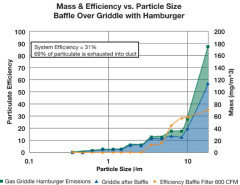
    The concept behind kitchen ventilation filtering is that the heavier particles will condense on the ducting unless filtered, whereas the lighter particles will be mostly exhausted to the atmosphere. See graph (the only such plot I've come across).