

The "Hallucination" Trap (AI renderings)
Just learned the AI technical term for when AI completely fabricates an answer or an image, yet presents it with total confidence as if it is a real fact: "Hallucinations"
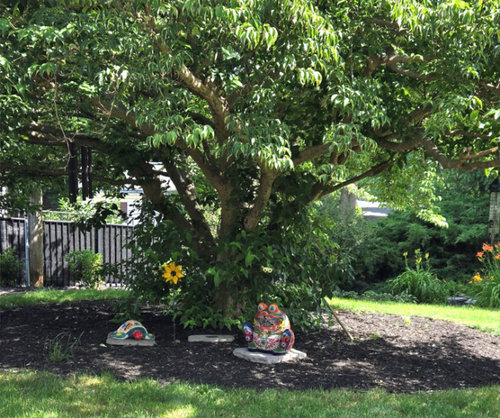
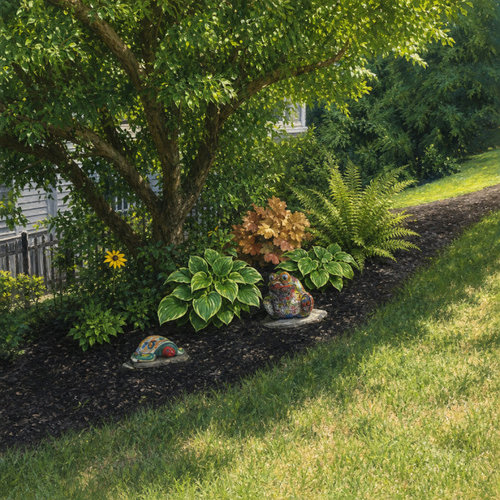
I experienced this just an hour ago - I uploaded a photo of a cleared mulch ring under my dogwood tree with the two pieces of Talavera pottery under it.
I asked specifically to have it updated as follows:
- Keep the frog and turtle in their current positions.
- Add two mature mouse ears hostas between them (small, rounded leaves).
- Place one Heuchera ‘Caramel’ just behind for color.
- Add one fern behind and slightly to the right of the turtle for texture.
- Keep all mulch and grass lines untouched.
Original Picture:
Here are some of the results, testing either an update the photo or create a rendering. . .
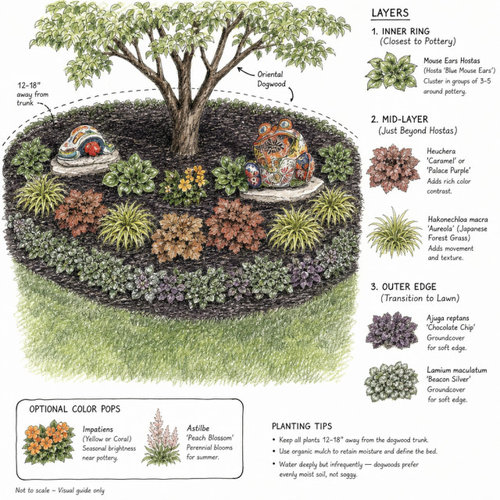
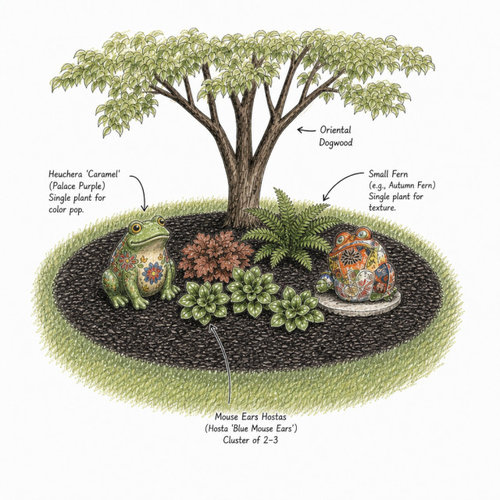
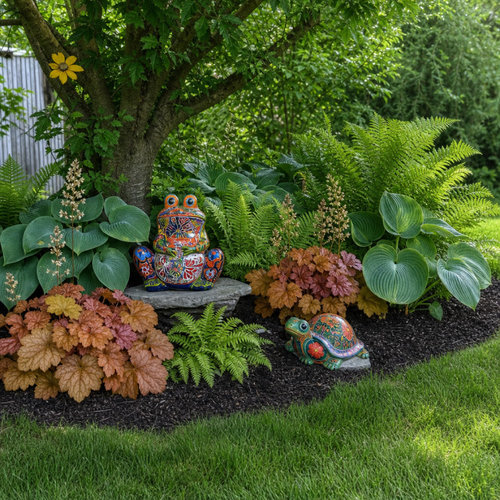
If you are trying to use AI to test paint colors, pick flooring, or lay out new furniture based on a photo of your house, here is exactly why the AI "hallucination" trap will fail you:
1. It Re-imagines, It Doesn't Edit
Generative AI tools do not cleanly place a new couch or swap a paint color on your existing walls. Instead, they look at your photo, read your text prompt, and mathematically predict a brand-new image from scratch based on millions of random internet pictures. This is why your existing windows suddenly move, your structural walls warp, and your actual architecture disappears.
It has learned what colors should work together and adapts the colors in the photo to work together, so your existing colors are "fixed" to go with the paint color you asked to be added.
If an AI generates a gorgeous living room layout, you cannot actually go out and buy it. AI is just rendering a "mathematical average" of 100,000 different chairs it has seen. It creates visual approximations, meaning the fabric texture, exact dimensions, and leg styles do not exist anywhere in the real world.
AI rooms always feature "glowing," perfectly filtered, symmetrical lighting where even deep, dark corners look pristine. In reality, your room has shadows, light switches, real-world asymmetry, and awkward floor vents. Relying on an AI render creates an impossible standard that real-world drywall and a paint roller can never match.
AI is great if you want a wild, broad inspiration mood board. But if you want to know if a specific green paint works with your actual oak trim, or if a sectional fits your layout, skip the bots. Stick to physical paint samples, real tape measures, and human eyes.
Comments (31)
 PRO2 months ago
You are correct, Jennifer, AI isn't perfect, at this point anyway.
I actually think it did a good job on your photo, and I've used it to similar effect. But of course, any color decision needs to be made in situ, and human eyeballs are always required when decorating or designing a room!
Jennifer Hogan
Original Author2 months agolast modified: 2 months agoI agree that the photo looks nice, but it isn't anything similar to what I asked for and isn't what I want (a pop of color under the tree using plants I already own - just need to split to plant here).
Related Professionals
Anniston Interior Designers & Decorators · Bend Kitchen & Bathroom Designers · Aberdeen Home Remodeling · Cape Girardeau Home Remodeling · Athens Home Remodeling · Altoona Kitchen Remodelers · San Diego Kitchen Remodelers · Victoria Interior Designers & Decorators · Norfolk Interior Designers & Decorators · Madison Interior Designers & Decorators · Grand Rapids Architects & Building Designers · Norfolk Architects & Building Designers · Akron Architects & Building Designers · York Architects & Building Designers · Middletown Kitchen & Bathroom Designers PRO2 months ago
AI might in the future be able to design a room or in your case a flower bed but right now it just analyzes pics on the internet and averages it out.
- PRO2 months ago
I think it did exactly what you asked for except it didn't add the astilbe and the impatiens. Can you ask it again?
 2 months ago
It rescaled all the plants. So it's doing the equivalent of changing a sofa to fit nicely in a room that is it really much too big for. In this case, it made the tree much smaller, and everything else much bigger. Giant fail.
Jennifer Hogan
Original Author2 months agolast modified: 2 months agoI asked specifically to have it updated as follows:
- Keep the frog and turtle in their current positions.
- Add two mature mouse ears hostas between them (small, rounded leaves).
- Place one Heuchera ‘Caramel’ just behind for color.
- Add one fern behind and slightly to the right of the turtle for texture.
- Keep all mulch and grass lines untouched.
The drawings and pictures were AI trying to do what I asked and failing over and over again. 14 attempts before it said I had no more images for the day.Jennifer Hogan
Original Author2 months ago@Patricia Colwell Consulting and @mad_gallica (z5 Eastern NY)
Exactly my point - it rescales and changes things, but hardly provides an accurate picture.
I have seen rooms where AI moves a window, changes the color of the floors or stone fireplace, moves walls or changes the size of a sofa to make it fit the picture instead of accurately depicting the room.
I think the technical name fits the issue well. "Hallucinations"Just what I always wanted - my designer to drop some acid before working on my furniture placement!
- PRO2 months ago
It just gives you an idea of what could work, I don't think anyone would expect it to be dead on. It's definitely easier than trying to draw it out or photoshopping it oneself.
- 2 months ago
I was asking Chat GPT some design question, i think about paint, and it randomly commented about the lighting in Houston -? I don’t live in Houston. I am on the east coast! I told it that, and it thanked me for letting it know. That being said, I do think it is helpful for general renderings of spaced
- 2 months ago
@Jennifer Hogan A paid ChatGPT account may help, but not because it magically makes every render correct. Some paid plans, like Plus, Pro, and Business, include access to Images with thinking, which is better suited for complex requests, the kind where the AI has to reason through physical details like proportions, window placement, furniture placement, and what should or shouldn’t change.
Paid plans also generally give you higher image limits, so you get more chances to iterate instead of being cut off after a handful of attempts.
But even with a paid account, AI renders are still interpretations. They can still get dimensions wrong, move windows, invent details, or misunderstand what is staying.
The paid version mostly gives you a better shot at getting there because you have stronger tools and more room to iterate, not because it guarantees accuracy.
Diana Biers is right: it won’t be dead-on the first try. It’s not quite that magical. You need to art-direct it after the first draft to get it where you want it to go. In my experience, free accounts just don’t give you enough room to do that well.
- 2 months agolast modified: 2 months ago
I'm finding that using one AI edit for the things that are hard to do manually, like turning furniture, then adding my own choices for art/accessories with Paint (or another photo editor), works reasonably well, with minimal AI distortion. Here's an example (original photo first, then hybrid-edited with AI plus rugsdirect.com's rug visualizer plus Paint):
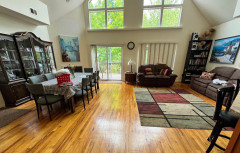
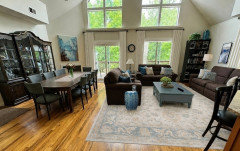
This method does still use AI--but sparingly!
 PRO2 months agolast modified: 2 months ago
Knock yourself out someone??
Three images, the result of a mood board sent to a client..I'm a tech fail, I had a client friend do these. on Chat GPT.




After a zillion "I do this, but then it changes something else!!! " Best he could do, because I could not give him the actual room , too much already ripped out like a corner fire and hideous built inWhat's off?
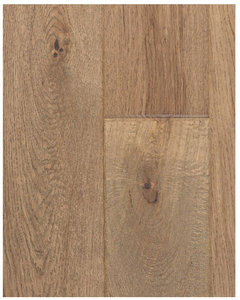
The floor should be :5" as below
PAINT! Swiss coffee BenMoore
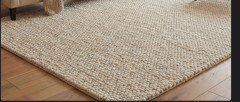
Book cases TIGHT to sofa sidesLighter rug, more texture
SOFA longer, 120 " four seat
Chairs are swivel, a litt;e angle
Fire opposite of couch ,
Fiiddle leaf right of windows, which are taller in a nine foot ceiling
fire....... 54 x 25, NOT linear, Tv above

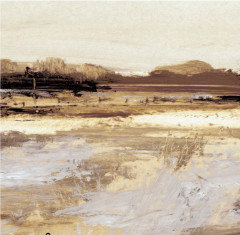
Grrrrrrrrrrrrr!!!!!!Knock yourself out _ I'm hopelessly colored pencil
 2 months ago
Spot on! Generative AI is great for abstract inspiration, but it completely falls apart when you need precise pixel-level editing or true-to-scale spatial accuracy.
I run into similar layout logic and dynamic alignment challenges quite often while keeping digital frameworks visually organized behind the scenes over at Deen Elevated. It really proves your point—whether you are dealing with automated digital pixels or real-world furniture placement, you can't substitute human eyes and actual physical dimensions for a mathematical average.
Trying to use it for exact remodeling placement is definitely a recipe for structural confusion!- PRO2 months agolast modified: 2 months ago
I'm at the point where I believe we'll destroy out brains and their wonderful ability to imagine, to interpret, to sense a mood,,,,a feeling- without the .....blah blah hand of all of these.visual aids.
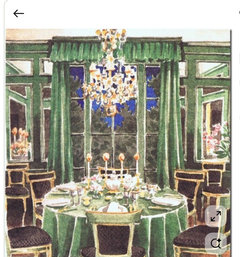
It's hard to get the feel of Paris, if you never GO to Paris lol. I can't imagine a glossy dark green cabinet, unless you SHOW me tha actual cabinet, and please fill it with stuff, as I can't do that either and by the way,,,we HAVE no books ? we only read on Kindel and not very often.....
I think of Mark Hampton,.........his incredible watercolors, and I too had his infamous, witty, book bedside for.....eons. You IMAGINED him , the room, the conversations with a client...
A little less reality in your face might be more wonderfully real ?
https://schematiclife.blogspot.com/2009/04/mark-hampton.html
 2 months ago
If you want a no fuss more realistic-ish approach try Google Gemini that uses Nano Banana. They do not add the illusions. It is very crude and looks like they found an item and dropped it into your image. It can be very frustrating trying to get an AI to do what you want without changing/adding other things you did not ask them to change or to interpret your prompts.
 PRO2 months ago
I have used AI in my research before but have gotten different answers to the exact same question at different times.
- PRO2 months ago
We wanted a watercolor version of our home and inputted this photo to ChatGPT:

This is what it generated:

Then we sent it to a photo site and received a hard copy to frame. Much easier, cheaper and better than anything I could do! Obviously it's not a real watercolor, so it depends on what your goals are. Ours were not to have a genuine hand-done watercolor, just something to hang on the wall!
Jennifer Hogan
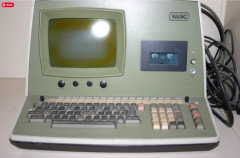
Original Author2 months agoWhen I think back to 1986, when I got a job in a law office using a brand new IBM PC and MS Word.
We had to type manual DOS command lines just to open it. The green-screen monitors weren’t 'What You See Is What You Get,' so we had to physically print documents just to see if our bolding or underlining worked. Storage was primitive—if you didn't manually save to a floppy disk your work vanished. When you did save your work you had to make a second disk to be sure that when one failed you had a backup.
I have no doubt that AI will follow the same path. It will improve, and we will become more proficient end-users. Right now there are some programs that create incredibly realistic videos and can do amazing photo editing, but the free, all purpose AI programs have a long way to go.Jennifer Hogan
Original Author2 months agoNever used the Multimate - legal offices used the WANG instead!
- PRO2 months agolast modified: 2 months ago
And ^^ always needs a reality check....
I spent five hours with a client yesterday who bought a second residence in Florida. He's the "gift" client; brilliant, funny, great taste ..... if a tad perfectionist.
He's been in and out over several hurry trips to the new home, we've got the online floor plan, and I was able to cobble reality /scale from all the general room sizes etc. .
Most of yesterday was devoted to rugs, which a huge brain like his should be able to deduce?
Not so much, as the insistence on placing them virtually into Chat GPT was hanging him up.
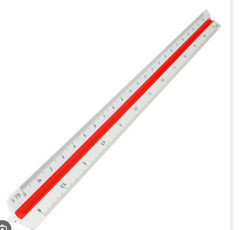
After a review of all the visuals, I dig in my tote, yank out the boring but informative......
As I left....he yells Thanks !""Very productive meeting"! Indeed.......: )
Rock, Paper, Scissors anyone?
- PRO2 months ago
Mark, if you're bored? Do me!! See the comment above with the visuals? If you're bored lol
- PRO2 months agolast modified: 2 months ago
Playing devil's advocate here: Most everything we use, touch, look through, sit on, live in, is not wholly natural. Medical care, education, business, law, cooking, artistic creations, all rely on manufactured/artificial goods. If you want totally natural, you have to live in a cave, the woods, the mountains or on the beach in a hut made out of sticks.
- 2 months agolast modified: 2 months ago
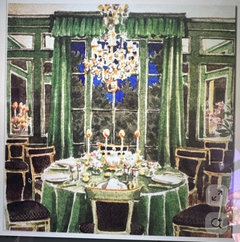
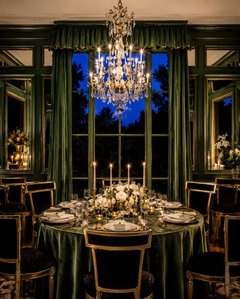
@JAN MOYER, get a pay subscription and use project folders. Mixing project questions in one conversation will only lead to AI confusion. If anyone should be able to art direct AI it should be you. This render took 4 iterations not sure how faithful to your directions it is. Don't keep asking the same way if it won't listen to your changes. If flooring plank size won't adjust to 5" then say "make planks 40% narrower" instead. Praise it when it gets it right since no one like to work for a slave master and you know how you get. :P
Also, ChatGpt has a memory scheme called 'dreaming' recalling details across all your conversations. It will begin to know how you like to work and your style the more you use it. Its great to talk through design decisions with it and to be shown alternatives to your ideas. I'll photograph something at HomeGoods and ask chatGPT what it thinks and it will sometimes say "Put it down and leave the store until you come to your senses".

- PROlast monthlast modified: last month
^^^
Welllllllllll excuuuuuuuse me!
I actually can do quite a number of things. The top of the list is 99.9% of the time to be able to communicate any design, any style, any room, to any client minus anything more than a mood board.
After 35 years of happy camper clients, I am frankly not interested in acquiring more tech skills, programs....I'm at trust me trust me not and if that is not to BE, , be on your merry way.
The only reason for the one above? Not your business, just a client with a specific medical condition, and one that has worsened over time since the last project,
By the way? The friend/client who produced as above, is Mensa brilliant......has a love affair with Chat GPT, and the unusual quirks to the information I was able to provide met up with the limitations of gpt.
I'm on my merry way now to his own mile distant project : ) and he can chat up every mood as he likes.
- last monthlast modified: last month
@JAN MOYER As I just showed, those weren’t really limitations of ChatGPT. They were limitations of the workflow: not using the right setup, not isolating the project, and continuing to ask for changes in a way the tool wasn’t responding to.
With a paid setup, project folders, and more specific iterative direction, it got much closer in a few passes in under two minutes. It may be worth learning the workflow so that, as a seasoned designer, you don’t have to depend on strangers online to correct renders for you.
Good luck with it… and you’re welcome.
- last monthlast modified: last month
@Diana Bier Interiors, LLC It came out great. In some ways, taking a watercolor painting (or color pencil sketch) and making it photo-realistic is even more impressive. The accuracy of this one is amazing if you look close. The back of the center chair is the most obvious mistake.






Olychick