

If this isn't RRD, it's equally lethal and contagious
Hi folks
As many of you know, I lost all my roses in 2022 to RRD so I'm obviously vigilant about watching for signs. In the years after digging out 850 roses I was jumping at every odd looking bit of growth, and I thank you all for your patience in talking me down from the ledges during that time. I really appreciate simple rules like "abnormal AND excessive" or "rubbery thorns" that help me distinguish RRD from other things. At no point anywhere in my yard is Roundup or other weedkiller sprayed, and not in the neighbor's yards either, so that's not a factor in the situation.
The types of growth pictured below are a new phenomenon that I've not seen before but ignoring it has come at a price over the last 2-3 years. For newbie rose growers, please ignore these photos as the kinds of chlorotic growth pictured below can come for many innocent reasons such as wet conditions and poor oxygen uptake (I think, anyway). A lot of roses can be chlorotic in spring until they get growing and they're fine.
That's what I assumed about a Bolero rose about a year or two ago that started out the spring looking extra scruffy with mangled puckered leaves and chlorotic growth with small stunted clusters of leaves and minimal to no blooms. It looked odd and icky, but it didn't meet the RRD test so I just kept an eye on it. After a while, another rose nearby started doing the same thing when it had looked fine earlier in the spring. Hmmm, not a usual progression. After a while Bolero simply didn't shake off the ick but started to dwingle, and I sprayed, bagged, and dug it out. It's common enough to replace and I wasn't going to risk things.
I watched two less replaceable roses last year through the same progression of chlorotic growth, scruffy undersized growth, miniscule blooms, and dwindling before I realized this was a pattern and dug them out (Tradescant and The Squire). In total, I dug out 4 roses with this suspicious growth in 2025. These roses are all in my "fussy pants" bed with relatively irreplaceable roses so I tried to give them a chance. I cut to the ground some that were particularly precious (like Acropolis) and so far this year it hasn't shown any troubling signs. I marked in my records which ones had a cane cut down and they only get one strike. Anything more and I dig them out.
Well this year, I've dug out 18 roses with the same pattern, most of which are in the same region. I'm getting much faster to jump on the chlorosis this late in the year and the growing backward as I've discovered once this shows up there's no shaking it off. I still don't see any abnormal clustering of growth and the thorns are sharp enough, not rubbery, but this is spreading in the bed and I can't ignore it.
I'll post some pictures of what I'm talking about, as far as I can capture it:
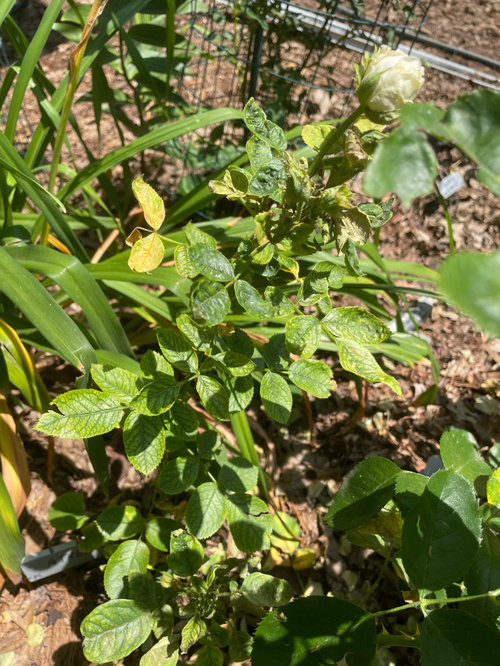
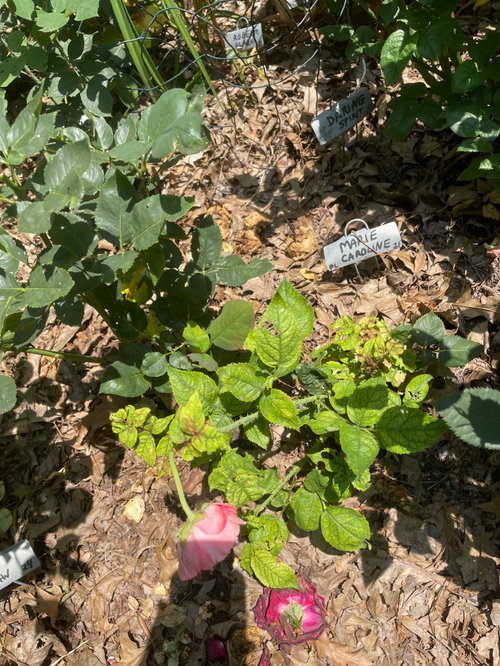
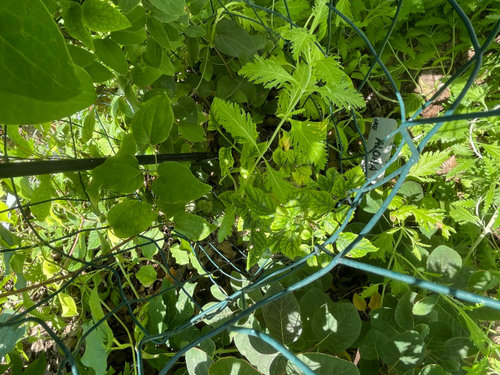
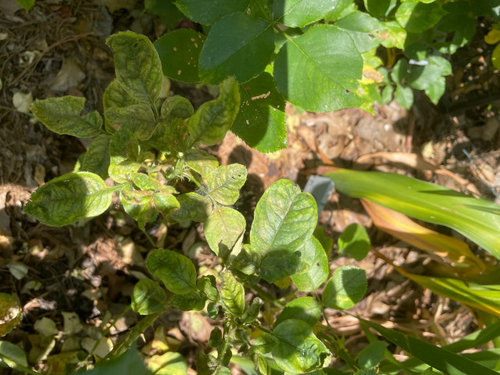
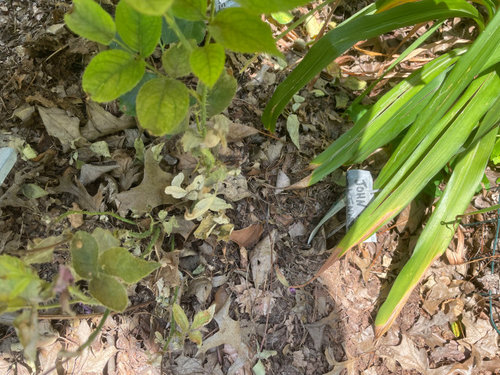
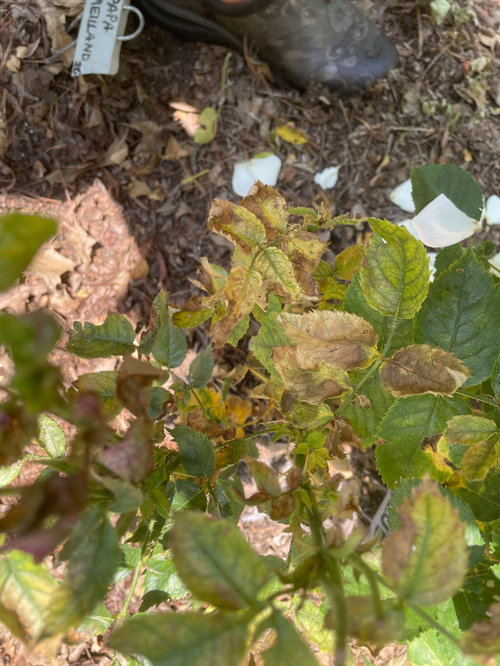
See, they don't look that bad, right? The last one is clearly drought stressed but those chlorotic veins are the symptom that stands out. The rose in the cage looking downward is Aloha - ignore the Russian Sage trying to crowd in. This pictured growth is here in July, not early spring BTW. All the roses got a good dose of Osmocote plus our rose society organic fertilizer in early May and have no reason for showing nutrient deficiencies, particularly since nearby roses are doing spectacularly. There aren't any environmental factors like heat sinks or poor drainage or other factors that should be causing this, and I just don't like how contagious it seems to be. Absolutely none of the roses that showed this pattern have survived and I'm not going to give any more a chance to spread the ick anymore without clear indication of something non-lethal to stop it. I just saw a scrawny Moonlight Romantica in a completely different bed show this pattern and it's coming out tomorrow.
There are a few roses in my yard I've done a cautious trim to the ground of canes with clear RRD, where a larger cane is growing out of a smaller one, on an otherwise healthy bush. For instance, Quadra had one of those that I pruned that cane to the ground and I sure hope it hasn't spread. RRD seems to catch on the biggest roses in a bed, and few are bigger than Quadra. I'll have to take a ladder to the top of him as well as Peach Melba to make sure there aren't any signs, but so far it seems to have worked to take out the offending cane before it spreads downward. It's odd to think that the obvious signs of RRD are things I can take relatively casually as necessary evil of rose growing, but this nasty ick is something else to me that I'm finding disturbing.
I've already dug out all the roses pictured here (a total of 18 so far this year) so I can't show you further photos of how they're doing. If you want to see a more recent picture of Moonlight Romantica speak quickly because it's coming out regardless in another day as soon as the temperature is below 100.
I welcome your input and detective work to figure out what's going on and potentially recognize this before it gets out of hand.
Thanks
Cynthia
Comments (20)
 2 months ago
I do not know, Cynthia, but I hope someone of our experts can help. I know you have been growing roses for decades so this is not an easy one.
nippstress - zone 5 Nebraska thanked Sheila z8a Rogue Valley OR nippstress - zone 5 Nebraska thanked Markay MD-Zone 7B
Related Professionals
Wilmington Landscape Architects & Landscape Designers · Traverse City Landscape Architects & Landscape Designers · Jamestown Landscape Architects & Landscape Designers · Orangeburg Landscape Contractors · Webster Landscape Contractors · Palm Desert Landscape Contractors · Savannah Home Builders · Toms River Home Builders · Newburyport Home Builders · New York City Home Builders · Canton Home Builders · Eau Claire Home Builders · Milwaukee Home Builders · Las Vegas Home Builders · Vancouver Home Builders nippstress - zone 5 Nebraska thanked mad_gallica (z5 Eastern NY)
 2 months ago
Nipstress, you mentioned chlorotic veins, but for me it’s the tissue between the veins that look chlorotic. Do you know, or can you test for, the soil pH in that bed? I presume between osmocote and the society stuff there’s no nutrient lack, including the micros, though that may be presumptous.
nippstress - zone 5 Nebraska thanked rifis (zone 6b-7a NJ)- 2 months ago
I agree with starting with a soil test. I'm particularly wondering if you don't have phosphorus or some other component of the fertilizers building up in your soil to harmful levels. You could also ask your local county extension office about sending off some of the symptomatic plant tissue.
nippstress - zone 5 Nebraska thanked claudia_dm_8a7b - 2 months agolast modified: 2 months ago
I'm at a loss to help you, Cynthia. What you're going through really grieves me.
By all means, follow the advice given and have classic specimens sent out for evaluation. This the logical thing to do. Have them tested for: bacterial, fungal, and viral pathogens. Also mineral deficiencies or excesses need to be considered, and tested for. Don't leave out any insect, mite, microbe or protozoa possibilities. Is mechanical damage a possibility, too? Field mice, voles, and even baby rabbits nibbling and stunting growth at ground level can go undiscovered, but the damage done plainly seen.
Moses.
nippstress - zone 5 Nebraska thanked Moses, Pitt PA, cold W & hot-humid S, z6 - 2 months ago
To clarify:
when I earlier wrote ”I presume … there’s no nutrient lack”, I meant no lack of nutrients applied to, and in, the soil.nippstress - zone 5 Nebraska thanked rifis (zone 6b-7a NJ) nippstress - zone 5 Nebraska
Original Author2 months agoThanks for the problem solving folks - your generosity in chiming in is very helpful. I'll try to respond to all your questions - they overlap in wisdom and sympathy so I'll do a group response rather than individually.
I've found a place locally that does soil tests and I'll create a sample and send it in shortly. I haven't done anything new with mulch - just leaves as always and they're spread throughout all my beds without widespread harm that I can see elsewhere. It's the isolated nature of the roses affected that puzzles me. You can see in the picture of Marie Caroline another rose just behind it that is thriving green and utterly normal. The rest of them are similarly little islands of misery in the midst of healthy growth.
When I dig out the roses they are stunted and dwindled to miniscule pipe cleaner canes above ground but not obviously chewed in ways I can detect. I had a vole problem in one bed about 8 years ago and those were pretty distinctive problems with the main cane totally disconnected from the roots by vicious little teeth. This isn't normal winter damage, something I am sadly quite familiar with, including roses that pretend to leaf out on tiny canes then give up the ghost. In this case, several of the ones I've dug out are robust Palatine bare roots well established or 3 year old own root roses a good 4-5' tall (like Aloha). Marie Caroline above isn't happy and is drooping on the ground, but she has pencil-thick canes and hasn't yet dwindled to nothing. Her blooms however as you can see are distorted and scruffy which set off questions of RRD.
I'd be shocked if the roses and soil are over-fertilized since this is only the second year in about 10 years where I actually did my once-a-year spring fertilizing. I'm sooo lazy with fertilizer and usually too tired after spring planting to use it in time. Last year was only the organic fertilizer (various meals, equivalent to Rose Tone or the Mills Mix) not the Osmocote.
I left every single garden bed rose-free for 18=20 months after I dug out the RRD affected roses in 2022, and I didn't replant in those beds till 2024. That was collective advice from our GW expert on RRD, StillAnn, as well as others who face the same disease. I don't think rose replant disease is a very common issue in the US, more often seen in long-planted soils like those on the other side of The Pond.
I agree there must be some issue with the roses taking up the available nutrients, the puzzle is why. I suspect the soil test will say my nutrient availability is fine, after 20+ years of leaf mulch improving my already pretty good loamy soil. These are long-standing garden beds that haven't been grass in 25 years and the soil is rich enough I can plant bulbs with my fingers if there's enough moisture. If it's not the soil, that would mean it has to be some disease, critter, bug, or verrrrry localized spots of environmental problem. I can't think of anything I've done differently in these beds from my other beds, or differently than in past years, other than dipping my shovel in a bleach/water solution after I dig out the affected roses. That is after they're affected not before, however, and the shovel has plenty of time to dry before it digs ou another affected rose. It could be just Rose Mosaic Virus but I've never seen such a simultaneous self destruction from RMV and it almost never kills the roses, at least not quickly.
As for testing the roses themselves for tissue problems, I simply don't know anywhere regionally that does it. When I had that sweeping amount of RRD I tried to get them tested but there was only one place my Ag Extension said I could mail it regionally and the cost was going to be several hundred dollars, just to confirm what I already knew it had.
The affected roses are from different vendors, though the First Offender - Bolero - was from a local nursery that had a BAD case of RRD in their planted roses right next to the roses they had for sale. I didn't discover that bed until I'd bought and planted roses from their other store so the damage (if any) was already done. Since this doesn't look like RRD, and the affected roses are from at least 8 different vendors, it isn't the source material as far as I can tell.
All this is musing to answer the very pertinent questions you've asked. I'll let you know what the soil test says when it comes in, but I'm just flummoxed. So far nothing beyond Tradescant and The Squire are hard to replace, but some of the roses now in that bed are much more irreplaceable.
I'd love to hear if anyone else has seen something similar in their roses that's a rapid wasting away of a previously healthy rose, other than RRD. In the meantime, I'll keep monitoring and digging as needed. When I dig out a rose I move a daylily into its place so I'm not tempted to plant back in the hole that had the affected rose. For now, that's all I know to do.
Thanks for your help!
Cynthia
- 2 months ago
I have an Alnwick Castle DA rose that went squirrely a couple of years ago. No photos, sadly. It looked like herbicide damage to me, but no other plants were affected. I never used herbicides. I thought it was really odd to have one rose affected if something blew in. Gradually the plant has improved. I never figured out what was wrong.
nippstress - zone 5 Nebraska thanked Sheila z8a Rogue Valley OR  2 months ago
Well it is a total head scratcher, I do hope the soil test comes up with a diagnosis.
The first time I had an isolated rose struggle and decline for no apparent reason, the problem turned out to be ants that had nested amongst the roots. They create air pockets with their tunnelling that leave feeder roots dangling in mid air, unable to access water and nutrients. I know the signs now so can catch a nest early enough to take action, but it is a regular occurrence in my dry, clay soil. Probably not something you suffer from.nippstress - zone 5 Nebraska thanked NollieSpainZ9 2 months ago
The OP wrote "All the roses got a good dose of Osmocote plus our rose society organic fertilizer in early May and have no reason for showing nutrient deficiencies, particularly since nearby roses are doing spectacularly." Also, "I'd be shocked if the roses and soil are over-fertilized since this is only the second year in about 10 years where I actually did my once-a-year spring fertilizing. I'm sooo lazy with fertilizer and usually too tired after spring planting to use it in time. Last year was only the organic fertilizer (various meals, equivalent to Rose Tone or the Mills Mix) not the Osmocote."
Have you considered that the local rose society's fertilizer may not have been mixed thoroughly and there might be clumps of something here and there that got applied to certain roses and not others?nippstress - zone 5 Nebraska thanked apple_pie_ordernippstress - zone 5 Nebraska
Original Author2 months agoThanks for sharing stories of your own roses! It might be a mystery like Sheila had or ants like Nollie had but I haven't seen any. Good point Apple Pie about the rose society fertilizer. It was a new company this year and there might not have been great mixture. Nothing has clumped up around the roots that I can see and the fertilizer is a soft mix of fine meal and other substances. I only add about a half cup per rose because of cost and a LOT of roses, but the fertilizer might have affected these. It would seem that the effect would have been in spring though instead of kicking in during July.
Wonderful ideas everyone - all of them might be possible, I'm just responding to your input with more information as you raise questions. I can't say it's NOT anything that you've mentioned, just how likely it seems. Right now the most likely explanation is "unknown" which doesn't answer the question very well.
Cynthia
- 2 months agolast modified: 2 months ago
You may have already addressed this and I missed it, but have you checked with fellow local rose society members to see if anyone else has had this problem? The new source of the rose meal mix piques my interest... maybe a contaminant of some sort? Edit to clarify: a contaminant that didn't get fully mixed in, but was concentrated in part of the mix?
nippstress - zone 5 Nebraska thanked susan9santabarbara  2 months ago
I'm really sorry about your rose problems. I can relate with losing a lot of roses over the past 2 years. I don't have nearly as many as you do, but I can really relate to that freaked out feeling, "oh, no!! Not again." Could you dig up one of the roses and pot it up with fresh potting soil and see if that improves it? I really hope you can figure this out and that it's not a huge problem for you.
nippstress - zone 5 Nebraska thanked rosecanadiannippstress - zone 5 Nebraska
Original Authorlast monthThanks again for problem solving with me Susan and rosecanadian! I like the idea of an experiment to dig up and pot an affected rose and see if the concentration of fertilizer or quality of the soil changes the chlorosis. Right now I've dug out all the offending roses and the only ones I regret were Tradescant and The Squire last year (but they were dwindling to nothing) and Athena and Aloha this year. Aloha is replaceable but I'd have to hunt for Athena as it was from Palatine.
For now I'll keep an eye out and try potting up a rose to see if it changes if a new one gets icky chlorotic (yes rifis, it's the space between the veins not the veins themselves). I need a new name for this phenomenon. At least it doesn't sound like something that's spreading rose to rose, as I'd feared, so I don't have to worry about direct contamination. Moonlight Romantica isn't looking as chlorotic anymore so we'll see about another one.
Thanks again for your help!
Cynthia
- last month
Nippstress, I think I have seen something similar in my garden and don’t know what it is. The plant starts out fine then begins to grow backwards. Last 2 falls I’ve had aphid problems that I couldn’t control and they sucked the life out of a lot of my roses or lost their strength that they couldn’t overcome winter damage and spring wakeup. But I think something is going on insects, bacterial, etc. in the ground. This morning when I was out I happened to notice some trees, bushes looking sick, like something is attacking them, naked or dying branches. Then I thought that can prob attack my roses, too. Now I’ve come across your comment, seeing your pictures, and it has me wondering more seriously. I bet those plants looked better earlier in the season.
- last monthlast modified: last month
Cynthia, Today I took a picture of the area I mentioned earlier in the post. Notice the dead tree, lighter unhealthy looking green.

 last monthlast modified: last month
More than a decade ago, I did 2 posts in Organic Rose forum on types of soil and mineral deficiencies, see links below: https://www.houzz.com/discussions/4034324/how-to-tell-mineral-nutrient-deficiency-in-plants-and-soil#n=68
https://www.houzz.com/discussions/3954615/mineral-deficiency-symptoms-in-roses#n=76
The best thing I did in 2011 was to follow the late Rosarian Karl Bapst's tip of getting a soil test via EarthCo. soil testing company. I sent one cup of my soil to that lab, and my soil test came back: exceedingly high in magnesium, but OK for other nutrients. My soil pH was tested at 7.7 (alkaline), and I confirm my pH by re-testing with red-cabbage juice and litmus strip.
Magnesium is what makes my dense clay so sticky like glue when wet, but becomes rock-hard clay when dried. I have to use a knife to scrape off the mud stuck tight on my shoes after gardening. The soil test company advised me to use gypsum (calcium sulfate) to break up my rock hard clay that clumped together in large chunks (the size of a grapefruit). Soil test stated that my clay has plenty of organic matter.
A friend in Texas got her soil tested via local Extension. It came back a bit high in calcium, but SUPER HIGH in phosphorus. Her soil test said NOT to use any manure for 3 years !!
What type of soil texture do you have? Fluffy & loamy that sifts through your fingers easily, or does it stick to your fingers like glob of glue like my dense clay? My clay stuck so tight to my skin that washing it off with soap won't do, I have to use rubbing alcohol to wipe off the sticky black gumbo clay from my skin.
Sandy soil is most lacking in magnesium (magnesium is what "glue" soil particles together in a clump). Magnesium is what retains moisture in soil and it's a co-factor for potassium (necessary for dark green and glossy leaves). My high magnesium clay stays wet for a long time. Both my neighbor and I watered our tomatoes less than 3 times per year.
My first impression when I looked at your pics. many times is: magnesium deficiency coupled with potassium deficiency if your soil is fluffy and loamy.
My 2nd impression when I looked at your pics is: phosphorus burn. Phosphorus doesn't get leached out like calcium or potassium. Phosphorus' mobility is a 1 compared to nitrogen mobility of 10, and potasium mobility of 3, so phosphorus stay put where applied and can burn roots.
Back in 2002, I burnt a dozen geraniums by topping them with bone meal (high in calcium and phosphorus), their growth got stunt and their lower leaves got scorched burnt to brown and yellow.
I have this spot that I planted tomato for the past 26 years. Tomato is a high-phosphorus crop so I put 1/2 bag of manure in that hole yearly. This year I moved one rose into that spot, and it's went from 100% healthy in potting soil, to looking like your pictures (burnt brown leaves at bottom). I'm going to dig that rose up, then use the high phosphorus soil to top my tomato bed (tomato loves high phophorus).
Below is my compilation of nutrient deficiencies after 35 years of growing roses:
Over-fertilization: wilting, leaves curl down.
Too acidic: leaves curl up & thinner, and blackspots, crisp burn on tips.
Too alkaline: Pale, leaves twisted (boron def) or crinkled (copper def).
Potassium def: zero blooms, balling, thin & weak stems, and blackspots.
Calcium def: less petals, stunt growth & tip die-back & pale and small upper leaves
Nitrogen def: small leaves & pale LOWEST leaves
Sulfur def: entire plant is pale & stunt growth
Iron def: pale UPPER leaves with greener veins



NollieSpainZ9