

Discouragement in Tuscany
Well, here we are, the end of July. Summers here have become ever-more unbearable, and this one is probably the worst yet. I'm facing up to the sad truth that roses just don't give me the same satisfaction that they used to do. When I started out more than 20 years ago, I'd get a spectacular display of beauty in May/June. All of the roses opened up together, the plants were covered in flowers-it was awesome. But climate change has put an end to that. I work much harder than I used to ,improving soil and watering what I can, but to no avail. This year has been typical of the current trend. The rains that we used to have in March and April came in May,just as the roses were preparing to open. The grey weather prevented them from doing so, and once it passed and they began, the temperatures suddenly soared way up to an abnormal level, which basically truncated the flush. Ever since then it's basically remained extremely hot and humid. Once upon a time, 90degrees F was considered as "extremely hot" in my area. Now, that's considered as relatively mild. We're headed for another long period of temperatures in the 100's .
I force myself to go out there and water, but it's so depressing to see all these plants that were looking so well in the spring now dwindling down to nothing. I realize that I'm exaggerating-my depressive state makes me "see" mostly just the bad stuff,not all the things that are resisting quite well and are actually looking good. Some of this negativity is due to the fact that I don't have a glorious spring flush to remember fondly, just the fact that the new implants, which were doing so well before the summer ,now threaten to just grow backwards.. I guess that this is what the northerly gardeners experience after brutal winters. Here it's the summers that are the killers.
Comments (19)
 13 days ago
Is there someone who could water the roses for you during the upcoming heat dome days?
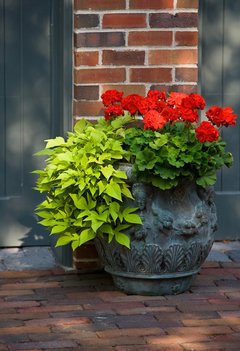
There are many annual summer flowers that thrive in heat such as zinnias and marigolds. in my area, red and white ivy geraniums i bloom well into fall. French lavender is also doing well in 90 degree heat. Perhaps planning a few pots near the house for next year would be entertaining? Armchair gardening can be fun when it is too hot outside to do anything.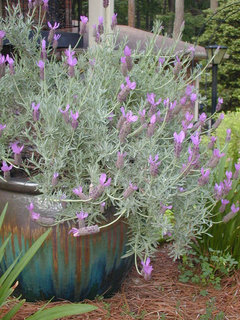 Spanish lavender in pot is a fragrant focal point · More Info
 Windsor Companies · More Infobartisback thanked apple_pie_order
 13 days agolast modified: 13 days ago
Bart,
Have you found any varieties that laugh at heat? Surely there are some roses that take the heat better than others. Although the heat resistant varieties may not be the 'prettiest,' roses, growing them to the exclusion of the wimps may be your best alternative.
If you grow only once blooming roses and enjoy their lavish spring display, after they finish blooming it doesn't matter how crazy hot the following weather is. You got your rose enjoyment period altered/abbreviated, but the aggravation and disappointment of enduring the cruel summer heat is gone.
You will find a way.
Moses.
bartisback thanked Moses, Pitt PA, cold W & hot-humid S, z6Related Professionals
Gary Landscape Architects & Landscape Designers · Webster Landscape Architects & Landscape Designers · Cowansville Landscape Architects & Landscape Designers · Covington Landscape Contractors · Lawton Home Builders · Akron Home Builders · Salinas Home Builders · Middletown Landscape Architects & Landscape Designers · New London Landscape Contractors · Beatrice Landscape Contractors · Murrieta Landscape Contractors · San Bernardino Landscape Contractors · Marquette Home Builders · Middletown Home Builders · Vancouver Home Builders 13 days ago
I’m so sorry, Bart. The heat is a killer, both for the roses and the ambitions of the gardeners. I think you need to do whatever works for you, and if that means you start moving towards drought and heat lovers vs roses, then go for it. I love roses, but I love other plants too and there are some gorgeous options out there for hot , dry gardens. Fighting to grow something that requires so much from you isn’t sustainable in the long run. A garden is a place of joy and serenity and should feel peaceful to you… if it brings you more anguish than joy, then a shift in focus might be due. I’m rooting for you, whatever direction you decide to take.
bartisback thanked judijunebugarizonazn8 12 days ago
The last couple of springs have not been so stellar here rose-wise, either, Bart, due to unusual, weird weather, this year being particularly bad because not only was the blooming off-kilter and generally on the stingy side, the level of foliage disease was unprecedented and only now kinda-sorta getting back to normal. I, too, am re-evaluating which roses are still worth growing and considering alternatives where conditions have apparently become more marginal for roses due to climate change.
bartisback thanked catspa_zone9sunset14 12 days ago
If I recall correctly, Bart, your home has no outside space and your garden is a tract of land some distance from it, with no water source? Thus you have to rely solely on the rain/rainwater collection? In those circumstances, I’m afraid I simply would not grow roses at all, or at best grow an extremely limited number of the toughest roses.
I salute you for your determination and perseverance, but perhaps the time has come for a total rethink? I am certainly having one and my set up is nowhere near as difficult as yours. Even having access to a (so far unlimited) supply of well water and a handy tap right outside my door, I am struggling to keep roses and many so-called drought-tolerant perennials hydrated, alive and kicking. However, no amount of water can counteract the increasingly extreme heat combined with the scorchingly hot winds that blow over from Africa - so many rose blooms, leaves and canes just scorch and burn.
I have learnt a lot over in the ten years I have had this garden, but if starting again from scratch, I would approach the design, materials and planting in an entirely different way.bartisback thanked NollieSpainZ9 12 days ago
Bart, I feel for you. Having your garden a drive away and no water on the site does sound near on impossible.
I might do pots where you live to have the gardening bring more joy than pain.
Our beloved Ingrid did, I do believe, give up after the global climate turned her property to desert. She even had water, but it proved too difficult for her.
Pots at home could fill a rose need.
bartisback thanked Sheila z8a Rogue Valley OR- 12 days ago
What Sheila said about pots, and also 2 suggestions - my most heat tolerant roses are china hybrids with small blooms (mostly red, of course). My what-I think-it-is 'Cramoisi Superior", has had bloom on it since April, although many of my other roses have decided to go dormant (our heat has been in the 90s on and off). Also, there is a type of salvia (its common name is "Mexican Sage" for a reason), called 'salvia leucantha' that just laughs at our dry heat, and blooms here from July through November continuously - beautiful dark purple blooms on a generous bush. I see it all over in the late Summer and Fall, growing in places where it obviously does not get watered at all. (our rains start in Nov usually).
bartisback thanked jacqueline9CA  12 days ago
I've been reading about the high temperatures in Italy and it's scary. I can imagine that many gardens are suffering and many gardeners are giving up right now. Even sadder is when you start to look forward to the days of terrible forest fire smoke because it blocks the brutal sun.
We had similar heat waves in 2021 - an unprecedented 117F/47C was something we're still talking about 5 years later. But what I learned that year is that my three favorite plants are Roses, Cistus and Hardy Fuchsias - the superstars of heat waves! That doesn't mean they looked great during the heat wave - but what impressed me was their quick recovery.
If those kinds of temperatures become more commonplace I have a short list of roses that I plan to surround myself with - Chinas, Teas and Wichurana ramblers, because they don't seem to care what the weather throws at them and I never water them!bartisback thanked ElfRosa- bartisback thanked Sheila z8a Rogue Valley OR
bartisback
Original Author12 days agoThank you all so much for your answers and sympathy. Nollie, your responses especially resonate with me:
"However, no amount of water can counteract the increasingly extreme heat combined with the scorchingly hot winds that blow over from Africa - so many rose blooms, leaves and canes just scorch and burn.
I have learnt a lot over in the ten years I have had this garden, but if starting again from scratch, I would approach the design, materials and planting in an entirely different way."
Here, the heat "waves" just follow each other continuously,so plants can't bounce back. I am going to have to change my focus, that's obvious. Problem is, I've still got this huge pot ghetto of mostly roses with which to cope. I'm not very interested in pot culture,I'm afraid. The whole thing that got me into roses in the first place was that planting a garden out at my land gave me an excuse to be there! and the rosacea family does thrive there in the form of wild roses, brambles, etc. I just got too cocky,over-reached myself...and of course didn't forsee just how awful things were going to get here. And Nollie, I, too, am in an "alledgedly cooler " area-the foothills of the Appenines.
So now, my problem is: how to fill in the several prominent areas of my garden that are now left to the weeds, due to the death/removal of the plants that formerly occupied them???This is the main challenge, because with this kind of weather,it's a struggle to get anything new established.- 12 days ago
I recall a dry island in Greece that had water shipped in by boat from the mainland, then trucked to cisterns. Would having a truck deliver water to a cistern be reasonable in your situation?
bartisback thanked apple_pie_order - 11 days ago
Hi, bart.
Like you, I'm feeling rather wilted these days, and the real heat hasn't even started yet (today, reaching its maximum tomorrow and staying there for the next week, according to the forecast).
I was out yesterday in our olive planting and the woods beside it, digging out elm roots, miserable invaders that they are. I was mostly in the shade, which made it manageable, though I sweated plenty, but I was enjoying what I saw. I don't know how much thought you give to the non-flower ornamental elements of your garden. In summer--well, all year round--I take considerable pleasure in the rounded silvery olives, and their contrast with the rough dark columnar Italian cypresses. These architectural elements are pleasing all year round. The bit of woodland looked quite handsome, too, the plants healthy, the foliage large and deep green. They were mostly oaks and flowering ashes. Close planting is really important now, I suspect; the plants shading and protecting each other. Up at the house, our enormous, hard to control bay laurel is still a substantial, shapely tree.
I certainly am watching to see what does well in this heat, as well as what will revive once the rain starts. Hedges are important for shade and cooling, and for encouraging trees to sprout.
As in Elfrosa's case, Chinas, Teas, and Wichurianas do well in my climate, though the former two need considerable soil amendment. Wichurianas are really good here, and since I love them, this class and I have a happy relationship. So far we've had no problems with winter chill, which means I continue to grow lilacs and bulbs, and the once-flowering old roses: Gallicas, Damask, Albas, and others, which are generally very good in my garden.
Along with the gray-foliaged subshrubs, of which shrub germander and phlomis are the stars, evergreen shrubs and subshrubs are important in my garden. Cotoneaster lacteus is handsome twelve months a year, is drought tolerant and can take sun; Daphne odora 'Aureomarginata', an aristocrat, is a shade plant, but very drought tolerant; subshrubs Ruscus hypoglossum and Alexandrian laurel are shade plants--the Ruscus takes deep shade--but provide texture and green all year and, again, are very drought tolerant. These are all plants that, once established, I never water. Privet, which I know no one is passionate about, is good, and, bart, I know you dislike photinia because of its red foliage, but it's everything-tolerant and, when mixed with other plants, its semi-glossy green and red new foliage is welcome in the wildish conditions of my garden. There are more. I'm thinking of attempting more plants of lentisk (Pistachia lentiscus) and myrtle (part shade) which come from further south then where I live, but the plants of them I have do quite well here.
Remember, even now, summer isn't forever. Depression can make a gardener forget that. I hope you get to feeling better soon, and find other things to think about, or perhaps you can engage in some planning. I'm thinking of plant orders for the coming days when it will be really hot. Or just find a good book.
bartisback thanked Melissa Northern Italy zone 8 - 11 days agolast modified: 11 days ago
I think you just have to be totally brutal and get rid of your rose pot ghetto and anything else that is struggling, bart!
As to the replacements. Melissa makes some excellent suggestions and I grow quite a few on her list. For shrubs and sub-shrubs that survive with little, or any, supplemental water, I would add Pyracantha, Nandina Domestica (both of which make excellent hedges for shade and shelter), Viburnum Tinus, hardy Hibiscus, Pittosporum, Cistus, Abelia Prostratus, Rosemary Prostratus, the shrubby rather than herbaceous salvias, selected Euphorbias. Even then, most of the flowering shrubs and sub-shrubs do so better and longer with some supplemental water. Few herbaceous perennials are doing well for me, the salvia nemorosas, fancy echinaceas, hardy geraniums etc. are all really struggling. Agapanthus and Dicliptera Suberecta are excellent, though - about the only plants providing some summer colour in the garden right now.
Privet, Viburnum, Cistus, Pistacia lentiscus and Rosa Sempervirens grow wild on my land and in the surrounding areas, often clinging on to dry, rocky slopes. Looking at what grows wild around you is the first place I would start.
As you say, getting anything established is a real challenge. Planting in late autumn (subject to heat, often it just goes on far too long) is obviously preferable, ideally after a spell of really decent rain, but you still need to water well at first until young plants have a chance to get their roots down. Not sustainable long term, but if practical, permissable and you could afford it, apple pie’s suggestion of trucking in some water to fill up a cistern, at least to water in new plantings, is not such a bad idea.
bartisback thanked NollieSpainZ9 - 10 days ago
Total sympathy here.
What about neighbors - maybe someone who'd let you hook up to their system for a fee? Ime, Italians are unusually kind and humane, as a group.bartisback thanked Need2SeeGreen 10 (SoCal) bartisback
Original Author10 days agoAgain, thank you all for your sympathy and ideas. At present, I bring 200 liters of water in a tank every time I go out there to water. But the problem remains: this is simply not sustainable. I only go twice a week-I don't have the energy to do more, not to mention the fact that gas is so expensive these days, plus I have to pay for the water. All of these factors render this situation un sustainable (Need2See,my land is out in the woods; there are no real "neighbours") .There's a tiny village somewhat nearby, but they rely on their ancient well for water,and it's just enough for them. Italy simply does not have the hydraulic resources that the US does. I certainly can't afford to drill for water myself!)
Fact is, Nollie is right-it's time for a re-think. The climate has just changed too much. . When I started out over 20 years ago, it was with the idea that I'd only really be watering plants in their first year, as Melissa does, and that used to work brilliantly ,even for roses. I didn't even do that much soil improvement,by gum. I've go to work my way back to that approach.Being "totally brutal" with my rose pot ghetto sounds awful tempting! But the fact is that most of them are doing well,so I plan to keep planting them out (I don't want to keep all these pots. Way too much water,fertilizing, re-potting, etc involved) and THEN gradually become more brutal-"sink or swim, buddies!" Hopefully I'll be able to continue with my present scheme of watering ,and I'll try to keep all the new roses in just 2 areas of the garden. I have several wisterias that I want to plant out. They are fantastically beautiful when in bloom, grow fast, provide shade, and can indeed handle only being watered the first year or so,but these will have to go in other areas of the garden,so that will complicate watering, but hopefully only for one year. One can still hope that next summer won't be quite as awful as this one is, though obviously the trend is not favourable...
- 10 days ago
Bart, best wishes to you as you move forward. I could never in a million years garden here in this climate as I do without the water availability I have. It just couldn’t happen. Our yearly rainfall is supposed to average 14”. This year I suspect we might reach that amount as our monsoon rains have been coming much better than many other seasons. I’m grateful beyond words. The heat is terrible but the water makes all the difference. I do mulch heavily, both to conserve water and to feed and build up my soil, which is gritty and lacking in any organic material naturally. I’m amazed at what can happen over the course of five years if one continues to add organic matter. Still, the heat and drought end up defining what I can and cannot grow much of the time, though I am now able to grow some plants that I couldn’t when I started gardening here 8 years ago, simply because my soil is better and the microclimate of my yard is much better with the walls my husband and I have built. I find that each plant I manage to grow helps the next one I plant, if that makes sense.
bartisback thanked judijunebugarizonazn8 - 10 days ago
Hi Bart, you have my sympathies and my admiration for doing all that with just a tank, and twice a week. We have temperatures 98-100+ for much of the summer and droughts after the rains stop in May until usually October or November. I also lack enthusiasm for pot culture.
I realize it may not be workable or a desirable solution, but have you considered burying ollas (unglazed clay pots) near the roses you really want to save most? That method is supposed to be good for conserving water and allowing to release over time.
Like Moses I also wonder if you could find varieties that are more tolerant of these conditions. In the US we have Earth-kind designated roses that go through a trial in hot, dry Texas where they get no care except minimal watering. Whatever route you decide to go I wish you the best and I hope you find a solution that brings joy back to your garden.bartisback thanked claudia_dm_8a7b  6 days ago
Bart, what a struggle. You definitely will have to do some reimagining, which will require drastic changes. The important thing is to make your garden a place that makes your heart happy. :) That you can do. :) :) There are lots of knowledgeable people here and elsewhere on the internet. You can make this a place of your dreams again. :) :)
bartisback thanked rosecanadian

NollieSpainZ9