Software
Houzz Logo Print
glendonwynne

14 years ago
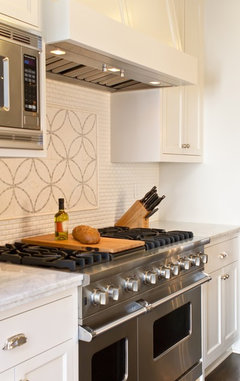
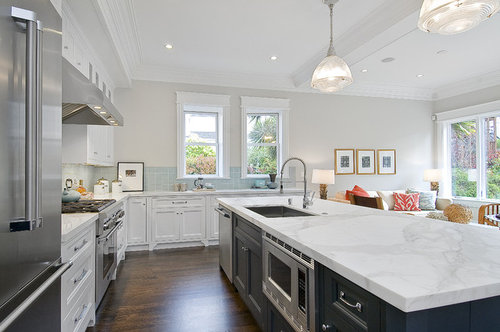
What material are the countertops?
Kitchen · More Info

Comments (30)

  • PRO
    14 years ago
    The kitchen island is honed Calacatta marble with an 1 1/2" thick mitred edge detail.
  • 14 years ago
    The island is Calacatta, though the permiter counters are Caesarstone ' Organic
    White'.
    Calacatta is beautiful and no two pieces are exactly alike, though some homeowners like the flexibility of having a more durable surface that is not susceptible to etching or staining to use for prep work. Caesarstone is about as durable as it gets for countertops.
  • 14 years ago
    Did u need to seam two pieces for island island? What r dimensions?
  • PRO
    14 years ago
    The island is 118" x 42". I had to search for quite some time to find one slab of marble that was large enough to do this in one piece. The other alternative would be to use two bookmatched slabs and seam them in the middle That looks good too.
  • 14 years ago
    I have an island that needs a countertop that is 127" x 46". Any advice or leads on locating a calacatta statuario slab that size? I like the look of a single slab rather than two seamed together. I am in the SoCal area. Thanks.
  • PRO
    14 years ago
    Calacutta slabs are beautiful, but I would consider Ceasarstone for your kitchen. Ceasarstone is manufactured and available in extra large sizes, most likely accommodating your large island in one piece. Marble is susceptible to stains, water marks, chips, and etching. I use marble in other parts of a home only. There are many different shades of white Ceasarstone, also there are white granite slabs available. Granite is also a durable, low maintenance material. Hope this helps. Charmean Neithart
  • PRO
    14 years ago
    I used a white granite in this kitchen called Pearl White.
    Charmean Neithart Interiors, LLC. · More Info

    Sourced it at Marble Unlimited in Van Nuys. Also, another white granite option is Bianco Romano, has a little more color but still looks great in a white kitchen. The
    slab yard I shop at most of the time is Stonemart in North Hollywood, I think your in S. Cal. Huge selection, ask for Kim. Good luck. Charmean
  • 13 years ago
    Do Supreme White and biano Romano granite give approximately the same look as Calcutta marble? But easier to maintain?
  • PRO
    13 years ago
    In my opinion, yes. Bianco Ramano is what I suggest when someone wants a white counter look. I'm not as familiar with Supreme White. I never recommend marble for kitchen countertops.
  • 13 years ago
    I have a kitchen that is awaiting tile for my bianco antiquo. do you have any suggestions? Shelly in Connecticut.
  • 13 years ago
    You should realize what you are getting yourself into when you use marble for countertops. It is much more fragile than granite. That being said, I ended up getting an oversized calacatta gold extra slab that was 134" long so that a 125" x 46" single piece countertop with 1.5" mitred edge could be fabricated. It looks great, but it won't for long and I will have to chalk up the dings as "forming a patina". I don't think that the white granites look like calacatta...but perhaps a bit like carrara goia. Some white granites have a grainy look which is nothing like calacatta or carrara marble. Bear in mind that there is a significant price range for the types of calacatta and carrara. In general, carrara goia is pretty cheap, calacatta statuary is probably double the cost, and calacatta gold is double the cost of statuary. Ironically, I thought that calacatta gold was hugely expensive only to find out that some blue granites make them appear relatively cheap. BTW, I opted to use black beauty granite for my kitchen countertops since they will take more abuse. It contrasts the white kitchen and it has large stone chunks which make it look more like a marble. I had considered using caesarstone but opted for natural stone instead. It bothered me that caesarstone is primarily epoxy. I think that it is 93% quartz, but that is by weight, which means that by volume over half of it is really epoxy. For chemical resistance, it is superior to granite and marble though.
  • 13 years ago
    What's bad about epoxy? Is Caesarstone readily available in the US?
  • 13 years ago
    Caesarstone is readily available in the US, as are other brands of similar composition of quartz bonded in epoxy. Every material has its good qualities and bad qualities. I think that caesarstone would be great for areas that you will beat on with cleansers like in the bathroom. Although some would argue otherwise, I have concerns about using it in the kitchen. Really not a problem in most people's kitchen, but I envision having someone placing a pan directly from the stove onto the caesarstone and melting the epoxy a bit. That really can't be repaired. However, others argue that such a hot pan might also crack a granite countertop even though it won't burn it. Another advantage that caesarstone might have over a granite or marble that has distinct veining is that the caesarstone is pretty homogenous looking...you can use it for long countertops and if you needed to use a couple pieces, the seam would not be noticeable. I tend to like the look of natural stones...just personal preference, and not really based on utility. That being said, I did see slabs made of a bunch of geodes that were embedded in epoxy, and also slabs with fossils embedded in epoxy...both looked really neat, but cost a ton of money.
  • PRO
    13 years ago
    last modified: 13 years ago
    The largest part (by volume) of Cesarstone and many other man-made materials are plastic resins. These are petrochemical products and some of these materials (Silestone being a brand that often does it) contain some pretty potent chemicals - microban/triclosan - to make them "anti bacterial".

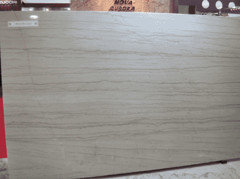
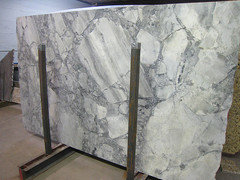
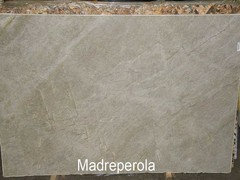
    Many natural stones do not require any sealer and will not react to acids the way marbles do. Soapstone being but one example. If you prefer a white kitchen, materials like White Macaubas, Super White or even Madre Perola will give you a "marble" type of look without the etching issues. These stones are not the typical "granular" looking granites either.

    As far as easier maintenance with marble tops are concerned: If you have them honed (satin finish as opposed to polished), etches will be way less noticeable. Marble has been used for counter surfaces in Europe for many centuries. The main difference between the European attitude towards marble and the American one is, that the Europeans do not expect perpetually brand new looking, shiny sparkly surfaces. They really do not care if the countertops develop a life history of their own.
  • 13 years ago
    Thanks for the information! I would imagine there's a large difference between natural stone and a counter top material such as the Caesarstone, correct?
  • PRO
    13 years ago
    last modified: 13 years ago
    Price-wise you might find, depending on your market, that natural stone and engineered surfaces are around the same price point, with some options like IceStone clocking in at way higher prices than most average granites.

    Performance-wise, I do prefer a well-selected, situation-appropriate natural stone over engineered surfaces.

    In the field of aesthetics: It would depend on your preference. If you like fairly consistent, oatmeal consistency over amazing, natural and one-of-a-kind, natural stone might not be the right choice for you :)

    Whatever you choose, make sure that you and your fabricator are on the same page and that you trust and feel comfortable with your fabricator. Do some research and do not believe the advertising hype. Speak to customers and get word-of-mouth referrals. See installed jobs - not just what is present in the showroom!
  • 13 years ago
    I am using Calacata Calda in my kitchen. My contractor says if we hone it, it will look like the back of the slab which does not show any of the subtle greens in the marble. Is this true? Think I should hone it, but worried it will not look as stunning as it looks polished in terms of the veining coloration. Any input is much appreciated!!
  • PRO
    13 years ago
    It is true that you do not see as much detail in a honed slab but it will not look like the backside of the slab. You can polish the slab and then after years of use it will eventually be honed.
  • 13 years ago
    So, I am wondering if just the perimeters of my 8 ft island will look honed over time and the interior portions that won't get as much traffic will still be polished. Will this look odd? Is there an in between finish called "satin" and would that work? Thanks for your help!
  • PRO
    13 years ago
    That depends on the stone fabricator - they may be able to do a high honed finish. The reason a honed finish is recommended is because marble etches from acid, like citrus juice, tomato sauce, etc. and the honing helps to minimize the marks that will show on a polished finish. You can always re-polish the stone in place, but its a bit of a messy process.
  • 13 years ago
    I used polished calacatta for my island because it looks exceptional. However, there should be a realization that it will look like that for a relatively short period of time before it gets inadvertent etching. I have sealed it, which will add some protection against staining but not etching. Actually, the sealant only extends the time before staining from about 15 minutes to a couple hours. If left overnight, it will stain. Fortunately, I have been able to avoid the stains, but etching has happened. Splashes of citrus juice, vinegar, etc. causes a bunch of etching marks. It is noticeable when looking at the slab from an angle. I don't regret getting polished, since it has a great look and will eventually have a honed look when it becomes etched enough over time. The honed finish does not look like the backside of a slab. It just looks a less reflective like an antiglare coating. It does hide the etching more than for a polished surface. I suppose that if I were to expose the slab to heavy practical use, the honed finish may make more sense. My polished island is not used for really messy food prep. Instead, I use my dark granite countertop for that. I can beat on that and it hides a lot of the wear.
  • 13 years ago
    Thanks for your response! So it sounds like the "etching" on the polished marble is not as glaringly noticeable as I thought??? I am still struggling with what decision to make. Some have recommended a high honed finish which is in between the two. Or I may go with polished, see how it wears over time and if I can't live with it ask my fabricator if I can hone in place....
  • 13 years ago
    It depends. Small minor etches are difficult to spot unless you look for them. However, a relatively large area about 4" wide where someone left some spilled vinegar made the etched area very noticeable. The etched area was still really smooth, but it looked honed. I am not sure how difficult it is to polish a countertop and not damage any adjacent hardware. Most people that get calacatta, against advice as to how it isn't very practical for a kitchen, have a mindset that it will get dings over time and to just accept that fact. I expect my countertops to receive many blemishes over the years and each will have a goofy story about how they happened.
  • PRO
    13 years ago
    Honing will give you a satin finish. Depending on your contractor, he may also suggests using an enhancing sealer, which will deepen the color of the stone. A hone is a lovely, lustrous finish that will not show the etches.
  • 13 years ago
    I had thought of using Tiger Ager since I heard that it provides really good stain resistance, but since it is a color enhancer, I didn't want it darkening the calacatta. Might consider using it on a dark stone, but stains don't show as much anyways on the dark stone.
  • 13 years ago
    I didn't realize Tiger Ager changed the color of the stone. I read this link I found on Houzz : http://www.granitegurus.com/2010/05/experiment-of-etching-marble-part-deux.html. He didn't say anything about Tiger Ager changing the color of the Carrara marble in his experiment, just that it prevented stains better than 5 coats of Bulltet Proof.
  • 13 years ago
    That was an interesting article that I read, too. I think that when I looked online to buy the product, I noticed somewhere that it is a color enhancing sealer which may darken stone a bit, which would defeat the point of spending bucks on a really white stone. I actually ran my own tests with sample pieces of the same stone using varying application times/coats of Miracle 511 and 511 Porous Plus. I tested a wide range of items such as chili sauce, soy sauce, olive oil, etc. Nothing prevented etching. Also, I noticed that the application time for a polished surface needs to be a lot longer than for a honed surface. The sealer seemed to have difficulties penetrating. I ended up sealing for about 30 minutes, keeping the surface really wet in order to soak up as much of the sealer as possible. The good part about 511 is that if part of the sealer dried up before wiping, it can be redissolved by rubbing with a rag that is wet with the sealer. Not particularly difficult to seal, but requires a whole lot of towels to progressively wipe the excess in order not to leave streak marks. I also noticed that although it bought a substantial amount of extra time before a substance would soak into the stone, most things eventually penetrated if left wet overnight. I heard that because the silicone seals the pores that it is easier to remove with a poultice, but haven't had an occasion to see if that is true or not.
  • PRO
    12 years ago
    May i know the dimensions of this room/Area and ceiling height after coffer-ed ceiling added.
  • 12 years ago
    Gorgeous Kitchen! what are dimensions of entire space…including sitting area and eating area! Thanks!