Software
Houzz Logo Print
phdtck1

Are 6" can lights dated?

12 years ago
Is there a difference between 6", 5" and 4" canned lights for a residential space? Specifically for a kitche, dining and living room area?

Comments (17)

  • 12 years ago
    A 6" recessed is capable of using a bulb with twice the lumen output, so you would need half the holes in the ceiling. A 6" recessed is capable of using a brighter LED replacement and dissipating the heat of the driver much better. If you are using low voltage and/or dedicated LED housing, then the answer can be more complicated. If they are going in an insulated ceiling, or are remodel cans, then the answer can change further. Specific usage is important to know. As technology advances, the answers keep changing. It also depends on how much money you want to spend.
  • PRO
    12 years ago
    Yes
  • PRO
    12 years ago
    Stylistically, I suppose so. That said, there is an extensive range of options in lighting and a variety of trims available in all sizes. The first question in lighting is: what kind of light do I need for what purpose. All else follows. Remember that particularly with recessed lighting, it is the effect of light that you seek--not the fixture.
  • 12 years ago
    last modified: 12 years ago
    We switched to the 5" halo for one small subdivision (somewhere over 1000 recessed cans). We rarely use them after that and rarely leave in a black baffle after the home owner sees them. 80- 90% of thousands of recessed I put in every year are 6". The reason is that everyone wants this trim.

    http://www.cooperindustries.com/content/public/en/lighting/products/recessed_general_purpose_downlighting/incandescent/_6_inch_trims/_270275.brands.lighting!halo!recessed!downlighting!_6_inch!_6_incandescent_trims.html

    It does not collect dead moths and other bugs like all the other trims. This is important, especially for squeamish ladies in their kitchens. Without a black baffle, the visual effect is not much different than a 5" trim and the light spreads out better for more even lighting. In the electrical business, once you get out of the showrooms, we classify people into two groups. Those that actually intend to use their kitchen, and those that want a show kitchen. And if you try to rely on under cabinet lighting for more than 30% of the real lighting, people start getting eye strain from it. It is like trying to prepare dinner in front of your car headlights.
  • 12 years ago
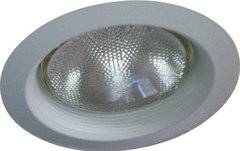
    We generally use this bulb in the trim.
  • 12 years ago
    I used 4 inch cooper halo cans at the suggestion of a lighting designer. Worst mistake ever. The cost of the trims is about twice as much as the larger sizes and there weren't many options for the led retrofit at the time (2 years ago). It seemed ok when they put in the cans, but when it was time for trims and bulbs the price was unbelievable. Also, the light output was minimal, so I ended up using the mirrored trim to help bounce the light. Also, the smaller the can, the less light, so the more cans you need. the result is runway lights on the ceiling and a lot of money.
  • PRO
    12 years ago
    Interesting experience from Fred. Clearly different from ours with the black baffle. We've got the both black and white baffles in live lighting in our showroom. Our customers have chosen the black Halo 5001MB 20 - 1 over the white baffles (which have turned yellow in the showroom). Many thousands sold. To each his/her own, I guess! Mark
  • PRO
    12 years ago
    When considering white versus black baffles on line voltage recessed lighting, we look at whether the client is typically out all day and home in the evening when the lights are on, or if there is a lot of daytime use. I look at line versus low voltage lighting in relation to specific lighting needs, bearing in mind that dimmers are cheap on line voltage and expensive (and made require space consuming transformers) on low voltage lines.

    People who are home during the day may prefer the lighter feel of white baffles, they effectively disappear into the ceiling. But people who are putting in lighting for the effect of the light when turned on quickly find that the glare caused by white baffles draws the eye and reduces the effect of the down-lighting (that they have spent a bundle on). Most people don't know they have alternatives or that lighting is a design world in itself.

    The eye gets used to the black baffles during the day, and the effect of the light at night is dramatic. That said, where we use an adjustable fitting to direct a beam at a work of art or vase of flowers, for example, the room may be fitted with white baffles for a more seamless look. Low voltage lights are used, then, for very specific purposes, usually directional with a beam focused to illuminate an object museum-style and the intensity carefully considered to avoid damage to fragile media such as paint, photographs, paper, fabric, etc.

    Lighting can take a drab interior and give it mystery, or warmth in a cold climate, coolness in a hot one. It can and will destroy colour and artifacts over time--so pay attention to the intensity of the light. The effect can be reduced by increasing the distance between the light and the object, or reducing ambient light, etc. Older people generally appreciate brighter light. This need can be accommodated with dimmers so that you are not frying your artworks consistently ;-)

    In this thread, it may also be worth mentioning that wall washers, pinholes and similar kinds of diffusers can make a large can look like a sleek shaft of light. It's a great topic to explore.
  • 12 years ago
    Mark, try the 30WAT. It does not yellow like the white baffle similar to the black one you reference. I can even paint them with heat resistant paint if I want to match the ceiling better. It is called the 30 super trim on this page.

    http://www.cooperindustries.com/content/public/en/lighting/brands/halo/recessed/downlighting/_6_inch/_6_incandescent_trims.html

    Apparently, my first link won't work unless copied and pasted.
  • PRO
    12 years ago
    Thanks, Fred, for the suggestion.
  • 12 years ago
    What a G.R.E.A.T. thread! So many questions answered and ideas created. Thanks...
  • 12 years ago
    I don't recommend plastic white baffles because they tend to yellow from the heat and the ultraviolet light. A metal baffle should not yellow in the same manner. I think a PAR bulb helps the UV compared to a BR or R bulb because it directs the light in the right direction away from the paint. The other problem I have found with metal baffled is yellowing caused by convection. The bulb makes the air hot and it rises into the fixture causing a steady stream of moisture and solid particles to contact the baffle. This is baked on by the heat. The convection has been reduced to nearly nothing in my experience by using air tight products. I use an ICAT can for almost everything. This in conjunction with an airtight trim could be compared to a double pane window vs. a single pane. Neither the trim or housing are entirely airtight, but close, and the house breathes through the lights causing problems. With the double seal, I have gone into remodels and taken the trims down to reuse them. All they need is a little soap and water most of the time, but too good of a scrubbing can make them need a fresh coat of paint :)
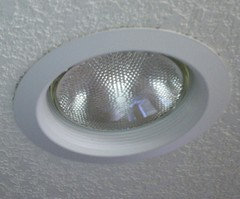
    The one pictured above is 2+ years old and is directly over a stove with no range hood. It has never been cleaned.
  • 9 years ago

    yes, VERY interesting.

  • 9 years ago

    Can anyone help me find Halo trm6tbz trim rings? They seem to be out of stock at the affordable places. Electric supply companies want $25 ea, I need 17!

  • PRO
    8 years ago

    There hasn't been much mention of clear alzak baffles. They tend to disappear during the day, similar to white baffles, and reflect much better. I stopped specifying 6" cans years ago in residential applications in ceilings ten feet or less. They are incredibly dated, oversized, and not at all attractive (of course it's my opinion!).

  • PRO
    8 years ago

    When specifying LED lamps for recessed fixtures, it's all about the Color Rendering Index (CRI). For example, if you can't tell the difference between your navy and black socks unless you bring them outside, chances are you have low CRI lamps (lamps=light bulbs in industry parlance).

    And since LED light is not measured in watts to determine its quantifying amount of light, we use lumens to determine how much light is emitted.

    I've seen some Nora Lighting 4" with a 90+ CRI and 1250 lumens. That's a very high CRI. In fact, anything above 80 is considered acceptable, but the higher the CRI, the better. 100 is perfect. FYI, 1250 lumens is about 83 watts. That's a bright recessed fixture, so you'd want a dimmer.

    Speaking of dimming, LED doesn't become warmer as it dims. Incandescent, including halogen, does. There are several manufacturers making LED fixtures that dim warm, but you pay for it since it requires two sets of LEDs: white and amber. As the light dims, the white electrodes fade and the amber ones increase. I know both Nora and Juno make these, and I'm sure there are others.