

African Violets - Do I dare?
Do you have them? What is the care like? Any tips?
Share your experience! (Photos encouraged)
Comments (96)
 12 years agoWhat wonderful stories! I also grew up with African Violets and have fond memories. I am a hobby grower of African Violets and their relatives. I have several plant stands full of them. Here is a picture of a few blooming African Violet trailers...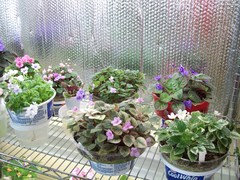
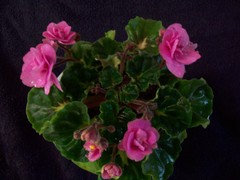
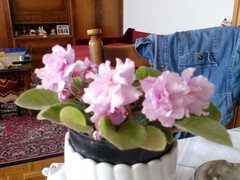
- 12 years agojanefiedler, are the "extras" attached to your main plant? If they are and your plant is a standard, you want to remove them. They are suckers. It's fine if you have a trailer. A standard grows in a rosette shape like this picture.
Related Professionals
Cumberland Interior Designers & Decorators · Bartlesville Interior Designers & Decorators · Fort Dodge Interior Designers & Decorators · Coldwater Interior Designers & Decorators · Sheboygan Interior Designers & Decorators · Salinas Interior Designers & Decorators · San Bernardino Interior Designers & Decorators · Santa Fe Interior Designers & Decorators · Fredericksburg Architects & Building Designers · Boston Architects & Building Designers · Sioux Falls Architects & Building Designers · Modesto Architects & Building Designers · Gillette Architects & Building Designers · Panama City Kitchen & Bathroom Designers · Rutland Kitchen & Bathroom Designers- 12 years agoMy great grand mother grew amazing african violets and her secret in many different locations was to save ALL of your egg shells and keep them in non-chlorine water at room temp. Use this to water from below. Keeping them on a bed of pebbles will keep the humidity at the right level. In her last house she was lucky enough to have a beautiful wide window where her son installed glass shelves and made trays for the plants. Every time we would visit and every time other family members would visit a new violet would appear and we would all go home with a beautiful plant which would immed die.
None of us have any kind of "green thumb" altho her Great Great Great Grand
Daughter seems to be developing one. - 12 years agoWe all seem to love them! I started growing them because of a dear almost-Grandma who always had them. They remind me of her. I buy one with a bloom and keep it moist, but allow to dry on top between waterings. I water with the African Violet food that is liquid, a few drops in a quart for each time you water. You can use it other ways, too. I get beautiful blooms. Just keep out of direct sun! Filtered light and even quite low light will be enjoyed. Over exposure will cause the plant to sort of tighten up, crimping inward and upward, to shade itself. An African Violet, I think, is beautiful when it is sort of reaching out its stems to receive light. I never worry too much about room humidity just because for me it is hard to regulate. I have even rooted a stem in water. Suspend the cutting by putting it through the top of an herb jar cap with large holes, like for oregano. Change water so its does not get slimy. Again, for your AV plant, be careful when days lengthen in the northern hemisphere: sun angles can shed direct rays on the plant and do damage. Have fun!! They are sweet little companions.
- 12 years agoTighter pots will give more blooms through limited root growth. Repot not more than 2-3 years. To repot: Water the plant. Prepare the new pot that has drainage holes that is the next size up with African Violet soil. Make a central hole that will accommodate the base and roots of the plant. An hour after watering, loosen around edge of pot with a popsicle stick or something. Be CAREFUL OF THE STEMS! THEY BREAK OFF BY SNAPPING! Tip pot over newspaper and ease out and hold the base of the plant, being careful not to snap stems as they are not supple. Ease the root ball into the hole and fill in soil gaps with a long thin spoon. Tamp down gently. I use the liquid AV food in my water. Hope this helps.
 12 years agothanks a lot for helpful tips and the Stand for the stand for the pots I admire. My be I ll get it done here in Nairobi Kenya. Very elegant varieties of your collections... Keep it up...
 12 years agoI too love them, and used to have some of the prettiest ones you have ever seen and they even got huge! Several things to watch for are as follows. 1. place in a window area that receives only moderate morning sun. 2. place them ind a deep type saucer and water only from the bottom via the saucer. 3. feed them with the African Violet food according to directions on bottle. 4. Never get the leaves wet, and do not over water, check on line about how often. I would always check the soil with a gentle poke of my index finger to see how wet it was and how deep. If I am not mistaken, I thing if you happen to break a leaf, with proper care you may be able to grow another one. Don't quote me on that part, because it has been a very long time ago that I had them, so I may be wrong about that part. Good Luck. I would start with one health plant just to see how it goes!
- 12 years agolast modified: 12 years agoI believe that African violets do came from Africa – humid, shaded,but light conditions are what they do like; I use to water them always from the bottom and was shocked when my office colleague grew quite a few on office windowsills while pouring water all over them – we all expected that she’ll kill them! But - they grew so quickly, so beautifully.. My late mother grew them for years, too; last addition for her collection developed from the leaf of one of my violets that she loved – pink with lilac spots on ballerina skirt like petals...She complained to me that plant is nice, big and healthy but no flowers..So I told her what I read about African plants: they often live in dry conditions, just about to die, and then, when rain comes they rush to produce flowers, to reproduce...So she asked if they need to be scared that they will die for lack of water – and I said yes. She was not happy, she had many for many years and never heard of this..but she did it. My niece lived with my mum at that time – she called this African violet – wicked violet – ‘cos she wouldn’t flower; mum went for surgery which was postponed – and when she came home -wicked violet had her first flowers! She sat at her pc and immediately wrote to me about it. When surgery was done, just before being released from hospital, my mum passed away. My brother still has wicked violet; I almost killed mine with pesticide spray when she got infested – only one leaf rooted again, and recently I had first bunch of flowers;
One thing I am absolutely sure of: whichever way one waters them it is fine, as long as they don’t ‘sleep with the wet feet’ – not sit overwatered for days. In northern hemisphere they will die from direct sunshine in southern window – everything else is fine; and I use stick fertilizer for A. Violets...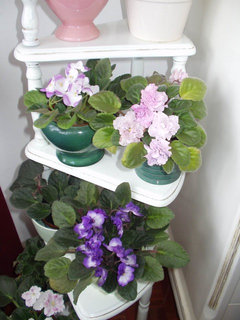
- 12 years agoI have 22 African violets that have been with me much longer than my husband of 12 years and 8-year-old daughter. They are fussy in the fact that they require pretty specific conditions but they are not as delicate as people believe. I have discovered that they will tell you when they are happy where they are by thriving and blooming seasonally or when they are unhappy (too much or too little sun, too much or too little water) by not thriving and not blooming. If they aren't doing well, try moving them or changing their watering regimen. I have found that 2-part African violet pots keep my plants very happy in terms of moisture. The lower glazed reservoir holds water that gradually seeps into the inner un-glazed portion of the pot that holds the plant. The upper portion of these pots is glazed to be gentle on the tender leaf stems that rest on the edge of the pot. Terra cotta pots are too rough for violets - they like glazed pots or the plastic pots they come in from the nursery. I water once a week in the reservoir so the leaves don't get wet and the roots never get soaked. My plants get light filtered through lace curtains from a western facing window. They preferred my old house with radiators but they have adjusted to the drier environment of my new home that has central air and forced hot air heat. If anything, I might water them a bit more if they appear a bit floppy. I found a great book that gave instructions how to deal with leggy plants. Basically, I unpot the plant, I prune off any excess leaves, cut the stem leaving an inch or two to go under the soil, scrape the dry, corky surface of the lower stem to promote root growth and stick it in water to start roots growing. When the roots are established after a few weeks, repot in new violet soil. I sometimes keep these transplants covered by a cloche or glass dome to give them some extra humidity while their new root system is getting established.
Violets aren't a huge investment and they are so cheerful blooming on a window sill. Good luck! - 12 years agoI had an older gentleman advise me to water them by taking your empty milk jug that you plan to recycle, rinsing it, and without throwing away the water, use it to water your violets. Mine seem to like the milk remnants (calcium?) a lot!
- 12 years agoI have had violets on and off for over 4 decades. I would say there are micros, mini's, smalls, and full sized, and I've seen some 'cascading' too. Some varieties of micros can be stunted to a pot not much bigger than a thimble, with reservoir of course and a wick; and will bloom... I have had full sized ones in sherbert containers, the old plastic ones that held a few quarts... and everything in between. Most 'full sized' ones will give a leaf 1.5 to 2.5 inches long and do well in a 3 to 4 inch pot. They will bloom once they are a bit rootbound.
Bottom water always. Easiest way to keep them happy is to put them in a reservoir pot with wick or onto capillary matting, with only ONE drain hole having dirt protrude to where it makes contact with the matting. Best lighting ever was fluorescent double fixture with one cool white and one gro bulb, at 2" over the plant, 12 hour days. Give a formulated African violet food once a month, I would mix it then use an eye dropper to slide it in between the leaves and give 4-5 bulbfuls to each one.
Next best is bottom water with a saucer at least one inch deep, give it 0.5 to .75 inch of room temp water every three or so days. Not direct light, sunny window will burn them. In winter (October to end of March) they go in a western window that gets 2 or so hours of low west sun and lots of bright light; then I have to put a bit of something to filter it (sheer curtain) Always keep them from touching the glass. If it's very cold out it can freeze leaves, if it's very hot it can burn the leaves.
I have had dedicated shelf unit with capillary matting and lights; and one stint where they were put in a dedicated 'fish keeping' room and lived for several months with just the humidity (dripping almost) in there.
if you're getting mushy limp jelly like stemmed leaves, that is too much water or pot standing in water too long (waterlogged roots). Water on a leaf will cause it to spot. If you get some on a leaf take a small bit of paper toweling and touch it to the leaf to wick up the water. Edge of the toweling will pick it right up. Pale leaves are not enough sun or too much water or they could use a little fertilizer (that is your last choice to try). The 'milk rinse' 3boysful mentions is a way to perk them up, I don't do it often because it can draw the micrognats and things of that nature. Make sure the water isn't too "white".  PRO12 years agoWhat an interesting discussion. Also shows why people looking for information on growing any kind of plant, not just African violets, get very frustrated -- there is so much conflicting information. The people who wrote on this thread had all sorts of experiences: bright southern windows to indirect light to all-fluorescent, water from bottom or on top of soil or under the shower; water when they are so dry they wilt to keeping a reservoir full so that the soil stays wet; and on and on.
I think this is proof that plants, at least the ones that are commonly grown in people's houses, are incredibly adaptable, and if you have the good fortune to get a strong individual, it will adapt to almost any cultural practice. The other point is the "strong individual." Not all "African violets," or any species for that matter, are going to be the same. There are different varieties, and different cultivars, and within one cultivar there will be some individuals stronger than others. Not to mention the different cultural practices by different growers will result in plants that are stronger or weaker.
I suspect that the reader from Singapore, for example, may be having trouble with African violets not because of the climate or light in that part of the world, but because of the quality of plants they're getting.
The best advice is to move plants around and try different watering, light, and so on, until you find what works for you. Or if one kind of plant is just no making it, try a different kind.
And never forget, the way to a green thumb lies through a big garbage can. 12 years agoI got one plant from my MIL (she loves them) and I put it on the counter, next to the kitchen window. It has indirect light. I know they are a bit like orchids, which I have quite a few; they want indirect light and not over-watered. After about 2 years, the plant got to large and I had to split it. Once it bloomed, I realized that there were actually two plants in one (one was purple while the other pink and with different looking blooms). Now they are both pretty large and they bloom constantly.
Plants, in general, will adjust, but we need to find the right place. I have a Calathea with elongated leaves and one with rounder leaves. They are next to each other. The one with the elongated leaves is doing really well, while the other died twice (yes, twice; I was ready to throw it out when I saw something green underneath). I don't know if it will come back to life again, but I'll have to wait and see. The same is valid for outdoor plants. I have a bench with two pots at each end. I usually plant the same plants in each pot. One always has the plants larger than the other.That one probably gets a little bit more sun, but not that much. PRO12 years agojust add them to your list of flowers you've killed ;) they are on mine ! black thumb for life !!! i now just stick to cacti and the like. i've been able to keep an aloe vera plant alive for over a year and am SO proud :)) i compromise and have PICTURES of flowers or even a SOFA with a floral pattern. xoxo eva
 Totally Custom · More Info
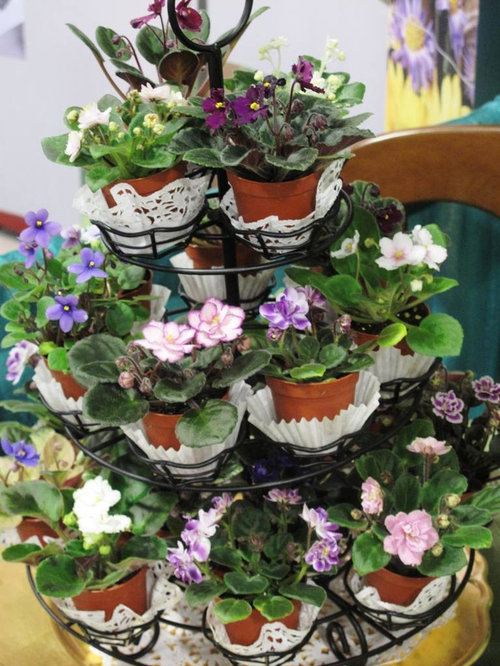
- 12 years agoI am loving that plant stand in the first picture. Does anyone know where something like that could be found? I like the idea of having a bunch of violets and keeping them altogether. My late Aunt Mary always had a few violets; I had forgotten about that. Good memories.
- PRO12 years agolooks like a cupcake stand to me ;) i don't know, could be wrong. xoxo eva @ thesofaworks.com
http://www.crateandbarrel.com/3-tier-cupcake-stand/s408843?a=1552&device=c&network=g&matchtype=&gclid=CLaIx96vkL0CFUiEfgodVmMACw - 12 years agojanefiedler, if it's a trailer like the ones in my first picture (someone above used the term "cascading") then they are fine. If yours is supposed to be in a rosette form like my second picture, the suckers should be removed. They will ruin the symmetry of the parent plant. You can actually detach the suckers from the parent plant and pot them up to make new plants if you want. You will see a small rosette forming on the side of the stem (main stalk of your plant), that will be your sucker. The sucker should have at least four leaves and measure about 1 1/2 inches for removal if you want them to survive. Plants will sucker from time to time and some varieties will sucker more than others. Excessive suckering can either be the result of poor culture, damage, or disease, or if they are pushed to their peak of growth and flowering. I hope this information helps you with your beautiful plant.
- 11 years ago
My mom had at least 50 African Violets and she always watered from the top. I grew some from cuttings and misted them daily. The leaves loved it. Just imagine the jungles of Africa where they are native plants. The leaves are constantly getting wet.
 11 years ago
I've had lots in the past. Easy to grow in a bright spot without direct sun or just early, early morning sun. I just watered slowly from the top by separating two leaves a bit so the leaves didn't get wet. Then let them dry before watering again, like nearly every houseplant likes. I think I used to mix a fair amount of perlite in my potting soil for African Violets to keep the soil light. Use a plant food with a high blooming number - I can't remember which of the three numbers that is.
- 11 years ago
You are all most cordially invited to join us on the Garden Web topic African Violets. We would love to have you there! Joanne
- 11 years ago
Perlite is a plus for sure. I recently read that you could soak egg shells and use that water for plants. Also, a thin layer of used coffee grounds on top of soil.
I give my African violets diffused light if I am not there to just give them some direct east sun early in the morning and then move into indirect light. I do water from on top, but do not get water on leaves for aesthetic purposes. I do use the liquid food because it is safe and easy to use. I so let them dry between waterings, too. I am currently waiting for blooms. - 11 years ago
It is best to have a draining tray or shallow dish under African violets and to add a small bit of water to the tray/dish and have the plant and soil draw up the water as needed. However, once in a while I water from the top, adding just enough to make the surface of the soil a bit moist. If the water does run through to the tray/dish, I pour out the water except for a depth of one-fourth inch. Whenever I want to rinse out a cup/container that has a bit of coffee, tea, milk, or orange juice in it, I pour in some purified water and then use this diluted liquid to water plants. I do the same with vegetable juices from green beans, peas, corn, and so on as long as they do not contain salt. The acid, vitamins, and minerals from the food substances make excellent plant food.
 11 years ago
Home Depot/Lowe's have special pots for African violets - no worries about over watering. Buy one of them and you will be golden.
- PRO11 years ago
I totally agree with most of the above comments involving watering, except for a couple of points. I've read of using diluted milk not only as a fertilizer but also as a foliar spray, but I just can't get past the possibility of bad smells from souring milk. Apparently many people use it successfully, it's just not something I want to do.
But regarding watering, soil doesn't "draw up water as needed." Water enters the soil whenever there's room for it in the spaces between the particles of soil; in other words, soil tends to remain completely saturated if there's a constant supply of water to enter it. If your plants are doing well, it means that the soil is not staying completely saturated all the time, that it is getting sufficiently aerated that the roots aren't drowning. It can also mean that the roots in the bottom of the pot, where the soil is constantly wet, are all gone, and only the upper part of the soil, which has the opportunity to dry out, contains viable roots. However, if your violets are looking good, keep on doing what you're doing.
Finally, there's no such thing as a special pot or "self-watering system" that will ensure you will have no worries over watering. You still have to remember to fill the reservoir, if that's how the system works, and you still need to check the soil moisture throughout the depth of the pot, if you want to be good with your plants.
- 10 years ago
to those who are growing AVs in tropical areas, I advise you don't open your windows to often. Put them on any window except west or east facing ones. Water only when needed (I usually do it when the leaves become droopy) if you are planning on planting indoors with air conditioning, use plastic pots (The clay becomes cold and then the leaves laying on the clay will rot) I grow a couple, and they are starting to bloom. They are in clay pots though so I think I might repot them after they finish blooming to a plastic pot. I don't put any fertiliser on the plant but i think i might begin to.
- 10 years ago
JTA -
I think all of the participants including you will benefit from reading a good book on African Violets. My preferred author is Melvin Robey. Some of his classic books are getting published again and are available on Amazon. Again - Joanne invited everybody to participate in the discussions on African Violets part of this forum.
PS. If you put an AV on a southern window - you will burn the leaves. E and W directions are preferred. Plastic pots are better than clay - not because clay is so much colder - but because clay is porous and accumulates salts when water evaporates from the surface. Direct contact with a salted surface burns the leaves or leaf stalks when they touch the rim. You do not wait until the leaves become droopy to water the plant. You water before it otherwise you kill the hair roots and compromise the plant. You fertilize your violets all the time with a very weak solution - usually 1/2 of what is recommended on the bottle is a good guess. You give them a month or 2 break after you repot them - because the AV soil comes preloaded with a slow release fertilizer and you give the plants time to use it up.
PPS I do not want to step on your toes. Your ideas come from an observation and intuition. But... it is already in a book.
 8 years ago
Interesting to read this old post. Not so old really. Seems like most people have a nice memory of someone they remember that grew violets. Rosie
 8 years ago
Those are beautiful I don’t have none at the moment u can take a cutting stick it in a glass of water it will root
 8 years agoI’m attempting to grow my first African violet plant. My plant is situated in my kitchen on the east side window. I love love all the tips given here. Any additional tips?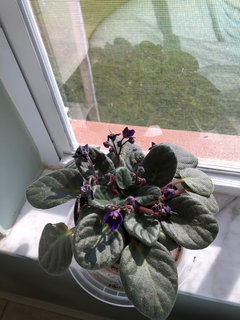
- 8 years ago
I have discovered something for propagating: I purchased a jar of rooting hormone. If I by accident snap a leaf off the AV plant, I let it sit for a day, wet the stem, and dip it in the rooting hormone powder. Then I plant it in either vermiculite or AV soil. Water as needed.
For my mature plants, I make a mixture of the liquid AV food. It is meant to be used with each watering. No fuss, just keep a small keg handy.
- 8 years ago
Why do you let it sit for a day instead of giving it a fresh slant cut, dip in powder and planting immediately? Rosie
 PRO8 years ago
they always make me think of the movie, Amistad and my high school boyfriend who always bought them for his mother.
- 8 years ago
I let the cutting sit because I read it somewhere that I should do so. It allows for some callous to build up. A guess it gets a tougher skin to take the rooting hormone and the pressure of being put into the soil. By the way, very light watering if at all the first day.
- 8 years ago
I have heard some people let them sit a bit after cutting and before planting to develop the "callous" and others, like me, plant right away. I do that because of time. I don't know that either is right or wrong.
Any suggestions or thoughts anyone? Rosie
- 8 years ago
No luck with African violets myself; tried them, probably over watered them; they died.
I live in planting Zone 7 and the yard is full of "violets" every spring -- blooms are white; purple; white & purple; white & lavender.
https://en.wikipedia.org/wiki/Viola_(plant
If the African violets don't grow well for you, try the other kind.
- 8 years ago
Or you could learn to grow AVs..they're not really difficult if you know the basics.
- PRO8 years ago
Most people don't recommend letting the cutting sit before planting - as far as I know, that mainly applies to succulent cuttings. Although I'm sure there are people who let their AV cuttings sit before planting, if you look at a bunch of articles talking about starting them, no one advises the sitting.
- 8 years ago
I didn't think so and I was taught to cut and plant. I just wondered if anyone noticed a difference in the two methods! Thanks for the input TFW!!! Rosie
- 8 years ago
Yes, It may be best for succulents only. Try both ways. also, i noticed a great AV in my doctor's office in sun! It was facing northwest and was about 6' back from window. I couldn't believe it. They do need a good deal of light, but ideally filtered. Too dark they don't get blooms.
- 8 years ago
Some AV people do advise letting them sit dry to avoid bacteria. I let them dry slightly and dust with Rootone. If I get leaves mailed that to me that arrive a bit wilted, I rehydrate them for 24 hours or until they are crisp again. Then recut them, let them dry a bit before planting. I also place them in an incubator, or see-through box covered with clear plastic wrap, leaving a small space for air. There are videos on You Tube. Joanne
 6 years ago
I know this post is old, but I have to chime in... can everybody please stop giving advice as to the best situation or window... this depends entirely upon your latitude - how close to, or far from, the equator you are. A sunny southern aspect in Northern Canada is entirely different to a sunny southern aspect in equatorial Ecuador. And that's just the Northern hemisphere... don't forget to reverse your north and south when speaking to the other hemisphere. And an arid dry climate with high UV and no sheltering trees or buildings is different to a dry arid climate with sheltering trees and buildings. Consider the micro climate that your whole house is situated in, as well as individual rooms. Apart from obvious basics, plants are like people, what one violet likes, another may dislike, depending on genetics and former culture.
Do use your senses, and also your common sense, when deciding on placement. I have an AV book written for Britain - I live in the Australian desert - so a certain amount of 'translation' and adjustment of light requirements, potting media etc, is obvious.
- 4 years ago
I enjoyed reading this thread
interesting how these plants adapt … even in my own home from one season to the next i have learned to change my routine
air conditioning in summer and direct south sun and glazed ceramic pots and bad soil was a bad recipe for me (powdery mildew) soil didnt dry fast enough
i lost my most beautiful AV, and i am still mad about it lol
i went back to nursery pots, use the pretty glazed pots as cache pots only, i water less in summer due to my home being air conditioned and then wood stove heated in Wisconsin winters (dry and toasty in here) means i water more in winter but i fertilize year round with Optimara or with dynagro ”grow” formula
i move them off to the side of the south window so they get some early morning direct sun or late afternoon direct sun and bright indirect sun all day
one thing to add:
pot size should be 1/3 the size of the total width of the plant they are also shallow rooted so if your plant leaf edge to leaf edge spans 6 inches, you should be potting it in a 2 inch pot
the roots grow out to the side more than they grow downward so shallow pots are ideal provided you have proper soil and drainage
i also make sure their stem sits a little higher in the pot so that their leaves arent sitting on top of the soil and there is more room for air circulation (the crown sits just above the soil surface)
Each row of leaves produce a set of flowers only once according to what i read
i pinch older lower leaves periodically
one girl said she pinches the leaves in the center of the crown if it gets too crowded and when she does she gets profuse blooms i havent tried it yet… I’m just too scared lol
i use al taplas 5:1:1 mix and they are happy in it and growing well, i had terrible luck with miracle grow soil (even their african violet soil but i also had glazed ceramic pots) or anything homemade with vermiculite - it was far too dense
mine bloom regulary, i top water rain or distilledwith a medical grade squirt bottle on the soil only but if a leaf gets wet i dab it with paper towel the only time its been an issue for me is in the summer if my home is too humid or too cool for the leaves to dry up …. i think the key is how fast are those leaves going to dry in your climate?
i have one AV in a closed terrarium and her leaves get wet all the time shes happy
she is the one i successfully propogated with a leaf cutting placed directly into straight chicken grit and then positioned her in an east window… took a few months but then to my surprise i saw the growth … from there i transferred her to a closed terrarium so dont tell me their leaves cant get wet lol
i didn‘t let the leaf harden off before propogating but i made sure it was a healthy leaf and not a ratty one in decline
another that i repotted sent me an offshoot i just discivered so now i have another plant
they are finicky but once you understand their needs they are very rewarding and i welcome their beautiful blooms in these dreary wisconsin winters … they are my winter blues antidote
my late mother grew beautiful african violets and i inherited all of her beautiful plants years back and unfortunately i killed every last one of them (overwatering and bad soil and inexperience at a younger age) i’m still recovering lol
theres something about nurturing plants that is very rewarding, especially in these crazy times we are living in















halbanes