Software
Houzz Logo Print
lwarren2_gw

Constructing raised bed with bottom to avoid root invasion

16 years ago

Hi -- We have dismantled our raised garden bed because tree roots have invaded it. We want to make another vegetable garden in the same area but want to have a bottom on it to prevent tree roots from getting in again. I'm supposing the whole garden will have to be elevated off the ground by some means (cinder block)? I'm looking for ideas. If we're going to do this, we want to do it out of materials that will last; don't want to have to do it again in a few years. Thanks for any ideas ...

Comments (22)

  • 16 years ago

    I don't mean to sound negative but I'm not sure that there's much you can do that will have any lasting effect. What I mean is that I've seen on many occasions tree roots lift concrete sidewalks and asphalt right out of the ground. You may be able to slow them down a little but it's doubtful you'll be able to eliminate them all together. If there's moisture the roots will get to it. I wish I had some positive thoughts for you.

    Greg
    Nevada

  • 16 years ago

    I was thinking the same thing. I also wonder if there will be enuff direct sun to grow a garden in this spot?

    Maybe containers would be better?

    The site at www.squarefootgardening.com does or has shown a bed which was elevated right off the patio. The idea was to make something for people in a wheel chair.

    HTH

    Here is a link that might be useful: www.squarefootgardening.com

  • 16 years ago

    As others have said, it will not work. You must have drainage holes, and through those holes hair roots will penetrate and enlarge. Having roots from trash trees in one of my gardens, I dig a trench along the side where the trees are, and cut or chop any root I encounter. Not good for the trees. Have your ax, your hand saw, and your spade around for this job, and do it in late winter or whenever the ground is soft.

  • 16 years ago

    I'd rent a trench digger, which have basically a giant underground chain saw blade, to sever the roots near the edge of the garden. Then pull them out with a spade and pry bar. Repeat every couple of years.

    I'd only cut the roots, whether by hand or by machine, in a straight line at least 20 feet from the trunk, farther if the tree is very large. Otherwise you risk severely damaging or killing the tree.

  • 16 years ago

    After trenching, as suggested by glib and nygardener, it also helps to put a root barrier in the trench. I hear you can purchase products designed for this purpose. Or alternatively, you can find a suitable substitute. I've used plastic 12 inch wide siding material cut into 14 to 15 inch segments. These were overlapped and burried in my trench at a 14 to 15 inch depth. This seems to be working fairly well.

  • 16 years ago

    In response to "Glib", I totally agree about roots getting through any drainage holes and that is why I'm looking for a way to elevate the entire thing off the ground. I looked on the square foot garden website recommended by "gumby ct" above and saw that they sell legs for their wooden boxes. I would like something like that only on a larger scale, deeper boxes, and out of material that won't rot. We live in S. California and my husband is against the large (100 gal.) Rubbermaid tanks because he's afraid they'll get too hot; they're also a weird shape. He's thinking he'd like to use cinder block. Cinder block could support a bottom ... but what sort of material would last for a bottom? Galvanized water tanks is another idea I saw, but again, my husband saw where someone said the metal gets too hot. He's also worried about the zinc in galvanized metal corroding and dissolving and getting in the veggies. We haven't found that perfect solution yet ... if there is one ....

  • 16 years ago

    the only way that will provide some answer and then it depends how experienced the people are who install it, is to put in a root barrier between where you want the garden and the offending tree. this is like a rubberized sheet placed into the ground, they usually use a water jet to cut the trench.

    i would suggest it is not going to be cheap so try to research those who install them to be sure you ge the best installer, ths one is not a DIY job.

    or no garden at all is the way i see it.

    len

    Here is a link that might be useful: lens garden page

  • 16 years ago

    Redwood is pretty resistant to rotting but even that will eventually fail, and it's also expensive. Builders supply stores also have square foot concrete pavers that you could lay down and you could build a box on top of them, but then you'd still have problems with the roots coming through the cracks between the pavers. It's going to be tough to find something to build above the ground that's going to last very long. Does the tree absolutely have to be there, or can you put a little garden in somewhere else on the property?

    Greg
    Nevada

  • 16 years ago

    You could always pour a concrete slab and then build a box out of cinder blocks or some other type of block. This would eliminate the roots coming up from the bottom and a wooden box from rotting.

    Greg
    Nevada

  • 16 years ago

    On the hosta forum people suggest using spin out bags to plant hosta under aggressively rooting trees like silver maple. Perhaps you could modify these and use these to line your bed.

  • 16 years ago

    -- Cinder block could support a bottom ... but what sort of material would last for a bottom?

    Trex is a brand name for composite decking material that is not supposed to decay. It is a little pricey but will do what you are looking for.

    Here is a link that might be useful: http://www.trex.com/decking/

  • 7 years ago

    Ok I'm curious kgbrn how much did that setup cost?

  • 7 years ago

    No one posted a REASONABLE solution. We have eucalyptus small but evasive roots strangling our garden beds. Cant we just put bottoms on them drill a few holes for drainage and then lay the new solid bottoms on a layer of weed cloth and an inch of gravel? or will this still not work ?


  • 5 years ago

    I had in-ground garden beds (made from trex) that were invaded by tree roots. I dug out the beds and sifted the soil to get rid of the roots. I then put down cinder blocks, 9 in a 4'x4' garden bed, with their top surface level with the top of the in-ground beds. I then put down two layers of 1/2" cement backerboard which is supported by the top of the cinder blocks and perimeter of the in-ground garden bed. I drilled drain holes about every 12" in the cement backerboard. Now I have a 16" air gap between the new bottom of the garden bed and the old bottom of the in-ground garden bed. I build a raised garden bed perimeter and set it on top of the cement backerboard. I'm hoping the tree roots won't reach up through that airgap into the new garden bed. We'll see... Don't use the Hardie cement backerboard that has grooves to help you break it to size. I tried that first and it broke at some of those grooves. Dug out beds and used thicker double layer of cement backerboard.

  • 5 years ago

    How is the garden bed working out for you so far?


  • 4 years ago

    I think I will give up..The Cotttonwood overpowers me!!!!

  • 4 years ago

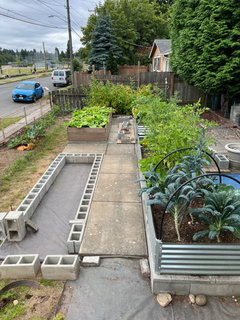
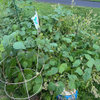
    Update: We are finishing the last raised bed (serious pandemic slowdown on construction projects). Here's a picture of the 3 very productive beds and the last one in progress. Truly, creating an air gap under your raised beds is the only way to stop tree roots permanently. It's not expensive if you use cinder blocks and galvanized corrogated roofing for lining and a kit for the actual bed (see original pictures above). The wooden one on the left is from Trex, but these were recycled from the original beds that sat directly on the ground, so no added costs there. The investment is in the manual labor.


  • 4 years ago

    S Glanz, no, you cannot layer any kind of material directly on the ground and expect tree roots of any species to not find their way up into your beds. Tree roots will break right through landscape fabric, grow through drilled drainage holes, etc. Unfortunately, there is no "reasonable" way to win over Mother Nature. Maybe you could try using large pots and galvanized agricultural troughs and transition to a totally above ground solution. Still, the troughs and large pots need to be raised a bit off the ground. I use bricks under troughs and decorative risers for large pots.

  • 4 years ago

    Thanks for your feedback, that is not what I wanted to hear necessarily, but very helpful.

  • 2 years ago

    Im useing horse watering troughs they are cery deep gavinized metal set them on cinder blocks not on ground I drill holes in bottom for drainage if you set on grond roots will get into drillholes

  • 2 years ago

    The plantsin your garden's roots will go deeper then you will ever build. Stopping tree roots also means stopping garden roots. I have this issue and when I find tree roots pull them out. A pain but I do it 1-2 times a year. Tree roots can raise concrete so stopping them is difficult. i would not bother with it.

Sponsored
Urban Upkeep LLC
Average rating: 5 out of 5 stars6 Reviews
Columbus High Quality Painting Expert