Software
Houzz Logo Print
ongrosa

Orchids - Dendrodum Nobile

11 years ago
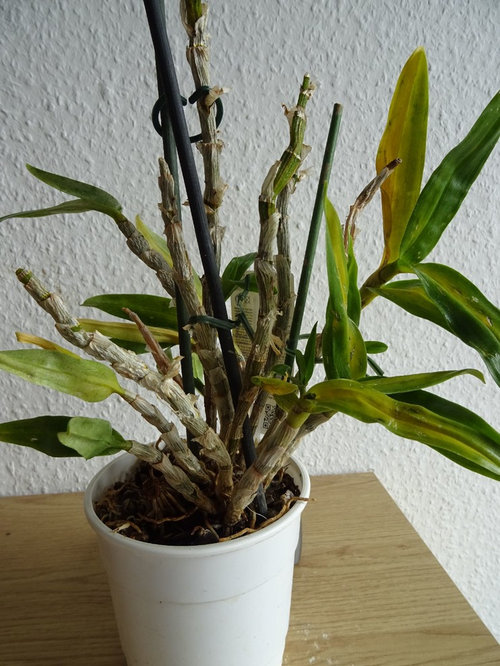
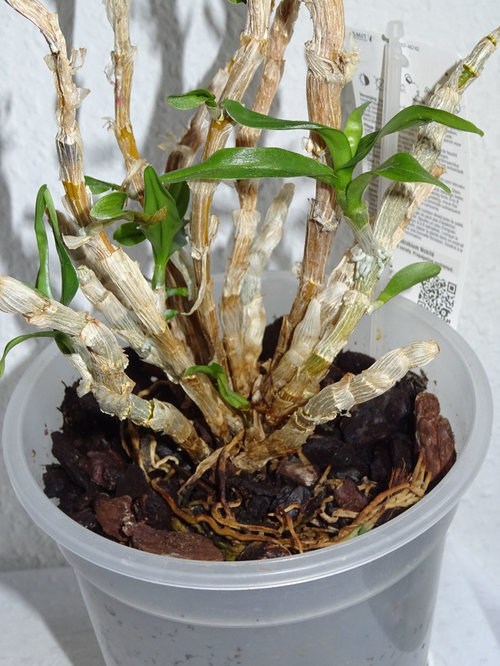
My Dendrobium Nobile hasn't bloom for 2 years.

All the leaves has withered after being infected by scales since 2 mths ago. Also, I have repotted the plant with new mix being afraid that their might be more pest hidden in the old mix.

From the 2nd picture, it is the present status of the Dend. Nobile. New leaves are emerging from all sides of the stems and I am wondering if it will ever bloom again?


Comments (8)

  • 11 years ago

    arthurm2015, thanks for your advice of yesterday. You said that the winter daily average temp. required is 7 - 17°C. and a lot of light. Unfortunately, my room temp. in the winter is max. 15°C, that is if the winter isn't severe. Also there aren't so much of lights in the room here in winter. Can that be the reason why this Dendrobium Nobile isn't adaptable to my room temp.

    And I am giving the feed in the same way as the other Phals. Once weekly in the summer and once per 3 wks or 4 wks in the winter.

    I took the advice of Bill to look into the American Orchid Society and it says -

    Group 1 Species such as Den. chrysanthum, Den. friedricksianum, Den. nobile and Den.wardianum

    "Culture Growth period in summer; give warmth, water and fertilize heavily from when roots appear until top leaf appears on canes. Then give high light, little or no water, no fertilizer, cool nights (40 to 50 F). In other words, forget about them."

    At present, the Dend. is placed at the south window where there isnt so much of strong sun (though it is bright) as in my east window. I am still giving fertilizer weekly.

    I need to know, should I move the plant to the east window to get more light, and do I continue to fertilize or forget it?

  • 11 years ago

    Bill, thanks for your advice of yesterday.

    You mentioned that -

    "Nobiles are prone to producing Keikis on old canes, and that's ok. Leave them on and let them bloom then remove them and pot up as new plants."

    When do I remove the Keikis? From the photo as you can see only 1 set of the leaves has roots emerging, like half a centimeter length which I think still look so fragile to detach them from the mother stem.

    I dont understand what it means to give 30-10-10 fertilizer or Nitrogen fertilizer...use 10-10-10?

    I dont understand with this kind of ratio fertilizing.

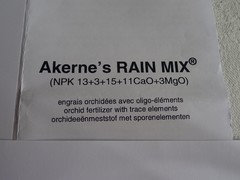
    At present I am using Akerne's Rain Mix which I bought it since 5 wks ago, and have been giving this feed regularly once or twice weekly. Hope I am not over fertilising the plants?

  • 11 years ago

    Tks Kivi. The potting looks soggy because I made the picture after the watering. Yes the plastic pot has many holes in it and esp. with this Dend. I let it drain dry overnight before placing it in the container. We have now in germany very warm temp. Already for 2 wks have been 28 - 32°C. My room temp. is 25 - 28°C. Yes, I do move my plants outside (in the balcony with east rising sun) but not in the past few days with the sun so strong that I thought it might do more damage than good.

  • 11 years ago

    Ginger, We old folks who have been playing with plants most of our lives do sometimes take shortcuts with the things we say, and how we say them, not always realizing that lots of folks just getting started , or dealing with a different language, sometimes don't have a clue what we are saying......I'll try to do better.......☺

    Keikis on Nobiles.......The Nobiles love to grow with their roots all bound up in a mess. (Root bound, or pot bound) For that reason I would always leave my keikis on the plants until after they bloomed....having the extra blooms on the plant added to its beauty. The keikis usually did not bloom until they had at least two canes, and a nice set of roots hanging out in the air near the top of the mother plant. After they bloomed, and the new growth was maybe an inch long, you can pull or cut the keiki off the mother plant and pot it up in its own pot. That way you have a new blooming size plant with a good root system that is just like its mother.

    Now, fertilizer....You are in a different country, so the packaging and labeling on your fertilizer may be a bit different from what I am accustomed to, but here is what I meant when I throw the analysis numbers around (30-10-10 or 10-10-10)

    These numbers are part of the analysis of the fertilizer. The analysis tells you exactly what is in the fertilizer, and how much of each ingredient there is.

    In the US the ingredients are usually listed in descending order of the amounts, so the three primary elements in the fertilizer are listed first, with the amounts of each contained In the mix given as a percentage.

    The first three ingredients are Nitrogen, Phosphate or Phosphorus, and Potash, or Potassium. The amounts of each of these elements contained in the particular fertilizer are listed as a percentage.

    In orchid growing we tend to use fertilizers with two analysis more than any other.....(30-10-10, and 10-10-10) These numbers represent in order, the percentage of Nitrogen, Phosphate or Phosphorus, and Potash or Potassium contained in the mix.

    We know Nitrogen makes foliage grow, so if we want to make a plant grow and be pretty and lush green, we give it more Nitrogen. We also know that when a plant is growing rapidly, it does not like to take the time to bloom well, so if we want to slow down the growth so as to induce blooming, we usually change to a balanced fertilizer (10-10-10) as the growth matures and bloom making begins.

    There are many many different fertilizers with different analysis, and many different things one can do for plants by changing the type of fertilizers used, but this is the basic.

    I am not familiar with your fertilizer, but we usually tell people to use any fertilizer at half the recommended strength, and no more than about twice a month at maximum. You have to know something about where your plant, or its ancestors grew in the wild to know when to feed and what kind of food to feed. It does sound like you are feeding a bit heavy. We usually feed Nobles with 30-10-10 in the spring/summer, after the blooms are gone and while they are growing. In the late winter early fall change to balanced 10-10-10 or even no fertilizer at all, and reduce the watering and give them a hard chill to make them bloom. After blooming, almost no water and cool until new growth begins, then back to lots of light, warmth, water, and 30-10-10 Fetrt.

    Hope this helps.

    Bill

  • 11 years ago

    Thanks Bill for the very well explained chemistry. I have had googled some
    articles about orchids fertilizer and never understand the analysis ratio. But
    now I have understood very clearly. I thought I am so stupid to understand this chemistry but not so stupid
    after all!
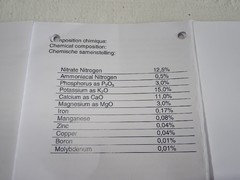
    The Akerne's Rain Mix fertilizer is a MSU fertilizer of the Michigan State University. It was since 5 weeks ago, I ordered it from a UK supplier, attached with a very simple print-out paper that described this as a well balanced orchid fertilizer, and with recommended dosage of half gram per litre at every watering. I attached 2 photos of the description of the article.

    As you think the feed I am giving is heavy, so should I have to look for another fertilizer? Previously I was using the german liquid fertilizer that is shown as 5 - 4 - 6 and recommended dosage was 25ml liquid fertilizer added to 2 Litre of water.


    Now about the keikis, as you can see from the photo, only 1 set of leaves has roots of about quarter inch long. Should I wait till the roots are longer to detach it from the mother plant, or can I wait for the other keikis to emerge with roots?

    As described in the American Orchid Society culture sheet -

    Group 1 Species such as Den. chrysanthum, Den. friedricksianum, Den. nobile and Den.wardianum

    "Culture Growth period in summer; give warmth, water and fertilize heavily from when roots appear until top leaf appears on canes. Then give high light, little or no water, no fertilizer, cool nights (40 to 50 F). In other words, forget about them."

    The question is shall I move the Dendrobium to the east window where there are more strong light and warm, and heavy fertilizer?

  • 11 years ago

    Ginger, you can use either fertilizer you want to. While the Dendrobium is growing, it needs to be fed.....When it Is dormant, you can cut the fertilize out if you want to. I am basically telling you how I was accustomed to growing Noble type Dendrobiums when I had my own plants, and was working at a greenhouse that sold them. There is no single way to grow orchids or any other plant. You are in a different climate from me, so you will have to modify what I say to more conform to your conditions.

    As far as the Keiki's are concerned, I normally left them on the mother plant until after they bloomed. You can take them off any time you want to provided thy have enough roots.

    " Keikis on Nobiles.......The Nobiles love to grow with their roots all bound up in a mess. (Root bound, or pot bound) For that reason I would always leave my keikis on the plants until after they bloomed....having the extra blooms on the plant added to its beauty. The keikis usually did not bloom until they had at least two canes, and a nice set of roots hanging out in the air near the top of the mother plant. After they bloomed, and the new growth was maybe an inch long, you can pull or cut the keiki off the mother plant and pot it up in its own pot. That way you have a new blooming size plant with a good root system that is just like its mother."

    Give the plant as much light as you can without burning it. feed it while It is growing, and either reduce feeding it or stop feeding it when it is dormant. Your choice.

    Bill

    Ginger Groenendijk thanked Bill
  • 11 years ago

    Thanks Bill for your advice.