
Search results for "Accelerated" in Home Design Ideas
 Tile Doctor Ltd
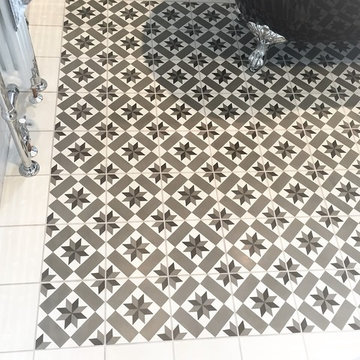
I’m often asked if you should seal a tile before grouting and the answer is a definite yes, and this Encaustic Cement tiled bathroom floor installation in Stockport is a great example as to why. The tiles had not been sealed before grouting and then, once the tiler went to grout the newly installed tiles with a grey grout, the colour ran into the tiles, staining them and leaving them looking grubby and dirty. Had the tiles been sealed it would of made the process of removing the grout from the surface of the tile much easier.
If you haven’t come across them before Encaustic cement tiles are often hand painted and are available in a range of beautifully artistic patterns, so it was a real shame that these tiles were allowed to be spoilt by an avoidable mistake. As you can imagine, the property owner was keen to have the tiles professionally restored, and she contacted me to get the job done. I took some photographs but I’m not sure that they do justice to the problem.
Rather than use a liquid cleaning product, I opted to use diamond encrusted handheld burnishing pads to remove the grout stains. Our burnishing system comprises four pads of varying grits. I started with the Coarse grit burnishing pads applying to the tiles it with a small amount of water as lubricant to grind down the grubby marks. Following this I worked my way through the system, applying Medium, Fine and Very Fine pads to gradually restore the appearance of the floor. Once the burnishing process has been completed I rinsed the tiles and then accelerated the drying process using a heat gun to prepare them to be sealed.
Removing any excess moisture before sealing is essential as even a small amount can cloud the sealer and prevent it from properly protecting the tiles from dirt and stains. Once satisfied that the floor was dry, I proceeded to seal it using Tile Doctor Colour Grow. As an impregnating sealer Colour Grow penetrates deep into the pores of the stone to fill them and thus prevent dirt from becoming ingrained. Colour Grow’s colour intensifying properties also really accentuated the patterns of the Encaustic Cement tiles.
Now that these fantastic tiles have been properly sealed it will be far easier for the customer to keep them clean in future. Needless to say, she was very happy with the result. We recommend topping up your sealer on a regular basis to ensure problems like those which occurred here do not damage the appearance of your tiles.
Steve Keary
Greater Manchester Tile Doctor

 Moss Yaw Design studio
Engineered cedar siding creates beautiful gray-blue tones at the exterior of the home, while adding a textural element to activate the simple exterior design.
 Grid Floors Pvt. Ltd.
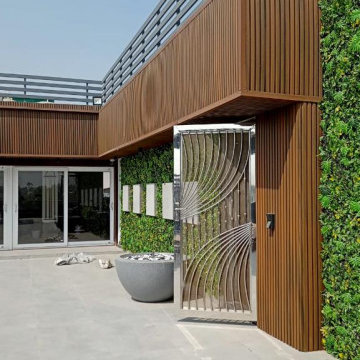
Providing & fixing of GRID FLOORS CLADDING PANELS of size 163mm x 20mm x 2400mm. GRID FLOORS PANELS are hybrid composites with a wood plastic composite core made of 65% wood fiber, 30% High Density Polyethylene and 5% Additives and face capping of high performance polymer compound for high UV resistance and vibrant aesthetics produced using co extrusion process. The Cladding panels should adhere to accelerated weather testing as per ASTM G154:2016,Cycle-1, Density of 1.3g/cum & tensile strength >22Mpa . The panel should be compatible with no visible screw installation system using Novel Castillo GI coated steel strips. UltraShield combines the proven strength
of high-density polyethylene plastic and wood fibers with an outer shell of polymer that completely encapsulates the board in an impermeable layer of protection that provides scratch, stain, and fade resistance. Ultra Shield combines the proven strength of high-density polyethylene plastic and wood fibers with an outer shell of plastic that completely encapsulates the board in an impermeable layer of protection from scratches, stains, and fading. The plastic we use is a proprietary compound that includes the same plastic used to make high impact golf ball covers. Shields formula provides color streaking and deep wood grains that bring you the warmth and beauty of wood without the maintenance. The Shield withstands high traffic without exhibiting signs of wear and tear as seen in conventional composite wood. Shield encases all four sides to give absolute protection from Mother Nature’s harshest conditions. Abrasion Resistance ASTM D4060-1033 mg (1000 cycles Brinell hardness EN15534 8.2N/mm 2.3
Boiling test EN15534 Water absorption in weigth: 1.10% 4 Bond Strength EN319 Average Bond Strength>2.3MPa No obvious abruption and damage after test Fire Resistance ASTM E84 Flame Spread Index(FSI): 85 Smoke Developed Index(SDI): 300 UV Weathering Test ASTM G154 After 3000 hours test, Grey Scale3, E*=3.56 Swelling and water absorption (24hours immersion) EN15534 Swelling: 0.06% in thickness, 0.03% in width, 0.03% in length Water absorption: 0.49%, Anti-static (
EN14041(2004) ) No annoying electrostatic discharges any more.
Find the right local pro for your project
 Grid Floors Pvt. Ltd.
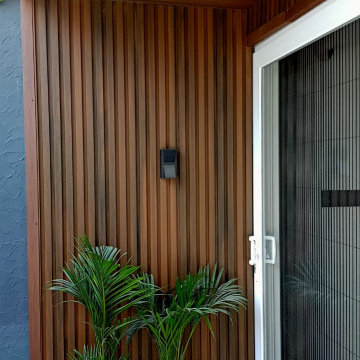
Providing & fixing of GRID FLOORS CLADDING PANELS of size 163mm x 20mm x 2400mm. GRID FLOORS PANELS are hybrid composites with a wood plastic composite core made of 65% wood fiber, 30% High Density Polyethylene and 5% Additives and face capping of high performance polymer compound for high UV resistance and vibrant aesthetics produced using co extrusion process. The Cladding panels should adhere to accelerated weather testing as per ASTM G154:2016,Cycle-1, Density of 1.3g/cum & tensile strength >22Mpa . The panel should be compatible with no visible screw installation system using Novel Castillo GI coated steel strips. UltraShield combines the proven strength
of high-density polyethylene plastic and wood fibers with an outer shell of polymer that completely encapsulates the board in an impermeable layer of protection that provides scratch, stain, and fade resistance. Ultra Shield combines the proven strength of high-density polyethylene plastic and wood fibers with an outer shell of plastic that completely encapsulates the board in an impermeable layer of protection from scratches, stains, and fading. The plastic we use is a proprietary compound that includes the same plastic used to make high impact golf ball covers. Shields formula provides color streaking and deep wood grains that bring you the warmth and beauty of wood without the maintenance. The Shield withstands high traffic without exhibiting signs of wear and tear as seen in conventional composite wood. Shield encases all four sides to give absolute protection from Mother Nature’s harshest conditions. Abrasion Resistance ASTM D4060-1033 mg (1000 cycles Brinell hardness EN15534 8.2N/mm 2.3
Boiling test EN15534 Water absorption in weigth: 1.10% 4 Bond Strength EN319 Average Bond Strength>2.3MPa No obvious abruption and damage after test Fire Resistance ASTM E84 Flame Spread Index(FSI): 85 Smoke Developed Index(SDI): 300 UV Weathering Test ASTM G154 After 3000 hours test, Grey Scale3, E*=3.56 Swelling and water absorption (24hours immersion) EN15534 Swelling: 0.06% in thickness, 0.03% in width, 0.03% in length Water absorption: 0.49%, Anti-static (
EN14041(2004) ) No annoying electrostatic discharges any more.
 Grid Floors Pvt. Ltd.
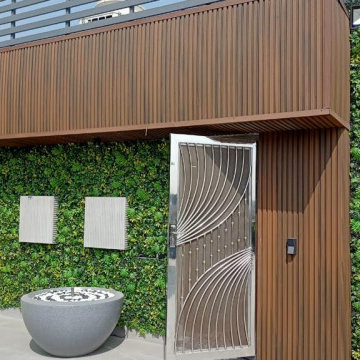
Providing & fixing of GRID FLOORS CLADDING PANELS of size 163mm x 20mm x 2400mm. GRID FLOORS PANELS are hybrid composites with a wood plastic composite core made of 65% wood fiber, 30% High Density Polyethylene and 5% Additives and face capping of high performance polymer compound for high UV resistance and vibrant aesthetics produced using co extrusion process. The Cladding panels should adhere to accelerated weather testing as per ASTM G154:2016,Cycle-1, Density of 1.3g/cum & tensile strength >22Mpa . The panel should be compatible with no visible screw installation system using Novel Castillo GI coated steel strips. UltraShield combines the proven strength
of high-density polyethylene plastic and wood fibers with an outer shell of polymer that completely encapsulates the board in an impermeable layer of protection that provides scratch, stain, and fade resistance. Ultra Shield combines the proven strength of high-density polyethylene plastic and wood fibers with an outer shell of plastic that completely encapsulates the board in an impermeable layer of protection from scratches, stains, and fading. The plastic we use is a proprietary compound that includes the same plastic used to make high impact golf ball covers. Shields formula provides color streaking and deep wood grains that bring you the warmth and beauty of wood without the maintenance. The Shield withstands high traffic without exhibiting signs of wear and tear as seen in conventional composite wood. Shield encases all four sides to give absolute protection from Mother Nature’s harshest conditions. Abrasion Resistance ASTM D4060-1033 mg (1000 cycles Brinell hardness EN15534 8.2N/mm 2.3
Boiling test EN15534 Water absorption in weigth: 1.10% 4 Bond Strength EN319 Average Bond Strength>2.3MPa No obvious abruption and damage after test Fire Resistance ASTM E84 Flame Spread Index(FSI): 85 Smoke Developed Index(SDI): 300 UV Weathering Test ASTM G154 After 3000 hours test, Grey Scale3, E*=3.56 Swelling and water absorption (24hours immersion) EN15534 Swelling: 0.06% in thickness, 0.03% in width, 0.03% in length Water absorption: 0.49%, Anti-static (
EN14041(2004) ) No annoying electrostatic discharges any more.

 a.d.d. concept + design
Large farmhouse black two-story mixed siding exterior home idea in San Francisco

 User
UserFree The Flash Season 4 Episode 17 Online Full Putlocker As our Online TV online viewing live channels free live HD TV Online Full The Flash Season 4 Episode 17 hq Online Full,"Title: # Null and Annoyed" The Flash Season 4 Episode 17 Null and Annoyed hqonline The Flash Season 4 Episode 17 Online live streaming online on History Channel Live Now Work 100% The Flash,'Null and Annoyed'
Watch The Flash Season 4 Episode 17 online. "Title: # Null and Annoyed" Find & Watch Every TV Show & Movie in One Place "The CW" let's full Tv length watch The Flash Season 4 Episode 17 online free, The Flash Full Video HD, Stream directly to your PC tv.lendralive The Flash Season 4 Episode 17 Full.
Watch >> http://tv.lendralive.com/play-60735-4-17
Strorylline : Barry and Ralph take different approaches to finding the remaining bus metas before DeVoe gets to them. However, Ralph's cavalier attitude frustrates Barry and the two clash over what it means to be a hero.
Episode : Null and Annoyed
Air Date : 4/10/2018
Summary : After a particle accelerator causes a freak storm, CSI Investigator Barry Allen is struck by lightning and falls into a coma.
The Flash Season 4 Episode 17 Best&Quality The Flash Season 4 Episode 17
review First Time The Flash returns for The Flash Season 4 Episode 17 LIVE STREAM YouTube
Video for The Flash Season 4 Episode 17 Live?
The Flash Season 4 Episode 17
The Flash Next on The Flash Season 4 Episode 17 YouTube
Video for The Flash Season 4 Episode 17 Live TV?
new episodes of The Flash Next on The Flash Season 4 Episode 17 Live
The Flash Season 4 Episode 17 online Kinja
The Flash Season 4 Episode 17 Online free full
putlocker Oliver Queen and his father are
The Flash Season 4 Episode 17 free streaming hd
The Flash Season 4 Episode 17 online Tv links for the s of 7 live stream The Flash
The Flash Season 4 Episode 17 streaming The Flash
'The Flash' Season 2 Spoilers Debbie and Her New Bag of
The upcoming episode of "The Flash" will be putting a foc on the issue of
The Flash" The Flash Season 4 Episode 17 Null and Annoyed march
The Flash Season 4 Episode 17 Synopsis Released
The Flash Season 4 Episode 17 Synopsis
Searches related to The Flash Season 4 Episode 17 Live
The Flash Season 4 Episode 17 megavideo
The Flash Season 4 Episode 17 recap
The Flash Season 4 Episode 17 streaming
The Flash Season 4 Episode 17 cast
The Flash Season 4 Episode 17 Trailer
The Flash Season 4 Episode 17 guide
The Flash Season 4 Episode 17 Online Free
 LEDER illumination Manufacturer
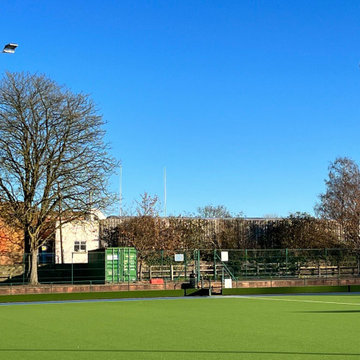
Elevating the Field: A Masterclass in Professional Sports Lighting
After two decades leading LED product development and global exports, I’ve learned that stadium lighting isn't just about brightness—it’s about precision, player comfort, and long-term economic viability.
Our latest installation showcased here represents the perfect synergy between advanced optical engineering and rugged durability. Here is why this project stands as a benchmark for modern sports infrastructure.
1. Professional-Grade Optical Precision
For this project, we didn't just "flood" the field with light. We engineered a solution:
Asymmetric Beam Control: We utilized custom-engineered lenses to direct light strictly onto the playing surface. This eliminates "sky glow" and light pollution for the surrounding community.
Anti-Glare Technology: By controlling the peak intensity angles, we’ve ensured that athletes can track the ball in the air without being blinded, a critical factor for high-speed sports performance.
Uniformity Excellence: The lighting distribution achieves a high uniformity ratio, eliminating dark spots and shadows that can lead to player injury.
2. Industrial-Strength Thermal Management
The secret to a 10-year lifespan isn't the LED chip; it's the heat dissipation.
Aero-Grade Heat Sinks: These fixtures feature high-purity aluminum housing with a vertical thermal flow design.
Longevity in Harsh Conditions: Designed to withstand extreme outdoor temperatures, the system ensures that lumen depreciation is kept to a minimum, protecting the client’s investment for years to come.
3. Global Compliance & Export Quality
From a trade perspective, we understand that reliability is the only currency that matters in international projects.
Certified Durability: The system carries full IP66 waterproof and IK08 impact ratings, making it resilient against heavy storms and physical impact.
International Standards: Fully compliant with CE, RoHS, and DLC Premium requirements, ensuring seamless integration into power grids worldwide and eligibility for green-energy subsidies.
4. The ROI: Efficiency Meets Sustainability
Switching to this high-efficiency LED system resulted in a 65% reduction in energy consumption compared to the previous metal halide installation. With integrated smart-control compatibility, the facility can now manage lighting levels based on usage, further accelerating the payback period.
The Bottom Line:
Lighting a sports facility is an investment in the community and the athletes. We don't just provide lamps; we provide a professional environment where the game can be played at its best, long after the sun goes down.
Are you looking to upgrade your facility to international standards? Let’s discuss how our 20 years of expertise can illuminate your next project.
 Windy City Painters
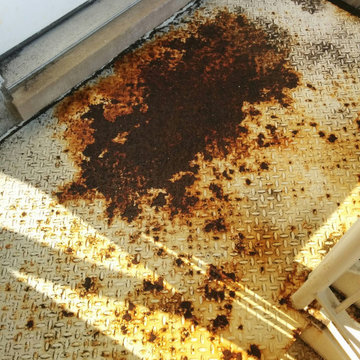
Windy City Painters recently tackled heavily corroded metal stairs on the North Side - the kind of job where surface prep makes or breaks the entire project. The stairs had years of rust scaling, flaking old paint, and a few sections where pitting had gone deep.Here in Chicago, metal stairs take a brutal beating. Freeze-thaw cycles crack protective coatings from October through April. Road salt spray migrates from boots and walkways. Humidity off the lake accelerates oxidation on any exposed metal. Older two-flats and greystones often have original ornamental iron stairways that haven't been properly treated in decades.OUR 4-STEP METAL STAIR PROCESS:Mechanical prep with wire wheel grinder and needle gun descaling on heavy corrosion zonesOspho rust-converting primer applied to all remaining oxidized surfaces - this chemically transforms rust into a stable baseSherwin-Williams Corothane moisture-cure urethane primer for extreme industrial barrier protectionTwo topcoats of Sherwin-Williams Corothane aliphatic finish for maximum UV, moisture, and chemical durability Q: What does metal stair painting cost in Chicago?A: Most North Side residential metal staircases run $800-$2,500 depending on step count, structure height, rust severity, and whether any welding repairs are needed before painting begins.Q: Can you paint over rust?A: Not directly. Windy City Painters always converts or removes rust first using Ospho or wire wheel grinding so high-performance coatings like Corothane bond correctly and last.Q: How long does painted metal stairs last in Chicago?A: With Sherwin-Williams Corothane moisture-cure urethane primer and topcoat, properly prepped metal staircases in Chicago typically hold 8-12 years through harsh winters and foot traffic. Q: Do you handle ornamental iron staircases on greystones or two-flats?A: Absolutely. Windy City Painters works regularly on vintage metal stairways found on North Side greystones, courtyard buildings, and Victorian brownstones.Q: What if sections are broken or bent?A: We assess whether a welder is needed before painting begins. We coordinate that repair before any coatings go down.Q: Is there prep before the primer?A: Yes - wire wheel grinding, needle gun descaling on heavy zones, and a full wipe-down before Ospho and Sherwin-Williams Corothane primer application.Q: How do I get a quote?A: Visit windypainters.com or call us directly. Windy City Painters provides free on-site estimates for all metal stair painting projects.Protect your investment before next winter hits. windypainters.com#ChicagoPainter #WindyCityPainters #ChicagoIL #HomeImprovement #ChicagoHome #MetalStairPainting #RustyStairs #ChicagoNorthSide #StairPainting #MetalPainting #ChicagoContractor #ExteriorPainting #GreystoneLiving #ChicagoTwoFlat #CurbAppeal
 Windy City Painters
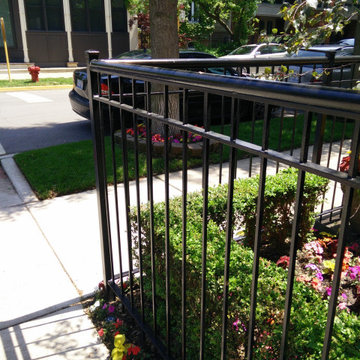
Ever notice how your iron fence looks worse every spring after Chicago winters? That steady seasonal decline is not inevitable - it is a preparation and coating problem that Windy City Painters solves with systematic metal restoration.
PROJECT OVERVIEW
Iron fence painting in Chicago requires more than a fresh coat of paint. Chicago's freeze-thaw cycles, road salt exposure, and high seasonal humidity create conditions that destroy inadequately prepared metal coatings within a year or two. Windy City Painters approaches every iron fence project as a corrosion control job first and a painting job second. The result is a finish that holds up through multiple Chicago winters without peeling, bubbling, or allowing rust to spread beneath the surface.
MAterials AND PRODUCTS
Windy City Painters selects products specifically rated for ferrous metal in high-corrosion environments. For rust conversion, we use Ospho phosphoric acid treatment or Corroseal water-based rust converter, both of which chemically transform active rust into a stable iron phosphate compound. For priming and finish coats, Rust-Oleum DTM and Sherwin-Williams DTM rust-inhibitive direct-to-metal coatings provide excellent adhesion, flexibility, and moisture resistance. These products are formulated to expand and contract with metal through temperature swings without cracking.
THE PROCESS
Step 1 - Mechanical Surface Preparation: Wire wheel grinding and needle gun descaling remove all loose rust, failing paint, and mill scale. This step is non-negotiable. No rust-inhibitive coating performs correctly over contaminated or loosely adhered substrate. Windy City Painters treats this phase as the foundation of the entire project.
Step 2 - Rust Conversion Treatment: Ospho or Corroseal is applied to any remaining rust after mechanical prep. These products do not simply cover rust - they react with iron oxide to create iron phosphate, a chemically stable surface that accepts primer without ongoing corrosion underneath. Contact time and full surface saturation are critical.
Step 3 - Rust-Inhibitive Priming: Rust-Oleum DTM or Sherwin-Williams DTM rust-inhibitive primer is applied by brush to ensure full penetration into ornamental details, crevices, and rail joints where moisture collects. Spray application alone misses critical contact points on older Chicago ironwork.
Step 4 - Finish Coat Application: Two finish coats of Rust-Oleum DTM or Sherwin-Williams DTM topcoat deliver color saturation, UV stability, and a hard film that resists chipping from foot traffic, landscaping equipment, and seasonal debris impact common to Chicago urban properties.
CHICAGO-SPECIFIC CHALLENGES
Chicago iron fences face a combination of stressors that accelerates failure compared to milder climates. Road salt spray migrates well beyond the street surface and deposits chlorides on fence metal throughout winter. Freeze-thaw cycles - sometimes occurring multiple times in a single week - expand and contract metal enough to crack coatings that lack flexibility. Older ornamental iron on greystones, Victorian brownstones, two-flats, and courtyard buildings often has decades of paint buildup that must be addressed before any restoration coating will perform correctly.
WHAT TO EXPECT LONG-TERM
A properly prepared and coated iron fence painted by Windy City Painters typically performs five to seven years before requiring recoating in Chicago conditions. Annual spring inspection for salt residue, minor touch-up of any chips within the first season, and a light rinse to remove winter road chemicals all extend coating life. Structural rust that has compromised rail integrity should be addressed by a welder before painting - Windy City Painters identifies these conditions during initial assessment.
PRO TIPS
Tip 1: Never paint over rust without a conversion treatment first. Paint applied over active rust creates a sealed environment where corrosion accelerates invisibly until the coating fails completely.
Tip 2: Budget for welded repairs on iron fences older than twenty-five years. Ornamental iron on Chicago historic properties often has pitting or section loss that painting alone cannot address structurally.
Tip 3: Time your iron fence painting project for late spring or early fall when temperatures stay consistently above fifty degrees overnight. DTM coatings need adequate cure time before the first freeze to achieve full hardness.
Call Windy City Painters to schedule your iron fence assessment at windypainters.com.
FAQ
Q: What is the cost of iron fence painting in Chicago?
A: Iron fence painting cost in Chicago varies by linear footage, rust severity, and ornamental complexity. Windy City Painters provides free on-site estimates so you receive an accurate number before any commitment is made.
Q: Do you need to remove all old paint before repainting an iron fence?
A: Not always. Windy City Painters assesses existing coating adhesion. Sound paint in good condition can remain. Peeling, bubbling, or paint over active rust must be removed for the new coating to perform correctly.
Q: Can structural rust on an iron fence be repaired without replacing the fence?
A: Depends on severity. Surface and moderate rust responds well to conversion treatment and DTM coatings. If rust has caused section loss or structural weakness, Windy City Painters recommends a welder address those areas before painting.
Q: How long does iron fence painting take?
A: Most residential iron fence projects take one to three days including prep, rust conversion, priming, and two finish coats. Windy City Painters sequences cure time between coats to ensure full adhesion at every stage.
Q: What is the best paint for iron fences in Chicago?
A: Rust-Oleum DTM and Sherwin-Williams DTM rust-inhibitive coatings are among the best options for Chicago iron fences due to their flexibility, moisture resistance, and ability to handle freeze-thaw temperature swings without cracking.
Q: Is it worth painting an old iron fence or should I replace it?
A: Painting is almost always more cost-effective than replacement for structurally sound iron. Windy City Painters assesses every fence honestly and only recommends replacement when restoration would not deliver a durable result.
Q: How do I find a reliable iron fence painting contractor near me in Chicago?
A: Look for contractors who specify rust conversion products by name, explain their mechanical prep process, and provide references from similar Chicago properties. Windy City Painters documents every step and warranties our work.
 Windy City Painters
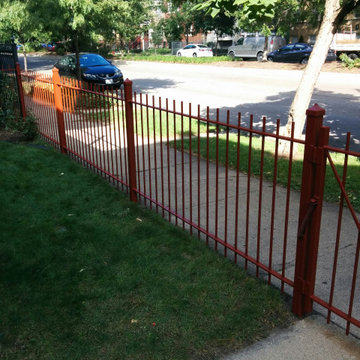
Ever notice how your iron fence looks worse every spring after another Chicago winter? That slow deterioration is not cosmetic - it is active metal failure that compounds every freeze-thaw cycle until replacement becomes the only option. Windy City Painters works with homeowners across the Chicago North Side and Near West Side to restore original iron fencing on greystones, two-flats, Victorian brownstones, and coach houses before that point is reached.
PROJECT OVERVIEW
This iron fence restoration involved a classic Chicago residential property with original wrought iron fencing showing surface rust across the majority of pickets, flaking previous paint coats, and localized deep pitting near the base rails. A structural check identified two loose pickets requiring welding before any surface preparation or coating began. Total linear footage fell in the mid-range for a standard Chicago residential lot.
MATERIALS AND PRODUCTS
Windy City Painters selected Ospho rust converter for chemically neutralizing active iron oxide before priming. Ospho reacts with rust to form a stable phosphate compound that stops corrosion progression rather than simply sealing over it. Sherwin-Williams DTM rust-inhibitive primer was applied to all bare and converted surfaces, followed by two finish coats of Rust-Oleum DTM in satin black. DTM - direct to metal - formulas provide corrosion inhibitors built into the coating matrix, which matters significantly in Chicago's climate.
THE PROCESS
Step 1 - Structural Assessment and Welding Coordination. Before any surface preparation begins, Windy City Painters inspects every picket and rail connection for structural integrity. Loose or cracked iron must be welded before coating. Paint applied over a compromised joint will fail within one season as movement continues to break the bond. On this project, two pickets were tack-welded by a coordinating welder before prep started.
Step 2 - Wire Wheel Grinding and Needle Gun Descaling. All rusted sections were ground to bare or near-bare metal using wire wheel attachments and needle gun descaling tools. This step removes loose scale, flaking previous coatings, and surface contamination that would prevent primer adhesion. Skipping mechanical prep is the single most common reason iron fence paint fails prematurely on Chicago properties.
Step 3 - Ospho Rust Converter Application. Ospho was brushed into all pitted and converted areas and allowed to cure fully. The phosphoric acid chemistry converts iron oxide into iron phosphate, arresting active rust and creating a surface that accepts primer more effectively than bare metal alone. Corroseal is an equivalent alternative used on projects with heavier pitting.
Step 4 - DTM Primer and Finish Coat Application. Sherwin-Williams DTM rust-inhibitive primer was applied across all prepared surfaces. Two topcoats of Rust-Oleum DTM in satin black followed after full primer cure. DTM finish coats add a second corrosion-inhibiting layer and provide the UV and weather resistance needed for Chicago exterior iron work.
CHICAGO-SPECIFIC CHALLENGES
Chicago iron fencing faces conditions that accelerate corrosion faster than most US markets. Lake humidity keeps metal surface moisture elevated through much of the year. Road salt splash from winter maintenance reaches fencing along parkways and sidewalk edges, introducing chlorides that aggressively attack iron. Freeze-thaw cycles expand any rust pocket that has formed under paint, lifting coatings from the inside and creating the classic bubbled-paint appearance homeowners notice every spring.
WHAT TO EXPECT LONG-TERM
With Ospho conversion, DTM primer, and two DTM finish coats properly applied over mechanically prepared surfaces, most Chicago residential iron fences hold 5-8 years before needing significant touch-up. Annual visual inspection for any chips or bare spots, with immediate touch-up using Rust-Oleum DTM, extends that window considerably.
PRO TIPS
Tip 1 - Address any bare metal spot the same season you notice it. A pinhole of exposed iron becomes a rust bubble within one Chicago winter and a flaking section by the following spring.
Tip 2 - Never paint over active rust without a converter step. Ospho or Corroseal is inexpensive insurance against a complete repaint two years early.
Tip 3 - Check picket bases at grade level every spring. Ground contact accelerates corrosion at the base faster than anywhere else on the fence. Catching it early keeps welding out of the equation.
Contact Windy City Painters at windypainters.com for a project estimate.
FAQ
Q: What does iron fence painting cost in Chicago? A: Residential iron fence painting with proper rust prep typically runs $300-$900 for standard lot footage. Windy City Painters provides itemized estimates based on linear footage, rust severity, and whether structural welding is required before surface preparation begins.
Q: Do you paint over rust or remove it first? A: Windy City Painters always addresses active rust before priming. Ospho or Corroseal rust converter chemically neutralizes iron oxide, and wire wheel grinding removes loose scale - coating over unaddressed rust guarantees early failure on Chicago iron fences.
Q: When does an iron fence need welding before painting? A: Loose pickets, cracked rails, or connections with visible movement require welding before any coating work begins. Paint cannot stabilize a structural joint - Windy City Painters coordinates with welders when this condition is identified during initial assessment.
Q: How long does iron fence paint last in Chicago? A: With mechanical prep, Ospho conversion, and Sherwin-Williams or Rust-Oleum DTM coatings, properly restored iron fencing holds 5-8 years in Chicago's freeze-thaw climate before needing significant maintenance.
Q: Is Ospho better than Corroseal for Chicago iron fences? A: Both are effective rust converters. Ospho is a liquid phosphoric acid treatment suited for moderate rust and pitting. Corroseal is a latex-based converter-primer hybrid better suited to heavier rust profiles. Windy City Painters selects based on site conditions.
Q: What finish sheen works best on iron fencing? A: Satin or semi-gloss black is the traditional and most durable choice for Chicago greystone and brownstone properties. Satin hides minor surface imperfections better than gloss while still providing adequate UV and moisture resistance.
Q: Can iron fence painting be done in spring or fall in Chicago? A: Yes. Windy City Painters schedules iron fence work in temperatures above 50 degrees Fahrenheit with low ambient humidity - spring and early fall are often ideal windows that avoid both winter cold and peak summer humidity.


 Windy City Painters
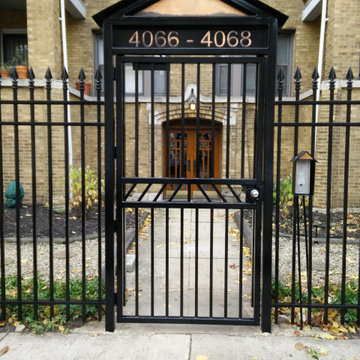
s your ornamental iron fence flaking rust onto the sidewalk every time Chicago wind kicks up? That is not a cosmetic problem - it is a sign that bare metal is exposed to moisture and the corrosion cycle is accelerating. Windy City Painters restores iron fencing on Chicago greystones, two-flats, Victorian brownstones, and courtyard buildings using professional-grade rust conversion and rust-inhibitive systems designed for the Midwest climate.
PROJECT OVERVIEW
Ornamental iron fence painting in Chicago is a multi-stage restoration process, not a simple brush-and-go job. Chicago properties - particularly the dense residential streetscapes of the North Side and Near West Side - feature decorative iron fencing that ranges from simple tubular picket to elaborate spear-top and scroll designs. When paint fails on iron, rust accelerates quickly. Windy City Painters evaluates each fence for structural rust-through, surface rust, and paint adhesion before recommending a scope of work.
MATERIALS AND PRODUCTS
Rust conversion: Ospho (phosphoric acid-based) or Corroseal (latex rust converter) depending on rust severity and surface porosity. Both chemically convert iron oxide into a stable compound that primer bonds to permanently rather than simply coating over active rust.
Primer: Rust-Oleum DTM (Direct to Metal) rust-inhibitive primer or Sherwin-Williams DTM Acrylic Coating primer, both formulated to penetrate weld seams, crevices, and pitted metal surfaces where brush application is essential.
Finish coat: Sherwin-Williams DTM Acrylic in satin or semi-gloss for UV resistance, color retention, and flexibility through freeze-thaw cycles. Two finish coats applied by brush for full coverage on ornamental profiles.
THE PROCESS
Step 1 - Mechanical Preparation: Wire wheel grinding with angle grinders removes loose rust and failing paint across flat rail surfaces. Needle gun descaling reaches weld joints, picket bases, and decorative scroll details where wire wheels cannot access. Windy City Painters inspects for rust-through after mechanical prep and flags any sections needing welding before painting proceeds.
Step 2 - Rust Conversion: Ospho or Corroseal is applied by brush to all remaining rust-affected surfaces. Ospho reacts with iron oxide over 24 hours, converting it to iron phosphate. Corroseal encapsulates and converts simultaneously. Both products create a chemically stable surface that dramatically improves primer adhesion on previously rusted iron fence sections.
Step 3 - Primer Application: Rust-Oleum DTM or Sherwin-Williams DTM rust-inhibitive primer is worked into every joint, crevice, and ornamental detail by brush - never sprayed alone on open ironwork where overspray and thin coverage risk undercutting. Full wet film thickness is verified before drying. Windy City Painters does not rush cure times between coats.
Step 4 - Finish Coats: Two coats of Sherwin-Williams DTM Acrylic topcoat are applied by brush for maximum film build on vertical pickets and horizontal rails. Color is matched to original or updated per homeowner preference. Semi-gloss finish resists dirt accumulation and makes future cleaning easier between repainting cycles.
CHICAGO-SPECIFIC CHALLENGES
Chicago presents iron fence painting conditions that milder climates do not. Road salt spray from city streets migrates onto fence bases through snowplow activity and foot traffic. Freeze-thaw cycling - sometimes occurring 30 or more times per winter - expands and contracts metal faster than paint can flex if film build is inadequate. High summer humidity slows cure times and risks blushing in topcoats applied too early in the morning. Windy City Painters schedules iron fence work during appropriate temperature and humidity windows and never applies coatings when rain is forecast within 24 hours.
WHAT TO EXPECT LONG-TERM
A properly prepped and primed iron fence in Chicago should hold a quality DTM finish for 5-8 years before needing significant maintenance. Annual inspection of base welds and picket bottoms - areas where water pools - catches early rust before it requires full mechanical prep again. Touch-up painting of isolated spots extends coating life significantly.
PRO TIPS
Tip 1: Never let a painter skip straight to topcoat on a rusty fence. Active rust under paint fails within one or two seasons. Ospho or Corroseal conversion is non-negotiable on Chicago iron.
Tip 2: Inspect fence picket bases at ground level every fall. That is where water collects, salt concentrates, and rust begins its worst work. Early touch-up costs far less than full restoration.
Tip 3: Request brush application on ornamental ironwork rather than spray-only. Brush work ensures wet paint is physically worked into every joint and crevice where rust originates.
Ready to restore your iron fence? Visit windypainters.com to schedule a free estimate with Windy City Painters.
Q: What does iron fence painting cost in Chicago? A: Iron fence painting in Chicago typically runs $8-$18 per linear foot. Rust severity, fence height, ornamental detail complexity, and whether welding repairs are needed all affect the final cost for professional iron fence restoration.
Q: How do you treat rust before painting an iron fence? A: Windy City Painters uses Ospho or Corroseal rust converters after mechanical prep. These products chemically neutralize iron oxide, creating a stable surface that rust-inhibitive primer bonds to permanently rather than painting over active corrosion.
Q: What primer is best for painting a rusty iron fence in Chicago? A: Rust-Oleum DTM and Sherwin-Williams DTM rust-inhibitive primers are our go-to products for iron fence painting in Chicago. Both are formulated for direct metal application and resist the moisture and freeze-thaw stress Chicago winters produce.
Q: How long does painted iron fencing last in Chicago? A: A professionally prepped and primed iron fence in Chicago holds a quality DTM finish for 5-8 years. Annual inspection of base welds and low points, with spot touch-up as needed, extends that service life considerably.
Q: Do I need a welder before painting my iron fence? A: If rust has eaten through fence rails or pickets structurally, Windy City Painters will identify those sections during prep and recommend welding before any primer or paint is applied. Painting over structurally failed metal is a waste of money.
Q: Can I paint an iron fence myself? A: DIY iron fence painting without proper rust conversion and DTM primer systems almost always fails within two seasons in Chicago. Professional prep, product selection, and application technique are why Windy City Painters results last 5-8 years.
Q: What neighborhoods does Windy City Painters serve for iron fence work? A: Windy City Painters serves Chicago North Side and Near West Side neighborhoods, working on greystones, two-flats, Victorian brownstones, courtyard buildings, and coach houses throughout the city.
 Neumann & Rudy Architecture
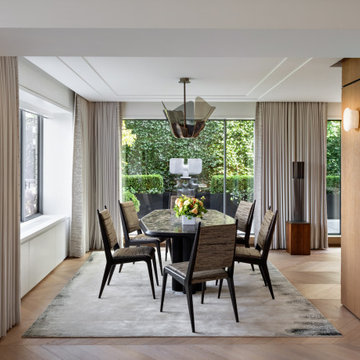
This dining room operates as a processional volume, choreographed along a deep axial sightline that terminates not in a wall but in a garden — an ivy-clad plane of green glimpsed through full-height glazing. The architecture is fundamentally additive rather than decorative: a coffered, stepped ceiling plane with recessed reveal channels floats above the seating zone, its subtle datum lines describing a rectangular "room within a room" that anchors the table without recourse to enclosing partitions. Flanking this central passage, two millwork pylons — one clad in pale limed oak on the right, one in a fine bone-toned wallcovering on the left — function as vestigial pilasters, compressing the entry threshold before releasing into the loftier dining volume. The floor reinforces this directionality through a wide-plank chevron parquet laid on the primary axis, its herringbone rhythm accelerating the eye toward the terrace. The furniture plan is deliberately non-orthogonal: an elongated oval table on twin cylindrical pedestals softens the room's rectilinear discipline, while the loosely arrayed chairs break parade-ground symmetry in favor of a more inhabited, gestural composition. Deep-set corner windows and a low banquette-height sill with integrated casework at left introduce a secondary spatial episode, a quieter alcove that relieves the room's axial insistence.
## II. Materiality, Color & Texture
The palette is a study in warm neutrality calibrated across a narrow tonal band, with contrast delivered through texture rather than hue. The foundational register is greige-to-oatmeal: floor-to-ceiling drapery in a heavy, densely gathered linen falls in pin-sharp cartridge pleats, its matte drape absorbing light and softening the glass wall's hard geometry. Against this, the dining chairs are upholstered in a slubbed, striated fabric — likely a raw silk or abaca-like bast fiber — whose horizontal grain reads almost as bark, and which is set in taut opposition to the ebonized, tapered hardwood frames in the Italian mid-century idiom of Gio Ponti or Ico Parisi. The tabletop, a mottled verdigris-and-bronze stone or fossilized surface, introduces the room's only earth-toned saturation, echoed by the burl-and-walnut plinth supporting a slender fluted bronze sculpture. The oak millwork is limed and open-grained, deliberately dry and tactile beside the high-polish patinated brass of the pendant. Underfoot, a hand-knotted silk rug in cloud-grey with charcoal ombré edges introduces atmospheric perspective — a painterly gradient that dematerializes the floor plane. Chromatic release arrives entirely from two sources: the framed abstract expressionist canvas at right, with its viridian, cobalt and violet gestural detonations, and the living wall of ivy beyond the glass. Both function as color events, not color schemes.
## III. Lighting, Atmosphere & Style Profile
Daylight is the primary luminaire here, entering as a broad, north-soft wash through the terrace glazing and diffused further by the ivy screen, which acts as a natural lambrequin filtering glare into a cool, even green-tinted light. Artificial sources are deployed sculpturally rather than functionally: the pendant — a folded, petal-form composition of smoked glass and patinated metal — reads as a suspended object of art, throwing a warm downward pool onto the table while its dark bronze silhouette provides essential visual weight against the white ceiling. Wall-mounted alabaster sconces bracket the room at both thresholds, their translucent stone glowing with a low-lumen, candle-adjacent warmth that establishes perimeter intimacy after dusk. The resulting atmosphere is serene, curated and quietly patrician — a room engineered for extended conversation rather than display. Stylistically, the project synthesizes a **contemporary Soft Minimalism** with a strongly collected **Mid-Century Italian** sensibility: the restraint of the architectural envelope and monochromatic textile program provides a gallery-like neutral ground, upon which a small number of high-character objects — the sculptural pendant, the Ponti-esque seating, the abstract canvas, the exterior stone sculpture — perform as museum-grade punctuation. It is an interior that achieves luxury through material integrity and negative space rather than ornament.

 Tomecek Studio Architecture
Project by Studio H:T principal in charge Brad Tomecek (now with Tomecek Studio Architecture). This project tests the theory of bringing high quality design to a prefabricated factory setting. Enrolled in the LEED-Home Pilot, this residence completed certification. The modular home was conceived as two boxes that slide above one another to create outdoor living space and a lower covered rear entry. The passive solar design invites large amounts of light from the south while minimizing openings to the east and west. Factory construction saves both time and costs while reducing waste and using a controlled labor force.
Built in a factory north of Denver, the home arrived by flatbed truck in two pieces and was craned into place in about 4 hours providing a fast, sustainable, cost effective alternative to traditional homebuilding techniques. Upgraded lighting fixtures, plumbing fixtures, doors, door hardware, windows, tile and bamboo flooring were incorporated into the design. 80% of the residence was completed in the factory in less than 3 weeks and other items were finished on site including the exterior stucco, garage, metal railing and stair.
Stack-Slide-Stitch describes the conceptual process of how to tie together two distinct modular boxes. Stack refers to setting one modular directly on top of the other. Slide refers to the action that creates an upper southern deck area while simultaneously providing a covered rear entry area. The stitching or interlocking occurs with the upward extension of the lower volume with the front deck walls and with the rear two story vertical.

 Spire North
Tucked away in the backwoods of Torch Lake, this home marries “rustic” with the sleek elegance of modern. The combination of wood, stone and metal textures embrace the charm of a classic farmhouse. Although this is not your average farmhouse. The home is outfitted with a high performing system that seamlessly works with the design and architecture.
The tall ceilings and windows allow ample natural light into the main room. Spire Integrated Systems installed Lutron QS Wireless motorized shades paired with Hartmann & Forbes windowcovers to offer privacy and block harsh light. The custom 18′ windowcover’s woven natural fabric complements the organic esthetics of the room. The shades are artfully concealed in the millwork when not in use.
Spire installed B&W in-ceiling speakers and Sonance invisible in-wall speakers to deliver ambient music that emanates throughout the space with no visual footprint. Spire also installed a Sonance Landscape Audio System so the homeowner can enjoy music outside.
Each system is easily controlled using Savant. Spire personalized the settings to the homeowner’s preference making controlling the home efficient and convenient.

 Heath Carpentry
This is an example of a mid-sized mid-century modern partial sun front yard concrete paver landscaping in Los Angeles for spring.

 Morgan Mural Studios
This hand painted mural of Giants Stadium Graffiti is in my son's room. The letters of his name (Lucas) create a frame for the stadium. Bricks, crumbling plaster and water stains, add an urban grunge feel perfect for an up and coming teenager. All the elements were hashed out clearly with my son ahead of time. We even had a signed contract. He had stipulated bubble letters, and when I decided to make it more angular, he was up in arms about the "breach in contract". In the end, he decided how it turned out was better than he could have imagined. He also has a better understanding of "artistic license".

 Taylor Knights
Peter Clarke
Staircase - small contemporary metal straight metal railing staircase idea in Melbourne with metal risers
Staircase - small contemporary metal straight metal railing staircase idea in Melbourne with metal risers


14