
Search results for "Actual time odds" in Home Design Ideas
 User
The living room furniture wasn’t doing our clients any favours. The comfort they once sought in the room had turned to lethargy, and they wanted to liven things up. (When the sag in your sofa turns you into a human burrito, it’s time to let go.) Before we brought in the new, however, we wanted to focus on functionality. How was the space going to be used? Our clients love to host casual get togethers with family and friends, and they love a family movie night, so we knew ample seating was a must-have.
We also wanted to make the living room feel as big as it actually is. Something to note: Let your furniture breathe! Allow for plenty of clearance between your furniture; don’t fill up your space with furniture just because the space allows for it. We got rid of the bookshelf and console table behind the sofa, which opened up the space for entertaining or for movie nights. Our clients now have room for a Christmas tree in the corner! Now the space is modern, purposeful, and oh so cozy! We stopped at nothing to make this living room feel as inviting as possible. The detailed tile in the fireplace, the textures in the accessories and pillows, and the various wood tones all work together to create comfort and style. And please don’t worry about mixing wood tones. When done with the right balance, the different shades will add warmth and depth to any space.
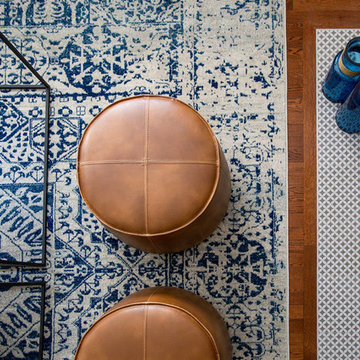
Ottomans are the perfect way to maximize seating and comfort. They can be used for extra seating or pulled over to a sofa to rest the legs for maximum lounging. Now that there’s plenty of clearance between the cocktail table and sofas, our clients have the space to move these versatile pieces around.
Thank you for visiting! We’re always honoured to share our transformed and updated homes! We hope you love this cozy living room as much as our clients do. If you have any questions about this project, feel free to ask us in the Comments below!

 AYDIN Hides
Luxury – Prestige – Status
KEY FEATURES
Hand Made in Europe
Hand-Made by 3rd. generation of Aydin family.
Premium Quality
Hand lined bottom
Hand stitching
100% genuine cowhide leather
European (Balkan) breed animals
Each product is BRANDED with serial number and Craftsmanship seal.
Hides used for making Patchworks are sourced ethically and humanely and 100% as byproduct of meat production
Animals are free-range raised, sustainable sourced mainly on mountain pastures of Eastern Europe.
Animal skins are endemic to breeds specific for Eastern European region.
Skins ARE NOT processed by mass processing facility, but rather family owned business with "Old Craft" certificate. This means that such business falls in "Traditional" category of business.
All skins are hand processed using solutions with the P.H value of drinking water.
Skins are processed in small batches, usually 5-10 at the time, in order for skin to preserve, to the greatest extend, its natural distinctions and quality.
NOTE: The photo on this page represents design and style of this rug and IT IS AN IMAGE OF ACTUAL product you will receive. All rug sizes are approximate. Due to the difference of monitor colors, some rug colors may vary slightly.
NOTE: Few products may contain some natural flaws due to conditions inherent to natural animal products (scratches, insect bites, wrinkles, cuts, etc.) that will be discretely repaired. Please note that we do not wedge our cowhides but we rather discretely stitch and repair. Such flaws are acceptable for this type of product, since it represents the life of the animal to the fullest possible extent.
 User
The living room furniture wasn’t doing our clients any favours. The comfort they once sought in the room had turned to lethargy, and they wanted to liven things up. (When the sag in your sofa turns you into a human burrito, it’s time to let go.) Before we brought in the new, however, we wanted to focus on functionality. How was the space going to be used? Our clients love to host casual get togethers with family and friends, and they love a family movie night, so we knew ample seating was a must-have.
We also wanted to make the living room feel as big as it actually is. Something to note: Let your furniture breathe! Allow for plenty of clearance between your furniture; don’t fill up your space with furniture just because the space allows for it. We got rid of the bookshelf and console table behind the sofa, which opened up the space for entertaining or for movie nights. Our clients now have room for a Christmas tree in the corner! Now the space is modern, purposeful, and oh so cozy! We stopped at nothing to make this living room feel as inviting as possible. The detailed tile in the fireplace, the textures in the accessories and pillows, and the various wood tones all work together to create comfort and style. And please don’t worry about mixing wood tones. When done with the right balance, the different shades will add warmth and depth to any space.
Ottomans are the perfect way to maximize seating and comfort. They can be used for extra seating or pulled over to a sofa to rest the legs for maximum lounging. Now that there’s plenty of clearance between the cocktail table and sofas, our clients have the space to move these versatile pieces around.
Thank you for visiting! We’re always honoured to share our transformed and updated homes! We hope you love this cozy living room as much as our clients do. If you have any questions about this project, feel free to ask us in the Comments below!
Find the right local pro for your project
 AYDIN Hides
KEY FEATURES
• Hand Made in Europe
• Hand-Made by 3rd. generation of Aydin family.
• Premium Quality
• Hand lined bottom
• Hand stitching
• 100% genuine cowhide leather
• European (Balkan) breed animals
• Each product is BRANDED with serial number and Craftsmanship seal.
• Hides used for making Patchworks are sourced ethically and humanely and 100% as byproduct of meat production
• Animals are free-range raised, sustainable sourced mainly on mountain pastures of Eastern Europe.
• Animal skins are endemic to breeds specific for Eastern European region.
• Skins ARE NOT processed by mass processing facility, but rather family owned business with "Old Craft" certificate. This means that such business falls in "tradition" category of business, since third family generation takes care of business.
• All skins are hand processed using solutions with the P.H value of drinking water (7)! We have been assured into that by being present inside the workshop during skin processing
• Skins are processed in small batches, usually 5-10 at the time, in order for skin to preserve, to the greatest extend, its natural distinctions and quality.
• NOTE: The photo on this page represents design and style of this rug and IT IS AN IMAGE OF ACTUAL product you will receive. All rug sizes are approximate. Due to the difference of monitor colors, some rug colors may vary slightly.
• NOTE: Few products may contain some natural flaws due to conditions inherent to natural animal products (scratches, insect bites, wrinkles, cuts, etc.) that will be discretely repaired. Please note that we do not wedge our cowhides but we rather discretely stitch and repair. Such flaws are acceptable for this type of product, since it represents the life of the animal to the fullest possible extent.
SQ21

 Bilotta Kitchen & Home
“It’s hard to believe these two sets of photos are actually the same space! The 1950s “modern” kitchen was tiny and dark, and the adjoining family room went largely unused by the family. Yet the owners love to cook and entertain, so this kitchen needed to go! Designer Fabrice Garson removed the wall between the two spaces and created one multi-purpose space: an open kitchen with abundant storage and prep space at the large range and island; a banquette for casual family meals or homework; and a separate table for dinner parties. Because they’d be losing their formal dining room, Fabrice recommended adding the coffered ceiling to lend an air of elegance to the new space. This once-gloomy cave morphed into an airy, luminous room. Pops of dark blue on the island, the banquette upholstery, and the banquette wallpaper add a fun element to temper the traditional tone of the inset cabinetry. And the mixture of stainless appliances with the brushed gold faucet, gold accents on the pendant fixtures, and the bronze crystal chandelier create an eclectic but elegant look.” (This blurb was part of Bilotta’s Blog Post written by Paulette Gambacorta)
The finished space features Signature Custom Cabinetry in a mix of white paint on the perimeter and a custom navy paint on the island. All hardware is a mixed of brushed nickel knobs and cup pulls. The countertops are Ceasarstone’s Bianco Drift and the backsplash is a classic and clean white ceramic subway tile. Appliances are all by Thermador with the exception of the Best hood insert which is hidden by the custom white painted hood. The sink is an apron front by Kohler in cast iron with a white enamel finish and is accented by a brushed copper faucet and water filter. The decorative lighting adding to the elegance of the space is by EuroStyle. The custom-built banquette and coffered ceiling were both designed by Fabrice and brought to life by his long time contractor Breton Contracting.
Designer: Fabrice Garson Photo Credit: After Photos by Peter Krupenye
 Michael Hally Design, Inc
Waterview Times Two
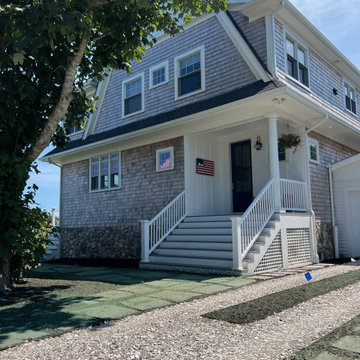
It is all about view here where river meets sea. The “new home” (actually an addition) is well-positioned on the site. Views are framed in traditional double hung windows with a six lites over one lite configuration. The waterside elevations are clad in a variety of multi-leaf sliding glass doors for view and access to the outdoor decks. For these glass panels, a simple “top row” of lites fits the bill. Here they seem to say, “I’m a traditionalist, but I’m walking a modern edge along the shore to promote better view, light and connection to the water.”
The views require no detailing or enhancements, but the house does. The roofline is unmistakably traditional. It keeps the roof line low, a must for a structure designed to conform with the FEMA prescribed BFE (Base Flood Elevation.) The exterior comes to life thanks to generous trim at the rake, fascia, soffits and frieze boards of the traditional gambrel roof. A skin of cedar shingles at 5” exposure reinforces the site-specific design. As you look around everywhere on this vacation peninsula, you’ll notice the consistency of weathered shingled exteriors. Its “dormered” second floor is tucked nicely in the roofline to also make sure it fits within the context of the neighboring older homes.
Because the coastal FEMA regulations pushed our home higher from the surrounding ground and safely from the impending storm surges, expansive decks extend along the water side. The decks are our de facto landscape and outdoor rooms. They are positioned vertically two stair risers below the finished first floor. The drop in deck heights preserves interior views over furniture and guests from inside the home. Steel cable railings provide a see-through safety “guard” as required by the building codes.
The open plan on the interior provides the perpetual connection to the water. View dominates and directs the floor plan. Symmetrical window groupings will organize the first-floor plan. There will be plenty of space to handle the guests, but its mission is to provide good order for day to day living for just the homeowners themselves. Beds on the upper level are positioned with view in mind too. Waking up to the sun reflecting off the water is opportunity not to pass up.
With the dust and noise finally behind us, we begin our plan for phase two. More Updates coming soon!
 Rocky Tops Granite & Marble LLC
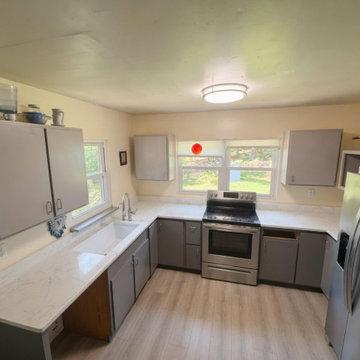
We put MSI Calacatta Aidana quartz into a kitchen out in Hopkins, and it's the kind of stone that changes how a room feels the day it goes in. Aidana's got that bright white background with soft veining moving through it, the kind of pattern that reads clean and calm from across the room but still has movement when you get up close to it. For a kitchen that gets used every day, that's exactly what you want. It doesn't compete with cabinets or fight the light coming through the windows, it just sits there looking good year after year.
Quartz like this is engineered, so the slabs come off the line consistent. That matters more than people think when you're templating a kitchen with a lot of linear footage, corners, and a sink cutout to deal with. We're not chasing a wild vein across a seam or hoping two slabs happen to match. The veining in Aidana is soft enough that seams disappear into the field instead of announcing themselves, and that's a craftsmanship thing as much as a material thing. Getting a seam tight and a pattern lined up right takes patience at the saw and patience setting it, not just a good slab to start with.
The kitchen itself got the full treatment, counters and an eased edge, which is the right call for a stone with this kind of quiet pattern. An eased edge keeps the eye on the surface and the veining instead of on the edge detail, and it's a practical choice too, it holds up well and doesn't chip the way a sharper profile can over time.
Day to day, this is a stone that just works. Quartz doesn't need sealing, it resists staining better than natural stone, and it shrugs off the usual kitchen abuse, knives set down too hard, hot pans set too close, kids leaning on the counter doing homework. It's a surface built for a family that actually cooks and lives in the space rather than one that's roped off for company.
Hopkins has been getting more of these kitchen jobs lately, and it's easy to see why homeowners out that way keep landing on Calacatta Aidana. It's a stone that photographs well and lives even better, bright and clean without being cold, and it gives a kitchen that finished, put-together look the moment you walk in.
 Rocky Tops Granite & Marble LLC
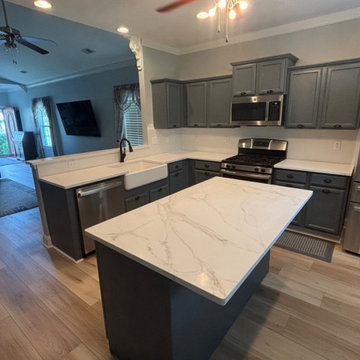
This kitchen with full height backsplash in Gaston came together in Calacatta Lilly, an engineered quartz from AG Stones that gives you that bright white background with soft gray and gold veining moving through it.
We used the same stone into the bathroom vanities too, so the whole house reads consistent without repeating the same room twice. Quartz like this is manufactured under controlled conditions, so the veining pattern is engineered to look natural while staying more predictable slab to slab than a lot of natural stone.
That consistency matters most in a kitchen, where the counters are doing the real work every day. Calacatta Lilly holds up to knives, hot pans, and the general chaos of cooking without needing much babying. It's non-porous, so there's no sealing schedule to keep track of, no worrying about a glass of wine sitting too long or lemon juice etching a ring into the surface. You wipe it down and move on with your life.
Getting the look right across a kitchen this size takes some care at the template stage. We're matching veining direction across the island, the perimeter, and working out where the seams fall so they land somewhere quiet, not right in your line of sight. With a manufactured stone like this, the pattern repeats in a way that actually helps us keep that continuity, but it still takes a careful eye to lay it out so the kitchen looks like one continuous piece rather than a handful of slabs pieced together.
In the bathroom, that same white and gray palette does something different. Vanities don't take the abuse a kitchen counter does, so the quartz there is more about keeping a clean, bright look day after day with almost zero maintenance. We finished both spaces with an eased edge, simple and clean, letting the stone itself carry the room instead of the edge detail.
Gaston sits right in that stretch of the Midlands where we do a lot of our work, and it's always good to get out there and put a stone like this into a house. Calacatta Lilly gives this kitchen and bath a bright, cohesive look that's going to hold up fine to daily life for a long time to come.
 Rocky Tops Granite & Marble LLC
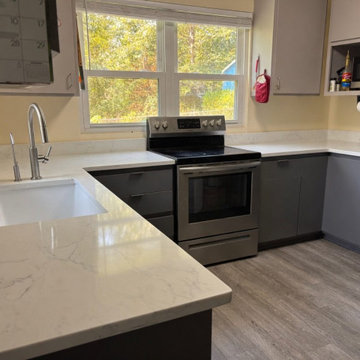
We put MSI Calacatta Aidana quartz into a kitchen out in Hopkins, and it's the kind of stone that changes how a room feels the day it goes in. Aidana's got that bright white background with soft veining moving through it, the kind of pattern that reads clean and calm from across the room but still has movement when you get up close to it. For a kitchen that gets used every day, that's exactly what you want. It doesn't compete with cabinets or fight the light coming through the windows, it just sits there looking good year after year.
Quartz like this is engineered, so the slabs come off the line consistent. That matters more than people think when you're templating a kitchen with a lot of linear footage, corners, and a sink cutout to deal with. We're not chasing a wild vein across a seam or hoping two slabs happen to match. The veining in Aidana is soft enough that seams disappear into the field instead of announcing themselves, and that's a craftsmanship thing as much as a material thing. Getting a seam tight and a pattern lined up right takes patience at the saw and patience setting it, not just a good slab to start with.
The kitchen itself got the full treatment, counters and an eased edge, which is the right call for a stone with this kind of quiet pattern. An eased edge keeps the eye on the surface and the veining instead of on the edge detail, and it's a practical choice too, it holds up well and doesn't chip the way a sharper profile can over time.
Day to day, this is a stone that just works. Quartz doesn't need sealing, it resists staining better than natural stone, and it shrugs off the usual kitchen abuse, knives set down too hard, hot pans set too close, kids leaning on the counter doing homework. It's a surface built for a family that actually cooks and lives in the space rather than one that's roped off for company.
Hopkins has been getting more of these kitchen jobs lately, and it's easy to see why homeowners out that way keep landing on Calacatta Aidana. It's a stone that photographs well and lives even better, bright and clean without being cold, and it gives a kitchen that finished, put-together look the moment you walk in.
 Rocky Tops Granite & Marble LLC
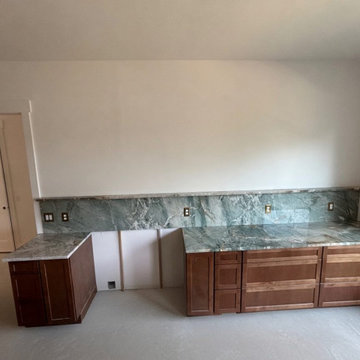
Tiffany Crystal quartzite is one of those stones that earns its keep in a kitchen. It's got that cool, crystalline background, whites and grays moving quietly across the surface with enough sparkle in the light to keep it from feeling flat. It reads clean and bright without going stark, which is why it works so well in a kitchen where people actually cook and gather, not just admire counters from across the room.
Quartzite is real stone, not engineered, so it comes with natural hardness that holds up to daily kitchen abuse. It resists scratching and handles heat well, though we still tell folks to use a trivet, because no counter needs a hot pan set straight on it just to prove a point. Sealing it right after install and keeping up with it over the years keeps the surface performing the way it should, and Tiffany Crystal takes a seal well because of its tight, dense structure.
Fabricating a slab like this takes some care in the layout. We spend real time bookmatching and dry-fitting pieces so the movement in the stone flows across seams instead of fighting itself at the corners. On a kitchen island or a run of perimeter counters, getting that continuity right is what separates a good installation from one that just gets the measurements correct. We kept the edge eased here, which is the right call on a stone with this much personality. It doesn't need extra shaping to draw the eye, the stone's already doing that work.
Day to day, this is a kitchen counter that's going to live hard and look good doing it. Quartzite shrugs off knife marks, stands up to acidic spills, and cleans up with regular dish soap and water. It's the kind of surface you stop babying after the first few months because it simply holds up.
Jobs like this one in Lexington are what we like seeing come through the shop. It's a straightforward kitchen application done with a stone that's got real depth to it, installed by people who care about how the seams and the veining line up when the job's done. That's the kind of work that keeps the Midlands trade honest.
 Rocky Tops Granite & Marble LLC
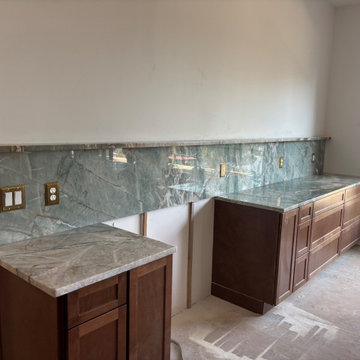
Tiffany Crystal quartzite is one of those stones that earns its keep in a kitchen. It's got that cool, crystalline background, whites and grays moving quietly across the surface with enough sparkle in the light to keep it from feeling flat. It reads clean and bright without going stark, which is why it works so well in a kitchen where people actually cook and gather, not just admire counters from across the room.
Quartzite is real stone, not engineered, so it comes with natural hardness that holds up to daily kitchen abuse. It resists scratching and handles heat well, though we still tell folks to use a trivet, because no counter needs a hot pan set straight on it just to prove a point. Sealing it right after install and keeping up with it over the years keeps the surface performing the way it should, and Tiffany Crystal takes a seal well because of its tight, dense structure.
Fabricating a slab like this takes some care in the layout. We spend real time bookmatching and dry-fitting pieces so the movement in the stone flows across seams instead of fighting itself at the corners. On a kitchen island or a run of perimeter counters, getting that continuity right is what separates a good installation from one that just gets the measurements correct. We kept the edge eased here, which is the right call on a stone with this much personality. It doesn't need extra shaping to draw the eye, the stone's already doing that work.
Day to day, this is a kitchen counter that's going to live hard and look good doing it. Quartzite shrugs off knife marks, stands up to acidic spills, and cleans up with regular dish soap and water. It's the kind of surface you stop babying after the first few months because it simply holds up.
Jobs like this one in Lexington are what we like seeing come through the shop. It's a straightforward kitchen application done with a stone that's got real depth to it, installed by people who care about how the seams and the veining line up when the job's done. That's the kind of work that keeps the Midlands trade honest.
 Rocky Tops Granite & Marble LLC
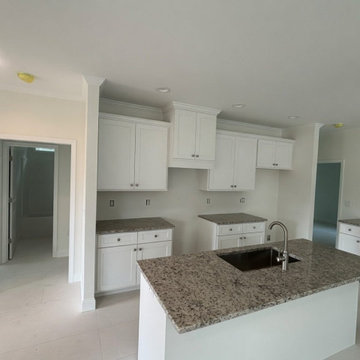
This kitchen in Bamberg came together in Dallas White granite, a stone that reads clean and bright without going stark. The background carries soft grays with subtle movement through it, enough character to keep the eye interested but calm enough to work with just about any cabinet color a builder picks for a spec house like this one. That's part of why it gets used so often in kitchens meant to show well and live well at the same time.
Granite's still one of the best choices you can make for a kitchen countertop, and Dallas White in particular holds up the way granite's supposed to. It's dense, it resists heat, and you can set a hot pan on it without worrying about scorching. Scratches aren't a concern with normal use, and the surface takes a polish that lasts for years. We seal it going in and that's about all the maintenance it ever needs.
Getting a granite slab like this into a kitchen right takes more than just cutting to size. We template the space first to make sure the seams land where they won't draw attention, usually tucked near the sink or stove, and any countertop longer than about 8 to 9 feet is going to need one. Matching the pattern across a seam so it reads as one continuous piece is where the work actually happens. The edge here is eased, a clean, simple line that lets the stone itself do the talking instead of competing with it.
Day to day, this is the kind of countertop that just works. Wipe it down, don't worry about it, and it'll look the same ten years from now as it does today. That durability is exactly what a spec house kitchen needs, something that shows well to a buyer walking through and keeps performing long after they've moved in.
We do a lot of work through the Midlands, and Bamberg jobs like this one are a good example of what granite still does better than almost anything else on the market. It's a straightforward material that never stops earning its keep in a kitchen, and this one turned out exactly the way it should.
 Rocky Tops Granite & Marble LLC
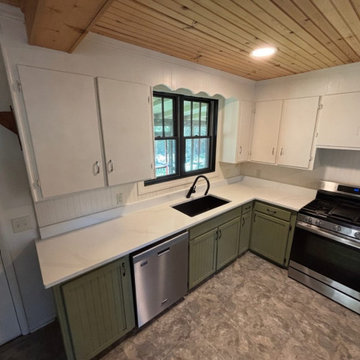
We put MSI Calacatta Elysio into a kitchen in Columbia, and it's one of those quartzes that just works in a room where people actually cook and live. Elysio's an engineered quartz manufactured right here in the great state of South Carolina. It features a bright clean background with soft gray and gold veining moving through it, the kind of look that reads calm from across the room but still gives you something to study up close at the counter.
Engineered quartz like this is consistent in a way natural stone just can't be. Every slab off the line looks close enough to the next that we're not fighting to match veining across seams or worrying about a wild vein hitting the sink cutout wrong. That consistency matters in a kitchen with multiple runs of counter, because the eye catches it immediately if the pattern jumps from one section to the next. Templating still has to be dead on, and we take the time at the seams to keep that veining looking like it keeps moving instead of stopping and starting over.
Day to day, Elysio holds up the way good quartz should. It doesn't need sealing, it resists stains from coffee, wine, and the everyday mess of a working kitchen, and it shrugs off scratches better than people expect. We still tell folks to use a trivet for hot pans straight off the stove, just good practice with any engineered surface. The edge is eased, clean and simple, the kind of detail you settle on at the end and then don't think about again because it just looks right.
Columbia kitchens see a lot of real use, families cooking, kids doing homework at the island, company gathered around while dinner's going. A quartz like Elysio fits that life. It's bright enough to open the room up, patterned enough to keep from looking flat, and tough enough that it's still going to look this good years from now. That's what we're after on every job in the Midlands, something that looks sharp walking in and keeps earning its keep long after we've packed up the tools.
 User
The living room furniture wasn’t doing our clients any favours. The comfort they once sought in the room had turned to lethargy, and they wanted to liven things up. (When the sag in your sofa turns you into a human burrito, it’s time to let go.) Before we brought in the new, however, we wanted to focus on functionality. How was the space going to be used? Our clients love to host casual get togethers with family and friends, and they love a family movie night, so we knew ample seating was a must-have.
We also wanted to make the living room feel as big as it actually is. Something to note: Let your furniture breathe! Allow for plenty of clearance between your furniture; don’t fill up your space with furniture just because the space allows for it. We got rid of the bookshelf and console table behind the sofa, which opened up the space for entertaining or for movie nights. Our clients now have room for a Christmas tree in the corner! Now the space is modern, purposeful, and oh so cozy! We stopped at nothing to make this living room feel as inviting as possible. The detailed tile in the fireplace, the textures in the accessories and pillows, and the various wood tones all work together to create comfort and style. And please don’t worry about mixing wood tones. When done with the right balance, the different shades will add warmth and depth to any space.
Ottomans are the perfect way to maximize seating and comfort. They can be used for extra seating or pulled over to a sofa to rest the legs for maximum lounging. Now that there’s plenty of clearance between the cocktail table and sofas, our clients have the space to move these versatile pieces around.
Thank you for visiting! We’re always honoured to share our transformed and updated homes! We hope you love this cozy living room as much as our clients do. If you have any questions about this project, feel free to ask us in the Comments below!
 Rocky Tops Granite & Marble LLC
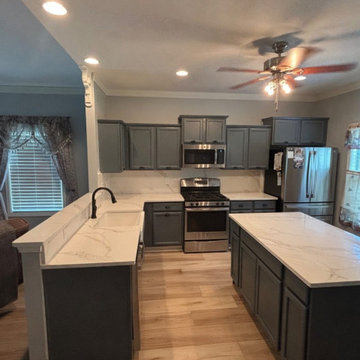
This kitchen with full height backsplash in Gaston came together in Calacatta Lilly, an engineered quartz from AG Stones that gives you that bright white background with soft gray and gold veining moving through it.
We used the same stone into the bathroom vanities too, so the whole house reads consistent without repeating the same room twice. Quartz like this is manufactured under controlled conditions, so the veining pattern is engineered to look natural while staying more predictable slab to slab than a lot of natural stone.
That consistency matters most in a kitchen, where the counters are doing the real work every day. Calacatta Lilly holds up to knives, hot pans, and the general chaos of cooking without needing much babying. It's non-porous, so there's no sealing schedule to keep track of, no worrying about a glass of wine sitting too long or lemon juice etching a ring into the surface. You wipe it down and move on with your life.
Getting the look right across a kitchen this size takes some care at the template stage. We're matching veining direction across the island, the perimeter, and working out where the seams fall so they land somewhere quiet, not right in your line of sight. With a manufactured stone like this, the pattern repeats in a way that actually helps us keep that continuity, but it still takes a careful eye to lay it out so the kitchen looks like one continuous piece rather than a handful of slabs pieced together.
In the bathroom, that same white and gray palette does something different. Vanities don't take the abuse a kitchen counter does, so the quartz there is more about keeping a clean, bright look day after day with almost zero maintenance. We finished both spaces with an eased edge, simple and clean, letting the stone itself carry the room instead of the edge detail.
Gaston sits right in that stretch of the Midlands where we do a lot of our work, and it's always good to get out there and put a stone like this into a house. Calacatta Lilly gives this kitchen and bath a bright, cohesive look that's going to hold up fine to daily life for a long time to come.
 Rocky Tops Granite & Marble LLC
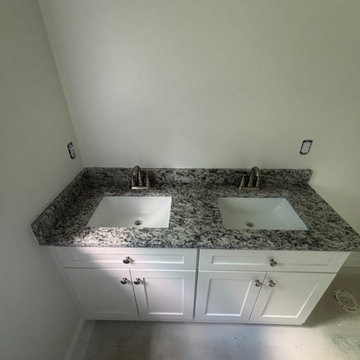
This kitchen in Bamberg came together in Dallas White granite, a stone that reads clean and bright without going stark. The background carries soft grays with subtle movement through it, enough character to keep the eye interested but calm enough to work with just about any cabinet color a builder picks for a spec house like this one. That's part of why it gets used so often in kitchens meant to show well and live well at the same time.
Granite's still one of the best choices you can make for a kitchen countertop, and Dallas White in particular holds up the way granite's supposed to. It's dense, it resists heat, and you can set a hot pan on it without worrying about scorching. Scratches aren't a concern with normal use, and the surface takes a polish that lasts for years. We seal it going in and that's about all the maintenance it ever needs.
Getting a granite slab like this into a kitchen right takes more than just cutting to size. We template the space first to make sure the seams land where they won't draw attention, usually tucked near the sink or stove, and any countertop longer than about 8 to 9 feet is going to need one. Matching the pattern across a seam so it reads as one continuous piece is where the work actually happens. The edge here is eased, a clean, simple line that lets the stone itself do the talking instead of competing with it.
Day to day, this is the kind of countertop that just works. Wipe it down, don't worry about it, and it'll look the same ten years from now as it does today. That durability is exactly what a spec house kitchen needs, something that shows well to a buyer walking through and keeps performing long after they've moved in.
We do a lot of work through the Midlands, and Bamberg jobs like this one are a good example of what granite still does better than almost anything else on the market. It's a straightforward material that never stops earning its keep in a kitchen, and this one turned out exactly the way it should.
 Rocky Tops Granite & Marble LLC
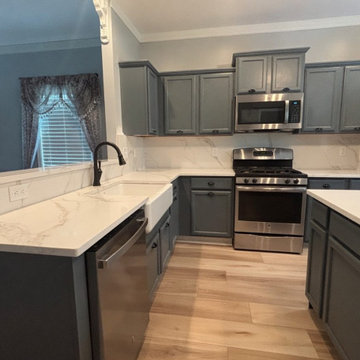
This kitchen with full height backsplash in Gaston came together in Calacatta Lilly, an engineered quartz from AG Stones that gives you that bright white background with soft gray and gold veining moving through it.
We used the same stone into the bathroom vanities too, so the whole house reads consistent without repeating the same room twice. Quartz like this is manufactured under controlled conditions, so the veining pattern is engineered to look natural while staying more predictable slab to slab than a lot of natural stone.
That consistency matters most in a kitchen, where the counters are doing the real work every day. Calacatta Lilly holds up to knives, hot pans, and the general chaos of cooking without needing much babying. It's non-porous, so there's no sealing schedule to keep track of, no worrying about a glass of wine sitting too long or lemon juice etching a ring into the surface. You wipe it down and move on with your life.
Getting the look right across a kitchen this size takes some care at the template stage. We're matching veining direction across the island, the perimeter, and working out where the seams fall so they land somewhere quiet, not right in your line of sight. With a manufactured stone like this, the pattern repeats in a way that actually helps us keep that continuity, but it still takes a careful eye to lay it out so the kitchen looks like one continuous piece rather than a handful of slabs pieced together.
In the bathroom, that same white and gray palette does something different. Vanities don't take the abuse a kitchen counter does, so the quartz there is more about keeping a clean, bright look day after day with almost zero maintenance. We finished both spaces with an eased edge, simple and clean, letting the stone itself carry the room instead of the edge detail.
Gaston sits right in that stretch of the Midlands where we do a lot of our work, and it's always good to get out there and put a stone like this into a house. Calacatta Lilly gives this kitchen and bath a bright, cohesive look that's going to hold up fine to daily life for a long time to come.
 AYDIN Hides
Luxury – Prestige – Status
KEY FEATURES
Hand Made in Europe
Hand-Made by 3rd. generation of Aydin family.
Premium Quality
Hand lined bottom
Hand stitching
100% genuine cowhide leather
European (Balkan) breed animals
Each product is BRANDED with serial number and Craftsmanship seal.
Hides used for making Patchworks are sourced ethically and humanely and 100% as byproduct of meat production
Animals are free-range raised, sustainable sourced mainly on mountain pastures of Eastern Europe.
Animal skins are endemic to breeds specific for Eastern European region.
Skins ARE NOT processed by mass processing facility, but rather family owned business with "Old Craft" certificate. This means that such business falls in "Traditional" category of business.
All skins are hand processed using solutions with the P.H value of drinking water.
Skins are processed in small batches, usually 5-10 at the time, in order for skin to preserve, to the greatest extend, its natural distinctions and quality.
NOTE: The photo on this page represents design and style of this rug and IT IS AN IMAGE OF ACTUAL product you will receive. All rug sizes are approximate. Due to the difference of monitor colors, some rug colors may vary slightly.
NOTE: Few products may contain some natural flaws due to conditions inherent to natural animal products (scratches, insect bites, wrinkles, cuts, etc.) that will be discretely repaired. Please note that we do not wedge our cowhides but we rather discretely stitch and repair. Such flaws are acceptable for this type of product, since it represents the life of the animal to the fullest possible extent.
 Rocky Tops Granite & Marble LLC
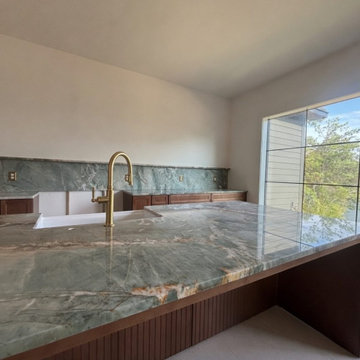
Tiffany Crystal quartzite is one of those stones that earns its keep in a kitchen. It's got that cool, crystalline background, whites and grays moving quietly across the surface with enough sparkle in the light to keep it from feeling flat. It reads clean and bright without going stark, which is why it works so well in a kitchen where people actually cook and gather, not just admire counters from across the room.
Quartzite is real stone, not engineered, so it comes with natural hardness that holds up to daily kitchen abuse. It resists scratching and handles heat well, though we still tell folks to use a trivet, because no counter needs a hot pan set straight on it just to prove a point. Sealing it right after install and keeping up with it over the years keeps the surface performing the way it should, and Tiffany Crystal takes a seal well because of its tight, dense structure.
Fabricating a slab like this takes some care in the layout. We spend real time bookmatching and dry-fitting pieces so the movement in the stone flows across seams instead of fighting itself at the corners. On a kitchen island or a run of perimeter counters, getting that continuity right is what separates a good installation from one that just gets the measurements correct. We kept the edge eased here, which is the right call on a stone with this much personality. It doesn't need extra shaping to draw the eye, the stone's already doing that work.
Day to day, this is a kitchen counter that's going to live hard and look good doing it. Quartzite shrugs off knife marks, stands up to acidic spills, and cleans up with regular dish soap and water. It's the kind of surface you stop babying after the first few months because it simply holds up.
Jobs like this one in Lexington are what we like seeing come through the shop. It's a straightforward kitchen application done with a stone that's got real depth to it, installed by people who care about how the seams and the veining line up when the job's done. That's the kind of work that keeps the Midlands trade honest.
 Tile Doctor Ltd
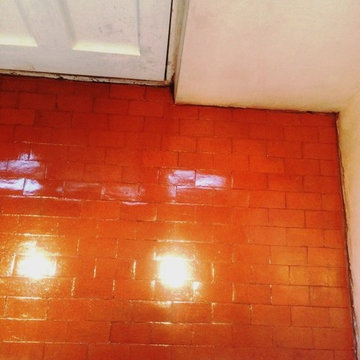
Here’s a quick job I completed in the coastal town of Eastbourne in East Sussex. While more commonly I am asked to work on entire floors, this customer was specifically interested in restoring a small doorway-like area with Quarry tiled flooring, the reason being that it had been covered for a long time by an old wardrobe and dog basket. As a result, the area had not been properly cared for, becoming very dusty and dirty. Also revealed were some unsightly splashes of white paint from previous decoration work.
The customer was keen to finally give this area of the floor the attention it needed, and so asked me to come in to provide a thorough clean and lay down some fresh sealer.
My first task was actually to relocate the old wardrobe and dog basket to the garage to get the area ready for cleaning. Then, to begin the cleaning process, I stripped away any old existing sealer and the white paint splashes by using Tile Doctor Remove & Go stripper in combination with a wire brush. Remove & Go is a versatile product that can also be used to break down glues and other adhesives.
I then washed the area down with water and promptly vacuumed up any moisture, before sitting down with a heat gun for an hour to dry the tiles. Usually a floor should be left for up to 48 hours to dry completely before sealing, but in this case the area was so small that I was able to dry it in the space of an hour.
Nonetheless, I opted to install a fan and leave the floor for an extra hour over lunch to ensure any excess moisture was removed. This is really important to do before sealing, as any remaining moisture can cloud the sealer and damage its performance.
To complete the restoration, I sealed the tiles using nine coats of the topical, water-based sealer Seal & Go, which is suitable for building up surface protection against dirt and stains on internal unsealed porous surfaces such as Victorian, Quarry and Sandstone tiles. The Quarry tiles were quite porous, which is not uncommon for Quarry Tiles and really soaked up the sealer.
As the photographs show, the results of the restoration were very good, with smiles all round – including from the slightly bemused family dog!
Rupert Mcleod
East Sussex Tile Doctor
125