
Search results for "Authorities account" in Home Design Ideas


 Ky-Kan Coatings
Concrete can be made to look like any substance. Tile, stone, wood, brick, etc. With unlimited color options, Ky-Kan Coatings can transform any room in your home or business using lightweight, beautiful concrete.

 Zelaya Properties LLC
We used: Custom cherry cabinetry in Arts & Crafts Shaker style by Kabinart in Boulder and Espresso stains. Liberty Hardware Venetian bronze 1-1/2" cabinet knobs. KitchenAid Architect II Series 22 CF counter-depth French door refrigerator. KitchenAid Architect Series II 27" convection single wall oven. KitchenAid 36" 6-burner dual fuel freestanding commercial-style range. KitchenAid Architect II Series 24" dishwasher. Sharp Insight Pro Series 24" built-in microwave drawer (Model #KB6524PS). Crystorama Solaris 12" wide pendant lights in English bronze. Granite countertops in Brown Fantasy. 3"x6" polished marble backsplash.
Paint colors:
Walls: Glidden Silver Cloud 30YY 63/024
Ceilings/Trims/Doors: Glidden Swan White GLC23
Robert B. Narod Photography
Find the right local pro for your project
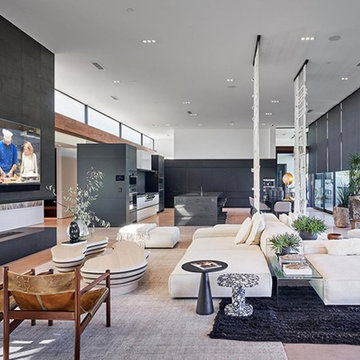
 Electronic Design & Consulting, Inc.
This article is posted here with the consent of the author. The views and opinions expressed in this article are those of the author and do not necessarily reflect the official policy, position, view, or opinion of Crestron Electronics, Inc., or of any of its employees. Crestron Electronics is not responsible for, and does not verify the accuracy of, any of the information contained in this article.
By Jeff Singer
The “smart” revolution began several years ago with smartphones (a.k.a phones) and has extended in recent years to thermostats, doorbells, alarm systems, and kitchen appliances. Smart devices are so ubiquitous that the term “smart” is overused to the point that it is almost meaningless. Companies are eager to jump on the bandwagon and claim their products are “smart,” and consumers proudly claim they have a smart home because they have lighting control. Misconceptions about smart homes are prevalent and create confusion in the marketplace. This can have deleterious effects on businesses and underserve consumers. Here are seven of the most popular misconceptions about smart homes:
1. Apps are smart
Apps are convenient and easy to use. Yes, it seems there’s an app for everything. People expect to be able to download an app and do just about anything. App developers and many companies do not disavow consumers of this myth. On the contrary, they promote this idea with carefully worded descriptions. The promise of having the world at your fingertips for $1.99 is very enticing. Although it sounds too good to be true, it is also too good to pass up for many people. This leads to undervaluing home control and disappointment when the apps don’t work, which undermines confidence in our industry. The fact is that apps are not smart. They do not control anything. They must connect to and communicate with a control system or cloud service that processes, prioritizes, and executes commands. That’s the real magic and what most people do not understand.
2. Smart devices work together
With so many smart appliances and devices on the market today, it’s understandable that the average consumer might think that they actually communicate and work together. This is simply not the case. Smart devices are not that smart. They are designed and manufactured by different, often competing, companies. There are no national or industry standards governing these products. Even if they all operate using Wi-Fi® communications, that doesn’t mean they work together. Some companies promote a home control platform, which unites different devices from different companies – in theory. The platform is yet another third-party software totally dependent on other companies developing APIs and writing control modules for their hardware to run on that piece of software. The devices are not independently compatible. Also, when updates are made to either the hardware or the software, functionality may be affected for some period. That’s a nice way of saying the device or system won’t work and there’s no way of knowing for how long.
3. It’s a DIY project
Which brings us to the next myth, which is that the average person can do it themselves. Unless you are a skilled professional, I would not advise taking on a smart home project. You want to make a light turn on and off with your Alexa® or Google Assistant™ virtual assistant software, go for it. A smart home takes much more planning and expertise. I have no problem changing a light bulb or hanging a light fixture in my dining room; however, I am not going to rewire my house. I may change the flush valve in my toilet, but I’m not going to replace the pipes in my house. You get it. Integrating devices and systems, establishing different zones, creating scenes, designing the UI with a balance between control, feedback, and simplicity – all takes experience and skill.
4. Need a programmer to make changes
Early adopters may have experienced the pain of trying to make a simple change or update to their home control system. Years ago, if the cable provider changed the channel line-up, the homeowner would have to call the dealer or programmer to make an appointment for them to come out to the house to reprogram the system. The system wouldn’t work as expected until it was updated, which often took several days and beaucoup bucks. Not anymore. Technology has evolved so now it’s easy for system owners to change favorite channels, create scenes, rename buttons, update images, and more. While a professional is needed for the initial installation and setup, the system is easy to manage once it’s up and running. This makes life so much easier for both dealer and customer.
5. Tech becomes obsolete quickly
Similar to updating the UI, updating firmware or hardware used to be a stressful process. A smart home should be intelligent enough to update itself. Apps don’t become obsolete. Updates are constantly pushed out from the cloud, making them better all the time. The same is true for a good smart home system. New features, functions, and device support gets added in the background consistently, so the system you installed (or purchased) yesterday gets better over time. Swapping out decorative elements, such as keypads, dimmers, and touch screens is also seamless. When a new device is added, all the settings are pulled down from the cloud and it just works. No system interruptions. No sunk costs. No imposing house calls. No surprise bills.
6. Lighting control saves energy and money
Lighting control is one of the most popular smart systems, but it takes more than just one system to make a home smart. On the surface, it makes sense that if you dim the lights ten percent, then you save ten percent of energy costs. If the shades are raised during the day to take advantage of sunlight so the lights don’t need to be on (or at least not 100%), but that causes the room temperature to rise a few degrees, which triggers the air conditioner to run longer and more often, was energy usage (or cost) reduced? A smart home integrates all the various systems and technology to optimize comfort, convenience, safety, and sometimes energy.
7. Home technology is easy to hack
Security is at the forefront of people’s minds these days. Personal identities are stolen; email accounts hacked; private photos publicized; and more. A smart home must outsmart those who don’t respect privacy. Crestron control systems adhere to the strictest security standards. The same Crestron control system that goes into a home is also installed in secure government and military facilities, global banking institutions, hospitals, and other mission critical applications. When installed correctly by a trained professional, a Crestron smart home is the gold standard for security, comfort, and convenience.

 Moderne Builders
Gorgeous master bath with dramatic retro "wave" tile. Peak Photography
Example of a 1950s bathroom design in Los Angeles
Example of a 1950s bathroom design in Los Angeles

 Homestead Doors, Inc.
Door #10
FP3190
Flat 3 Panel Interior Door with Farmhouse Sticking
Solid Poplar stiles and rails
MDF panels
Painted White
1 x 4 door casing
1 x 6 baseboard
Bravura 336B door knob
Call us for a quote on your door project
419-684-9582
Visit https://www.door.cc
 highland
Plumbing issues rarely occur at a convenient moment. When selecting whom to install plumbing in Melbourne homes, one must find someone who is licensed, readily available and has the right to tell you the costs upfront before work is commenced. This guide includes what to look at prior to hiring a plumber melbourne and common hiring mistakes to avoid.
Explaining how to choose the right plumber Melbourne homeowners
Why choosing the right plumber matters
Poor plumbing repair may be more expensive to repair than the original problem. Experience, licensing, and communication are also all issues that impact on a job being done right the first time round. A few minutes checking credentials will save later on down the line. Difficult hiring choices may result in:
● Repeat callouts: Incomplete repairs, which fail once again in the matter of weeks, necessitate a visit by another tradesperson, and additional expense. ● Hidden charges: Unclear price estimates that become unexpected bills after the project has begun. ● Property damage: Rushing or unlicensed work that causes damage to pipes, fittings and adjacent walls and floors.
Check licensing and qualifications first
All plumbers operating in Victoria have to have the valid licence issued by the Building and Plumbing Commission. Licensing validates the formal training as well as legal responsibility of the work done. This is checked within a few minutes prior to securing any job. Pre-hiring ensure the following before the hiring:
● Licence number: A registered plumber is able to issue a licence number which is confirmed by the appropriate authority. ● Insurance coverage: Public liability insurance insures the property in the case of damage at the time of plumbing work. ● Trade specialization: Gas fitting and hot water work need to be covered by certain qualifications other than, in general, a plumbing licence. ● Membership bodies: The association with established industry organizations is usually an indication of continued training and accountability benchmarks.
Ask about availability and response time
Plumbing emergencies do not follow business hours. An explosion of a pipe or gas break should be addressed immediately, irrespective of the days or the time of the day. Skill is no more crucial than availability in the matter of picking a plumber. Some useful questions to ask before making a reservation are:
● Emergency availability: Checking that the callouts are not provided on weekends, evenings or during public holidays with long delays. ● Response time: Inquiring about the speed at which a plumber can commonly arrive to address an emergency in the house under contact. ● Call-out fee: An explanation of whether or not a call-out fee is charged and whether or not the fee is waived when the work is carried out. ● Service area: In this case, it will be necessary to check whether the plumber visits the given suburb of Melbourne on a regular basis.
Understand pricing before work begins
The most frustrating aspect among the plumbing customers is unclear pricing. An honest plumber discusses prices and alternatives with him/her prior to commencing any job. Written quotes insure the homeowner and the tradesperson. Fair pricing practices normally involve:
● Fixed quotes: An open quote properly quoted and then inspected, not an hourly estimate. ● Written breakdowns: Detailed expenses showing labour, materials as well as any other expenses prior to beginning of work. ● No pressure tactics: Time to study the options without requesting a decision to be made immediately on-site. ● Transparent extras: All other costs including after-hours costs would be explicitly known prior to the job.
Common errors one should not make when employing a plumber
Hasty judgments made in the plumbing crisis tended to come back to bite. The failure to do basic checks may lead to low-quality workmanship or high prices. Most frequent hiring issues are avoided with a brief wait before making a booking. Frequent mistakes include:
● Skipping licence checks: Recruiting solely on price without first ensuring they are properly licensed and insured. ● Accepting verbal quotes only: Accepting oral estimates rather than writing down, making itemised price explanations. ● Ignoring reviews: Finding a plumber without examining customer feedback in the past few reviews on different independent review sites. ● Overlooking guarantees: Not enquiring of work done, whether it comes with any part or labour warranty.
A look at the frequently asked questions
What is the average price of a Melbourne plumber?
Prices are depending on the type of job hence a written estimate is always advisable.
Is a call-out fee always charged?
Not necessarily; lots of plumbers cancel a charge after the job is done.
Is there a plumber who can do gas fitting?
No, the other licence qualification is a separate gas fitting licence qualification.
Is it necessary to base a hiring decision on reviews?
Yes, there are some patterns in the quality of reliability and workmanship according to recent reviews.
Is emergency plumbing available on weekends?
There are numerous certified plumbers who have emergency services available on weekends and after hours.

 Stained Glass Denver
The stained glass panels for the doors were designed in prairie style fashion. This look was made popular in the early 1900’s by famous architect Frank Lloyd Wright. Wright was known for creating designs that took the entire room into account as opposed to focusing on one aspect. The geometric shapes and thick leaded lines that you see here were very typical of his designs. Though prairie styles originated nearly one hundred years ago, they continue to remain popular today among art enthusiasts and have a powerful influence on modern architecture.
You too can bring the look of Frank Lloyd Wright artwork into your home with prairie style stained glass from Stained Glass Denver. We work with local artisans that are very talented in creating a wide range of stained glass designs. Not only can stained glass enhance the physical appearance of your home, but it can also increase its resale value and provide your family with privacy. To learn more about what we can do for your home, just contact our office. We look forward to working with you on your next home improvement project.

 CairnsCraft Design & Remodel
Great spacious bathroom with lot of amenities.
Photographer: Jon Upson
Large elegant master beige tile and porcelain tile drop-in bathtub photo in San Diego with an undermount sink, raised-panel cabinets, medium tone wood cabinets, granite countertops, beige walls and a two-piece toilet
Large elegant master beige tile and porcelain tile drop-in bathtub photo in San Diego with an undermount sink, raised-panel cabinets, medium tone wood cabinets, granite countertops, beige walls and a two-piece toilet

 GS Construction
Example of a small classic 3/4 white tile and stone tile mosaic tile floor alcove shower design in Chicago with an undermount sink, recessed-panel cabinets, black cabinets, quartzite countertops, a two-piece toilet and gray walls


 Simple Steps
This modern bathroom wall is a very dark grey tile made from recycled stone dust. Its color is PB 3106 Dark Grey and is in the brushed texture.
Example of a mid-sized minimalist master gray tile and stone tile bathroom design in Miami with gray walls
Example of a mid-sized minimalist master gray tile and stone tile bathroom design in Miami with gray walls


 Stonelace Designs
Originally, the exterior of the Napa ranch residence was a standard knocked down stucco finish. We covered over the entire exterior of the house with a natural plaster product that has been made in Italy for centuries, known as Rialto or Vero. This product is a combination of slaked lime mixed with 60% reconstituted crushed marble dust. Quarried from the legendary Carrara marble mines. The finish itself is a vertically combed striated texture embedded into the plaster. While it cures, a transparent group of patinas are applied to the stone-like plaster substance to create a look of an aged villa.

 Village Home Stores
Full-overlay Rustic Beech cabinets in the "Charleston" door style and "Briarwood" finish.
Village Home Stores
Example of a large mountain style kitchen design in Chicago
Example of a large mountain style kitchen design in Chicago


 Concepts The Cabinet Shop
Morgan Albers
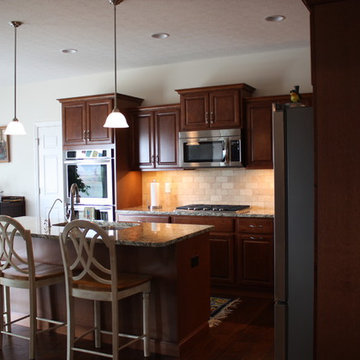
Eat-in kitchen - mid-sized traditional l-shaped dark wood floor eat-in kitchen idea in Indianapolis with an undermount sink, raised-panel cabinets, medium tone wood cabinets, granite countertops, beige backsplash, stainless steel appliances and an island
Eat-in kitchen - mid-sized traditional l-shaped dark wood floor eat-in kitchen idea in Indianapolis with an undermount sink, raised-panel cabinets, medium tone wood cabinets, granite countertops, beige backsplash, stainless steel appliances and an island

 The Bodily Works
Example of a mid-sized transitional enclosed carpeted and beige floor home theater design in Salt Lake City with gray walls and a wall-mounted tv

 Root Design Company.com
Landscape & Pool Design: Root Design Company
Photo credits: Jessica Carr
Design ideas for a mediterranean landscaping in Austin.
Design ideas for a mediterranean landscaping in Austin.


2