
Search results for "Biology" in Home Design Ideas

 Advanced Tech Systems
A sleek, wireless bedside keypad gives this homeowner control of lights in the master suite and throughout the house. (Look on the left nightstand)
Inspiration for a mid-sized contemporary master light wood floor and beige floor bedroom remodel in Raleigh with beige walls and no fireplace
Inspiration for a mid-sized contemporary master light wood floor and beige floor bedroom remodel in Raleigh with beige walls and no fireplace
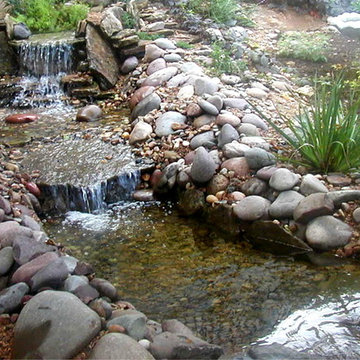
 Texas Ponds and Water Features, LLC
The first residential pond project taken on by our founder back in 2000. Our style has changed, but our commitment to trying to replicate nature has not. the waterfall contains and hides a Biofalls biological filter and the stream takes the filtered water back to the pond. As with all our ponds, Aquascape products were used throughout the entire project.
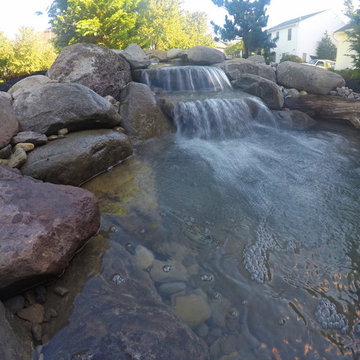
 C.E. Pontz Sons
A small backyard pond is a great way to turn a drab backyard into a relaxing oasis. As you can see from this small backyard pond project installed in Lancater, PA. This backyard pond project included installation of a Aquascape Ecosystem 8’x11′ Pond. The pond installation included low voltage underwater lighting and automatic dosing system. Automatic dosing systems help to maintain optimum water quality in your pond. Existing landscaping were the pond was to be installed was transplanted and reinstalled after pond construction was complete.
The secret behind building a low maintenance water feature is to develop a working ecosystem in your pond. A mechanical skimmer filter on the left of this diagram holds your pump and skims the surface of debris. The pump then transfers the water through a flexible PVC pipe to the biological biofalls on the right. With the help of beneficial bacteria the biofalls will clean the water and return it to the pond via the waterfall. The plants and fish work together to control excessive algae blooms. The gravel unlike a smooth pond liner provide surface area for beneficial bacteria to break down organic waste on the pond floor.
Find the right local pro for your project


 Rachel Loewen Photography
Rachel Loewen Photography © 2017 Houzz
Inspiration for a scandinavian living room remodel in Chicago
Inspiration for a scandinavian living room remodel in Chicago
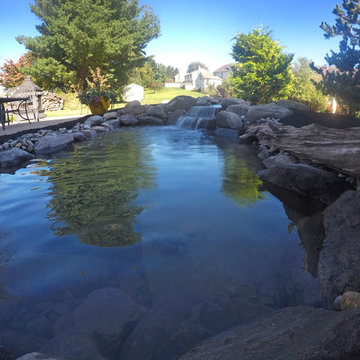 C.E. Pontz Sons
A small backyard pond is a great way to turn a drab backyard into a relaxing oasis. As you can see from this small backyard pond project installed in Lancater, PA. This backyard pond project included installation of a Aquascape Ecosystem 8’x11′ Pond. The pond installation included low voltage underwater lighting and automatic dosing system. Automatic dosing systems help to maintain optimum water quality in your pond. Existing landscaping were the pond was to be installed was transplanted and reinstalled after pond construction was complete.
The secret behind building a low maintenance water feature is to develop a working ecosystem in your pond. A mechanical skimmer filter on the left of this diagram holds your pump and skims the surface of debris. The pump then transfers the water through a flexible PVC pipe to the biological biofalls on the right. With the help of beneficial bacteria the biofalls will clean the water and return it to the pond via the waterfall. The plants and fish work together to control excessive algae blooms. The gravel unlike a smooth pond liner provide surface area for beneficial bacteria to break down organic waste on the pond floor.

 Sweet Smiling Landscape Design
When I came to this property not only was the landscape a scrappy mess the property also had some very real grading and drainage issues that were jeopardizing the safety of this house. As recent transplants from New Jerseys to Southern California these clients were in awe of all the plants they were seeing in their neighborhood. Living on the water at the Ventura harbor they wanted to be able to take full advantage or the outdoor lifestyle and cool ocean breeze. Being environmentally conscious citizens, these clients were very concerned that their garden was designed with sustainability as a leading factor. As they said in our initial consultation, “Would want or garden be part of the solution not part of the problem.”
This property is the last house on the bottom of a gently sloping street. All the water from the neighbor’s houses drain onto this property. When I came into this project the back yard sloped into the house. When it would rain the water would pool up against the house causing water damage. To address the drainage we employed several tactics. Firstly, we had to invert the slope in the back yard so that water would not pool against the house. We created a very minor slope going away from the house so that water drains away but so the patio area feels flat.
The back of the back yard had an existing retaining wall made out of shabby looking slump stone. In front of that retaining wall we created a beautiful natural stone retaining wall. This retain wall severs many purposes. One it works as a place to put some of the soil removed from the grading giving this project a smaller carbon foot print (moving soil of a site burns a lot of fossil fuel). The retaining wall also helps obscure the shabby existing retaining wall and allows for planting space above the footing from the existing retaining wall. The soil behind the ne retaining wall is slightly lower than the top of the wall so that when the run on water on from the neighbor’s property flows it is slowed down and absorbed before it has a chance to get near the house. Finally, the wall is at a height designed to serve as overflow seating as these clients intend to have occasional large parties and gatherings.
Other efforts made to help keep the house safe and dry are that we used permeable paving. With the hardscape being comprised of flag stone with gravel in-between water has a chance to soak into the ground so it does not flow into spots where it will pool up.
The final element to help keep the house dry is the addition of infiltration swales. Infiltration swales are depressions in the landscape that capture rain water. The down spouts on the sides of the houses are connected to pipe that goes under the ground and conveys the water to the swales. In this project it helps move rain water away from the house. In general, these Infiltration swales are a powerful element in creating sustainable landscapes. These swales capture pollutants that accumulate on the roof and in the landscape. Biology in the soil in the swales can break down these pollutants. When run of watered is not captured by soil on a property the dirty water flows into water ways and then the ocean were the biology that breaks down the pollutants is not as prolific. This is particularly important in this project as it drains directly into the harbor. The water that is absorbed in to the swales can replenish aquafers as well as increasing the water available to the plants planted in that area recusing the amount of water that is needed from irrigation.
When it came to the planting we went with a California friendly tropical theme. Using lots of succulents and plants with colorful foliage we created vibrant lush landscape that will have year around color. We planted densely (the images in the picture were taken only a month after installation). Taller drought tolerant plants to help regulate the temperature and loss of water from the plants below them. The dense plantings will help keep the garden, the house and even the neighborhood cooler on hot days, will provide spaces for birds to enjoy and will create an illusion of depth in a somewhat narrow space.
Today this garden is a space these homeowners can fully enjoy while having the peace of mind that their house is protected from flooding and they are helping the environment.
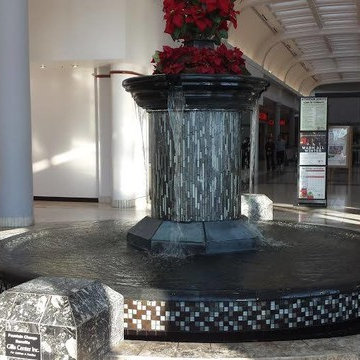
 Kansas City Landscape
>
Services
CATEGORIES OF SERVICES
~MEMORIAL FOUNTAINS KANSAS CITY
~ARCHITECTURAL POOL FOUNTAINS
KANSAS CITY
~SPRAY RINGS KANSAS CITY
~FLOATING FOUNTAINS KANSAS CITY
~ARCHITECTURAL FOUNTAINS KANSAS CITY
~INTERACTIVE FOUNTAINS KANSAS CITY
~STATUARY FOUNTAINS KANSAS CITY
~ROCK - BOULDER FOUNTAINS
KANSAS CITY
~WATERWALLS KANSAS CITY
~DISPLAY FOUNTAINS KANSAS CITY
~WATERFALL - FOUNTAINS KANSAS CITY
~RAINBARS AND RAIN CURTAINS
KANSAS CITY
~INTERIOR FOUNTAINS KANSAS CITY
~WATER FEATURE CONSTRUCTION
KANSAS CITY
~WATER FEATURE DESIGN AND
ENGINEERING KANSAS CITY
~CUSTOM FOUNTAIN FABRICATION
KANSAS CITY
-WATER FEATURE, FOUNTAIN, RAINBARS,
SPRAY RINGS, FLOATING FOUNTAINS
~BAPTISMAL FONT KANSAS CITY
~ARCHITECTURAL PARKING LOT FOUNTAIN KANSAS CITY
~INFINITY EDGE FOUNTAIN KANSAS CITY
~CURRENT WATER FEATURE PROJECT
KANSAS CITY
~FIRE AND WATER FOUNTAINS
KANSAS CITY
~HOSPITAL FOUNTAIN KANSAS CITY
~AMUSEMENT PARK FOUNTAINS
KANSAS CITY
~CORPORATE HEADQUARTERS FOUNTAINS KANSAS CITY
~POND FOUNTAIN KANSAS CITY
~RAINBARS *FEATURED ON CURB APPEAL*
KANSAS CITY
~FOUNTAIN PUMPS/PARTS KANSAS CITY
-LAKE MANAGEMENT KANSAS CITY
-POOL CONSTRUCTION KANSAS CITY
-POOL MAINTENANCE AND MANAGEMENT
KANSAS CITY
FOUNTAIN SERVICES KANSAS CITY
Fountain Design and Construction
Tile and Stone Installation
Underwater Fountain Lighting
Plumbing, Filtration and Waterproofing
Regular Fountain Maintenance
Water Feature Integration
Clean Pump Intake Screens
Clean Mechanical/Biological Filter Media
Clean Skimmer Baskets/Strainers
Clean Decorative Spitters, Nozzles, Art Pieces
Brush Interior Fountain Basin
Skim Surface Area to Remove Debris
Fountains - Monitor Water Chemical Levels
Add Water Chemicals as Required
Repair Fountain Equipment as Required
Ponds - Monitor Pond Water Levels
Add Natural Pond Products as Required
Repair Pond Equipment as Required
Evaluate if Replacement Parts are Needed (example: filter media pads, light bulbs)
Test Fountain/Pond Electrical & Lighting
 Costa Bella Builders
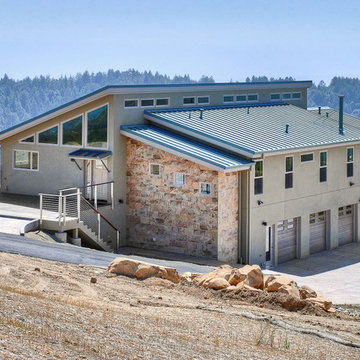
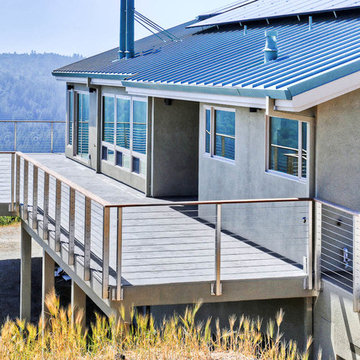
This sustainable project was completed on a private 80 acre view parcel in the hills above Corralitos, CA. The owners were drawn to us through the Green Building link on our website and after an initial meeting, hired us to manage the preliminary feasibility studies, site work, design and eventual construction.
With this type of project, we start at the beginning; making sure that development on the site is both possible and practical before we spend a lot of our client’s budget on plans that may not be suitable. After we determined that building on the property would be permitted by the Santa Cruz County Building and Planning Departments, we completed several feasibility steps that included:
•A geologic review
• Percolation test (for septic)
• Water well probability analysis
• Grading analysis
• Biologic review
• Site survey and topographic mapping
• Earthquake zone and archeological clearances
With these steps finished, we set up interviews with several local architects that we partner with to find the one that was most appealing to our client. The owners were integral to the process and agreed with our choice of Daniel Silvernail, Architect. He impressed the clients with his gracious nature and open attitude; welcoming feedback and the preferences they had throughout the design process. In addition to being very reasonably priced, Mr. Silvernail quickly gave his attention to the preliminary design plans. After client reviews and approval the full architectural and construction blueprints were finished. We had the complete ready-to-submit-for-permit documents in less than 10 weeks; this included structural engineering, energy calculations and Green Building ratings. We were all impressed by his professionalism throughout the design and building process.
 Laughing Waters, Inc
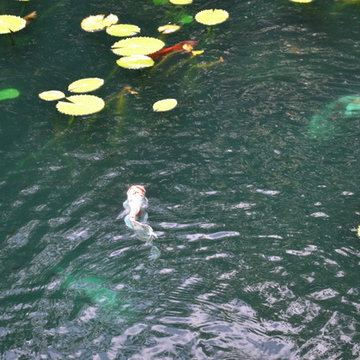
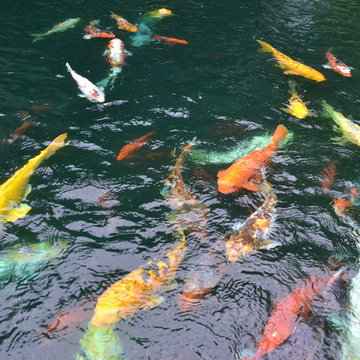
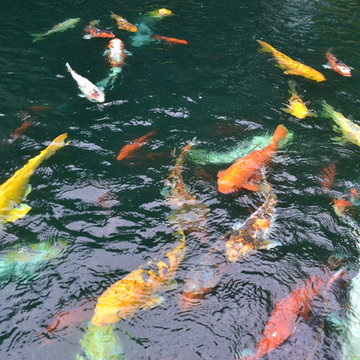
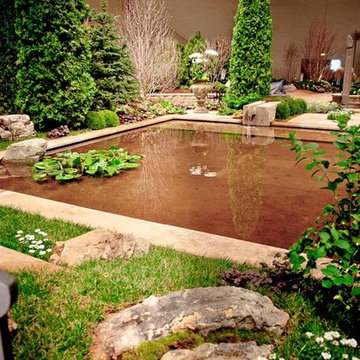
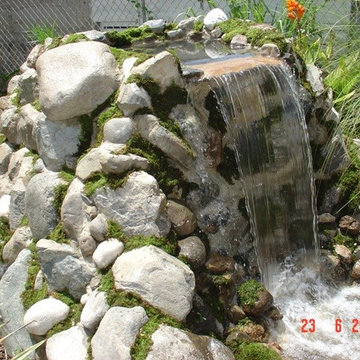
This garden imagines the ruin of an ancient Roman bath, remodeled into a koi pond and swimming pool in a splendid formal garden. All over Europe at the height of their empire, the Romans built elaborate baths connected to gymnasiums, not unlike modern health clubs. This landscape, inspired by "Capability" Brown, who designed the gardens of many English great homes in the 18th Century, incorporates the weathered, carved stone of a rediscovered Roman bath organically into the landscape, with natural boulders standing in contrast. Water lilies, iris and other aquatic plants inhabit the water's edge. Biological filtering by plants and bacteria would make it safe to swim among the fish.
 Costa Bella Builders
This sustainable project was completed on a private 80 acre view parcel in the hills above Corralitos, CA. The owners were drawn to us through the Green Building link on our website and after an initial meeting, hired us to manage the preliminary feasibility studies, site work, design and eventual construction.
With this type of project, we start at the beginning; making sure that development on the site is both possible and practical before we spend a lot of our client’s budget on plans that may not be suitable. After we determined that building on the property would be permitted by the Santa Cruz County Building and Planning Departments, we completed several feasibility steps that included:
•A geologic review
• Percolation test (for septic)
• Water well probability analysis
• Grading analysis
• Biologic review
• Site survey and topographic mapping
• Earthquake zone and archeological clearances
With these steps finished, we set up interviews with several local architects that we partner with to find the one that was most appealing to our client. The owners were integral to the process and agreed with our choice of Daniel Silvernail, Architect. He impressed the clients with his gracious nature and open attitude; welcoming feedback and the preferences they had throughout the design process. In addition to being very reasonably priced, Mr. Silvernail quickly gave his attention to the preliminary design plans. After client reviews and approval the full architectural and construction blueprints were finished. We had the complete ready-to-submit-for-permit documents in less than 10 weeks; this included structural engineering, energy calculations and Green Building ratings. We were all impressed by his professionalism throughout the design and building process.

 Tom Brzoskwinia
One of the most popular hardwood floor finishing which offers Tom & Peter Flooring is provided by WOCA. If you’ve decided that you want a natural looking wooden floor that is lacquer-free, then the likelihood is that you’ve chosen oil as your way of protecting your wood and making your floor look great at the same time. WOCA for wood flooring comes in various forms and is a great way of making sure that your wood is protected, but at the same time looks natural. A highly popular as well as effective way of treating wood floors, oils effectively penetrate into the wood and in some cases harden into the surface of the floor to stop damage and to maintain the wood in its optimum condition.
WOCA Oil finish hardwood flooring has taken the United States market by in 2014 and shows no signs of slowing down in 2016 and now. Here are some of the most common questions we have regarding this type of finish which we will I’m to answer in today’s my blog:
Is oil finish as durable as traditional factory urethane finishes with aluminum oxide?
When it comes to durability, oil finish flooring tackles the issue with a completely different method. The penetrating oil serves as protection from moisture and wear while allowing the user to feel the wood grains in their bare feet. If compared directly to factory finished aluminum oxide finish, the oil finish flooring will not perform as well to abrasion and impact. However, the beauty of this finish is the fact that it will camouflage any scratches which will inevitably accumulate over time.
Will this finish evaporate over time and will this be harmful for indoor air quality?
Another concern for oil finished floors its effect on indoor air quality. For on-site applications, some varieties suggest several coats which typically require the residents to be out of the home due to mild odors. However, there are factory finished UV-cured or single coat applications which lessen the downtime. Despite the odors produced during the drying process, oil finish floors rank amongst the lowest for VOC (volatile organic compound) emissions. Certain brands even boast true zero VOC. This fact alone makes oil finished floors one of the best options for green building solutions.
“WOCA products are certified by independent laboratories, the German Institute for Biological Building Materials, and are in accordance with DIN–Norm 53–160. WOCA WoodCare Denmark products meet or exceed the most stringent U.S. standards for volatile organic compounds.” –WOCA Oil Finish Manufacture
Does this type of finish require additional maintenance which I am not familiar with?
For weekly cleaning, oiled floors use a special cleaner which contains an oil and soap mixture. After a period of 12-18 months some oil may evaporate causing the wood grains to appear dry. An additional layer of oil can be reapplied to keep the floor looking fresh. Although oil finished floors require more involvement in periodic maintenance in high traffic areas, this maintenance can be done much easier than the equivalent of an onsite sand and refinish.
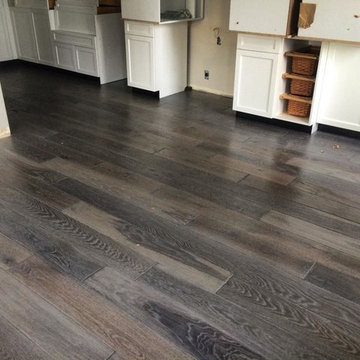
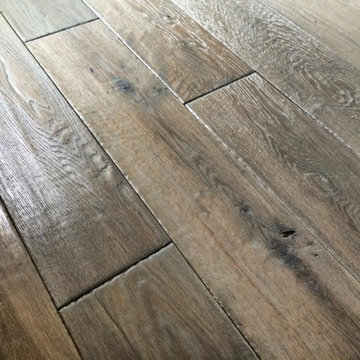
WOCA Master Color Oil contains pigment, which provides a single-step hardwood floor staining process. Laying down the stain and the finish in one step.
This product comes 14 different colors, from Black to Extra White, and you can mix them freely to create various color palettes that will meet the demands of any job.
Below are some pictures of the finished job…
 Tom Brzoskwinia
One of the most popular hardwood floor finishing which offers Tom & Peter Flooring is provided by WOCA. If you’ve decided that you want a natural looking wooden floor that is lacquer-free, then the likelihood is that you’ve chosen oil as your way of protecting your wood and making your floor look great at the same time. WOCA for wood flooring comes in various forms and is a great way of making sure that your wood is protected, but at the same time looks natural. A highly popular as well as effective way of treating wood floors, oils effectively penetrate into the wood and in some cases harden into the surface of the floor to stop damage and to maintain the wood in its optimum condition.
WOCA Oil finish hardwood flooring has taken the United States market by in 2014 and shows no signs of slowing down in 2016 and now. Here are some of the most common questions we have regarding this type of finish which we will I’m to answer in today’s my blog:
Is oil finish as durable as traditional factory urethane finishes with aluminum oxide?
When it comes to durability, oil finish flooring tackles the issue with a completely different method. The penetrating oil serves as protection from moisture and wear while allowing the user to feel the wood grains in their bare feet. If compared directly to factory finished aluminum oxide finish, the oil finish flooring will not perform as well to abrasion and impact. However, the beauty of this finish is the fact that it will camouflage any scratches which will inevitably accumulate over time.
Will this finish evaporate over time and will this be harmful for indoor air quality?
Another concern for oil finished floors its effect on indoor air quality. For on-site applications, some varieties suggest several coats which typically require the residents to be out of the home due to mild odors. However, there are factory finished UV-cured or single coat applications which lessen the downtime. Despite the odors produced during the drying process, oil finish floors rank amongst the lowest for VOC (volatile organic compound) emissions. Certain brands even boast true zero VOC. This fact alone makes oil finished floors one of the best options for green building solutions.
“WOCA products are certified by independent laboratories, the German Institute for Biological Building Materials, and are in accordance with DIN–Norm 53–160. WOCA WoodCare Denmark products meet or exceed the most stringent U.S. standards for volatile organic compounds.” –WOCA Oil Finish Manufacture
Does this type of finish require additional maintenance which I am not familiar with?
For weekly cleaning, oiled floors use a special cleaner which contains an oil and soap mixture. After a period of 12-18 months some oil may evaporate causing the wood grains to appear dry. An additional layer of oil can be reapplied to keep the floor looking fresh. Although oil finished floors require more involvement in periodic maintenance in high traffic areas, this maintenance can be done much easier than the equivalent of an onsite sand and refinish.
WOCA Master Color Oil contains pigment, which provides a single-step hardwood floor staining process. Laying down the stain and the finish in one step.
This product comes 14 different colors, from Black to Extra White, and you can mix them freely to create various color palettes that will meet the demands of any job.
Below are some pictures of the finished job…
5