
Search results for "Comprehensive patterns" in Home Design Ideas
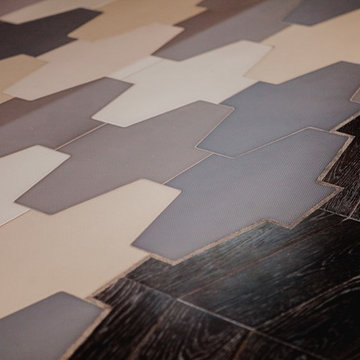


 Stonecreek Building Company, Inc.
Timmerman Photography
Sculpture by Mayme Kratz
This is a home we initially built in 1995 and after it sold in 2014 we were commissioned to come back and remodel the interior of the home.
We worked with internationally renowned architect Will Bruder on the initial design on the home. The goal of home was to build a modern hillside home which made the most of the vista upon which it sat. A few ways we were able to achieve this were the unique, floor-to-ceiling glass windows on the side of the property overlooking Scottsdale, a private courtyard off the master bedroom and bathroom, and a custom commissioned sculpture Mayme Kratz.
Stonecreek's particular role in the project were to work alongside both the clients and the architect to make sure we were able to perfectly execute on the vision and design of the project. A very unique component of this house is how truly custom every feature is, all the way from the window systems and the bathtubs all the way down to the door handles and other features.
 safe ZOnea
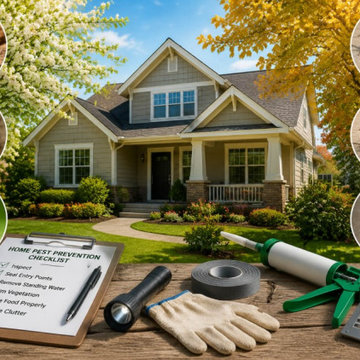
Maintaining a pest-free home requires attention throughout the year. Seasonal changes affect pest behavior, and understanding these patterns can save homeowners from costly damage and health hazards. In this guide, we will explore practical strategies for spring pest prevention tips, ensuring your property stays protected through every season. From spotting early signs to implementing proactive measures, these steps empower homeowners to take control before infestations occur.
Understanding Seasonal Pest Patterns
Pests adapt to changing weather, and knowing their patterns helps prevent infestations effectively.
Spring: Awakening Pests
Spring signals the end of winter dormancy for many pests. Rodents, ants, and termites start seeking food and warmth. Effective spring pest prevention tips include:
● Cleaning gutters and removing debris
● Sealing cracks and gaps in exterior walls
● Inspecting wood piles and compost areas
● Monitoring early signs of termite activity
Pro Tip: Conduct a termite inspection or a professional evaluation to catch infestations early before they spread.
Summer: Peak Pest Season
Warm temperatures accelerate pest breeding cycles. For a comprehensive summer pest prevention guide:
● Maintain lawns and trim vegetation away from homes
● Check window and door screens for tears
● Store food in sealed containers
● Inspect water sources that attract mosquitoes
Do You Know? Mosquitoes can lay eggs in a teaspoon of water. Eliminating stagnant water is crucial to reducing their population.
Fall: Preparing for Winter
As temperatures drop, pests search for warm indoor spaces. Key actions include:
● Inspecting for winter rodent entry points
● Sealing attic vents, crawl spaces, and foundation gaps
● Cleaning storage areas to minimize hiding spots
● Checking chimney and fireplace openings
Quick Fact: Rodents can enter homes through openings as small as ¼ inch.
Seasonal Pest Checklist for Homeowners
Creating a structured seasonal pest checklist simplifies preventive measures and ensures nothing is overlooked.
Season
Key Actions
Spring
Inspect for termites, seal exterior gaps, clean gutters, and check compost
Summer
Repair screens, trim vegetation, remove standing water, and secure food
Fall
Seal entry points, inspect attic/crawlspace, clear debris, and prepare storage
Winter
Monitor indoor activity, keep firewood away from walls, and maintain traps
Inspection & Maintenance Tips
● Schedule annual pest inspections by professional Virginia pest control consultation to detect hidden problems
● Keep a log of pest sightings and treatment dates
● Regularly replace weather stripping and caulk cracks
Note: Even small preventive steps, when consistently applied, drastically reduce infestations.
Common Pests and Their Seasonal Behaviors
Understanding how different pests behave each season helps homeowners take timely action to protect their property.
● Ants and Termites: Ants emerge in spring seeking food, while termites become active and can damage wood unnoticed. Early detection is critical.
● Rodents and Mice: Fall and winter increase rodent intrusions. Block all entry points and keep food sealed.
● Mosquitoes and Flies: Summer creates the ideal breeding environment for mosquitoes. Eliminate standing water and use physical barriers like nets.
● Spiders and Other Insects: Seasonal shifts cause spiders to move indoors. Regular vacuuming and decluttering reduce hiding spots.
Eco-Friendly Prevention Methods
● Use natural repellents like peppermint oil or diatomaceous earth
● Encourage beneficial insects, such as ladybugs, to reduce pest populations
● Plant pest-deterring plants near home boundaries, like marigolds or lavender
Integrated Pest Management (IPM)
Adopt an IPM approach by combining physical barriers, monitoring, and environmentally safe treatments. This minimizes chemical use while maintaining a pest-free home.
Quote: “Prevention is the most effective form of pest control.” – National Pest Management Association
Seasonal Pest Prevention Tools
● Snap traps and humane rodent traps
● Sticky traps for insects
● Outdoor perimeter sprays (eco-friendly)
● Moisture meters to detect early termite or mold problems
Pro Tip: Keep tools organized and accessible to act quickly when pest activity is noticed.
Planning: Annual Pest Calendar
Month
Recommended Action
March-April
Spring pest prevention tips: Inspect, seal, clean gutters
June-July
Summer pest prevention guide: Screens, standing water, food storage
September
Seasonal pest checklist: Seal entries, declutter, prep storage
November
Winter rodent entry points: Monitor indoors, maintain traps
Key Takeaways
● Seasonal awareness prevents infestations and property damage
● Consistent inspections and maintenance are essential
● Simple eco-friendly measures can significantly reduce pests
● Use a structured checklist and calendar for effective prevention
Conclusion
Homeowners who stay proactive and follow spring pest prevention tips, along with year-round monitoring, ensure their properties remain safe and comfortable. Using a summer pest prevention guide, checking winter rodent entry points, and maintaining a seasonal pest checklist ensure your home remains safe and comfortable. Remember to combine inspections, physical barriers, and environmentally friendly methods for the best results.
FAQs
Q1: How often should I perform a termite inspection?
A1: Conduct inspections annually, especially in spring, to detect early signs of termite activity and prevent extensive damage.
Q2: Can pests enter my home during winter?
A2: Yes, rodents and insects seek warmth and shelter indoors. Sealing entry points and monitoring for activity is crucial.
Q3: What is the most effective eco-friendly method for pest prevention?
A3: Using natural repellents, encouraging beneficial insects, and eliminating water sources effectively reduces pest populations without chemicals.
Ensure your home is ready for every season. Schedule a professional Virginia pest control consultation or a termite inspection in Suffolk, VA, today and stay ahead of potential infestations.
Find the right local pro for your project

 Mercury Mosaics and Tile
Fish Scale ceramic tile is one of our signature shapes, inspired by the glistening movement of the sea. That is why it is perfect in this modern Hawaii bathroom.

 Prestige Custom Building & Construction, Inc.
Staircase - mid-sized traditional wooden straight wood railing staircase idea in New York with painted risers

 MEC
Gold & Platinum Breeze by Sarah Ryan - Moroccan fish-scale patterened beauty in glorious metallic and glass shine. | Have a custom mosaic idea? We can help, with our brilliant Italian-trained mosaicists and easy-to-install tiled masterpieces. Worldwide shipping available on the complete range of quality handcrafted marble & glass mosaic products. For inquires and more info, contact us: http://mecartworks.com

 TRU Landscape Services
A closeup of our interlocking pavers work. This paver is a darker almost bluish color which accents the white stucco walls of the rest of the landscape. TRU Landscape Services
Sponsored
Sunbury, OH

J.Holderby - Renovations
Franklin County's Leading General Contractors - 2X Best of Houzz!
 ReVision Design + Build
© Ascendant Imaging
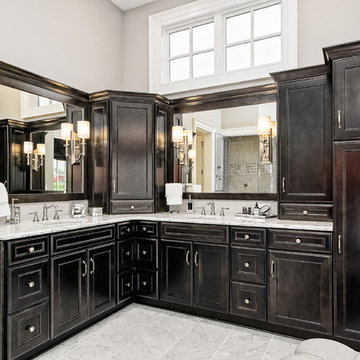
Inspiration for a large transitional master white tile and porcelain tile porcelain tile, beige floor, double-sink and wallpaper freestanding bathtub remodel in Charlotte with furniture-like cabinets, green cabinets, a two-piece toilet, white walls, an undermount sink, quartz countertops, a hinged shower door, white countertops, a niche and a built-in vanity
Inspiration for a large transitional master white tile and porcelain tile porcelain tile, beige floor, double-sink and wallpaper freestanding bathtub remodel in Charlotte with furniture-like cabinets, green cabinets, a two-piece toilet, white walls, an undermount sink, quartz countertops, a hinged shower door, white countertops, a niche and a built-in vanity

 JM Kitchen & Bath Design
Stone Mosaic Tile floors, marble countertops and backsplash and white painted raised panel cabinets in this luxurious master bathroom with freestanding soaking tub in Greenwood Village Colorado.
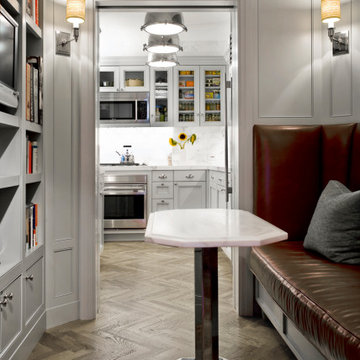
 Neumann & Rudy Architecture
**I. Spatial Composition & Architectural Volume**
This vignette operates as a masterclass in the choreography of compressed urban space, deploying a classic enfilade strategy to extract depth from a modest footprint. The composition is organized around a cased opening — flanked by heavy, mitered pilaster-style jambs and a substantial crown-capped header — that frames the kitchen beyond like a proscenium, establishing a telescoping sightline from the foreground banquette nook through to the range wall and its marble backsplash. The immediate volume is a canted, faceted room; the angled corner walls and the polygonal ceiling perimeter generate a subtle rotational geometry that is echoed, with deliberate rhyme, in the octagonal tabletop and its faceted plinth base. Architectural discipline is supplied by comprehensive millwork: recessed applied-molding wall panels calibrated to the wall heights, a built-in bibliothèque with adjustable shelving and integrated media niche on the left, and a bench base detailed as cabinetry with a plinth and reveal, so the seating reads as architecture rather than furniture. The crowning gesture is a stone-clad soffit and cove above the multi-part cornice, which visually lifts the ceiling plane and dissolves the corner conditions of the canted plan into a continuous, luminous band.
**II. Materiality, Color & Texture**
The palette is a study in low-chroma tonal layering, structured on a base of dove-grey lacquered joinery whose cool, faintly greige undertone reads as both patrician and contemporary. Against this, book-matched white marble with grey and taupe veining appears in three registers — the ceiling cove, the kitchen backsplash, and the honed tabletop — creating a vertical and horizontal continuity of stone that binds the two rooms into one material narrative. Underfoot, wide-plank white oak laid in a herringbone pattern is finished in a wire-brushed, cerused grey-brown, its open grain supplying essential tactility and directional energy that counteracts the smoothness of the cabinetry. The tonal reserve is punctured by a single decisive chromatic move: the oxblood-to-cognac aniline leather banquette, its capitonné-adjacent piping and channeled seat cushion delivering saturated warmth and a supple, patinating counterpoint to the cool minerals. Metals are deliberately stratified — brushed stainless on the appliance suite, polished nickel on the cabinet hardware and pendant collars, and a high-mirror chromed column and base on the table that pulls reflected fragments of the room into itself. Textile relief arrives through a heather-grey wool bolster and the woven, honeycomb-textured sconce shades, while the sunflowers and pantry provisions behind glazed muntin doors introduce a curated, humanizing note of the quotidian.
**III. Lighting, Atmosphere & Style Profile**
The lighting scheme is layered and hierarchical. Ambient illumination is borrowed rather than direct: the kitchen functions as a light well, its own concealed under-cabinet lighting and cove-washed ceiling projecting a cool, diffuse glow forward through the cased opening, so the brighter volume beyond reads as both destination and light source. In the foreground, symmetrically paired wall sconces with textured drum shades cast a warm, amber-filtered ellipse of light onto the paneling — providing intimate, low-level modeling that emphasizes the millwork's shadow lines and flatters the leather's depth. The kitchen's aligned trio of spun-metal dome pendants, with polished collars and diffused lenses, reinforce the axial perspective and supply task-appropriate downlight, while the marble cove above serves as an indirect reflector, softening any residual harshness. The cumulative atmosphere is hushed, refined, and slightly cinematic — a quiet formality more contemplative than performative. Stylistically, the project synthesizes into a form of Transitional Classicism, or more precisely a tailored American Neoclassicism recalibrated for contemporary living: the vocabulary of paneled millwork, crown profiles, and cased openings is retained, but stripped of ornament, flattened in profile, and rendered in a monochrome envelope, then energized by faceted geometries, mirror-finish metal, and a single confident stroke of leather. It is restraint deployed as luxury.

 Stonebridge Mosaics
A beautiful design of Thassos and Mother of Pearl in a very unique shade of blue!
Minimalist bathroom photo in New York
Minimalist bathroom photo in New York


 Hansen Brothers Construction
Freestanding bathtub - large cottage master porcelain tile and multicolored floor freestanding bathtub idea with shaker cabinets, dark wood cabinets, white walls, a vessel sink, quartz countertops, a hinged shower door and white countertops
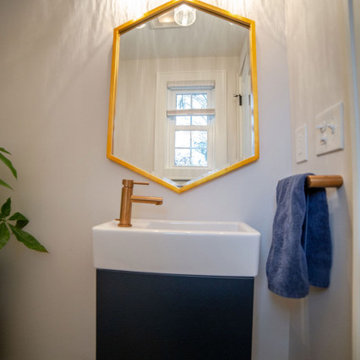

 User
Took an old outdated bathroom and turned it into this sleek, bright bathroom. Notice all the natural light and clean lines.
Freestanding bathtub - mid-sized contemporary master white tile and ceramic tile porcelain tile freestanding bathtub idea in Nashville with an undermount sink, shaker cabinets, white cabinets, concrete countertops, a one-piece toilet and white walls
Freestanding bathtub - mid-sized contemporary master white tile and ceramic tile porcelain tile freestanding bathtub idea in Nashville with an undermount sink, shaker cabinets, white cabinets, concrete countertops, a one-piece toilet and white walls

 Carpet and Flooring Centers Of NJ, Inc.
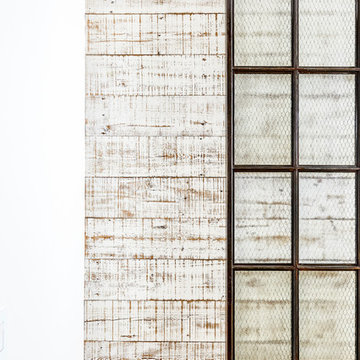
Mid-sized elegant carpeted straight staircase photo in New York with carpeted risers


 Bella Tile and Stone
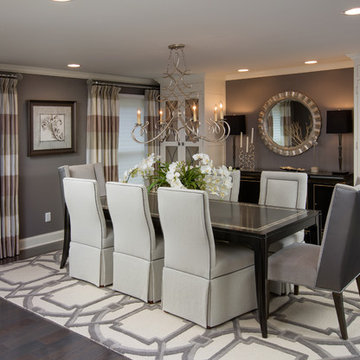
Mid-sized transitional enclosed light wood floor and beige floor family room photo with white walls, a standard fireplace, a tile fireplace and no tv


 Ehrlich Yanai Rhee Chaney Architects
The ground floor volumes wrapped in an elongated hand-fired brick, emphasizing the horizontality of the architecture that lays solidly on the land.
(Photography by: Matthew Millman)

 Betty Wasserman Art & Interiors
Modern luxury meets warm farmhouse in this Southampton home! Scandinavian inspired furnishings and light fixtures create a clean and tailored look, while the natural materials found in accent walls, casegoods, the staircase, and home decor hone in on a homey feel. An open-concept interior that proves less can be more is how we’d explain this interior. By accentuating the “negative space,” we’ve allowed the carefully chosen furnishings and artwork to steal the show, while the crisp whites and abundance of natural light create a rejuvenated and refreshed interior.
This sprawling 5,000 square foot home includes a salon, ballet room, two media rooms, a conference room, multifunctional study, and, lastly, a guest house (which is a mini version of the main house).

 Bardet Construction
Grouted vinyl tile that looks like traditional tile.
Inspiration for a small eclectic white tile and ceramic tile vinyl floor and multicolored floor alcove bathtub remodel in Sacramento with furniture-like cabinets, gray cabinets, a two-piece toilet, gray walls, an undermount sink, marble countertops and gray countertops
Inspiration for a small eclectic white tile and ceramic tile vinyl floor and multicolored floor alcove bathtub remodel in Sacramento with furniture-like cabinets, gray cabinets, a two-piece toilet, gray walls, an undermount sink, marble countertops and gray countertops
13