
Search results for "Earn extra" in Home Design Ideas
 Rocky Tops Granite & Marble LLC
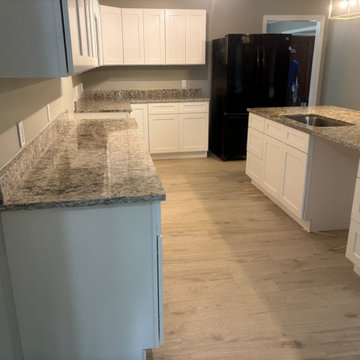
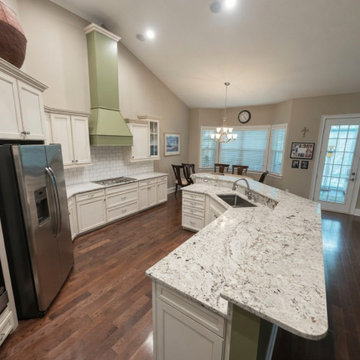
This kitchen came together with Ornamental White granite on the counters. No waterfall, no fancy backsplash story here, just solid granite doing what granite does best, holding up to real cooking and real life in a busy South Carolina kitchen.
We finished the edges with an eased profile, which is the detail people don't think about until they're leaning on the counter every day. An eased edge takes the sharp corner off the slab and rounds it just enough so it's comfortable to work against, without adding a bunch of extra machining that can chip or crack down the line. It's a clean, classic look that doesn't fight with the granite's natural pattern, and it wears well over years of use.
Granite is still one of the best choices you can put in a kitchen. It's hard, it's heat resistant, and you can set a hot pan on it without worrying. It'll take a knife dragged across it by accident and shrug it off. Every slab has its own movement in the stone, its own crystal structure catching light differently depending on where you stand, and templating a kitchen like this means matching that pattern at the seams so it reads like one continuous piece instead of two pieces bolted together.
Day to day, this countertop is going to earn its keep. Granite seals up easily and, once it's sealed, it resists staining from wine, oil, coffee, whatever gets set down on it. It doesn't scratch from normal kitchen use, and it doesn't dull over time the way some softer stones can. That's why we keep coming back to it for kitchens that actually get used, not just looked at.
We fabricate and install jobs like this all over the Midlands, and it's the same story every time: good stone, cut right, set level, edges finished clean. That's what makes a countertop last for decades instead of years, and that's what you're getting here.
 Rocky Tops Granite & Marble LLC
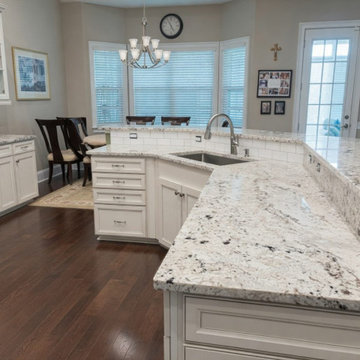
This kitchen in Lexington came together in BSI Zurich granite, and it's the kind of stone that does a lot of the work in a room just by sitting there. Zurich has a cool gray background with movement that breaks up into darker flecks and softer crystal patches, so it reads calm from across the room but keeps your eye busy up close. That range makes it easy to live with next to most cabinet colors, whether the boxes are painted white, a soft gray, or a warmer wood tone.
Granite like this is quarried in big blocks and cut into slabs, and no two slabs come out exactly the same. That's part of why we template each kitchen on site instead of working off a generic plan. We measure the actual cabinets, account for the sink and cooktop cutouts, and lay out the slabs so the veining and pattern flow the way they should across the island and the runs of counter, especially where two pieces meet at a seam. Getting that seam tight and matched so it disappears into the pattern takes a steady hand and slabs picked with the layout in mind from the start.
Granite is one of the toughest countertop materials you can put in a kitchen. It shrugs off hot pans, resists scratching from everyday knife work, and holds up to the kind of daily traffic a real kitchen sees, dishes, coffee, kids doing homework at the island, all of it. It does need to be sealed, and staying on top of that keeps it looking like day one for years. We finished this one with an eased edge, clean and simple, which is the right call for a stone with this much going on in the surface. It doesn't need extra shaping to look finished.
Lexington's seen a lot of kitchens go through updates like this one, and granite remains a favorite around the Midlands because it holds up to how people actually cook and live. This Zurich kitchen is a good example of why: a stone with real character, installed tight and clean, that's going to keep earning its keep for a long time.
 Rocky Tops Granite & Marble LLC
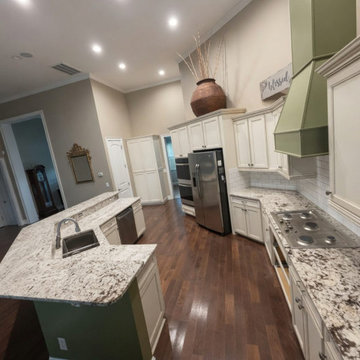
This kitchen in Lexington came together in BSI Zurich granite, and it's the kind of stone that does a lot of the work in a room just by sitting there. Zurich has a cool gray background with movement that breaks up into darker flecks and softer crystal patches, so it reads calm from across the room but keeps your eye busy up close. That range makes it easy to live with next to most cabinet colors, whether the boxes are painted white, a soft gray, or a warmer wood tone.
Granite like this is quarried in big blocks and cut into slabs, and no two slabs come out exactly the same. That's part of why we template each kitchen on site instead of working off a generic plan. We measure the actual cabinets, account for the sink and cooktop cutouts, and lay out the slabs so the veining and pattern flow the way they should across the island and the runs of counter, especially where two pieces meet at a seam. Getting that seam tight and matched so it disappears into the pattern takes a steady hand and slabs picked with the layout in mind from the start.
Granite is one of the toughest countertop materials you can put in a kitchen. It shrugs off hot pans, resists scratching from everyday knife work, and holds up to the kind of daily traffic a real kitchen sees, dishes, coffee, kids doing homework at the island, all of it. It does need to be sealed, and staying on top of that keeps it looking like day one for years. We finished this one with an eased edge, clean and simple, which is the right call for a stone with this much going on in the surface. It doesn't need extra shaping to look finished.
Lexington's seen a lot of kitchens go through updates like this one, and granite remains a favorite around the Midlands because it holds up to how people actually cook and live. This Zurich kitchen is a good example of why: a stone with real character, installed tight and clean, that's going to keep earning its keep for a long time.
Find the right local pro for your project
 Rocky Tops Granite & Marble LLC
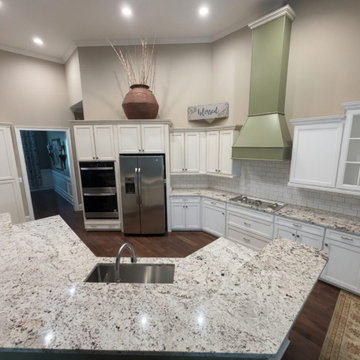
This kitchen in Lexington came together in BSI Zurich granite, and it's the kind of stone that does a lot of the work in a room just by sitting there. Zurich has a cool gray background with movement that breaks up into darker flecks and softer crystal patches, so it reads calm from across the room but keeps your eye busy up close. That range makes it easy to live with next to most cabinet colors, whether the boxes are painted white, a soft gray, or a warmer wood tone.
Granite like this is quarried in big blocks and cut into slabs, and no two slabs come out exactly the same. That's part of why we template each kitchen on site instead of working off a generic plan. We measure the actual cabinets, account for the sink and cooktop cutouts, and lay out the slabs so the veining and pattern flow the way they should across the island and the runs of counter, especially where two pieces meet at a seam. Getting that seam tight and matched so it disappears into the pattern takes a steady hand and slabs picked with the layout in mind from the start.
Granite is one of the toughest countertop materials you can put in a kitchen. It shrugs off hot pans, resists scratching from everyday knife work, and holds up to the kind of daily traffic a real kitchen sees, dishes, coffee, kids doing homework at the island, all of it. It does need to be sealed, and staying on top of that keeps it looking like day one for years. We finished this one with an eased edge, clean and simple, which is the right call for a stone with this much going on in the surface. It doesn't need extra shaping to look finished.
Lexington's seen a lot of kitchens go through updates like this one, and granite remains a favorite around the Midlands because it holds up to how people actually cook and live. This Zurich kitchen is a good example of why: a stone with real character, installed tight and clean, that's going to keep earning its keep for a long time.
 Rocky Tops Granite & Marble LLC
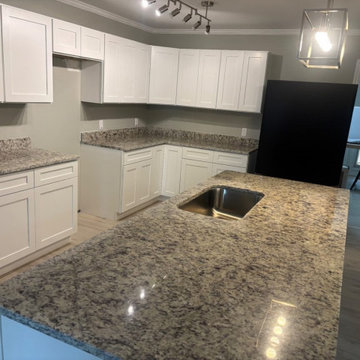
This kitchen in Lexington came together in BSI Zurich granite, and it's the kind of stone that does a lot of the work in a room just by sitting there. Zurich has a cool gray background with movement that breaks up into darker flecks and softer crystal patches, so it reads calm from across the room but keeps your eye busy up close. That range makes it easy to live with next to most cabinet colors, whether the boxes are painted white, a soft gray, or a warmer wood tone.
Granite like this is quarried in big blocks and cut into slabs, and no two slabs come out exactly the same. That's part of why we template each kitchen on site instead of working off a generic plan. We measure the actual cabinets, account for the sink and cooktop cutouts, and lay out the slabs so the veining and pattern flow the way they should across the island and the runs of counter, especially where two pieces meet at a seam. Getting that seam tight and matched so it disappears into the pattern takes a steady hand and slabs picked with the layout in mind from the start.
Granite is one of the toughest countertop materials you can put in a kitchen. It shrugs off hot pans, resists scratching from everyday knife work, and holds up to the kind of daily traffic a real kitchen sees, dishes, coffee, kids doing homework at the island, all of it. It does need to be sealed, and staying on top of that keeps it looking like day one for years. We finished this one with an eased edge, clean and simple, which is the right call for a stone with this much going on in the surface. It doesn't need extra shaping to look finished.
Lexington's seen a lot of kitchens go through updates like this one, and granite remains a favorite around the Midlands because it holds up to how people actually cook and live. This Zurich kitchen is a good example of why: a stone with real character, installed tight and clean, that's going to keep earning its keep for a long time.
 Rocky Tops Granite & Marble LLC
This kitchen came together with Ornamental White granite on the counters. No waterfall, no fancy backsplash story here, just solid granite doing what granite does best, holding up to real cooking and real life in a busy South Carolina kitchen.
We finished the edges with an eased profile, which is the detail people don't think about until they're leaning on the counter every day. An eased edge takes the sharp corner off the slab and rounds it just enough so it's comfortable to work against, without adding a bunch of extra machining that can chip or crack down the line. It's a clean, classic look that doesn't fight with the granite's natural pattern, and it wears well over years of use.
Granite is still one of the best choices you can put in a kitchen. It's hard, it's heat resistant, and you can set a hot pan on it without worrying. It'll take a knife dragged across it by accident and shrug it off. Every slab has its own movement in the stone, its own crystal structure catching light differently depending on where you stand, and templating a kitchen like this means matching that pattern at the seams so it reads like one continuous piece instead of two pieces bolted together.
Day to day, this countertop is going to earn its keep. Granite seals up easily and, once it's sealed, it resists staining from wine, oil, coffee, whatever gets set down on it. It doesn't scratch from normal kitchen use, and it doesn't dull over time the way some softer stones can. That's why we keep coming back to it for kitchens that actually get used, not just looked at.
We fabricate and install jobs like this all over the Midlands, and it's the same story every time: good stone, cut right, set level, edges finished clean. That's what makes a countertop last for decades instead of years, and that's what you're getting here.

 Exterior Worlds Landscaping & Design
"Elegant Detail: A close-up view of the pristine white tiled edge of the raised spa, highlighting the meticulous craftsmanship and modern design. The clear, deep blue water enhances the geometric precision and clean lines, creating a visually stunning contrast."
 Didonè Comacchio Architects
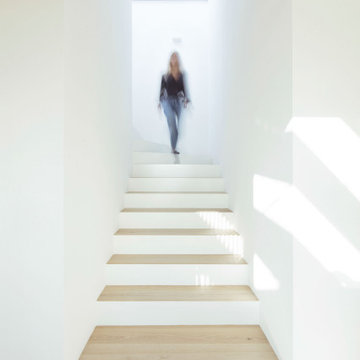
Staircase - mid-sized contemporary wooden l-shaped staircase idea in Venice with metal risers

 Rocky Tops Granite & Marble LLC
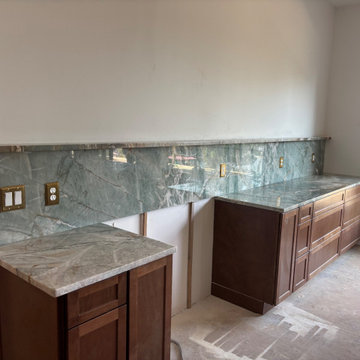
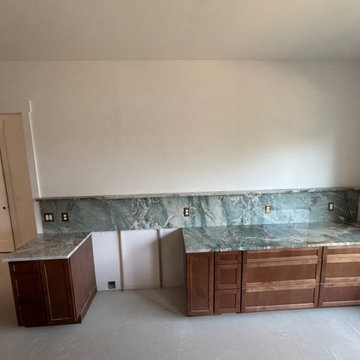
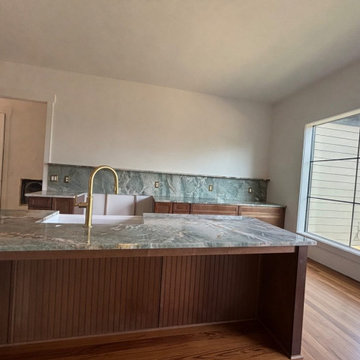
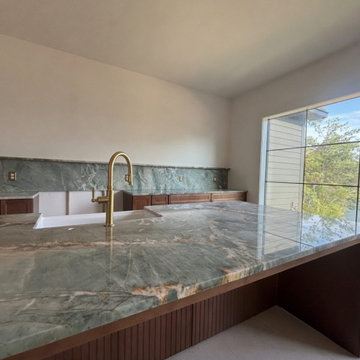
Tiffany Crystal quartzite is one of those stones that earns its keep in a kitchen. It's got that cool, crystalline background, whites and grays moving quietly across the surface with enough sparkle in the light to keep it from feeling flat. It reads clean and bright without going stark, which is why it works so well in a kitchen where people actually cook and gather, not just admire counters from across the room.
Quartzite is real stone, not engineered, so it comes with natural hardness that holds up to daily kitchen abuse. It resists scratching and handles heat well, though we still tell folks to use a trivet, because no counter needs a hot pan set straight on it just to prove a point. Sealing it right after install and keeping up with it over the years keeps the surface performing the way it should, and Tiffany Crystal takes a seal well because of its tight, dense structure.
Fabricating a slab like this takes some care in the layout. We spend real time bookmatching and dry-fitting pieces so the movement in the stone flows across seams instead of fighting itself at the corners. On a kitchen island or a run of perimeter counters, getting that continuity right is what separates a good installation from one that just gets the measurements correct. We kept the edge eased here, which is the right call on a stone with this much personality. It doesn't need extra shaping to draw the eye, the stone's already doing that work.
Day to day, this is a kitchen counter that's going to live hard and look good doing it. Quartzite shrugs off knife marks, stands up to acidic spills, and cleans up with regular dish soap and water. It's the kind of surface you stop babying after the first few months because it simply holds up.
Jobs like this one in Lexington are what we like seeing come through the shop. It's a straightforward kitchen application done with a stone that's got real depth to it, installed by people who care about how the seams and the veining line up when the job's done. That's the kind of work that keeps the Midlands trade honest.
 Rocky Tops Granite & Marble LLC
Tiffany Crystal quartzite is one of those stones that earns its keep in a kitchen. It's got that cool, crystalline background, whites and grays moving quietly across the surface with enough sparkle in the light to keep it from feeling flat. It reads clean and bright without going stark, which is why it works so well in a kitchen where people actually cook and gather, not just admire counters from across the room.
Quartzite is real stone, not engineered, so it comes with natural hardness that holds up to daily kitchen abuse. It resists scratching and handles heat well, though we still tell folks to use a trivet, because no counter needs a hot pan set straight on it just to prove a point. Sealing it right after install and keeping up with it over the years keeps the surface performing the way it should, and Tiffany Crystal takes a seal well because of its tight, dense structure.
Fabricating a slab like this takes some care in the layout. We spend real time bookmatching and dry-fitting pieces so the movement in the stone flows across seams instead of fighting itself at the corners. On a kitchen island or a run of perimeter counters, getting that continuity right is what separates a good installation from one that just gets the measurements correct. We kept the edge eased here, which is the right call on a stone with this much personality. It doesn't need extra shaping to draw the eye, the stone's already doing that work.
Day to day, this is a kitchen counter that's going to live hard and look good doing it. Quartzite shrugs off knife marks, stands up to acidic spills, and cleans up with regular dish soap and water. It's the kind of surface you stop babying after the first few months because it simply holds up.
Jobs like this one in Lexington are what we like seeing come through the shop. It's a straightforward kitchen application done with a stone that's got real depth to it, installed by people who care about how the seams and the veining line up when the job's done. That's the kind of work that keeps the Midlands trade honest.
 Rocky Tops Granite & Marble LLC
Tiffany Crystal quartzite is one of those stones that earns its keep in a kitchen. It's got that cool, crystalline background, whites and grays moving quietly across the surface with enough sparkle in the light to keep it from feeling flat. It reads clean and bright without going stark, which is why it works so well in a kitchen where people actually cook and gather, not just admire counters from across the room.
Quartzite is real stone, not engineered, so it comes with natural hardness that holds up to daily kitchen abuse. It resists scratching and handles heat well, though we still tell folks to use a trivet, because no counter needs a hot pan set straight on it just to prove a point. Sealing it right after install and keeping up with it over the years keeps the surface performing the way it should, and Tiffany Crystal takes a seal well because of its tight, dense structure.
Fabricating a slab like this takes some care in the layout. We spend real time bookmatching and dry-fitting pieces so the movement in the stone flows across seams instead of fighting itself at the corners. On a kitchen island or a run of perimeter counters, getting that continuity right is what separates a good installation from one that just gets the measurements correct. We kept the edge eased here, which is the right call on a stone with this much personality. It doesn't need extra shaping to draw the eye, the stone's already doing that work.
Day to day, this is a kitchen counter that's going to live hard and look good doing it. Quartzite shrugs off knife marks, stands up to acidic spills, and cleans up with regular dish soap and water. It's the kind of surface you stop babying after the first few months because it simply holds up.
Jobs like this one in Lexington are what we like seeing come through the shop. It's a straightforward kitchen application done with a stone that's got real depth to it, installed by people who care about how the seams and the veining line up when the job's done. That's the kind of work that keeps the Midlands trade honest.
 Rocky Tops Granite & Marble LLC
Tiffany Crystal quartzite is one of those stones that earns its keep in a kitchen. It's got that cool, crystalline background, whites and grays moving quietly across the surface with enough sparkle in the light to keep it from feeling flat. It reads clean and bright without going stark, which is why it works so well in a kitchen where people actually cook and gather, not just admire counters from across the room.
Quartzite is real stone, not engineered, so it comes with natural hardness that holds up to daily kitchen abuse. It resists scratching and handles heat well, though we still tell folks to use a trivet, because no counter needs a hot pan set straight on it just to prove a point. Sealing it right after install and keeping up with it over the years keeps the surface performing the way it should, and Tiffany Crystal takes a seal well because of its tight, dense structure.
Fabricating a slab like this takes some care in the layout. We spend real time bookmatching and dry-fitting pieces so the movement in the stone flows across seams instead of fighting itself at the corners. On a kitchen island or a run of perimeter counters, getting that continuity right is what separates a good installation from one that just gets the measurements correct. We kept the edge eased here, which is the right call on a stone with this much personality. It doesn't need extra shaping to draw the eye, the stone's already doing that work.
Day to day, this is a kitchen counter that's going to live hard and look good doing it. Quartzite shrugs off knife marks, stands up to acidic spills, and cleans up with regular dish soap and water. It's the kind of surface you stop babying after the first few months because it simply holds up.
Jobs like this one in Lexington are what we like seeing come through the shop. It's a straightforward kitchen application done with a stone that's got real depth to it, installed by people who care about how the seams and the veining line up when the job's done. That's the kind of work that keeps the Midlands trade honest.
 Rocky Tops Granite & Marble LLC
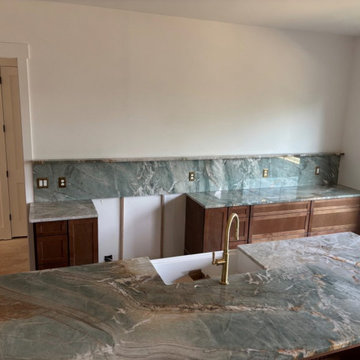
Tiffany Crystal quartzite is one of those stones that earns its keep in a kitchen. It's got that cool, crystalline background, whites and grays moving quietly across the surface with enough sparkle in the light to keep it from feeling flat. It reads clean and bright without going stark, which is why it works so well in a kitchen where people actually cook and gather, not just admire counters from across the room.
Quartzite is real stone, not engineered, so it comes with natural hardness that holds up to daily kitchen abuse. It resists scratching and handles heat well, though we still tell folks to use a trivet, because no counter needs a hot pan set straight on it just to prove a point. Sealing it right after install and keeping up with it over the years keeps the surface performing the way it should, and Tiffany Crystal takes a seal well because of its tight, dense structure.
Fabricating a slab like this takes some care in the layout. We spend real time bookmatching and dry-fitting pieces so the movement in the stone flows across seams instead of fighting itself at the corners. On a kitchen island or a run of perimeter counters, getting that continuity right is what separates a good installation from one that just gets the measurements correct. We kept the edge eased here, which is the right call on a stone with this much personality. It doesn't need extra shaping to draw the eye, the stone's already doing that work.
Day to day, this is a kitchen counter that's going to live hard and look good doing it. Quartzite shrugs off knife marks, stands up to acidic spills, and cleans up with regular dish soap and water. It's the kind of surface you stop babying after the first few months because it simply holds up.
Jobs like this one in Lexington are what we like seeing come through the shop. It's a straightforward kitchen application done with a stone that's got real depth to it, installed by people who care about how the seams and the veining line up when the job's done. That's the kind of work that keeps the Midlands trade honest.
 Rocky Tops Granite & Marble LLC
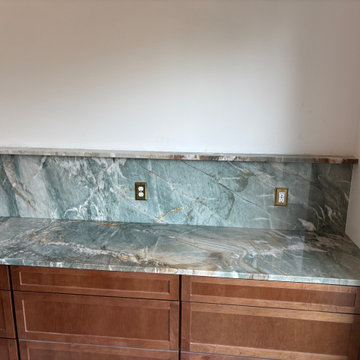
Tiffany Crystal quartzite is one of those stones that earns its keep in a kitchen. It's got that cool, crystalline background, whites and grays moving quietly across the surface with enough sparkle in the light to keep it from feeling flat. It reads clean and bright without going stark, which is why it works so well in a kitchen where people actually cook and gather, not just admire counters from across the room.
Quartzite is real stone, not engineered, so it comes with natural hardness that holds up to daily kitchen abuse. It resists scratching and handles heat well, though we still tell folks to use a trivet, because no counter needs a hot pan set straight on it just to prove a point. Sealing it right after install and keeping up with it over the years keeps the surface performing the way it should, and Tiffany Crystal takes a seal well because of its tight, dense structure.
Fabricating a slab like this takes some care in the layout. We spend real time bookmatching and dry-fitting pieces so the movement in the stone flows across seams instead of fighting itself at the corners. On a kitchen island or a run of perimeter counters, getting that continuity right is what separates a good installation from one that just gets the measurements correct. We kept the edge eased here, which is the right call on a stone with this much personality. It doesn't need extra shaping to draw the eye, the stone's already doing that work.
Day to day, this is a kitchen counter that's going to live hard and look good doing it. Quartzite shrugs off knife marks, stands up to acidic spills, and cleans up with regular dish soap and water. It's the kind of surface you stop babying after the first few months because it simply holds up.
Jobs like this one in Lexington are what we like seeing come through the shop. It's a straightforward kitchen application done with a stone that's got real depth to it, installed by people who care about how the seams and the veining line up when the job's done. That's the kind of work that keeps the Midlands trade honest.
 Rocky Tops Granite & Marble LLC
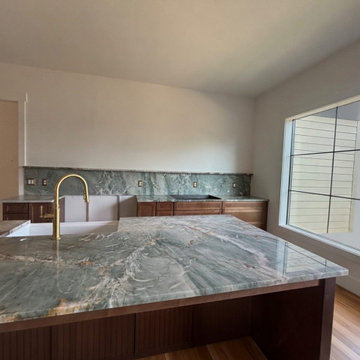
Tiffany Crystal quartzite is one of those stones that earns its keep in a kitchen. It's got that cool, crystalline background, whites and grays moving quietly across the surface with enough sparkle in the light to keep it from feeling flat. It reads clean and bright without going stark, which is why it works so well in a kitchen where people actually cook and gather, not just admire counters from across the room.
Quartzite is real stone, not engineered, so it comes with natural hardness that holds up to daily kitchen abuse. It resists scratching and handles heat well, though we still tell folks to use a trivet, because no counter needs a hot pan set straight on it just to prove a point. Sealing it right after install and keeping up with it over the years keeps the surface performing the way it should, and Tiffany Crystal takes a seal well because of its tight, dense structure.
Fabricating a slab like this takes some care in the layout. We spend real time bookmatching and dry-fitting pieces so the movement in the stone flows across seams instead of fighting itself at the corners. On a kitchen island or a run of perimeter counters, getting that continuity right is what separates a good installation from one that just gets the measurements correct. We kept the edge eased here, which is the right call on a stone with this much personality. It doesn't need extra shaping to draw the eye, the stone's already doing that work.
Day to day, this is a kitchen counter that's going to live hard and look good doing it. Quartzite shrugs off knife marks, stands up to acidic spills, and cleans up with regular dish soap and water. It's the kind of surface you stop babying after the first few months because it simply holds up.
Jobs like this one in Lexington are what we like seeing come through the shop. It's a straightforward kitchen application done with a stone that's got real depth to it, installed by people who care about how the seams and the veining line up when the job's done. That's the kind of work that keeps the Midlands trade honest.
 Sarah St. Amand Interior Design, Inc.
Photo Credit: Kelly Horkoff; K West Images
Inspiration for a large contemporary living room remodel in Toronto
Inspiration for a large contemporary living room remodel in Toronto

 Rachel Loewen Photography
Photo: Rachel Loewen © 2018 Houzz
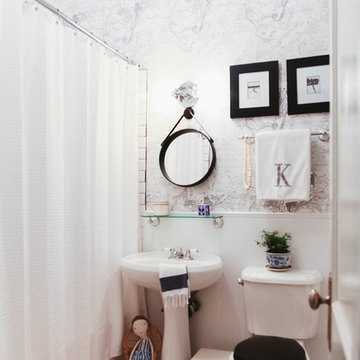
Inspiration for a transitional bathroom remodel in Chicago
Inspiration for a transitional bathroom remodel in Chicago


8