
Search results for "Earnings" in Home Design Ideas
 Rocky Tops Granite & Marble LLC
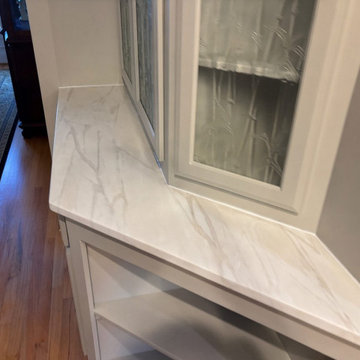
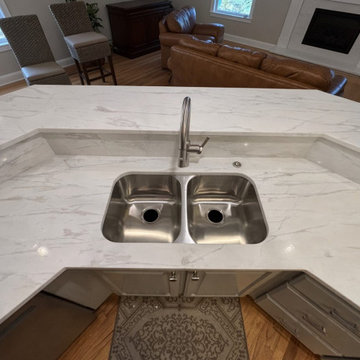
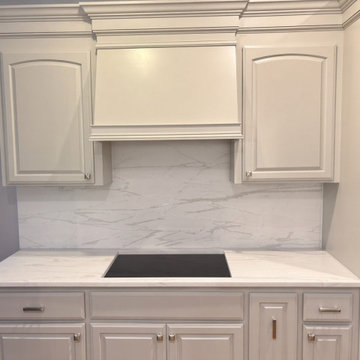
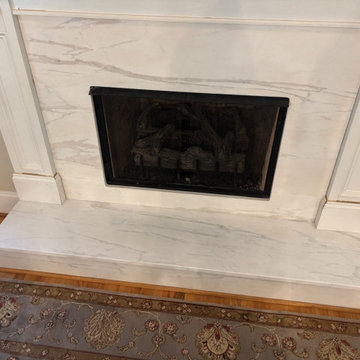
We installed Mystery White marble into a kitchen and matching fireplace surround in Irmo, and it's the kind of stone that makes a room feel brighter the second you walk in. The background is a clean white field, and the veining moves through it in soft gray threads, drifting rather than cutting straight lines. No two slabs are quite the same way, which is part of what makes marble like this worth the extra care in templating and layout.
Marble asks more of us than a lot of other stones. It's softer, it etches if you leave lemon juice sitting on it, and it needs a good sealer to keep it looking the way it did the day it was installed. But in a kitchen, that trade-off is worth it for a lot of people. The look is warmer and more alive than a lot of surfaces, and the veining gives the counters a sense of movement that holds your eye. We templated this one carefully to keep the veining reading naturally across the seams, so the pattern doesn't stop and start in a way that catches your attention for the wrong reason.
Getting the seams tight and the veins matched up means slowing down in the shop. We do a layout digitally before we ever cut, aligning the tops to find where the book-matching works best and where the color shifts are most forgiving. For a kitchen like this, with counters meeting at corners, that planning is what keeps the stone looking like one continuous surface instead of pieced-together slabs. We finished the edges eased, simple and clean, letting the stone itself carry the room instead of the profile.
Day to day, this kitchen will earn its keep. Marble takes heat well, so hot pans off the stove aren't a worry, but we always tell folks to use a cutting board and wipe up acidic spills quickly. Sealed properly and maintained with a little attention, it ages the way good marble always has, developing a soft patina over the years that a lot of homeowners come to like rather than fight.
Irmo's seen a good bit of kitchen work come through our shop, and a stone like Mystery White marble fits right into the character of these Midlands homes. It's classic without being predictable, and in this kitchen it does exactly what good marble should: it makes the whole room feel finished.
 Rocky Tops Granite & Marble LLC
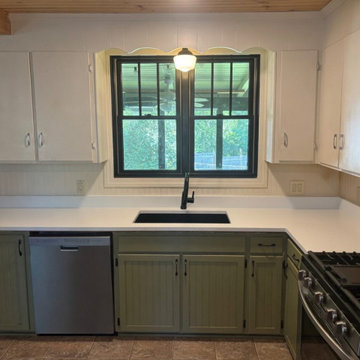
We put MSI Calacatta Elysio into a kitchen in Columbia, and it's one of those quartzes that just works in a room where people actually cook and live. Elysio's an engineered quartz manufactured right here in the great state of South Carolina. It features a bright clean background with soft gray and gold veining moving through it, the kind of look that reads calm from across the room but still gives you something to study up close at the counter.
Engineered quartz like this is consistent in a way natural stone just can't be. Every slab off the line looks close enough to the next that we're not fighting to match veining across seams or worrying about a wild vein hitting the sink cutout wrong. That consistency matters in a kitchen with multiple runs of counter, because the eye catches it immediately if the pattern jumps from one section to the next. Templating still has to be dead on, and we take the time at the seams to keep that veining looking like it keeps moving instead of stopping and starting over.
Day to day, Elysio holds up the way good quartz should. It doesn't need sealing, it resists stains from coffee, wine, and the everyday mess of a working kitchen, and it shrugs off scratches better than people expect. We still tell folks to use a trivet for hot pans straight off the stove, just good practice with any engineered surface. The edge is eased, clean and simple, the kind of detail you settle on at the end and then don't think about again because it just looks right.
Columbia kitchens see a lot of real use, families cooking, kids doing homework at the island, company gathered around while dinner's going. A quartz like Elysio fits that life. It's bright enough to open the room up, patterned enough to keep from looking flat, and tough enough that it's still going to look this good years from now. That's what we're after on every job in the Midlands, something that looks sharp walking in and keeps earning its keep long after we've packed up the tools.
 Rocky Tops Granite & Marble LLC
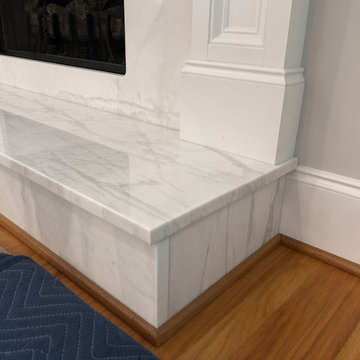
We installed Mystery White marble into a kitchen and matching fireplace surround in Irmo, and it's the kind of stone that makes a room feel brighter the second you walk in. The background is a clean white field, and the veining moves through it in soft gray threads, drifting rather than cutting straight lines. No two slabs are quite the same way, which is part of what makes marble like this worth the extra care in templating and layout.
Marble asks more of us than a lot of other stones. It's softer, it etches if you leave lemon juice sitting on it, and it needs a good sealer to keep it looking the way it did the day it was installed. But in a kitchen, that trade-off is worth it for a lot of people. The look is warmer and more alive than a lot of surfaces, and the veining gives the counters a sense of movement that holds your eye. We templated this one carefully to keep the veining reading naturally across the seams, so the pattern doesn't stop and start in a way that catches your attention for the wrong reason.
Getting the seams tight and the veins matched up means slowing down in the shop. We do a layout digitally before we ever cut, aligning the tops to find where the book-matching works best and where the color shifts are most forgiving. For a kitchen like this, with counters meeting at corners, that planning is what keeps the stone looking like one continuous surface instead of pieced-together slabs. We finished the edges eased, simple and clean, letting the stone itself carry the room instead of the profile.
Day to day, this kitchen will earn its keep. Marble takes heat well, so hot pans off the stove aren't a worry, but we always tell folks to use a cutting board and wipe up acidic spills quickly. Sealed properly and maintained with a little attention, it ages the way good marble always has, developing a soft patina over the years that a lot of homeowners come to like rather than fight.
Irmo's seen a good bit of kitchen work come through our shop, and a stone like Mystery White marble fits right into the character of these Midlands homes. It's classic without being predictable, and in this kitchen it does exactly what good marble should: it makes the whole room feel finished.
Find the right local pro for your project
 Rocky Tops Granite & Marble LLC
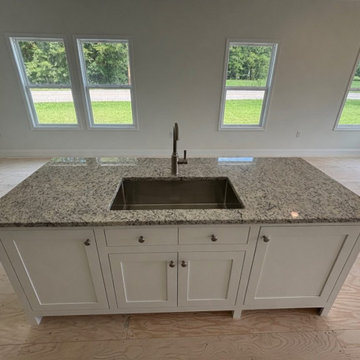
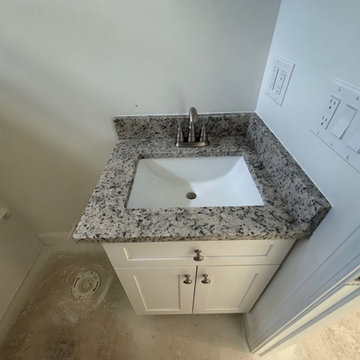
This kitchen in Bamberg came together in Dallas White granite, a stone that reads clean and bright without going stark. The background carries soft grays with subtle movement through it, enough character to keep the eye interested but calm enough to work with just about any cabinet color a builder picks for a spec house like this one. That's part of why it gets used so often in kitchens meant to show well and live well at the same time.
Granite's still one of the best choices you can make for a kitchen countertop, and Dallas White in particular holds up the way granite's supposed to. It's dense, it resists heat, and you can set a hot pan on it without worrying about scorching. Scratches aren't a concern with normal use, and the surface takes a polish that lasts for years. We seal it going in and that's about all the maintenance it ever needs.
Getting a granite slab like this into a kitchen right takes more than just cutting to size. We template the space first to make sure the seams land where they won't draw attention, usually tucked near the sink or stove, and any countertop longer than about 8 to 9 feet is going to need one. Matching the pattern across a seam so it reads as one continuous piece is where the work actually happens. The edge here is eased, a clean, simple line that lets the stone itself do the talking instead of competing with it.
Day to day, this is the kind of countertop that just works. Wipe it down, don't worry about it, and it'll look the same ten years from now as it does today. That durability is exactly what a spec house kitchen needs, something that shows well to a buyer walking through and keeps performing long after they've moved in.
We do a lot of work through the Midlands, and Bamberg jobs like this one are a good example of what granite still does better than almost anything else on the market. It's a straightforward material that never stops earning its keep in a kitchen, and this one turned out exactly the way it should.
 Rocky Tops Granite & Marble LLC
This kitchen in Bamberg came together in Dallas White granite, a stone that reads clean and bright without going stark. The background carries soft grays with subtle movement through it, enough character to keep the eye interested but calm enough to work with just about any cabinet color a builder picks for a spec house like this one. That's part of why it gets used so often in kitchens meant to show well and live well at the same time.
Granite's still one of the best choices you can make for a kitchen countertop, and Dallas White in particular holds up the way granite's supposed to. It's dense, it resists heat, and you can set a hot pan on it without worrying about scorching. Scratches aren't a concern with normal use, and the surface takes a polish that lasts for years. We seal it going in and that's about all the maintenance it ever needs.
Getting a granite slab like this into a kitchen right takes more than just cutting to size. We template the space first to make sure the seams land where they won't draw attention, usually tucked near the sink or stove, and any countertop longer than about 8 to 9 feet is going to need one. Matching the pattern across a seam so it reads as one continuous piece is where the work actually happens. The edge here is eased, a clean, simple line that lets the stone itself do the talking instead of competing with it.
Day to day, this is the kind of countertop that just works. Wipe it down, don't worry about it, and it'll look the same ten years from now as it does today. That durability is exactly what a spec house kitchen needs, something that shows well to a buyer walking through and keeps performing long after they've moved in.
We do a lot of work through the Midlands, and Bamberg jobs like this one are a good example of what granite still does better than almost anything else on the market. It's a straightforward material that never stops earning its keep in a kitchen, and this one turned out exactly the way it should.
 Rocky Tops Granite & Marble LLC
We installed Mystery White marble into a kitchen and matching fireplace surround in Irmo, and it's the kind of stone that makes a room feel brighter the second you walk in. The background is a clean white field, and the veining moves through it in soft gray threads, drifting rather than cutting straight lines. No two slabs are quite the same way, which is part of what makes marble like this worth the extra care in templating and layout.
Marble asks more of us than a lot of other stones. It's softer, it etches if you leave lemon juice sitting on it, and it needs a good sealer to keep it looking the way it did the day it was installed. But in a kitchen, that trade-off is worth it for a lot of people. The look is warmer and more alive than a lot of surfaces, and the veining gives the counters a sense of movement that holds your eye. We templated this one carefully to keep the veining reading naturally across the seams, so the pattern doesn't stop and start in a way that catches your attention for the wrong reason.
Getting the seams tight and the veins matched up means slowing down in the shop. We do a layout digitally before we ever cut, aligning the tops to find where the book-matching works best and where the color shifts are most forgiving. For a kitchen like this, with counters meeting at corners, that planning is what keeps the stone looking like one continuous surface instead of pieced-together slabs. We finished the edges eased, simple and clean, letting the stone itself carry the room instead of the profile.
Day to day, this kitchen will earn its keep. Marble takes heat well, so hot pans off the stove aren't a worry, but we always tell folks to use a cutting board and wipe up acidic spills quickly. Sealed properly and maintained with a little attention, it ages the way good marble always has, developing a soft patina over the years that a lot of homeowners come to like rather than fight.
Irmo's seen a good bit of kitchen work come through our shop, and a stone like Mystery White marble fits right into the character of these Midlands homes. It's classic without being predictable, and in this kitchen it does exactly what good marble should: it makes the whole room feel finished.
 Rocky Tops Granite & Marble LLC
We installed Mystery White marble into a kitchen and matching fireplace surround in Irmo, and it's the kind of stone that makes a room feel brighter the second you walk in. The background is a clean white field, and the veining moves through it in soft gray threads, drifting rather than cutting straight lines. No two slabs are quite the same way, which is part of what makes marble like this worth the extra care in templating and layout.
Marble asks more of us than a lot of other stones. It's softer, it etches if you leave lemon juice sitting on it, and it needs a good sealer to keep it looking the way it did the day it was installed. But in a kitchen, that trade-off is worth it for a lot of people. The look is warmer and more alive than a lot of surfaces, and the veining gives the counters a sense of movement that holds your eye. We templated this one carefully to keep the veining reading naturally across the seams, so the pattern doesn't stop and start in a way that catches your attention for the wrong reason.
Getting the seams tight and the veins matched up means slowing down in the shop. We do a layout digitally before we ever cut, aligning the tops to find where the book-matching works best and where the color shifts are most forgiving. For a kitchen like this, with counters meeting at corners, that planning is what keeps the stone looking like one continuous surface instead of pieced-together slabs. We finished the edges eased, simple and clean, letting the stone itself carry the room instead of the profile.
Day to day, this kitchen will earn its keep. Marble takes heat well, so hot pans off the stove aren't a worry, but we always tell folks to use a cutting board and wipe up acidic spills quickly. Sealed properly and maintained with a little attention, it ages the way good marble always has, developing a soft patina over the years that a lot of homeowners come to like rather than fight.
Irmo's seen a good bit of kitchen work come through our shop, and a stone like Mystery White marble fits right into the character of these Midlands homes. It's classic without being predictable, and in this kitchen it does exactly what good marble should: it makes the whole room feel finished.
 Rocky Tops Granite & Marble LLC
We installed Mystery White marble into a kitchen and matching fireplace surround in Irmo, and it's the kind of stone that makes a room feel brighter the second you walk in. The background is a clean white field, and the veining moves through it in soft gray threads, drifting rather than cutting straight lines. No two slabs are quite the same way, which is part of what makes marble like this worth the extra care in templating and layout.
Marble asks more of us than a lot of other stones. It's softer, it etches if you leave lemon juice sitting on it, and it needs a good sealer to keep it looking the way it did the day it was installed. But in a kitchen, that trade-off is worth it for a lot of people. The look is warmer and more alive than a lot of surfaces, and the veining gives the counters a sense of movement that holds your eye. We templated this one carefully to keep the veining reading naturally across the seams, so the pattern doesn't stop and start in a way that catches your attention for the wrong reason.
Getting the seams tight and the veins matched up means slowing down in the shop. We do a layout digitally before we ever cut, aligning the tops to find where the book-matching works best and where the color shifts are most forgiving. For a kitchen like this, with counters meeting at corners, that planning is what keeps the stone looking like one continuous surface instead of pieced-together slabs. We finished the edges eased, simple and clean, letting the stone itself carry the room instead of the profile.
Day to day, this kitchen will earn its keep. Marble takes heat well, so hot pans off the stove aren't a worry, but we always tell folks to use a cutting board and wipe up acidic spills quickly. Sealed properly and maintained with a little attention, it ages the way good marble always has, developing a soft patina over the years that a lot of homeowners come to like rather than fight.
Irmo's seen a good bit of kitchen work come through our shop, and a stone like Mystery White marble fits right into the character of these Midlands homes. It's classic without being predictable, and in this kitchen it does exactly what good marble should: it makes the whole room feel finished.

 RoomService 360
Near Italy’s northeast border lies the small town of Moimacco. Once an important stop along ancient trade routes, today, all of the modern furnishings offered by the Italian design house Bross are crafted in the quaint Italian town. Hallmarks of the Bross line of contemporary furniture are an attention to detail and a careful selection of quality materials, in particular, fine European woods. The Bross focus on fine craftsmanship lends an appealing, organic element to homes decorated in the modern interior design style.
The company’s commitment to producing high quality modern furniture has attracted some of the finest designers, including Paolo Piva, Gerd Lange, Enzo Berti, Laprell and Althaus and Ennio Arosio. The room service 360° collection of Bross furnishings includes buffets, consoles and dining and coffee tables that demonstrate the extraordinary technical prowess and artistic vision of these world-renowned designers. Bross is the perfect choice for contemporary homes.
Welcome to room service 360°, the premier destination for the world’s finest modern furniture. As an authorized dealer of the most respected furniture manufacturers in Europe, room service 360° is uniquely positioned to offer the most complete, most comprehensive and most exclusive collections of custom contemporary and modern furniture available on the market today. From world renowned designers at Bonaldo, Cattelan Italia, Fiam Italia, Foscarini, Gamma Arredamenti, Pianca, Presotto Italia, Tonelli and Tonin Casa, only the finest Italian furniture collections are represented at room service 360°.
On our website you will find the latest collections from top European contemporary/modern furniture designers, leading Italian furniture manufacturers and many exclusive products. We are also proud and excited to offer our interior design blog as an ongoing resource for design fanatics, curious souls and anyone who is looking to be inspired.
In our Philadelphia showroom we carefully select our products and change them frequently to provide our customers with the best possible mix through which they can envision their room’s décor and their life. This is the reason why many of our customers (thank you all!!!) travel for hours, and some fly to our store. This is the reason why we have earned the privilege to be the starting point for modern living for many of you.
 Rocky Tops Granite & Marble LLC
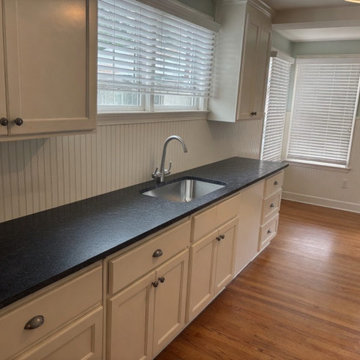
This kitchen in Forest Acres came together around a solid granite countertop, and it's the kind of stone that does the quiet work of holding a whole room together. Granite's been the go-to for kitchen counters for decades because it earns it. It's igneous rock, formed under heat and pressure, and that history is why it laughs off the stuff a real kitchen throws at it. Hot pans, knife work, everyday spills, granite takes it and keeps looking good.
We went with an eased edge on this one, which is the clean, simple line that a lot of Midlands homeowners want. It's not flashy, but that's the point. An eased edge softens the sharp corner just enough to be comfortable to lean against and easy to wipe down, and it lets the granite itself, the movement, the flecks, the depth in the stone, do the talking instead of a fussy edge profile competing for attention.
Getting a countertop like this right starts before the stone ever gets cut. We template the kitchen precisely, accounting for the cabinets, the appliances, and any out-of-square walls that always show up in real houses. Then it's cut, the edges are worked by hand to get that eased profile even and consistent around every corner, and the seams, if there are any, get lined up so the pattern reads as close to continuous as we can get it. Granite doesn't forgive sloppy fabrication. Every joint and cutout has to be tight because the stone's not going anywhere once it's set.
Day to day, this is a countertop that's built for actual cooking and actual life, not just for photos. Granite resists scratching, it handles heat better than almost anything else you'd put in a kitchen, and with a good sealer it shrugs off staining from wine, oil, or lemon juice. It's low maintenance once it's in, just a wipe down and, depending on the specific granite, a reseal every year or two to keep it performing at its best.
Forest Acres has a good mix of older homes getting updated and newer builds going in, and granite fits both. It's a material that's stood the test of time in kitchens across the Midlands, and this one's a solid, honest example of why. Clean lines, real stone, and a countertop that's going to outlast most everything else in that kitchen.
 Manomin Resawn Timbers
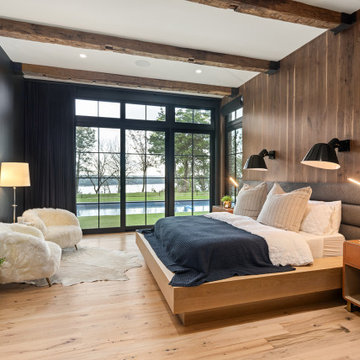
This primary bedroom at Sunset on St. Croix, a rustic modern luxury home, features weathered antique box beams overhead and antique white oak flooring underfoot, set against a wood paneled accent wall behind the bed. Black steel windows and doors open to a view of the pool and lake beyond, while faux fur accent chairs, a cowhide rug, and a tufted upholstered headboard bring warmth and comfort to the room's rustic modern palette.
Our weathered antique box beams are milled from a mix of softwoods, ranging from hemlock to pine, salvaged from joists, roof boards, decking, and walls of late 19th and early 20th century structures. The natural patina from a century of weathering gives them a darker, moodier character. Our antique white oak flooring takes the light and bright aesthetic of the species further, with a subtle grey patina earned over years of natural weathering, milled from timberstock salvaged from 19th century industrial buildings and displaying the unique grain patterns and durability old growth oak is known for.
Whether you are a homebuilder, a home remodeling contractor, a homeowner, or a designer planning a primary bedroom like this, Manomin Resawn Timbers has the reclaimed wood box beams and flooring to bring warmth and character to your home. Visit our showroom in Hugo, MN or reach out to us with a call or a message. 15152 Freeland Avenue North, Hugo MN 55038. Mon–Thu 8am–4:30pm, Fri 8am–4pm. 651.464.1771.
 Rocky Tops Granite & Marble LLC
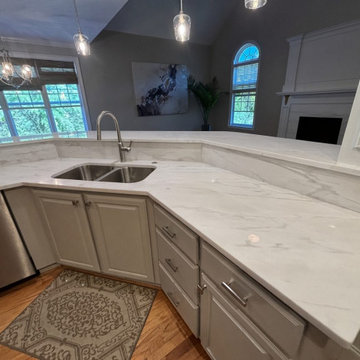
We installed Mystery White marble into a kitchen and matching fireplace surround in Irmo, and it's the kind of stone that makes a room feel brighter the second you walk in. The background is a clean white field, and the veining moves through it in soft gray threads, drifting rather than cutting straight lines. No two slabs are quite the same way, which is part of what makes marble like this worth the extra care in templating and layout.
Marble asks more of us than a lot of other stones. It's softer, it etches if you leave lemon juice sitting on it, and it needs a good sealer to keep it looking the way it did the day it was installed. But in a kitchen, that trade-off is worth it for a lot of people. The look is warmer and more alive than a lot of surfaces, and the veining gives the counters a sense of movement that holds your eye. We templated this one carefully to keep the veining reading naturally across the seams, so the pattern doesn't stop and start in a way that catches your attention for the wrong reason.
Getting the seams tight and the veins matched up means slowing down in the shop. We do a layout digitally before we ever cut, aligning the tops to find where the book-matching works best and where the color shifts are most forgiving. For a kitchen like this, with counters meeting at corners, that planning is what keeps the stone looking like one continuous surface instead of pieced-together slabs. We finished the edges eased, simple and clean, letting the stone itself carry the room instead of the profile.
Day to day, this kitchen will earn its keep. Marble takes heat well, so hot pans off the stove aren't a worry, but we always tell folks to use a cutting board and wipe up acidic spills quickly. Sealed properly and maintained with a little attention, it ages the way good marble always has, developing a soft patina over the years that a lot of homeowners come to like rather than fight.
Irmo's seen a good bit of kitchen work come through our shop, and a stone like Mystery White marble fits right into the character of these Midlands homes. It's classic without being predictable, and in this kitchen it does exactly what good marble should: it makes the whole room feel finished.
 Rocky Tops Granite & Marble LLC
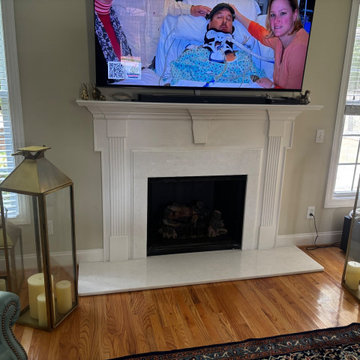
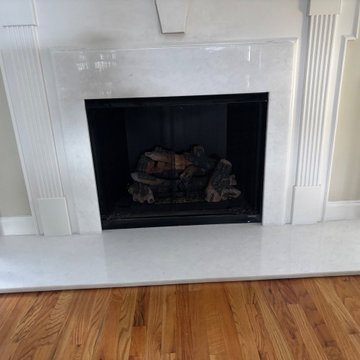
Hanoi White marble makes a fireplace surround the centerpiece of a room instead of just a backdrop for the TV. This one went into a home in Blythewood, and it's the kind of stone that earns that spot. White marble with soft gray veining has been the go-to for fireplaces for a reason: it catches light off to either side of the mantel and gives the whole wall a calm, finished look that paint or tile just can't match.
Marble takes a mellower polish than a lot of other stones, and the veining moves in loose, natural patterns that give it a warmer feel to the eye even though the stone itself stays cool to the touch. For a surround, we're not dealing with knife cuts or hot pans, so the wear concerns people sometimes bring up with marble in a kitchen don't really apply here. It's decorative and structural at the same time, built to frame a firebox and take the heat that comes off it without any trouble.
Fabricating a surround like this means getting the slab selection right before anything else. You want the veining to read well across the face and up the legs, not fight itself at the seams. We templated this one to the fireplace opening and cut it so the pattern carries through cleanly, then set it with an eased edge, simple and out of the way so the stone itself stays the focus. That's really the right call on a piece like this. Anything fussier on the edge would just compete with what the marble's already doing.
Day to day, a surround like this asks for very little. It's not a work surface, so scratching isn't a real concern, and a light sealing keeps it looking the way it did on install day for years. It'll take the ambient heat from the firebox fine, it wipes clean, and it holds up as the kind of feature you don't think about, you just enjoy.
Jobs like this are why we like doing this kind of work around Blythewood and the rest of the Midlands. A fireplace wall is one of the first things people see walking into a room, and Hanoi White marble with an eased edge gives this one a quiet, finished presence that's going to hold up for a long time.
 Rocky Tops Granite & Marble LLC
Hanoi White marble makes a fireplace surround the centerpiece of a room instead of just a backdrop for the TV. This one went into a home in Blythewood, and it's the kind of stone that earns that spot. White marble with soft gray veining has been the go-to for fireplaces for a reason: it catches light off to either side of the mantel and gives the whole wall a calm, finished look that paint or tile just can't match.
Marble takes a mellower polish than a lot of other stones, and the veining moves in loose, natural patterns that give it a warmer feel to the eye even though the stone itself stays cool to the touch. For a surround, we're not dealing with knife cuts or hot pans, so the wear concerns people sometimes bring up with marble in a kitchen don't really apply here. It's decorative and structural at the same time, built to frame a firebox and take the heat that comes off it without any trouble.
Fabricating a surround like this means getting the slab selection right before anything else. You want the veining to read well across the face and up the legs, not fight itself at the seams. We templated this one to the fireplace opening and cut it so the pattern carries through cleanly, then set it with an eased edge, simple and out of the way so the stone itself stays the focus. That's really the right call on a piece like this. Anything fussier on the edge would just compete with what the marble's already doing.
Day to day, a surround like this asks for very little. It's not a work surface, so scratching isn't a real concern, and a light sealing keeps it looking the way it did on install day for years. It'll take the ambient heat from the firebox fine, it wipes clean, and it holds up as the kind of feature you don't think about, you just enjoy.
Jobs like this are why we like doing this kind of work around Blythewood and the rest of the Midlands. A fireplace wall is one of the first things people see walking into a room, and Hanoi White marble with an eased edge gives this one a quiet, finished presence that's going to hold up for a long time.
 Rocky Tops Granite & Marble LLC
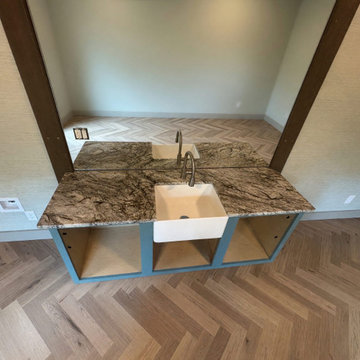
This Chapin kitchen centers on Blue Dunes granite, a stone that earns its name honestly. It carries soft gray and blue-gray tones that shift with the light, moving from almost silver near the window to deeper charcoal in the shadowed corners. It's the kind of granite that reads calm and cool without going cold, which makes it a natural fit for a kitchen built around a farmhouse sink and a lot of white or painted cabinetry.
Granite like this comes out of the quarry with real movement in it, so templating and slab selection matter more than people think. We lay out the pattern before we ever cut, matching the veining so it doesn't feel choppy from one run of countertop to the next. Once it's templated, we fabricate the top with an eased edge, which keeps the line clean and lets the stone's natural pattern do the talking instead of a fussy profile competing with it.
The farmhouse sink is the centerpiece here. Setting an apron-front sink means cutting the countertop to expose the front face of the sink cleanly, with tight, straight lines on both sides and a level reveal so it sits right against the cabinet face. That's a step you don't get a second try on. The single-hole faucet keeps the deck simple and lets the sink itself be the statement, which is exactly how a lot of homeowners want a working kitchen sink to feel.
Day to day, granite like Blue Dunes holds up to everything a real kitchen throws at it. It's heat resistant enough to set a hot pan on without worry, it resists scratching under normal knife work, and with a good sealer it shrugs off water and food acids for years without staining. It's low maintenance stone that still looks like it took real craft to install, which is the whole point of choosing granite for a hardworking kitchen.
Chapin kitchens tend to mix classic cabinetry with stone that has some personality, and Blue Dunes splits that difference well. It's calm enough to live with every day but has enough movement in the surface to keep it from feeling flat. Once the backsplash and surrounding finish work are done, this one's going to read as a clean, well-built kitchen anchored by a stone that was picked to last.
 Lindy Architect
This project was never really about the architecture. It was about a family that collects — art, ceramics, books, ideas — and needed a home that could hold all of that without turning into a museum.
The existing unit had good bones: generous ceiling heights, a floating stair, and enough square footage to work with. What it lacked was a coherent logic — a way of moving through the space that felt intentional, where each transition earned its moment.
We rebuilt that logic from the ground up.
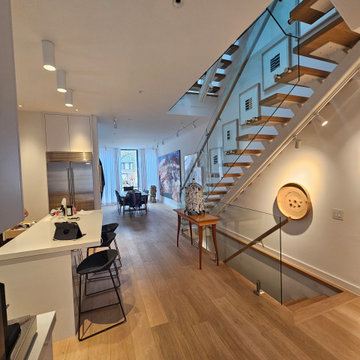
The ground floor is organized around a single corridor that runs from the kitchen island through to the living room, with the staircase serving as the spine of the whole sequence. Rather than treating the stair as purely functional, we kept the glass balustrade open and lit the treads from below, so it reads as a light source as much as a passage. The console beneath it became a natural landing for ceramics and found objects — not styled, just placed.
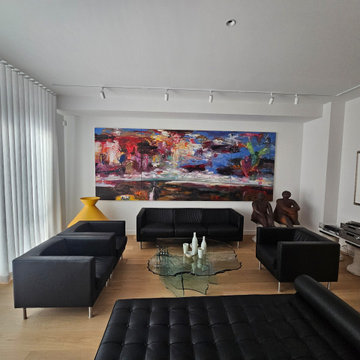
In the living room, the brief was simple: make room for a very large painting without the room feeling like a gallery. The answer was to keep everything else quiet — a white built-in that does its job, sheer linen curtains that diffuse the light, black leather chairs that anchor the space without competing. The painting does the rest.
Upstairs, the landing is lit by a skylight that washes the hallway in natural light through most of the day. We lined one side with a burl wood console and let the ceramics and framed works speak for themselves. The mix of abstract prints, a bold red canvas, and handmade vessels gives the corridor a rhythm that feels accumulated over time rather than installed all at once — because it was.
Throughout, the material palette is deliberately restrained: white oak floors, white walls, white millwork. The restraint isn't minimalism for its own sake — it's a backdrop. The owners bring the color, texture, and personality. Our job was to give them the right walls to hang things on.

 J. Francis Company LLC
Display shelves with custom brackets and concealed LED lighting and a storage / seating bench with a honed steel cap were created and installed. Custom white oak cabinets stained graphite and concrete countertops (Outlaw Studios) were designed and fabricated, including an extended splash with plate rail. Miele appliances and a rectangular sink with built-in tray compliment the minimalistic look.
Photography by Steven Dietz of Sharp Image Studios
 Lindy Architect
This project was never really about the architecture. It was about a family that collects — art, ceramics, books, ideas — and needed a home that could hold all of that without turning into a museum.
The existing unit had good bones: generous ceiling heights, a floating stair, and enough square footage to work with. What it lacked was a coherent logic — a way of moving through the space that felt intentional, where each transition earned its moment.
We rebuilt that logic from the ground up.
The ground floor is organized around a single corridor that runs from the kitchen island through to the living room, with the staircase serving as the spine of the whole sequence. Rather than treating the stair as purely functional, we kept the glass balustrade open and lit the treads from below, so it reads as a light source as much as a passage. The console beneath it became a natural landing for ceramics and found objects — not styled, just placed.
In the living room, the brief was simple: make room for a very large painting without the room feeling like a gallery. The answer was to keep everything else quiet — a white built-in that does its job, sheer linen curtains that diffuse the light, black leather chairs that anchor the space without competing. The painting does the rest.
Upstairs, the landing is lit by a skylight that washes the hallway in natural light through most of the day. We lined one side with a burl wood console and let the ceramics and framed works speak for themselves. The mix of abstract prints, a bold red canvas, and handmade vessels gives the corridor a rhythm that feels accumulated over time rather than installed all at once — because it was.
Throughout, the material palette is deliberately restrained: white oak floors, white walls, white millwork. The restraint isn't minimalism for its own sake — it's a backdrop. The owners bring the color, texture, and personality. Our job was to give them the right walls to hang things on.
 Rocky Tops Granite & Marble LLC
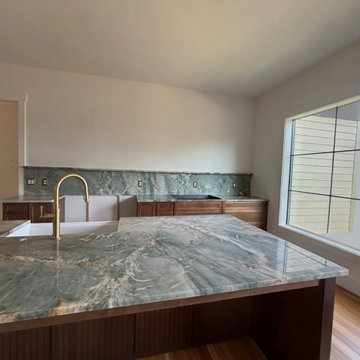
Tiffany Crystal quartzite is one of those stones that earns its keep in a kitchen. It's got that cool, crystalline background, whites and grays moving quietly across the surface with enough sparkle in the light to keep it from feeling flat. It reads clean and bright without going stark, which is why it works so well in a kitchen where people actually cook and gather, not just admire counters from across the room.
Quartzite is real stone, not engineered, so it comes with natural hardness that holds up to daily kitchen abuse. It resists scratching and handles heat well, though we still tell folks to use a trivet, because no counter needs a hot pan set straight on it just to prove a point. Sealing it right after install and keeping up with it over the years keeps the surface performing the way it should, and Tiffany Crystal takes a seal well because of its tight, dense structure.
Fabricating a slab like this takes some care in the layout. We spend real time bookmatching and dry-fitting pieces so the movement in the stone flows across seams instead of fighting itself at the corners. On a kitchen island or a run of perimeter counters, getting that continuity right is what separates a good installation from one that just gets the measurements correct. We kept the edge eased here, which is the right call on a stone with this much personality. It doesn't need extra shaping to draw the eye, the stone's already doing that work.
Day to day, this is a kitchen counter that's going to live hard and look good doing it. Quartzite shrugs off knife marks, stands up to acidic spills, and cleans up with regular dish soap and water. It's the kind of surface you stop babying after the first few months because it simply holds up.
Jobs like this one in Lexington are what we like seeing come through the shop. It's a straightforward kitchen application done with a stone that's got real depth to it, installed by people who care about how the seams and the veining line up when the job's done. That's the kind of work that keeps the Midlands trade honest.
 Rocky Tops Granite & Marble LLC
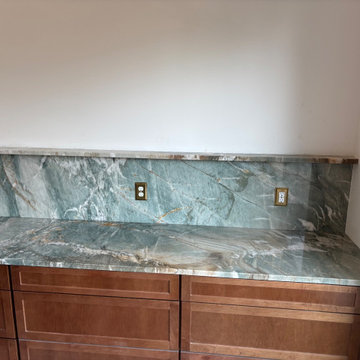
Tiffany Crystal quartzite is one of those stones that earns its keep in a kitchen. It's got that cool, crystalline background, whites and grays moving quietly across the surface with enough sparkle in the light to keep it from feeling flat. It reads clean and bright without going stark, which is why it works so well in a kitchen where people actually cook and gather, not just admire counters from across the room.
Quartzite is real stone, not engineered, so it comes with natural hardness that holds up to daily kitchen abuse. It resists scratching and handles heat well, though we still tell folks to use a trivet, because no counter needs a hot pan set straight on it just to prove a point. Sealing it right after install and keeping up with it over the years keeps the surface performing the way it should, and Tiffany Crystal takes a seal well because of its tight, dense structure.
Fabricating a slab like this takes some care in the layout. We spend real time bookmatching and dry-fitting pieces so the movement in the stone flows across seams instead of fighting itself at the corners. On a kitchen island or a run of perimeter counters, getting that continuity right is what separates a good installation from one that just gets the measurements correct. We kept the edge eased here, which is the right call on a stone with this much personality. It doesn't need extra shaping to draw the eye, the stone's already doing that work.
Day to day, this is a kitchen counter that's going to live hard and look good doing it. Quartzite shrugs off knife marks, stands up to acidic spills, and cleans up with regular dish soap and water. It's the kind of surface you stop babying after the first few months because it simply holds up.
Jobs like this one in Lexington are what we like seeing come through the shop. It's a straightforward kitchen application done with a stone that's got real depth to it, installed by people who care about how the seams and the veining line up when the job's done. That's the kind of work that keeps the Midlands trade honest.
122