
Search results for "Employee.independent" in Home Design Ideas
 Showplace Cabinetry
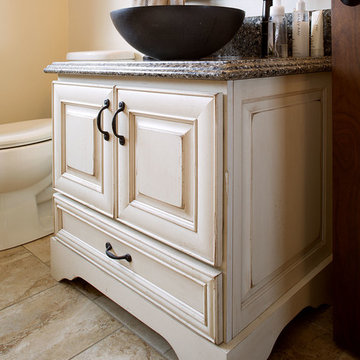
Door style: Cambridge | Species: Paint grade | Finish: Vintage Soft Cream
The Showplace Vintage Soft Cream painted finish creates an inviting setting in this combination laundry room and guest bath.
Learn more about Showplace Vintage, Casual Vintage, and Brushed Vintage finishes: http://www.showplacewood.com/ProdGuide1/PGvintage/PG.Vintage.html
 EK ARCHITECTURE, PLLC
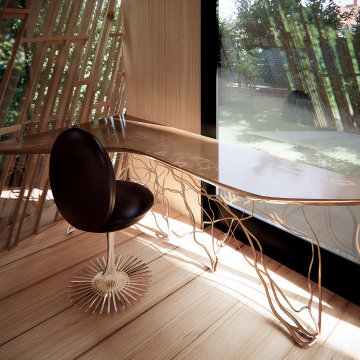
Discover our revolutionary line of customizable biophilic home-office furniture WellthyFlex. WellthyFlex is crafted from natural stone and carbon-fiber-reinforced plastic with its tree branch-inspired form. It brings the beauty of nature indoors. Each piece is thoughtfully designed to create a harmonious and soothing environment, allowing you to thrive in your work. Immerse yourself in the tranquility of your surroundings as our furniture's gentle curves and organic textures evoke a sense of calm and balance. Experience the power of biophilia as you tap into the therapeutic qualities of nature, boosting your focus, creativity, and overall well-being. Embrace the future of work with our biophilic home workplace furniture and create a sanctuary that inspires success.
Lightweight carbon-fiber-reinforced plastic, which would be algae-based in the near future, is used for table structure. With tensile strength at one-quarter the weight of steel, and lighter than aluminum, carbon-fiber-reinforced plastic legs are further optimized with generative design algorithms to use less material.
Algae-based carbon fiber:
https://www.compositesworld.com/articles/technical-university-of-munich-researchers-explore-using-algae-to-make-carbon-fiber

Find the right local pro for your project
 Electronic Design & Consulting, Inc.
This article is posted here with the consent of the author. The views and opinions expressed in this article are those of the author and do not necessarily reflect the official policy, position, view, or opinion of Crestron Electronics, Inc., or of any of its employees. Crestron Electronics is not responsible for, and does not verify the accuracy of, any of the information contained in this article.
By Jeff Singer
The “smart” revolution began several years ago with smartphones (a.k.a phones) and has extended in recent years to thermostats, doorbells, alarm systems, and kitchen appliances. Smart devices are so ubiquitous that the term “smart” is overused to the point that it is almost meaningless. Companies are eager to jump on the bandwagon and claim their products are “smart,” and consumers proudly claim they have a smart home because they have lighting control. Misconceptions about smart homes are prevalent and create confusion in the marketplace. This can have deleterious effects on businesses and underserve consumers. Here are seven of the most popular misconceptions about smart homes:
1. Apps are smart
Apps are convenient and easy to use. Yes, it seems there’s an app for everything. People expect to be able to download an app and do just about anything. App developers and many companies do not disavow consumers of this myth. On the contrary, they promote this idea with carefully worded descriptions. The promise of having the world at your fingertips for $1.99 is very enticing. Although it sounds too good to be true, it is also too good to pass up for many people. This leads to undervaluing home control and disappointment when the apps don’t work, which undermines confidence in our industry. The fact is that apps are not smart. They do not control anything. They must connect to and communicate with a control system or cloud service that processes, prioritizes, and executes commands. That’s the real magic and what most people do not understand.
2. Smart devices work together
With so many smart appliances and devices on the market today, it’s understandable that the average consumer might think that they actually communicate and work together. This is simply not the case. Smart devices are not that smart. They are designed and manufactured by different, often competing, companies. There are no national or industry standards governing these products. Even if they all operate using Wi-Fi® communications, that doesn’t mean they work together. Some companies promote a home control platform, which unites different devices from different companies – in theory. The platform is yet another third-party software totally dependent on other companies developing APIs and writing control modules for their hardware to run on that piece of software. The devices are not independently compatible. Also, when updates are made to either the hardware or the software, functionality may be affected for some period. That’s a nice way of saying the device or system won’t work and there’s no way of knowing for how long.
3. It’s a DIY project
Which brings us to the next myth, which is that the average person can do it themselves. Unless you are a skilled professional, I would not advise taking on a smart home project. You want to make a light turn on and off with your Alexa® or Google Assistant™ virtual assistant software, go for it. A smart home takes much more planning and expertise. I have no problem changing a light bulb or hanging a light fixture in my dining room; however, I am not going to rewire my house. I may change the flush valve in my toilet, but I’m not going to replace the pipes in my house. You get it. Integrating devices and systems, establishing different zones, creating scenes, designing the UI with a balance between control, feedback, and simplicity – all takes experience and skill.
4. Need a programmer to make changes
Early adopters may have experienced the pain of trying to make a simple change or update to their home control system. Years ago, if the cable provider changed the channel line-up, the homeowner would have to call the dealer or programmer to make an appointment for them to come out to the house to reprogram the system. The system wouldn’t work as expected until it was updated, which often took several days and beaucoup bucks. Not anymore. Technology has evolved so now it’s easy for system owners to change favorite channels, create scenes, rename buttons, update images, and more. While a professional is needed for the initial installation and setup, the system is easy to manage once it’s up and running. This makes life so much easier for both dealer and customer.
5. Tech becomes obsolete quickly
Similar to updating the UI, updating firmware or hardware used to be a stressful process. A smart home should be intelligent enough to update itself. Apps don’t become obsolete. Updates are constantly pushed out from the cloud, making them better all the time. The same is true for a good smart home system. New features, functions, and device support gets added in the background consistently, so the system you installed (or purchased) yesterday gets better over time. Swapping out decorative elements, such as keypads, dimmers, and touch screens is also seamless. When a new device is added, all the settings are pulled down from the cloud and it just works. No system interruptions. No sunk costs. No imposing house calls. No surprise bills.
6. Lighting control saves energy and money
Lighting control is one of the most popular smart systems, but it takes more than just one system to make a home smart. On the surface, it makes sense that if you dim the lights ten percent, then you save ten percent of energy costs. If the shades are raised during the day to take advantage of sunlight so the lights don’t need to be on (or at least not 100%), but that causes the room temperature to rise a few degrees, which triggers the air conditioner to run longer and more often, was energy usage (or cost) reduced? A smart home integrates all the various systems and technology to optimize comfort, convenience, safety, and sometimes energy.
7. Home technology is easy to hack
Security is at the forefront of people’s minds these days. Personal identities are stolen; email accounts hacked; private photos publicized; and more. A smart home must outsmart those who don’t respect privacy. Crestron control systems adhere to the strictest security standards. The same Crestron control system that goes into a home is also installed in secure government and military facilities, global banking institutions, hospitals, and other mission critical applications. When installed correctly by a trained professional, a Crestron smart home is the gold standard for security, comfort, and convenience.

 Closet Solutions
The definition of modern & clean luxury...in closet form.
Mid-sized gender-neutral carpeted and beige floor dressing room photo in Los Angeles with dark wood cabinets
Mid-sized gender-neutral carpeted and beige floor dressing room photo in Los Angeles with dark wood cabinets
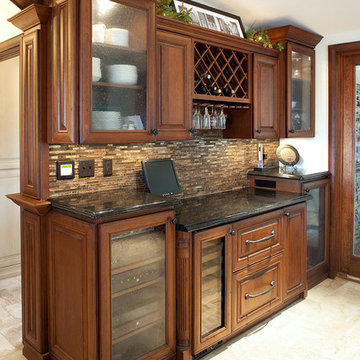 Showplace Cabinetry
Door style: Cambridge | Species: Cherry | Finish: Vintage Autumn
An entertainment and serving station is next to the doorway to the indoor pool area.
Learn more about Showplace decorative glass panes: http://www.showplacewood.com/SPECS/DecGlass/home/DecGlassHome.html
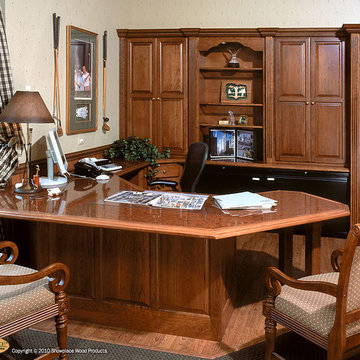 Showplace Cabinetry
Door style: Covington | Species: Cherry | Finish: Merlot with Ebony glaze
Showplace cabinetry makes this handsome executive office both practical and welcoming. Note the open display spaces, tall storage cabinets, and the integration of hanging-file cabinets below. A corner unit in the opposite corner of the office offers both AV capability and useful storage.
Learn more about Showplace cherry: http://www.showplacewood.com/WoodsFin2/woodsC.0.html
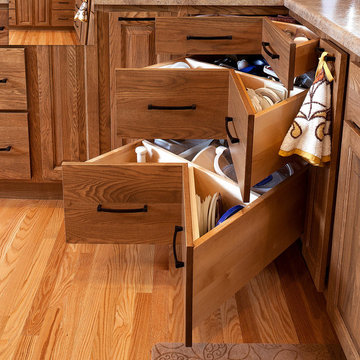 Showplace Cabinetry
Door style: Chesapeake | Species: Red Oak | Finish: Cognac
Since one of the homeowners lives life in a wheelchair, easy access was important in this design. Showplace interior accessories give lots of ways to keep lots of things within easy seated reach. Note how the clever square-corner three-drawer base cabinet makes the most of a spot that might otherwise be under-utilized.
Learn more about our style and convenience accessories to enhance your Showplace: http://www.showplacewood.com/ProdGuide1/PGaccs/accshome.html
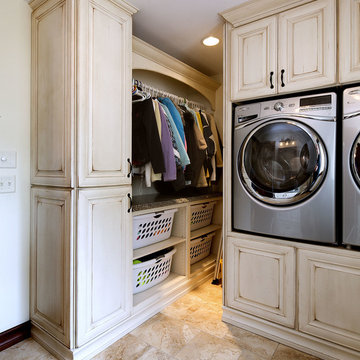 Showplace Cabinetry
Door style: Cambridge | Species: Paint grade | Finish: Vintage Soft Cream
The Showplace Vintage Soft Cream painted finish creates an inviting setting in this combination laundry room and guest bath. Note the generous space for hanging clothing, as well as the smart inclusion of basket spaces.
Learn more about the versatile palette of Showplace painted finishes: http://www.showplacewood.com/ProdGuide1/PGantq/PGantq.html
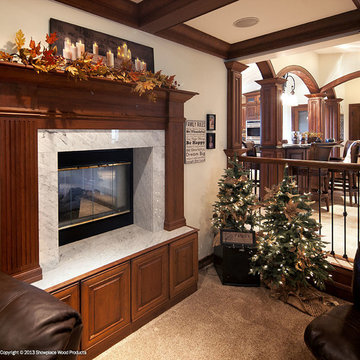 Showplace Cabinetry
Door style: Cambridge | Species: Cherry | Finish: Vintage Autumn
A couple of steps down from the room divider brings you to this comfortable family room. A Showplace fireplace surround adds homey charm, and Showplace components were used to create the overhead exposed beams.
Learn more about Showplace fireplace mantels and surrounds: http://www.showplacewood.com/furniture/surrhoods/surroundshoods.html
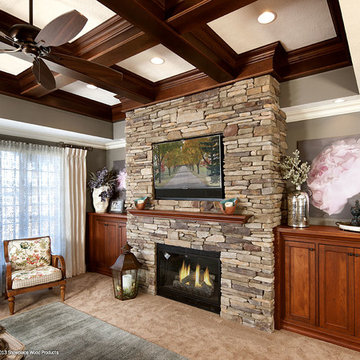 Showplace Cabinetry
Door style: Savannah Inset | Species: Cherry | Finish: Vintage Autumn
The living room adjacent to the kitchen is anchored by this dramatic fireplace. A Showplace mantel is below the TV recess, and Showplace cabinets are used for the built-ins on both flanks. Cherry in Vintage Autumn is a perfect choice for this warm and relaxing setting.
Learn more about Showplace fireplace mantels and surrounds: http://www.showplacewood.com/furniture/surrhoods/surroundshoods.html
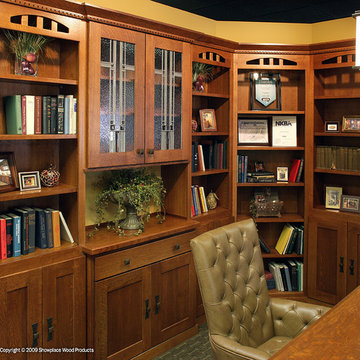 Showplace Cabinetry
Door style: Pendleton W | Species: Quartersawn White Oak | Finish: Autumn
This functional home office design captures the Mission theme with its clean lines and rich quartersawn grain. Also note the lovely leaded-glass doors.
Learn more about our Pendleton W door style: http://www.showplacewood.com/DOORS/pendletonW/Doors.PenW2.html
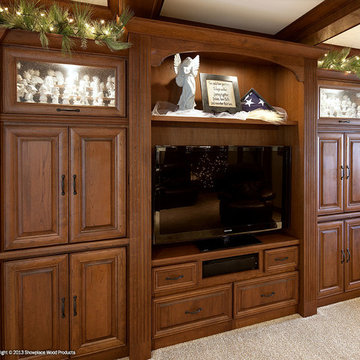 Showplace Cabinetry
Door style: Cambridge | Species: Cherry | Finish: Vintage Autumn
This large entertainment center anchors the family room, and communicates balanced dignity with timeless elegance.
Learn more about Showplace Wood Products: http://www.showplacewood.com/
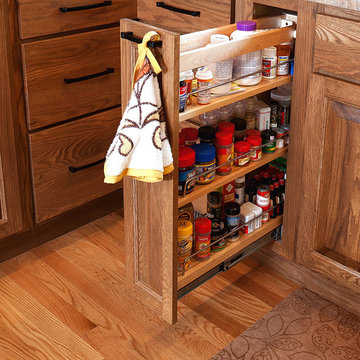 Showplace Cabinetry
Door style: Chesapeake | Species: Red Oak | Finish: Cognac
Since one of the homeowners lives life in a wheelchair, easy access was important in this design. Showplace interior accessories give lots of ways to keep lots of things within easy seated reach.
Learn more about our style and convenience accessories to enhance your Showplace: http://www.showplacewood.com/ProdGuide1/PGaccs/accshome.html
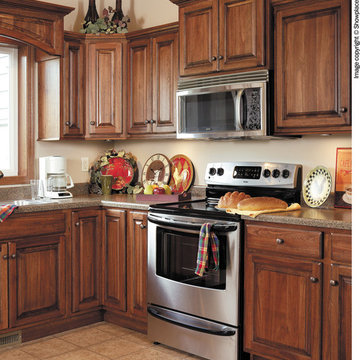 Showplace Cabinetry
Door style: Covington | Species: Lyptus | Finish: Distressed Truffle with Ebony glaze
A large raised-panel valance spans the window, linking runs of wall cabinets on each side. A graceful crown molding treatment on top is nicely refrained with the subtle inclusion of smaller moldings below the wall cabinets. Note the inherent variation of tone and grain that is a lovely attribute of Brazilian Lyptus hardwood.
Learn more about Showplace Vintage, Casual Vintage, and Brushed Vintage finishes: http://www.showplacewood.com/ProdGuide1/PGvintage/PG.Vintage.html
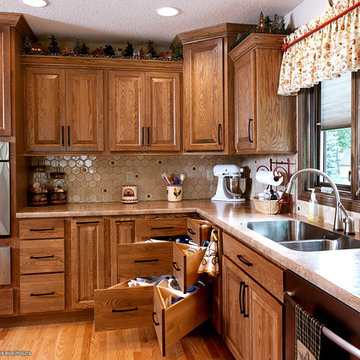 Showplace Cabinetry
Door style: Chesapeake | Species: Red Oak | Finish: Cognac
A distinctive tile backsplash adds texture to the design. Note how traditional crown moldings above the wall cabinets are paired with small flush moldings below.
Learn more about our style and convenience accessories to enhance your Showplace: http://www.showplacewood.com/ProdGuide1/PGaccs/accshome.html
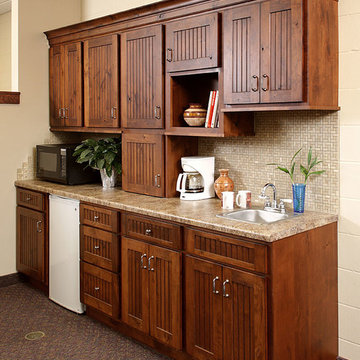 Showplace Cabinetry
Door style: Summit | Species: Rustic Alder | Finish: Autumn
This small kitchenette in a factory office was given new life with Showplace Renew refacing. The unique flexibility of Renew refacing allowed the addition of entirely new Showplace cabinets. The end result is more attractive and homelike, as well as more functional.
Learn more about Showplace Renew: http://www.renewcabinetrefacing.com/
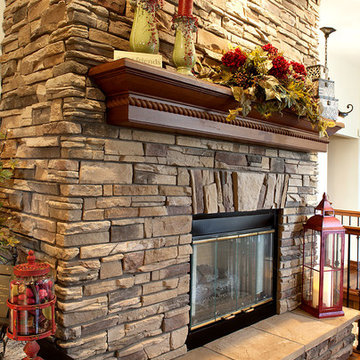 Showplace Cabinetry
Door style: Cambridge | Species: Cherry | Finish: Vintage Autumn
The stone living-room fireplace uses a custom Showplace mantel in cherry Vintage Autumn.
Learn more about Showplace fireplace mantels and surrounds: http://www.showplacewood.com/furniture/surrhoods/surroundshoods.html
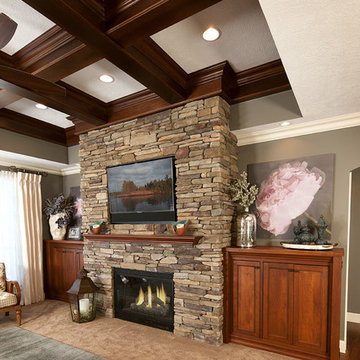 Showplace Cabinetry
Door style: Savannah Inset | Species: Cherry | Finish: Vintage Autumn
The living room adjacent to the kitchen is anchored by this dramatic fireplace. A Showplace mantel is below the TV recess, and Showplace cabinets are used for the built-ins on both flanks. Cherry in Vintage Autumn is a perfect choice for this warm and relaxing setting.
Learn more about Showplace Vintage, Casual Vintage, and Brushed Vintage finishes: http://www.showplacewood.com/ProdGuide1/PGvintage/PG.Vintage.html

 Bill Fry Construction - Wm. H. Fry Const. Co.
Covid During Construction and Making Face Masks
Dear Houzz Folks,
We've started getting back to work and are educating everyone at our projects on how to be safe during COVID, posting signage, and we've been making masks for our employees, colleagues, friends, family etc... Here's some information on what I've learned so far in sewing the best fitting face mask for COVID.
1. Put in a wire at the nose bridge (about 3.5 inches) - it helps with fit and if you wear glasses, it keeps them from fogging up. I found that doorbell wire, available at the hardware store, seems to work well. It isn't too thin or too fat, bends easily and holds its shape. I attach it by using a zigzag stitch on the interior seam of the outside of the mask (so there's a bit more cushion on the inside).
2. For the shaped masks, I make a pocket in case my friends, family, colleagues, want to insert a filter - it also allows for three layers of fabric in the breathing area and less bulk where the ties go. For patterns that don't offer pockets, I just make my own pattern pocket. I also first baste the two inside pieces first and then sew the front on. This way, there's no worries about slipping. No pins are needed and no pins minimizes the number of extra air holes in the fabric.
3. So that the ties/loops can be replaced or modified, I make a channel for rather than sewing it in permanently. Many videos show using a safety pin to pull the elastic through. If you sew much, you might have a bodkin in your sewing box, but it might be a bit too wide. Instead, I use a long hairpin (you could probably make a long loop with a paper clip). I run the hairpin through the channel, loop the elastic through the end of the pin and pull through. That takes much less time than piercing it with a safety-pin.
4. For the inside of the masks, it is nice to have softer fabric inside, so high-thread-count sheets purchased on sale work great. Then you can easily tell what is inside as well.
5. For surgical-style masks, there's a pattern with a pocket on the inside and a wire. I like the ideas in this video but use 2 fabrics and make them bigger. About a 9x9 inch for the outside and 9x8 inch for the inside. 5/8 seam on the nose and 1/4 seam on the bottom.
6. For the fitted masks, there are two patterns that I like. For this one, https://moinliz.de/mundschutz-naehen-mit-schnittmuster it expects you to print on European-sized paper, so if you want to get the size right, print at 100%
I also really like this pattern and I added a pocket and lengthened the ends to make channels https://intermountainhealthcare.org/covid19-coronavirus/homemade-cloth-face-coverings/ (scroll down to a link to download the pdf) Lots of folks sew craftpassion, but I like the fit of these patterns better. There are still some other patterns I have left to try!
6. After breaking lots of needles, I realized that I really didn't need to topstich the fitted masks over the bridge, so I just started skipping the bridge.
7. If you're going to wear a face-covering for a really long time, you might want to skip the ear hangers and go for ties behind the head. Instead of two ties, I'll use one long one so that the bottom one is a loop and the top one ties. Bungee cord works nice.
Happy Sewing!
: ) Rhoda Fry, Bill Fry Construction
1