
Search results for "Finding dependable" in Home Design Ideas

 Vetter Architects
A minimal insertion into a densely wooded landscape, the Collector’s Pavilion provides the owners with an 8,000 sf private fitness space and vintage automobile gallery. On a gently sloping site in amongst a grove of trees, the pavilion slides into the topography - mimicking and contrasting the surrounding landscape with a folded roof plane that hovers over a board formed concrete base.
The clients’ requirement for a nearby room to display a growing car collection as well as provide a remote area for personal fitness carries with it a series of challenges related to privacy and security. The pavilion nestles into the wooded site - finding a home in a small clearing - and merges with the sloping landscape. The building has dual personalities, serving as a private and secure bunker from the exterior, while transforming into a warm and inviting space on the interior. The use of indirect light and the need to obscure direct views from the public right away provides the client with adequate day light for day-to-day use while ensuring that strict privacy is maintained. This shifting personality is also dramatically affected by the seasons - contrasting and merging with the surrounding environment depending on the time of year.
The Collector’s Pavilion employs meticulous detailing of its concrete to steel to wood connections, exploring the grounded nature of poured concrete in conjunction with a delicate wood roof system that floats above a grid of steel. Above all, the Pavilion harmonizes with it’s natural surroundings through it’s materiality, formal language, and siting.
Overview
Chenequa, WI
Size
8,000 sf
Completion Date
May 2013
Services
Architecture, Landscape Architecture, Interior Design


 Synergy Home Improvements LLC
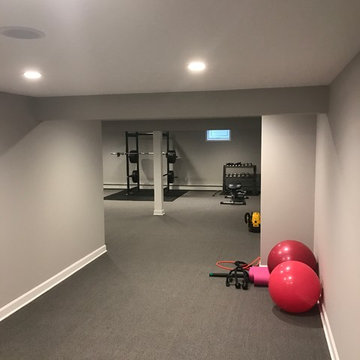
Home weight room - large traditional carpeted and gray floor home weight room idea in New York with gray walls
Find the right local pro for your project

 Floret
Learn seed starting basics and get a jump start on growing the flower garden of your dreams. In this striking guide you will find everything you need to grow, harvest, and arrange stunning seasonal blooms. With equal parts instruction and inspiration, Floret Farm’s Cut Flower Garden welcomes you into Erin Benzakein’s abundant, bloom-filled world, and is a feast for every flower lover’s eyes and soul. Floret Farm's Cut Flower Garden. Written by Erin Benzakein with Julie Chai. Photos by Michèle M. Waite. Published by Chronicle Books.
 IDF Studio
Photo by Tri Nguyen.
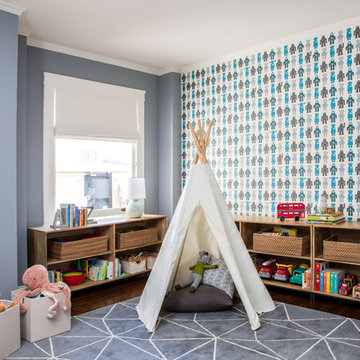
Inspiration for a transitional dark wood floor and brown floor playroom remodel in San Francisco with blue walls
Inspiration for a transitional dark wood floor and brown floor playroom remodel in San Francisco with blue walls

 SUPERIOR CHIMNEY SERVICES CORPORATION
Is it crazy to think about chimney repairs in the winter? It’s cold and snowy outside and the rooftops are solid white, coated with a layer of ice. A homeowner called us with a concern about her home. She reported that a small stream of water was coming down the chimney and into the firebox. To keep the water from flooding the firebox, the homeowner placed a Tupperware container to collect the water. Not a good look. Can chimney repairs in the winter be done by a certified chimney technician?
Chimney Repairs in the Winter
Chimney repairs can be completed in the winter, although it depends on what type of chimney repair is needed. Let’s take a quick look at the different chimney repairs in our cold winter months.
Chimney Cap: If your chimney cap comes loose, or if the winter winds knocked it out of place or blew it off completely, our certified chimney technician can go up on the roof and take care of the chimney cap for you with a chimney cap replacement. Our technicians follow the guidelines for safety, especially in the winter months when roofing systems are the slipperiest.
Flashing: Flashing is the connector from the roofing system to the chimney. It is the barrier that protects water from finding its way into your home. However, if the flashing becomes loose or comes away from the roof and chimney, it is open season for the rain to come directly into your home and create chaos.
Chimney Crown: The chimney crown is the slab of cement that sits on top of the chimney and right below the chimney cap. Hairline cracks can form in the chimney crown allowing water, melted snow, to enter. Even the smallest hairline crack can cause the melted snow to find the weak spot on the chimney crown and make its way into your home.
Remember, hairline cracks can and will grow in width and length with the freeze thaw cycles. When the melted snow freezes at night, it expands inside of the crack. If the temperatures cooperate in the daytime, it melts the snow. But remember, it doesn’t necessarily dry out inside of the crack. It can remain moist and freeze again at night.
Chimney Tuckpointing: Tuckpointing the chimney can be done in the winter, but it certainly isn’t an easy process as we’re dealing with wet mortar. Cracks can create an entry point for melted snow to enter, further deteriorating the mortar.
Although it is not optimal to perform chimney repairs in the winter, Superior Chimney takes precautions to ensure a safe and effective repair. Now the homeowner can get rid of the streaming water in the firebox and enjoy the rest of the winter with a warm and dry fireplace.
Be sure to contact us today if you have a water leak in your fireplace. If you would like to have your chimney inspected and checked for water leaks coming this spring, contact us today to schedule it up in March. This way, you’ll be all set and not compete with others in the Spring.

 safe ZOnea
Every year, the same thing happens. The first real snowfall arrives, demand for de-icing materials spikes overnight, and the businesses that waited too long find themselves scrambling for supply at the worst possible moment. Facility managers, property owners, contractors, and municipalities all depend on a steady supply of salt and ice melt to keep their properties safe and operational through winter. The ones who plan ahead sail through. The ones who don't pay more, wait longer, and take on real risk.
Sourcing de-icing materials well is not complicated, but it does require thinking ahead and understanding the options. The choices you make about what to buy, how to buy it, and who to buy it from have a direct effect on your costs, your reliability, and your ability to keep people safe when conditions turn dangerous. This article lays out what matters.
Why Your Choice of Supplier Matters More Than You Think
It is easy to treat de-icing material as a commodity, something you grab whenever you need it without much thought about where it comes from. That works fine until the moment it doesn't, usually in the middle of a storm when everyone needs supply at once and the casual sources have run dry. At that point, the relationships you built before the season become the difference between staying stocked and being stuck.
Reliable supply is the whole game in winter operations. A property that runs out of ice melt during a storm faces safety hazards, liability exposure, and disruption, none of which can wait for a back-ordered shipment. This is why establishing relationships with dependable rock salt suppliers before the season starts is one of the smartest moves a facility manager or contractor can make. It locks in supply, often locks in better pricing, and removes a major source of mid-winter stress.
The lesson here is to treat sourcing as a planning decision rather than a last-minute errand. The businesses that come through winter smoothly are almost always the ones that secured their supply chain early, chose suppliers who could actually deliver when it counted, and never had to gamble on finding material during a shortage. Reliability bought in advance is far cheaper than scarcity paid for in a crisis.
Bagged or Bulk: Matching the Material to the Job
One of the first practical decisions is whether to buy de-icing material in bags or in bulk, and the right answer depends entirely on the operation. Each format has clear advantages, and many operations end up using both for different purposes.
Bagged material offers convenience, control, and easy storage. It is simple to handle, easy to distribute to different locations or crews, straightforward to store without special equipment, and convenient for spot application by hand. It suits smaller properties, businesses without bulk storage, and situations where portion control and tidiness matter. Bulk material, on the other hand, tends to make sense for large operations that go through high volumes, where buying in quantity lowers the per-unit cost and the operation has the equipment and space to store and handle it. The tradeoff is between the convenience and flexibility of bags and the volume economics of bulk.
For many operations, the right approach is a mix: bulk for the high-volume core of the work and bags for flexibility, spot treatment, and locations where bulk handling is impractical. The key is to match the format to how the material will actually be stored, moved, and applied, rather than defaulting to one or the other out of habit. Thinking this through in advance avoids both the waste of over-buying bulk you can't handle and the expense of relying entirely on bags for a large operation.
Rock Salt Is Not Your Only Option
Rock salt, or sodium chloride, is the workhorse of winter de-icing for good reason. It is effective, widely available, and cost-efficient, which makes it the default choice for most operations most of the time. But it has limits, and understanding the alternatives helps you choose the right material for the conditions you actually face.
The most important limitation is temperature. Rock salt becomes less effective as temperatures drop, and in genuinely cold conditions it can struggle to do the job at all. This is where alternatives come in. Calcium chloride, for instance, works at much lower temperatures than rock salt and acts quickly, which makes it valuable when conditions are severe or when fast melting matters. Operations that face hard freezes or need dependable performance in extreme cold often keep calcium chloride for sale on hand for exactly those situations, using it alongside rock salt rather than instead of it.
The practical approach is to understand the conditions your property faces and stock accordingly. For many operations, rock salt handles the bulk of the work while a faster, colder-rated material like calcium chloride covers the extreme days when ordinary salt falls short. Matching the material to the temperature and the urgency of the situation is what separates an operation that stays ahead of winter from one that is constantly reacting to it.
Securing Your Supply Before the Season
Knowing what to buy is only half the equation. The other half is making sure you can actually get it when you need it, which means securing your supply before winter arrives rather than after it has already started. Timing is one of the most underrated factors in winter operations.
The logic is simple. Demand for de-icing materials is highly seasonal and spikes sharply during storms, when everyone needs supply simultaneously. Prices and availability both move against the buyer at exactly those moments. By contrast, planning ahead, estimating your needs and arranging supply before the season, puts you in a far stronger position. Working with established rock salt suppliers ahead of time means your material is accounted for before the rush, often at better pricing and with the confidence that it will be there when the first storm hits.
This kind of planning also lets you think clearly rather than react under pressure. You can estimate your seasonal needs based on your property and past winters, decide on the right mix of materials and formats, and arrange storage in advance. Operations that do this consistently spend less, worry less, and never find themselves making frantic calls during a storm. The effort of planning ahead is modest, and the payoff in reliability and cost savings is substantial.
Storing and Handling What You Buy
Securing supply is not much use if the material degrades before you can use it, which makes proper storage and handling an important and often overlooked part of the equation. De-icing materials are sensitive to moisture, and poor storage can turn a good supply into a clumped, hardened mess that is difficult to apply.
The fundamentals are straightforward. Keep material dry and protected from moisture, since salt and ice melt readily absorb water and can harden if exposed. Store it in a way that suits the format, whether that means a proper bulk storage area or a dry space for stacked bags. Keep it accessible, so crews can get to it quickly when a storm hits and time is short. And handle it with the right equipment for the format and volume, which protects both the material and the people working with it. None of this is complicated, but neglecting it can undermine even a well-planned supply.
Good storage practices protect the investment you made in securing supply early. There is little point in arranging your materials ahead of the season only to have them degrade before use. Treating storage and handling as part of the overall plan, rather than an afterthought, ensures that the material you secured is actually usable when the moment comes. It is the final link in a supply chain built to perform under winter conditions.
Estimating How Much You Actually Need
One question trips up operations of every size: how much de-icing material to buy. Order too little and you risk running short during a storm. Order too much and you tie up money and storage space in material you may not use. Getting the estimate reasonably right is a meaningful part of sourcing well.
Several factors shape the answer. The size and type of the areas you treat, sidewalks, lots, entrances, and drive lanes, set the baseline for how much material each application consumes. The local climate matters too, since colder regions and those with frequent snowfall go through far more material than milder ones. Application frequency depends on how often storms hit and how quickly surfaces need to be cleared, which varies with the kind of property and the expectations of the people who use it. And the type of material plays a role, since different products are applied at different rates.
Past experience is often the best guide. Operations that track what they used in previous winters, adjusted for the size of the property and the severity of the season, can estimate their needs with reasonable confidence. For newer operations without that history, it helps to plan conservatively and to work with a supplier who can replenish stock reliably, so that a low estimate does not turn into a mid-storm shortage.
The goal is not perfect precision but a sound, slightly cautious estimate paired with a dependable supply relationship. That combination lets an operation keep enough material on hand to handle the season without over-committing to volume it cannot store or use. Thinking this through before winter, rather than guessing during it, is one more way that planning ahead pays off when the snow starts to fall.
The Bottom Line
Sourcing de-icing materials well comes down to a few straightforward principles: plan ahead, choose reliable suppliers before the season, match your materials and formats to your actual needs and conditions, and store what you buy properly. The operations that follow these principles move through winter with confidence, while those that improvise pay more and take on needless risk.
Winter is predictable in one respect: it arrives every year, and demand for de-icing material spikes the moment it does. The businesses that prepare for that reality, rather than being surprised by it, are the ones that keep their properties safe, their costs controlled, and their operations running no matter what the season throws at them. A little foresight before the first snowfall pays off through every storm that follows.

 JMR Designs, Inc.
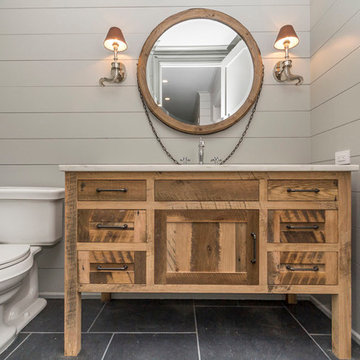
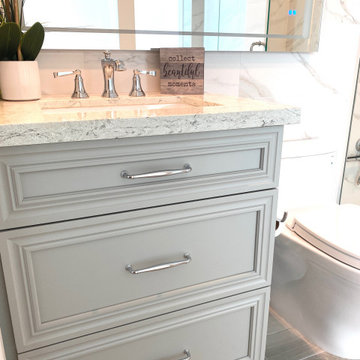
A complete bathroom renovation with marble porcelain tile, water mosaic inlay, grey cabinetry and quartz countertop done in a traditional, luxurious spa style.
 Haver & Skolnick LLC Architects
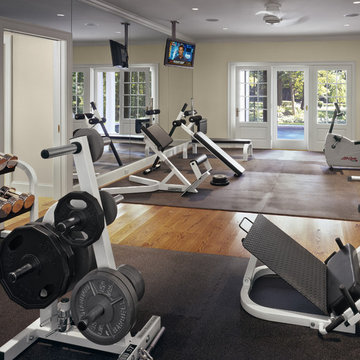
The first floor features a large family gym overlooking the pool.
Robert Benson Photography
Large elegant medium tone wood floor home weight room photo in New York with beige walls
Large elegant medium tone wood floor home weight room photo in New York with beige walls
 Accent Window Fashions LLC
HUNTER DOUGLAS ALUSTRA® VIGNETTE®
Designer fabrics that fold perfectly!
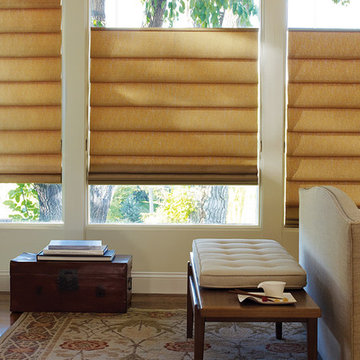
The dramatic look of Hunter Douglas Alustra® Vignette® Modern Roman Shades make a room. Exclusive fabrics, rich textures and a finished look with no exposed cords make these shades a defining fashion statement.
Design Inspiration EXCLUSIVE FABRICS
Our handpicked premium fabrics turn ordinary rooms into ones of beauty and distinction. When framed with our fabric-covered hardware, these fabrics create window fashions that can complement your décor and create welcoming, comfortable spaces.
Traditional™ fold SOFT YET MODERN
A 4-inch contoured fold for that traditional, yet modern, look at the window.
Tailored™ fold CRISP AND SOPHISTICATED
A 6-inch flat fold that is nicely pressed for a defined finish.
Tiered™ STACKED SOFTNESS
This option allows shades to stack up, down or anywhere in between.
Absorb Sound REDUCE OUTSIDE NOISE
Improve your room’s acoustics while reducing the intensity of outside sound. It starts at the windows. Simple. The degree of sound control will depend on the fabric you choose, so if this is an important feature to you, be sure to discuss it with your sales expert.
UV Protection SUNSCREEN FOR YOUR VALUABLES
Protect your furniture, flooring and artwork from fading with at least 75% protection from harmful UV rays.
Top-Down/Bottom-Up PRIVACY WITH A VIEW
A more versatile approach to light control. Open from the top, from the bottom, or find somewhere in-between–for the perfect balance of privacy and light.
Platinum™ Technology CONTROL FROM YOUR PHONE OR TABLET
Controlling your window treatments with a mobile device means you can set your blinds to movie mode, work mode, or 8 a.m. mode with the touch of a button, without leaving your seat. It’s effortless, fun and smart—with perfectly smooth operation.
Accents by the Yard™ FABRICS FOR YOUR ROOM DECOR
Fabrics are available by the yard, so you can create decorative accents for any room with matching fabric.
Lifetime Guarantee FOR LIFE
Hunter Douglas products are designed and custom-assembled in the U.S. with the highest level of quality. But just in case, every window treatment from Hunter Douglas is covered by our lifetime limited guarantee. Read the Hunter Douglas Warranty to learn more.
Hunter Douglas Alustra® Vignette® Modern Roman Shades with EasyRise™ Cord Loop
Hunter Douglas Alustra® Vignette® Modern Roman Shades with EasyRise™ Cord Loop
Fabric: Cassatt
Color: Oak Park
Available from Accent Window Fashions LLC
Hunter Douglas Showcase Priority Dealer
Hunter Douglas Certified Installer
Hunter Douglas Certified Professional Dealer
#Hunter_Douglas #Alustra #Vignette #Modern_Roman_Shades #EasyRise #Cord_Loop #Roman_Shades #Window_Treatments #HunterDouglas #Accent_Window_Fashions
Copyright 2001-2014 Hunter Douglas, Inc. All rights reserved.
 STACT Wine Displays Inc.
 http://www.getSTACT.com
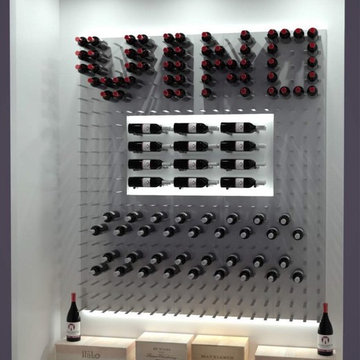
STACT wine racks are incredibly easy to specify and incorporate into wine cellars, wine rooms, kitchens, home bars, commercial bars, and restaurants. Our customers have found that when it comes to modern wine cellar solutions, our system offers a number of advantages versus other wine storage solutions available on the market, here are just a few:
✓ Quality - premium *furniture grade* solution is unique to the industry, with unrivalled refinement when it comes to materials, aesthetic and craftsmanship. Our panels feature a premium high-gloss painted finish (not a laminated surface). Each panel takes more than a week to complete, with meticulous attention to detail. Once numerous coats of lacquer have been applied, each panel is hand buffed to a mirror-like piano finish.
✓ Versatility - mount any way you wish, and designed to work equally well within both commercial and residential applications, our clients have found our modular system to be the most versatile, and easiest to specify, assemble, and install - whether for 9 bottles or 9,000 within a large scale wine cellar application (www.stact.co/cellars). Available on your choice of 10 finishes, mix and match STACT panels to create your own unique look (3,628,800 possible configurations).
✓ Convenience - designed for quick and easy *DIY installation*, our patented system comes ready-to-install to any drywall surface right out of the box, minimizing the costs associated with labor and installation when compared with many custom solutions you will find on the market. Avoiding the need for a dedicated wine cellar builder to produce and arrive on site for assembly and installation. In-stock items typically ship within 1 business day.
✓ Value - direct-to-client distribution model to effectively cut out retail markup. Builders and specifiers have found STACT to be a fraction of the price of what it would cost to develop and produce a comparable custom solution. Plus currently we are offering *free shipping worldwide*.
✓ Design pedigree - created by 2012 ICFF winning designer Eric Pfeiffer, our patented prefabricated ready-to-assemble modular design is unique to the industry.
✓ Space-saving - highest bottle capacity on the market (10.7 bottles / sq ft). Each panel supports 9-12 bottles depending on how they are configured.
✓ Security - superior bottle stability, versus other wall-mounted wine storage solutions on the market. The aircraft grade aluminum bottle support structure ensures a lower center of gravity there is a more substantial portion of the bottle resting below the contact points. Thus a minimalist design aesthetic is retained, while eliminating the need for unnecessary and unsightly materials/clutter such as rubber gaskets, straps, etc.
Credit: Vino Grotto Modern Wine Cellars


 Sierra Living Concepts Inc
Dimension:
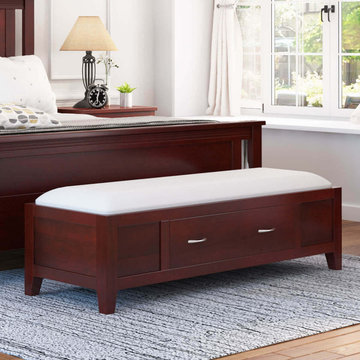
62" L X 22" D X 19.5" H
The foot of the bed has always provided great opportunities for décor and some other sensible storage ideas. You can find a combination of both in our Amenia Solid Mahogany Wood 1 Drawer Bedroom Ottoman.
The footbed ottoman has been designed in a lean, rectangular fashion with seating on top, which is donned in white upholstery. Its height has been carefully determined to suit the footboard of any bed. However, it’s actually the stunning solid Mahogany wood hand-craftsmanship that is the pièce de résistance of this bedroom ottoman.
With a beautiful dark-hued stain and an excellent heirloom quality, the ottoman stands on 4 feet with tapered edges. The front has 1 spacious drawer with stainless steel handles, and the sides have a gentle, wainscot-style recess. The overall look is extremely charismatic and attractive.
The best part is that you can seamlessly allocate this 1 drawer bedroom ottoman in any kind of an interior design setting. It can be set up in a contemporary style interior, or it can be paired with a traditional setting – it all depends on your aesthetic. However, it would look the best when paired with the contemporary platform bed, 2 nightstands, dresser and mirror frame from our Amenia Solid Mahogany Wood 6 Piece Bedroom Set.
Special Features:
• 100% Handcrafted
• Solid Mahogany wood craftsmanship
• Traditional style
• Rectangular design
• Seating at the top with plush white upholstery
• 1 drawer
• Tapered feet
• Stainless steel hardware
• Sleek, dark finish
• Heirloom quality
• Flexible aesthetics
• Easy maintenance
Note: Real wood is a product of nature, and as such, no two pieces are alike. Variations in solid wood grain patterns are to be expected and make each furniture uniquely beautiful, just like us humans.
Sponsored
Sunbury, OH

J.Holderby - Renovations
Franklin County's Leading General Contractors - 2X Best of Houzz!
 Clark & Co Homes
Doug Petersen Photography
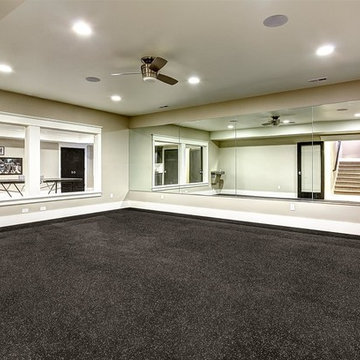
Example of a huge classic home weight room design in Boise with beige walls
Example of a huge classic home weight room design in Boise with beige walls
 Otogawa-Anschel Design-Build
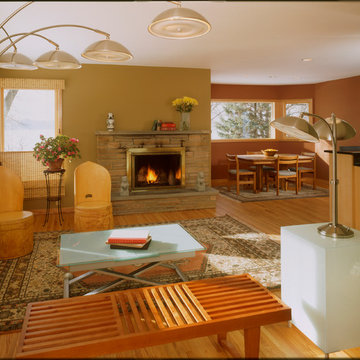
The owners of this 1970s-era split-level on Lake Calhoun recently added a third story bringing the home up-to-date with attractive soffits, angles, and half-walls built to create depth and dimension. But in a house where every room registered a dull white, a healthy dose of color becomes the true force for modernizing this space. The homeowners asked Otogawa-Anschel to bring color into their lives.
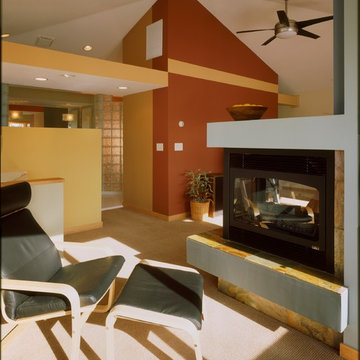
The standalone fireplace in the room’s center wears an entirely different chromatic palette on each side. From the sleeping area and looking out toward the lake, cool tones tease out the aqua and dark blue in the slate fireplace surround. From the opposite side, warm hues pick up the rose and violet of the same material. The wall separating the bedroom from the bathroom boasts a rich adobe red, set off by a gold soffit and a rich chocolate panel. The bold, earthy color triad serves as the eye-catching anchor point for the room.
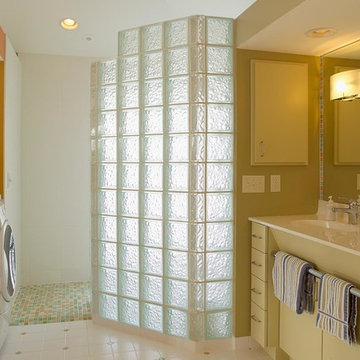
Asymmetrical glass block flanking the bathroom vanity opens up an otherwise restrictive space, allowing it to communicate with the walk-in closet on one side and the natural light spill on the other. Because the green glass block diffuses the light, the room’s colors work to compensate for this softening. A mix of tangerine, pale green, and lemon yellow tile used in the shower find a place on the floor and walls as well for a burst of synthetic sunshine designed to shift and bend depending on vantage point. The gently morphing pattern eliminates the flat sterility of white tile and ordinary glass block.
The transition from the second floor to the third floor features a combination of yellow hues that also appear to shimmer and shift with the movement of natural light through the space. In the intense afternoon sun, the pigments lose their distinction and become a solid glowing wall. As the sun sets, they regain their individual character.
Like any healthy relationship, the living room and dining room work together while maintaining independence. In the living room, a soft suede wall gives way to the room’s large bank of windows and smartly complements the stone fireplace. Muted greens and golds segue effortlessly to the spectacular lake view. Meanwhile, the vibrant tones of the dining room tastefully contrast the cool calm of the living area.
highlights
Fifty-six colors in whole house
Forty-two colors in master suite
 Otogawa-Anschel Design-Build
The owners of this 1970s-era split-level on Lake Calhoun recently added a third story bringing the home up-to-date with attractive soffits, angles, and half-walls built to create depth and dimension. But in a house where every room registered a dull white, a healthy dose of color becomes the true force for modernizing this space. The homeowners asked Otogawa-Anschel to bring color into their lives.
The standalone fireplace in the room’s center wears an entirely different chromatic palette on each side. From the sleeping area and looking out toward the lake, cool tones tease out the aqua and dark blue in the slate fireplace surround. From the opposite side, warm hues pick up the rose and violet of the same material. The wall separating the bedroom from the bathroom boasts a rich adobe red, set off by a gold soffit and a rich chocolate panel. The bold, earthy color triad serves as the eye-catching anchor point for the room.
Asymmetrical glass block flanking the bathroom vanity opens up an otherwise restrictive space, allowing it to communicate with the walk-in closet on one side and the natural light spill on the other. Because the green glass block diffuses the light, the room’s colors work to compensate for this softening. A mix of tangerine, pale green, and lemon yellow tile used in the shower find a place on the floor and walls as well for a burst of synthetic sunshine designed to shift and bend depending on vantage point. The gently morphing pattern eliminates the flat sterility of white tile and ordinary glass block.
The transition from the second floor to the third floor features a combination of yellow hues that also appear to shimmer and shift with the movement of natural light through the space. In the intense afternoon sun, the pigments lose their distinction and become a solid glowing wall. As the sun sets, they regain their individual character.
Like any healthy relationship, the living room and dining room work together while maintaining independence. In the living room, a soft suede wall gives way to the room’s large bank of windows and smartly complements the stone fireplace. Muted greens and golds segue effortlessly to the spectacular lake view. Meanwhile, the vibrant tones of the dining room tastefully contrast the cool calm of the living area.
highlights
Fifty-six colors in whole house
Forty-two colors in master suite
 Otogawa-Anschel Design-Build
The owners of this 1970s-era split-level on Lake Calhoun recently added a third story bringing the home up-to-date with attractive soffits, angles, and half-walls built to create depth and dimension. But in a house where every room registered a dull white, a healthy dose of color becomes the true force for modernizing this space. The homeowners asked Otogawa-Anschel to bring color into their lives.
The standalone fireplace in the room’s center wears an entirely different chromatic palette on each side. From the sleeping area and looking out toward the lake, cool tones tease out the aqua and dark blue in the slate fireplace surround. From the opposite side, warm hues pick up the rose and violet of the same material. The wall separating the bedroom from the bathroom boasts a rich adobe red, set off by a gold soffit and a rich chocolate panel. The bold, earthy color triad serves as the eye-catching anchor point for the room.
Asymmetrical glass block flanking the bathroom vanity opens up an otherwise restrictive space, allowing it to communicate with the walk-in closet on one side and the natural light spill on the other. Because the green glass block diffuses the light, the room’s colors work to compensate for this softening. A mix of tangerine, pale green, and lemon yellow tile used in the shower find a place on the floor and walls as well for a burst of synthetic sunshine designed to shift and bend depending on vantage point. The gently morphing pattern eliminates the flat sterility of white tile and ordinary glass block.
The transition from the second floor to the third floor features a combination of yellow hues that also appear to shimmer and shift with the movement of natural light through the space. In the intense afternoon sun, the pigments lose their distinction and become a solid glowing wall. As the sun sets, they regain their individual character.
Like any healthy relationship, the living room and dining room work together while maintaining independence. In the living room, a soft suede wall gives way to the room’s large bank of windows and smartly complements the stone fireplace. Muted greens and golds segue effortlessly to the spectacular lake view. Meanwhile, the vibrant tones of the dining room tastefully contrast the cool calm of the living area.
highlights
Fifty-six colors in whole house
Forty-two colors in master suite
Sponsored
Columbus, OH

Hope Restoration & General Contracting
Columbus Design-Build, Kitchen & Bath Remodeling, Historic Renovations
 Otogawa-Anschel Design-Build
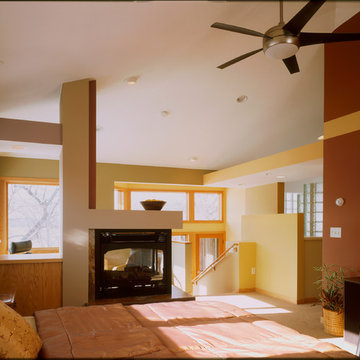
The owners of this 1970s-era split-level on Lake Calhoun recently added a third story bringing the home up-to-date with attractive soffits, angles, and half-walls built to create depth and dimension. But in a house where every room registered a dull white, a healthy dose of color becomes the true force for modernizing this space. The homeowners asked Otogawa-Anschel to bring color into their lives.
The standalone fireplace in the room’s center wears an entirely different chromatic palette on each side. From the sleeping area and looking out toward the lake, cool tones tease out the aqua and dark blue in the slate fireplace surround. From the opposite side, warm hues pick up the rose and violet of the same material. The wall separating the bedroom from the bathroom boasts a rich adobe red, set off by a gold soffit and a rich chocolate panel. The bold, earthy color triad serves as the eye-catching anchor point for the room.
Asymmetrical glass block flanking the bathroom vanity opens up an otherwise restrictive space, allowing it to communicate with the walk-in closet on one side and the natural light spill on the other. Because the green glass block diffuses the light, the room’s colors work to compensate for this softening. A mix of tangerine, pale green, and lemon yellow tile used in the shower find a place on the floor and walls as well for a burst of synthetic sunshine designed to shift and bend depending on vantage point. The gently morphing pattern eliminates the flat sterility of white tile and ordinary glass block.
The transition from the second floor to the third floor features a combination of yellow hues that also appear to shimmer and shift with the movement of natural light through the space. In the intense afternoon sun, the pigments lose their distinction and become a solid glowing wall. As the sun sets, they regain their individual character.
Like any healthy relationship, the living room and dining room work together while maintaining independence. In the living room, a soft suede wall gives way to the room’s large bank of windows and smartly complements the stone fireplace. Muted greens and golds segue effortlessly to the spectacular lake view. Meanwhile, the vibrant tones of the dining room tastefully contrast the cool calm of the living area.
highlights
Fifty-six colors in whole house
Forty-two colors in master suite


 Tile Doctor Ltd
If you want a polished stone floor to keep its appearance, then it will need a regular maintenance plan in place, without it the stone will lose its polish and start to look dull and un-inviting which was the story with this Travertine tiled floor installed throughout much of the grout floor of this house in the village of Great Wilbraham near Cambridge.
I was able to find out from the owner that the floor was last treated six years ago with Lithofin Stain Stop which is a solvent based impregnating sealer which like all sealers will wear off after a few years. Naturally this depends on the amount of wear the floor receives and what tends to happen is this process occurs more rapidly in the high traffic areas leading to an uneven appearance.
The best course of action now would be to remove what was left of the sealer and re-polish and seal the floor.
During my inspection of the floor I had noticed a number of irregular holes in one of the Travertine tiles which needed filling with a colour matching filler; this worked out quite well and as you can see from the photographs below the result looked entirely natural.
After protecting the clients skirting boards with protective film we proceeded to burnish the floor through with a set of Tile Doctor Diamond encrusted honing pads.
During the application of the first coarse pad we also added a strong dilution of Tile Doctor Pro-Clean combined with NanoTech Ultra-Clean to aid the removal of sealer residues from the pores of the Travertine. The floor was then rinsed and the soiled solution extracted using a wet vacuum.
With the sealer remove we were now able to concentrate on building up the polish on the stone by applying the remaining pads from Medium, Fine through to Very Fine, each lubricated with a little water and ensuring to rinse in-between the application of each pad.
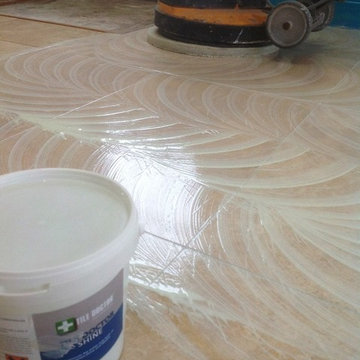
With the floor now clean and the polish restored the last step was to protect it so it would keep its appearance for as long as possible. There are a number of solutions for this but for a long durable shine I opted to work Tile Doctor Shine Powder into the Travertine.
The powder is applied liberally to the floor and then ground in using a slow speed floor rotary machine fitted with a white or tan buffing pad lubricated with water.
The shine on the floor has now been restored and the client has a beautiful and durable finish to their Travertine tiles.
Mick Conlon
Cambridge Tile Doctor
36