
Search results for "Fingertips" in Home Design Ideas

 Kole Made Design/Build
Eat-in kitchen - mid-sized rustic galley porcelain tile and gray floor eat-in kitchen idea in Philadelphia with a farmhouse sink, flat-panel cabinets, dark wood cabinets, wood countertops, white backsplash, subway tile backsplash and stainless steel appliances

 The Carpet Workroom
A 100% wool herringbone option by the name of Peter Island by Kaleen! An overall versatile wool that can be used as a stair runner, area rug, and wall to wall installations!

 McInturff Architects
Mount Airy MD
General Contractor: Mueller Homes
Photo: Julia Heine / McInturff Architects
Modern exterior home idea in DC Metro
Modern exterior home idea in DC Metro
Find the right local pro for your project

 Truitt and White Window and Door Showroom
Julian Hodges - Featured Project of the Month by Truitt & White
This month featured project brings you beautifully crafted gates and entryways from local craftsman Julian Hodges. For over 35 years, Mr. Hodges has been designing and crafting custom wooden gates in Berkeley and the greater Bay Area.
His projects mainly feature old growth, vertical grained redwood or western red cedar which is air or kiln dried. The gates are fully mortised and tenoned (male / female joints) and a very powerful epoxy is used to glue the parts together. Wherever a floating panel rides in a dado, drainage is provided in the form of several holes that are out of sight that allow any rain water to be ushered out at the bottom of the gate enabling the gate to dry itself rather than staying damp which otherwise could lead to long term decomposition of the wood.
Adding to the unique feel of each gate, Julian creates his own custom hardware from heavy gauge steel, which also provides a pleasing solid sound as it operates.
All gates are then finished in a penetrating oil seal which optimizes the longevity and good appearance of the gates.
For more information on Julian Hodges' work, visit www.julianhodges.com.



 P.S.pierreswatch
Architect Petr Kozeykin, Assistant Architect Ekaterina Vasilyeva, furniture design Petr Kozeykin, Manufacturer of furniture factory Bassi Fratelli, Photographer Sergey Morgunov
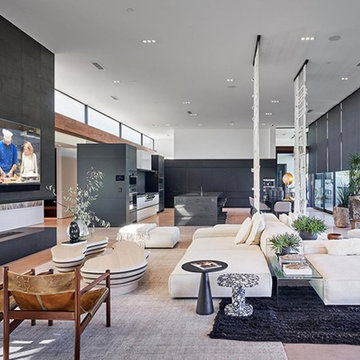
 Electronic Design & Consulting, Inc.
This article is posted here with the consent of the author. The views and opinions expressed in this article are those of the author and do not necessarily reflect the official policy, position, view, or opinion of Crestron Electronics, Inc., or of any of its employees. Crestron Electronics is not responsible for, and does not verify the accuracy of, any of the information contained in this article.
By Jeff Singer
The “smart” revolution began several years ago with smartphones (a.k.a phones) and has extended in recent years to thermostats, doorbells, alarm systems, and kitchen appliances. Smart devices are so ubiquitous that the term “smart” is overused to the point that it is almost meaningless. Companies are eager to jump on the bandwagon and claim their products are “smart,” and consumers proudly claim they have a smart home because they have lighting control. Misconceptions about smart homes are prevalent and create confusion in the marketplace. This can have deleterious effects on businesses and underserve consumers. Here are seven of the most popular misconceptions about smart homes:
1. Apps are smart
Apps are convenient and easy to use. Yes, it seems there’s an app for everything. People expect to be able to download an app and do just about anything. App developers and many companies do not disavow consumers of this myth. On the contrary, they promote this idea with carefully worded descriptions. The promise of having the world at your fingertips for $1.99 is very enticing. Although it sounds too good to be true, it is also too good to pass up for many people. This leads to undervaluing home control and disappointment when the apps don’t work, which undermines confidence in our industry. The fact is that apps are not smart. They do not control anything. They must connect to and communicate with a control system or cloud service that processes, prioritizes, and executes commands. That’s the real magic and what most people do not understand.
2. Smart devices work together
With so many smart appliances and devices on the market today, it’s understandable that the average consumer might think that they actually communicate and work together. This is simply not the case. Smart devices are not that smart. They are designed and manufactured by different, often competing, companies. There are no national or industry standards governing these products. Even if they all operate using Wi-Fi® communications, that doesn’t mean they work together. Some companies promote a home control platform, which unites different devices from different companies – in theory. The platform is yet another third-party software totally dependent on other companies developing APIs and writing control modules for their hardware to run on that piece of software. The devices are not independently compatible. Also, when updates are made to either the hardware or the software, functionality may be affected for some period. That’s a nice way of saying the device or system won’t work and there’s no way of knowing for how long.
3. It’s a DIY project
Which brings us to the next myth, which is that the average person can do it themselves. Unless you are a skilled professional, I would not advise taking on a smart home project. You want to make a light turn on and off with your Alexa® or Google Assistant™ virtual assistant software, go for it. A smart home takes much more planning and expertise. I have no problem changing a light bulb or hanging a light fixture in my dining room; however, I am not going to rewire my house. I may change the flush valve in my toilet, but I’m not going to replace the pipes in my house. You get it. Integrating devices and systems, establishing different zones, creating scenes, designing the UI with a balance between control, feedback, and simplicity – all takes experience and skill.
4. Need a programmer to make changes
Early adopters may have experienced the pain of trying to make a simple change or update to their home control system. Years ago, if the cable provider changed the channel line-up, the homeowner would have to call the dealer or programmer to make an appointment for them to come out to the house to reprogram the system. The system wouldn’t work as expected until it was updated, which often took several days and beaucoup bucks. Not anymore. Technology has evolved so now it’s easy for system owners to change favorite channels, create scenes, rename buttons, update images, and more. While a professional is needed for the initial installation and setup, the system is easy to manage once it’s up and running. This makes life so much easier for both dealer and customer.
5. Tech becomes obsolete quickly
Similar to updating the UI, updating firmware or hardware used to be a stressful process. A smart home should be intelligent enough to update itself. Apps don’t become obsolete. Updates are constantly pushed out from the cloud, making them better all the time. The same is true for a good smart home system. New features, functions, and device support gets added in the background consistently, so the system you installed (or purchased) yesterday gets better over time. Swapping out decorative elements, such as keypads, dimmers, and touch screens is also seamless. When a new device is added, all the settings are pulled down from the cloud and it just works. No system interruptions. No sunk costs. No imposing house calls. No surprise bills.
6. Lighting control saves energy and money
Lighting control is one of the most popular smart systems, but it takes more than just one system to make a home smart. On the surface, it makes sense that if you dim the lights ten percent, then you save ten percent of energy costs. If the shades are raised during the day to take advantage of sunlight so the lights don’t need to be on (or at least not 100%), but that causes the room temperature to rise a few degrees, which triggers the air conditioner to run longer and more often, was energy usage (or cost) reduced? A smart home integrates all the various systems and technology to optimize comfort, convenience, safety, and sometimes energy.
7. Home technology is easy to hack
Security is at the forefront of people’s minds these days. Personal identities are stolen; email accounts hacked; private photos publicized; and more. A smart home must outsmart those who don’t respect privacy. Crestron control systems adhere to the strictest security standards. The same Crestron control system that goes into a home is also installed in secure government and military facilities, global banking institutions, hospitals, and other mission critical applications. When installed correctly by a trained professional, a Crestron smart home is the gold standard for security, comfort, and convenience.

 Mads Anderson
Original Abstract Painting
60" x 70"
Oil Enamel on Canvas
Trendy living room photo in Omaha
Trendy living room photo in Omaha


 Floorology
This one of a kind and authentic bathroom features eye catching details such as the pebble tile that dances across the shower wall. The linear brown tile almost looks like wood planks giving a rustic feel to the bathroom. There is a bench for the shower and a generous bathtub surround.
Kelly Knipper, Floorology

 Cano Eixo Construction
600 sq. foot Master Bedroom addition in Danville, California. [ Includes Master Suite, Master Bathroom, Master Walk-in Closet. ]
Master Bathroom with Hidden Shower Drain.



 Colorado Custom Floors
Reclaimed Hardwood Floor
Small mountain style enclosed dark wood floor living room photo in Denver
Small mountain style enclosed dark wood floor living room photo in Denver

 Kinship Architecture
Blackened steel railings and stringer covers.
Minimalist wooden metal railing staircase photo in New York with wooden risers
Minimalist wooden metal railing staircase photo in New York with wooden risers


 David Lyles Decorative Painting
Close-up of the faux walnut--would you think this is paint?!
Example of a country home office design in Dallas
Example of a country home office design in Dallas

 Seeber Build
Rebar connection detail
Photography by Tanis Seeber, @ tanisphoto
Staircase - industrial staircase idea in Vancouver
Staircase - industrial staircase idea in Vancouver


45