
Search results for "Flagstone patios" in Home Design Ideas

 Newport Avenue Landscaping
Eric Parnell - NW Collective - www.thenwcollective.com
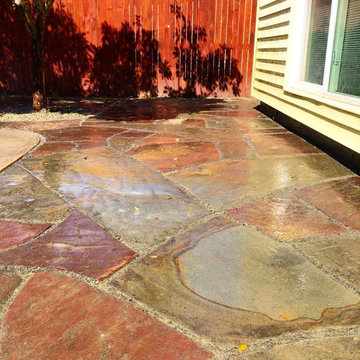
Inspiration for a large craftsman backyard patio remodel in Portland
Inspiration for a large craftsman backyard patio remodel in Portland


Find the right local pro for your project

 Trillium Tile
Mosaic tree roots fan out from the base of this Cedar, winding their way around this quartzite flagstone patio. The pebble mosaic was installed in-situ, a traditional process developed by the mosaic masters of the Mediterranean.





 Landwork Contractors, Inc.
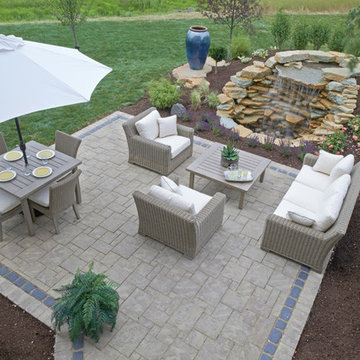
The natural stone coping from Unilock really helped put the finishing touch on this large scale patio. The patio was constructed over a gravel base using Unilock Beacon Hill Flagstone pavers in the Steel Mountain color with a Copthorne Basalt accent.
The retaining walls, steps and fire pit were constructed using Unilock Brussels Block complimented with the Black River natural stone coping.
This patio will host a lot of family and friends with over 1,800 square feet of patio.

 Ecoscape Environmental Design
This locally quarried stone creates a space for entertaining and transitioning from the rear entrance of the house to the big backyard. An herb garden with boulders integrates the patio space with the backyard orchard and raised vegetable garden beds.


 Diversified Contractors / DC Patio
DC Patio
Beautiful Pennsylvania Flagstone(Square Cut / Random Pattern) dry laid on compacted CR-6 & stonedust base. Seat Wall consists of mortared block, with Chocolate/Gray Natural Thins Stone Veneer,





 Flores Artscape, Inc.
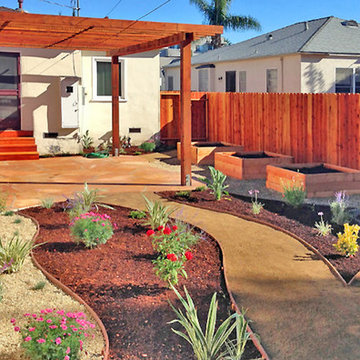
A custom flagstone patio is covered with a redwood pergola. There's also redwood steps, railing, fence, gate and planter boxes. In the foreground is a drought-tolerant area with flowering plants and other low-water ones. The decomposed granite walkway divides two mulch beds. There's also areas of gravel and some vine plants.

 Lynnwood Services
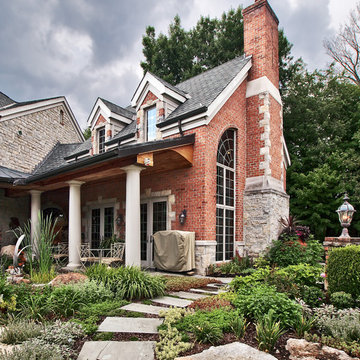
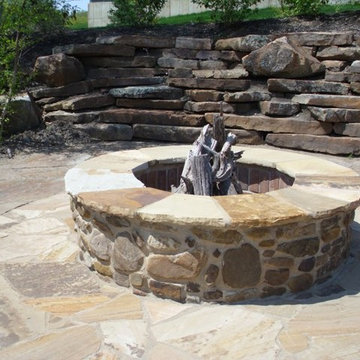
This Client needed an over flow patio space for a fir pit and additional guest. The slope of the yard presented an opportunity to create a cozy nook nestled into the landscape.
Sponsored
Columbus, OH

Structural Remodeling
Franklin County's Heavy Timber Specialists | Best of Houzz 2020!
 The Masons Co and Dionysian Artificers Landscape
Kansas City Brick & Masonry is the craft of shaping rough pieces of rock into accurate geometrical shapes, at times simple, but some of considerable complexity, and then arranging the resulting stones, often together with mortar, to form structures.
Quarrymen split veins, or sheets of rock, and extract the resulting blocks of stone from the ground.
Sawyers cut these rough blocks into cuboids, to required size with diamond-tipped saws. The resulting block if ordered for a specific component is known as sawn six sides (SSS).
Banker masons are workshop based, and specialize in working the stones into the shapes required by a building's design, this set out on templets and a bed mould. They can produce anything from stones with simple chamfers to tracery windows, detailed mouldings and the more classical architectural building masonry. When working a stone from a sawn block, the mason ensures that the stone is bedded in the right way, so the finished work sits in the building in the same orientation as it was formed on the ground. Occasionally though some stones need to be orientated correctly for the application; this includes voussoirs, jambs, coping sand cornice.
The basic tools, methods and skills of the banker mason have existed as a trade for thousands of years.
Carvers cross the line from craft to art, and use their artistic ability to carve stone into foliage, figures, animals or abstract designs.
Fixer masons specialize in the fixing of stones onto buildings, using lifting tackle, and traditional lime mortars and grouts. Sometimes modern cements, mastics and epoxy resins are used, usually on specialist applications such as stone cladding. Metal fixings, from simple dowels and cramps to specialised single application fixings, are also used. The precise tolerances necessary make this a highly skilled job.
Memorial masons or monumental masons carve gravestones and inscriptions.
The modern stonemason undergoes comprehensive training, both in the classroom and in the working environment. Hands-on skill is complemented by intimate knowledge of each stone type, its application and best uses, and how to work and fix each stone in place. The mason may be skilled and competent to carry out one or all of the various branches of stonemasonry. In some areas the trend is towards specialization, in other areas towards adaptability.

38