
Search results for "Leaving" in Home Design Ideas

 The Firefly Garden
Crushed in Vine is an autumnal wreath cheerfully peppered with tiny red accent lights. A garland of grape leaves wrapped in warm autumn colors brings doors and windows to life or serves as a welcoming table centerpiece for feasts and celebrations. This 18 inch arrangement is operated by three replaceable AA batteries.



 Benson Designs LLC
Arts & Crafts style railing with hand forged metal elements chosen by the home owners. Elements on the railing include detailed fish, dragonflies, hummingbirds, frogs, oak leaves, acorns, and beech leaves. Oak leaf and acorn detail shot.
Find the right local pro for your project
 Five Star Tree Care
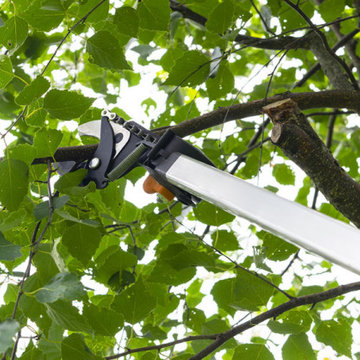
Effectively maintaining your landscape and trees take a good amount of time and effort. Often, homeowners will delay trimming or pruning their trees out of laziness or simply because they don’t know how to correctly care of their trees. But, you should know that tree trimming should be at the top of your to-do list for many reasons. Pruning, proper maintenance, and fertilization are all critical if you want the trees in your yard to thrive to grow strong. For homeowners that are unable to handle the tasks on their own, our professional tree trimming service can help. Five Star Tree Services has put together a list of the top three reasons why you need to trim your trees on a regular basis.
Healthier Trees
Regular tree trimming will keep your trees in their best health while also promoting growth. Sometimes trees may have dead or broken branches, removing them prevents decay and can even prevent an infection from spreading. If you leave damaged or rotting branches on your tree, it can spread the condition to other parts of the tree or even to other trees in the area.
When you prune your tree on a regular basis, it also promotes the growth of new leaves and branches. Reducing the thickness of the leaves and branches also opens up the inner part of the tree to the sun. Furthermore, air circulation is critical for a healthy tree and regular trimming ensures that your tree always has access to the fresh oxygen it needs to thrive. The healthier your tree is the better quality oxygen it will produce for the surrounding area.
Improve Property Value
Well-kept trees greatly improve the aesthetics of your home. Decaying branches or trees that are overgrown are not only unsightly and dangerous, but they can also have a negative impact on the curb appeal of your house. If your house is on the market, seeing an unkempt yard with untrimmed trees can leave potential buyers with a negative perception of your property. Keeping your trees trimmed and neat show that you care about your home and how it looks. Work hard for your property and it will turn the best profit when you finally sell.
Prevent Environmental Damage
Tree branches that are rotting or weak pose a safety hazard to your home and your family. Dead limbs or even overburdened are more likely to fall off of the tree and strike your home. There have been plenty of reports of dead or overly heavy branches suddenly falling on people as well. Trees that grow close to power lines also pose a threat if they are not trimmed on a regular basis. Limbs can grow too high or too long causing them to brush against the power lines. This may trigger a fire or even a power outage. Sick trees with limbs that are diseased are more likely to cause the entire tree to tip over. This can cause damage to your home, vehicles, or even a person if they are unlucky.
How Five Star Tree Services Can Help
If you are not sure about how or when to trim your trees, Five Star Tree Services is here to help. We offer a wide range of Toronto Tree Trim Services and pruning services for both commercial and residential locations. Our passionate team of tree care experts will keep your property safe and ensure that your trees are beautiful and can continue to grow in a healthy state. Give us a call at (416) 990-3355 to find out more information about the services we offer.
 The Firefly Garden
Crushed in Vine is an autumnal wreath cheerfully peppered with tiny red accent lights. A garland of grape leaves wrapped in warm autumn colors brings doors and windows to life or serves as a welcoming table centerpiece for feasts and celebrations. This 18 inch arrangement is operated by three replaceable AA batteries.
 Five Star Tree Care
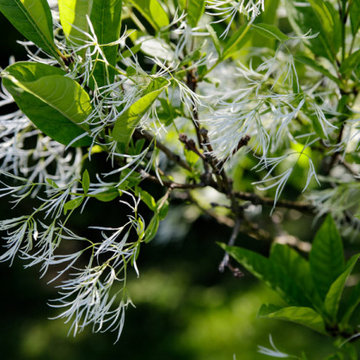
Are you looking for the perfect late spring and early summer wispy, white, fragrant flowering tree? If so, the fringe tree is what you are looking for! Not only do these trees create a beautiful addition to any yard, they can also make it look like it snowed when their petals fall. These trees don’t grow as tall as some other flowering trees, making them perfect for planting close to your patio, in small yards, under power lines, or as a shrub border. Our team at Five Star Tree Services has come up with some tips on how to care for these delightful trees and the different varieties they come in.
Fringe Tree Appearance
The average height of a fringe tree is about 10-20 feet tall. This makes it easy for it to fit into any garden nicely. The most prominent thing about this beautiful tree is its white fragrant flowers which bloom in May and early June. These flowers are grouped together in thin, fleecy hanging bands that are 6-8 inches long. These flowers appear all over the tree just before all the leaves start to sprout. After the flowers have fallen, you can enjoy the oval-shaped, dark green leaves for the summer and then the delightful yellow leaves during the fall.
The female trees can produce a blackish-blue fruit after the flowers fall, this is a great way to attract your local birds.
The bark on the tree is scaly and has red furrows with dark brown ridges. It does best in full sun with well drained but moist soil. It can also tolerate drought and is good with air pollution. With its strong branches but delicate flowers, in order to maximize your enjoyment of the flowers, make sure to plant this tree somewhere that is sheltered from the wind.
The Facts
Fringe trees are actually related to the olive family and are native to easters North America. They naturally grow on streambanks and hillsides in moist woods. Due to the tassel-like flowers, another name for this tree is Old Man’s Beard.
As a remedy for gallbladder inflammation, previously, the bark from the fringe tree has been used in herbal medicine. It has also historically been used as a way to treat wounds.
Varieties of Popular Fringe Trees
There are 2 popular fringe trees:
Chionanthus Retusus- this is a Chinese fringe tree. It is tall with lush branches and beautiful leaves. Other varieties under this are:
-Pizazz
-Carolina Moonlight
-Rubrum
-Emerald Snow
-Burgundy
-Snowdance
Chionanthus Virginicus- this is the native easters North American fringe tree we have been focusing on.
Care Instructions
Luckily, these trees are easy to care for. To have a happy tree and many blooms, follow these tree care tips.
Growth Zones- 3-9
Plant- in moist soil that has good drainage.
Height- 12-20 feet when mature. The growth rate is about 6-10 inches a year.
Sun Exposure- full sun
Flowers- May to early June. The blossoms usually last about 2 weeks.
Prune- Do not prune during dormant times. Once the tree is older, it won’t require much pruning. Simply cut out damaged, weak, or dead branches.
Deer Resistance- deer rarely damage these trees.
Threats
With this easy to care for tree, you don’t have to worry about much. However, there are a few pests to look out for.
In order to fight off pests like spider mites and scales, proper planting, watering, and fertilizing will keep it healthy and pest free.
If a tree gets stressed, borers will take this opportunity to tunnel inside the tree and eat the bark. To keep these trees safe, avoid injuring them. These trees can also act as a secondary host for the emerald ash borer. Avoid planting a fringe tree in known areas where these invasive insects like to live.
How Five Star Tree Services Can Help
If you have been looking for the perfect flowering tree to plant in your yard, the fringe tree might be the best one for you! If you have any questions about what trees are best for your property, make sure to give us a call at (416) 990-3355! Here at Five Star Tree Services, we can offer different options and also offer you our Richmond Hill Tree Planting Services!

 SUPERIOR CHIMNEY SERVICES CORPORATION
The dryer vent. Who is thinking about cleaning the dryer vent when we clean them every time we do laundry, right? Let me share with you what I discovered this weekend. I spent some time outside this weekend trying to do two things at one time. 1. Enjoy some of the sunshine 2. Spring Clean.
Spring Cleaning
As Spring cleaning is well underway, it seems like the leaves never went away from the Fall. In every corner of the home, there’s a pile of leaves wet and stuck to the ground. However, on the back side of the home, the leaves made its way from one side to the other. I knew this was going to take a while.
As I reached the half way mark, I remembered that a family member was inside washing a load of laundry. I could hear the low sound of the dryer running. But wait…the flap is barely moving.
Dryer Vent Cleaning #1 Benefit
Let’s first discuss the #1 benefit of a dryer vent sweep. You get done with your laundry faster and your dryer unit lasts longer. If the dryer vent isn’t cleaned once per year, the hot moist air remains in the dryer and venting system. It takes longer for the dryer to complete its job. And…not very good for the life of your dryer unit either. Infrequent dryer vent service shortens the life of your dryer unit as it needs to work harder and longer to dry your clothes. The moist air can also get trapped in your clothes and leave a musty smell. All that work, and you’re right back where you started.
Dryer Vent #1 Problem to Solve
The issue of dryer vents is a real one. According to the National Fire Protection Association, about 13,000 home dryer fires are reported each year. 34% of those fires are caused by lint. Now that’s not to say that you don’t clean your dryer vent. You do. But lint has a mind of its own. Some light and fluffy lint gets past the lint trap and accumulates in the duct that leads to the outside.
More Problems with Dryer Vents
Because we want you to be fully armed with information, here are some additional problematic signs that can cause a dryer vent fire.
Clothes are too hot to touch. Remember, there’s a cool down before you take the clothes out. When that’s still too hot, that’s a sign the dryer vent is clogged.
The room with the washer and dryer, it’s also too hot.
The dryer vent flap or slats outside isn’t working properly. If you also notice in the picture, lint and debris begin to make its way out of the slats or flap. That’s pretty full.
Smell the dryer sheet. If you notice it doesn’t smell like the dryer sheet, there’s a clog.
What Can a Homeowner Do?
To begin, to check your dryer vent outside. Is it working properly? Is there anything overflowing outside? Next, throw in a load of laundry. Does it smell musty? A little or a lot? Is the dryer overly hot in the cool down? Is it running longer than it used to?
If you get a slight yes to a full blown yes, then it’s time to get it cleaned by Superior Chimney. Give us a call at 877-244-6349 to schedule up your spring dryer vent cleaning. Smell like fresh spring!



 Steve Masley Consulting and Design
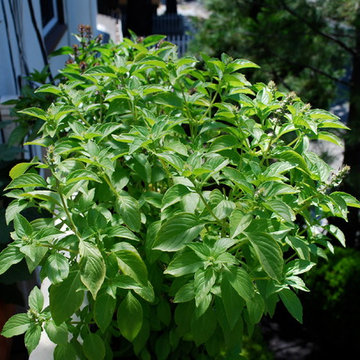
'Mrs. Burns' Lemon' basil thrives in a sunny window box off the front deck, steps away from the kitchen. Photo by Steve Masley
Deck - eclectic deck idea in San Francisco
Deck - eclectic deck idea in San Francisco
 The Firefly Garden
Crushed in Vine is an autumnal wreath cheerfully peppered with tiny red accent lights. A garland of grape leaves wrapped in warm autumn colors brings doors and windows to life or serves as a welcoming table centerpiece for feasts and celebrations. This 18 inch arrangement is operated by three replaceable AA batteries.

 Galilee Lighting
MURANO ART GLASS LEAVES.
The beautiful Murano glass leaves are hand-crafted into an artisan leave shape with a beautiful texture creating a breathtaking chandelier.
The art glass leaves are available in different beautiful colors of glass and in 3 different sizes:
7.5" long
9.5" long
11.5" long
The chandelier can be designed in any size and length and any number of glass pendants.
We offer free lighting design consultation
For a catalog by email sales@GalileeLighting.com
Call 305-807-8711.
www.GalileeLighting.com
WE DELIVER WORLDWIDE!

 highland
Ever been out in a park, forest, or even just in your backyard and wanted to see just a small side of the picture? Beauty is in the midst of us, but we are not doing enough to see it—we see only at a superficial level. The reality is that there is an entire universe on a scale that is so miniscule yet all around us, waiting to be discovered.
Put the digital microscope camera on the scope, and that little quantum universe you never knew was there awaits your gaze. Makes everyday outdoor activities exciting adventures and learning experiences with leaves, rocks, and bugs that are all interesting. It used to look just the same, and now it's vibrant with patterns, textures, and stories you didn't know before!
What is a Digital Microscope Camera?
A digital microscope camera is a compact device that magnifies very small objects and can display its real-time image on the screen. This new type of microscope can be taken outside and is much easier to transport than a conventional microscope. It is based on three important technologies: the magnification lenses, digital imaging, and As the name implies, snapping up shots of the objects when you bring them close and displaying them clearly on your smartphone, tablet, or its built-in display. This gives you the power to see details of a microworld anywhere you go, with no special equipment.
How a Digital Microscope Camera Works in Real Life
It is easy and yet powerful to operate a digital microscope camera. It brings very small objects closer by employing a system of lenses, and through a digital sensor, it turns the image into a compelling display. After focusing, the image becomes so big that it displays details that the human eye isn't able to see. Whereas, in an actual setting, an individual can simply place the gadget over an object, such as a leaf, insect, or soil surface. This is then performed to get a focus on the details, clear and sharp. In the blink of an eye, you will be exploring a hidden reality with patterns and structures.
Why Nature Looks Completely Different at the Micro Level
If you watch nature with an unbiased eye, it's all straightforward. Leaves are green; insects are tiny and land on a mere brown earth. However, things look so different through the microscope camera's zoom-in. A leaf is more than a leaf: it is a complex system of veins and cells! However, the insect is not merely a tiny insect anymore, but it gradually turns into an object with wings, eyes, and patterns, all of which seem almost like art. From soils a combination of small particles of rock, organic material, and unseen creatures.
Gaining appreciation for the details in leaves and plants.
Plant life is one of the most interesting objects to be examined under the microscope. The details on the leaves, stems, and petals are amazing and would get lost in the details otherwise. By using a digital microscope camera, the vein network that transports water and nutrients can be readily observed. These veins are naturally occurring and run in patterns that resemble roads and/or rivers in the landscape. Every leaf grows differently and is as individual as a fingerprint.
Discovering the Hidden World of Insects
There is no better thing to see under the microscope than one of the many interesting insects. They may appear at first glance to be quite unassuming and tiny, but magnified, they let one in on the whole other universe. They feature fine patterns in their wings – like those found on glass artworks – that are often difficult to see. They have eyes comprised of multiple repeating units. Even their legs and segments of their bodies have special textures.
The Secret Life Inside Soil and Sand
A microscope camera reveals a soil in which activity is taking place in a lively world in the seemingly lifeless soil. The very small particles of rock, decayed plant material, and micro-living organisms are interacting. Sand grains look similar to miniature crystals; all of them are distinctively shaped and structured. As organic matter decomposes, it forms patterns that illustrate how nature continually recycles itself.
Tree Bark: A Natural Storybook
Another interesting area of interest for micro-focusing is the bark of trees. Apparently, this appears to be rough and simple, but under magnification, it is seen as a highly detailed landscape of cracks, lines, and textures. The bark patterns that can be observed on each branch offer a glimpse of the branch's years of growth, weather, and environmental stresses. It's as if someone wrote the history of a tree on its trunk!
Tips for Getting the Best Microscopic Results Outdoors
A few simple techniques can make a big difference in the variety of images you get before getting clear and detailed images. Always make sure that the hands are stable or have a resting surface so that there is no shaking. Moving, even slightly, can cause the picture to become blurry. Lighting is one of the other important ones. This is because natural soft lighting is best suited, as it doesn't create strong reflections and it does show detail. Minimize exposure to strong sunlight/deep shade when possible.
Conclusion:
The digital microscope camera isn't just a camera; it's a new way of viewing life. Makes routine walks outdoors into thrilling explorations of the scientific world and how minute details make a difference. It can teach us something about living by the rules of nature! It is something that we can contemplate, clarify, and enjoy more.
What is a Digital Microscope Camera?
A digital microscope camera is a compact device that magnifies very small objects and can display its real-time image on the screen. This new type of microscope can be taken outside and is much easier to transport than a conventional microscope. It is based on three important technologies: the magnification lenses, digital imaging, and As the name implies, snapping up shots of the objects when you bring them close and displaying them clearly on your smartphone, tablet, or its built-in display. This gives you the power to see details of a microworld anywhere you go, with no special equipment.
How a Digital Microscope Camera Works in Real Life
It is easy and yet powerful to operate a digital microscope camera. It brings very small objects closer by employing a system of lenses, and through a digital sensor, it turns the image into a compelling display. After focusing, the image becomes so big that it displays details that the human eye isn't able to see. Whereas, in an actual setting, an individual can simply place the gadget over an object, such as a leaf, insect, or soil surface. This is then performed to get a focus on the details, clear and sharp. In the blink of an eye, you will be exploring a hidden reality with patterns and structures.
Why Nature Looks Completely Different at the Micro Level
If you watch nature with an unbiased eye, it's all straightforward. Leaves are green; insects are tiny and land on a mere brown earth. However, things look so different through the microscope camera's zoom-in. A leaf is more than a leaf: it is a complex system of veins and cells! However, the insect is not merely a tiny insect anymore, but it gradually turns into an object with wings, eyes, and patterns, all of which seem almost like art. From soils a combination of small particles of rock, organic material, and unseen creatures.
Gaining appreciation for the details in leaves and plants.
Plant life is one of the most interesting objects to be examined under the microscope. The details on the leaves, stems, and petals are amazing and would get lost in the details otherwise. By using a digital microscope camera, the vein network that transports water and nutrients can be readily observed. These veins are naturally occurring and run in patterns that resemble roads and/or rivers in the landscape. Every leaf grows differently and is as individual as a fingerprint.
Discovering the Hidden World of Insects
There is no better thing to see under the microscope than one of the many interesting insects. They may appear at first glance to be quite unassuming and tiny, but magnified, they let one in on the whole other universe. They feature fine patterns in their wings – like those found on glass artworks – that are often difficult to see. They have eyes comprised of multiple repeating units. Even their legs and segments of their bodies have special textures.
The Secret Life Inside Soil and Sand
A microscope camera reveals a soil in which activity is taking place in a lively world in the seemingly lifeless soil. The very small particles of rock, decayed plant material, and micro-living organisms are interacting. Sand grains look similar to miniature crystals; all of them are distinctively shaped and structured. As organic matter decomposes, it forms patterns that illustrate how nature continually recycles itself.
Tree Bark: A Natural Storybook
Another interesting area of interest for micro-focusing is the bark of trees. Apparently, this appears to be rough and simple, but under magnification, it is seen as a highly detailed landscape of cracks, lines, and textures. The bark patterns that can be observed on each branch offer a glimpse of the branch's years of growth, weather, and environmental stresses. It's as if someone wrote the history of a tree on its trunk!
Tips for Getting the Best Microscopic Results Outdoors
A few simple techniques can make a big difference in the variety of images you get before getting clear and detailed images. Always make sure that the hands are stable or have a resting surface so that there is no shaking. Moving, even slightly, can cause the picture to become blurry. Lighting is one of the other important ones. This is because natural soft lighting is best suited, as it doesn't create strong reflections and it does show detail. Minimize exposure to strong sunlight/deep shade when possible.
Conclusion:
The digital microscope camera isn't just a camera; it's a new way of viewing life. Makes routine walks outdoors into thrilling explorations of the scientific world and how minute details make a difference. It can teach us something about living by the rules of nature! It is something that we can contemplate, clarify, and enjoy more.


 VANDERFLEET Floral Design
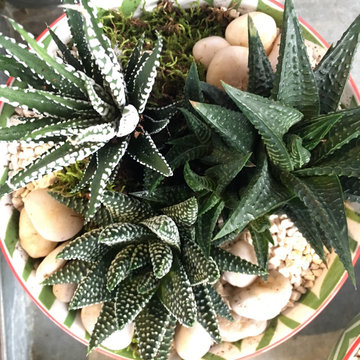
Succulent contemporary Haworthia planter, indoor.
Great for office, kitchen, living room or any bright area in the home.
Delivery available.
Family room - contemporary family room idea in Toronto
Family room - contemporary family room idea in Toronto



 Tile Doctor Ltd
This client from Highgate in North London, N6 contacted us about their large honed Limestone tiled floor that was installed throughout the ground floor. It had been laid seven years prior and was now grubby and in need of a deep clean and seal including the grout which had turned black with dirt.
I visited the property to survey and assess what was required and provided the owner with a quotation for the renovation. The hallway pictured was in the worst condition, it was a busy house with young children and dogs and over the years the sealer had worn down leaving it vulnerable to ingrained dirt. Without a sealer to protect the stone it had become heavily soiled and lost its original polished appearance.
Happy with the quote we scheduled a date for the work to go ahead. The quote included deep cleaning and burnishing the stone to bring back the polish, grout cleaning and re-sealing the Limestone to protect it.
We arrived on the first day and prepared the area by taping up the skirting and woodwork to protect them from potential splashing. Next step was to burnish the floor using a set of Tile Doctor Diamond Burnishing Pads, specifically the 400, 800 and 1500 grit pads fitted to a rotary machine, these were used in sequence running each pad over the tiles several times with water to lubricate the process. The water turns into a fine slurry as pores in the stone are opened and the dirt is released, the slurry is rinsed off with more water and extracted using an industrial wet vacuum after each pad. The finer 800 and 1500-grit pads slowly close the pores and refine the appearance of the stone building up the polish in the process.
A strong dilution of Tile Doctor Pro-Clean was then applied to the grout lines, leaving it for a short while to soak in and then hand scrubbing with a grout brush. The dirty cleaning solution and were then removed from the floor with the wet vacuum.
This process was repeated across the different sections of the Limestone floor until I was satisfied with its appearance. Before leaving for the day, I rinsed the floor again using a buffing machine fitted with a brush fitted to give it a final clean. The floor was dried as much as possible using the wet vacuum and then allowed it to dry off fully overnight.
The following day the final 3000-grit pad in the four-pad set was applied to the floor to bring up the polish even further. The pad is applied dry with only a little water sprayed onto the tile. We call this process a “Spray Burnish” and as well as leaving the floor nice and dry ready for sealing it adds a nice subtle shine to the stone.
The floor was then sealed with two coats of Tile Doctor Colour Grow sealer. This is a colour intensifying impregnating sealer that works by occupying the pores in the stone so dirt cannot become ingrained there. It will provide durable protection and make the floor much easier to keep clean. It worked well on the pale Limestone and beautifully enhanced the colour and features in stone. Once complete the floor looked brand new again.
I left a complimentary bottle of Tile Doctor Stone Soap with the client and gave them some information about how best to maintain the floor. This product is pH neutral and cleans whilst maintaining the patina on the stone helping to keep the floor in great condition.
The client was delighted with the result and left us a great review.
“Andrew is excellent and gets on with the job and we got a fantastic result. Highly recommend. By Aaron S, Highgate, 15 March 2021”
Andrew Newstead
North London Tile Doctor

47