
Search results for "Local culture" in Home Design Ideas
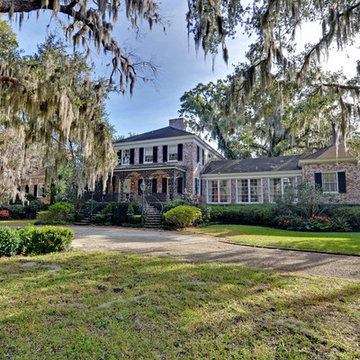
 Envision Web
Stuart Wade, Envision Virtual Tours
The second-largest and most developed of Georgia's barrier islands, St. Simons is approximately twelve miles long and nearly three miles wide at its widest stretch (roughly the size of Manhattan Island in New York). The island is located in Glynn County on Georgia's coast and lies east of Brunswick (the seat of Glynn County), south of Little St. Simons Island and the Hampton River, and north of Jekyll Island. The resort community of Sea Island is separated from St. Simons on the east by the Black Banks River. Known for its oak tree canopies and historic landmarks, St. Simons is both a tourist destination and, according to the 2010 U.S. census, home to 12,743 residents.
Early History
The earliest
St. Simons Island Village
record of human habitation on the island dates to the Late Archaic Period, about 5,000 to 3,000 years ago. Remnants of shell rings left behind by Native Americans from this era survive on many of the barrier islands, including St. Simons. Centuries later, during the period known by historians as the chiefdom era, the Guale Indians established a chiefdom centered on St. Catherines Island and used St. Simons as their hunting and fishing grounds. By 1500 the Guale had established a permanent village of about 200 people on St. Simons, which they called Guadalquini.
Beginning in 1568, the Spanish attempted to create missions along the Georgia coast. Catholic missions were the primary means by which Georgia's indigenous Native American chiefdoms were assimilated into the Spanish colonial system along the northern frontier of greater Spanish Florida. In the 1600s St. Simons became home to two Spanish missions: San Buenaventura de Guadalquini, on the southern tip of the island, and Santo Domingo de Asao (or Asajo), on the northern tip. Located on the inland side of the island were the pagan refugee villages of San Simón, the island's namesake, and Ocotonico. In 1684 pirate raids left the missions and villages largely abandoned.
Colonial History
As
Fort Frederica
early as 1670, with Great Britain's establishment of the colony of Carolina and its expansion into Georgia territory, Spanish rule was threatened by the English. The Georgia coast was considered "debatable land" by England and Spain, even though Spain had fully retreated from St. Simons by 1702. Thirty-one years later General James Edward Oglethorpe founded the English settlement of Savannah. In 1736 he established Fort Frederica, named after the heir to the British throne, Frederick Louis, prince of Wales, on the west side of St. Simons Island to protect Savannah and the Carolinas from the Spanish threat.
Between 1736 and 1749 Fort Frederica was the hub of British military operations along the Georgia frontier. A town of the same name grew up around the fort and was of great importance to the new colony. By 1740 Frederica's population was 1,000. In 1736 the congregation of what would become Christ Church was organized within Fort Frederica as a mission of the Church of England. Charles Wesley led the first services. In 1742 Britain's decisive victory over Spain in the Battle of Bloody Marsh, during the War of Jenkins' Ear, ended the Spanish threat to the Georgia coast. When the British regimen disbanded in 1749, most of the townspeople relocated to the mainland. Fort Frederica went into decline and, except for a short time of prosperity during the 1760s and 1770s under the leadership of merchant James Spalding, never fully recovered. Today the historic citadel's tabby ruins are maintained by the National Park Service.
Plantation Era
By the start of the American Revolution (1775-83), Fort Frederica was obsolete, and St. Simons was left largely uninhabited as most of its residents joined the patriot army. Besides hosting a small Georgia naval victory on the Fort Frederica River, providing guns from its famous fort for use at Fort Morris in Sunbury, and serving as an arena for pillaging by privateers and British soldiers, the island played almost no role in the war.
Following the war, many of the townspeople, their businesses destroyed, turned to agriculture. The island was transformed into fourteen cotton plantations after acres of live oak trees were cleared for farm land and used for building American warships, including the famous USS Constitution, or "Old Ironsides." Although rice was the predominant crop along the neighboring Altamaha River, St. Simons was known for its production of long-staple cotton, which soon came to be known as Sea Island cotton.
Between
Ebos Landing
the 1780s and the outbreak of the Civil War (1861-65), St. Simons's plantation culture flourished. The saline atmosphere and the availability of cheap slave labor proved an ideal combination for the cultivation of Sea Island cotton. In 1803 a group of Ebo slaves who survived the Middle Passage and arrived on the west side of St. Simons staged a rebellion and drowned themselves. The sacred site is known today as Ebos Landing.
One of the largest owners of land and slaves on St. Simons was Pierce Butler, master of Hampton Point Plantation, located on the northern end of the island. By 1793 Butler owned more than 500 slaves, who cultivated 800 acres of cotton on St. Simons and 300 acres of rice on Butler's Island in the Altamaha River delta. Butler's grandson, Pierce Mease Butler, who at the age of sixteen inherited a share of his grandfather's estate in 1826, was responsible for the largest sale of human beings in the history of the United States: in 1859, to restore his squandered fortune, he sold 429 slaves in Savannah for more than $300,000. The British actress and writer Fanny Kemble, whose tumultuous marriage to Pierce ended in divorce in 1849, published an eyewitness account of the evils of slavery on St. Simons in her book Journal of a Residence on a Georgian Plantation in 1838-1839 (1863).
Another
Retreat Plantation
large owner of land and slaves on St. Simons was Major William Page, a friend and employee of Pierce Butler Sr. Before purchasing Retreat Plantation on the southwestern tip of the island in 1804, Page managed the Hampton plantation and Butler's Island. Upon Page's death in 1827, Thomas Butler King inherited the land together with his wife, Page's daughter, Anna Matilda Page King. King expanded his father-in-law's planting empire on St. Simons as well as on the mainland, and by 1835 Retreat Plantation alone was home to as many as 355 slaves.
The center of life during the island's plantation era was Christ Church, Frederica. Organized in 1807 by a group of island planters, the Episcopal church is the second oldest in the Diocese of Georgia. Embargoes imposed by the War of 1812 (1812-15) prevented the parishioners from building a church structure, so they worshiped in the home of John Beck, which stood on the site of Oglethorpe's only St. Simons residence, Orange Hall.
The first Christ Church building, finished on the present site in 1820, was ruined by occupying Union troops during the Civil War. In 1884 the Reverend Anson Dodge Jr. rebuilt the church as a memorial to his first wife, Ellen. The cruciform building with a trussed gothic roof and stained-glass windows remains active today as Christ Church.
Civil War and Beyond
The
St. Simons Island Lighthouse
outbreak of the Civil War in 1861 put a sudden end to St. Simons's lucrative plantation era. In January of that year, Confederate troops were stationed at the south end of the island to guard the entrance to Brunswick Harbor. Slaves from Retreat Plantation, owned by Thomas Butler King, built earthworks and batteries. Plantation residents were scattered—the men joined the Confederate army and their families moved to the mainland. Cannon fire was heard on the island in December 1861, and Confederate troops retreated in February 1862, after dynamiting the lighthouse to keep its beacon from aiding Union troops. Soon thereafter, Union troops occupied the island, which was used as a camp for freed slaves. By August 1862 more than 500 former slaves lived on St. Simons, including Susie King Taylor, who organized a school for freed slave children. But in November the ex-slaves were taken to Hilton Head, South Carolina, and Fernandina, Florida, leaving the island abandoned.
After the Civil War the island never returned to its status as an agricultural community. The plantations lay dormant because there were no slaves to work the fields. After Union general William T. Sherman's January 1865 Special Field Order No. 15 —a demand that former plantations be divided and distributed to former slaves—was overturned by U.S. president Andrew Johnson less than a year later, freedmen and women were forced to work as sharecroppers on the small farms that dotted the land previously occupied by the sprawling plantations.
By
St. Simons Lumber Mills
1870 real economic recovery began with the reestablishment of the timber industry. Norman Dodge and Titus G. Meigs of New York set up lumber mill operations at Gascoigne Bluff, formerly Hamilton Plantation. The lumber mills provided welcome employment for both blacks and whites and also provided mail and passenger boats to the mainland. Such water traffic, together with the construction of a new lighthouse in 1872, designed by architect Charles B. Cluskey, marked the beginning of St. Simons's tourism industry. The keeper of the lighthouse created a small amusement park, which drew many visitors, as did the seemingly miraculous light that traveled from the top of the lighthouse tower to the bottom. The island became a summer retreat for families from the mainland, particularly from Baxley, Brunswick, and Waycross.
The island's resort industry was thriving by the 1880s. Beachfront structures, such as a new pier and grand hotel, were built on the southeastern end of the island and could be accessed by ferry. Around this time wealthy northerners began vacationing on the island.
Twentieth Century
The
St. Simons Island Pier and Village
opening in 1924 of the Brunswick–St. Simons Highway, today known as the Torras Causeway, was a milestone in the development of resorts in the area. St. Simons's beaches were now easily accessible to locals and tourists alike. More than 5,000 automobiles took the short drive from Brunswick to St. Simons via the causeway on its opening day, paving the way for convenient residential and resort development.
In 1926 automotive pioneer Howard Coffin of Detroit, Michigan, bought large tracts of land on St. Simons, including the former Retreat Plantation, and constructed a golf course, yacht club, paved roads, and a residential subdivision. Although the causeway had brought large numbers of summer people to the island, St. Simons remained a small community with only a few hundred permanent residents until the 1940s.
The
St. Simons Island
outbreak of World War II (1941-45) brought more visitors and residents to St. Simons. Troops stationed at Jacksonville, Florida; Savannah; and nearby Camp Stewart took weekend vacations on the island, and a new naval air base and radar school became home to even more officers and soldiers. The increased wartime population brought the island its first public school. With a major shipyard for the production of Liberty ships in nearby Brunswick, the waters of St. Simons became active with German U-boats. In April 1942, just off the coast, the Texas Company oil tanker S. S. Oklahoma and the S. S. Esso Baton Rouge were torpedoed by the Germans, bringing the war very close to home for island residents.
Due in large part to the military's improvement of the island's infrastructure during the war, development on the island boomed in the 1950s and 1960s. More permanent homes and subdivisions were built, and the island was no longer just a summer resort but also a thriving community. In 1950 the Methodist conference and retreat center Epworth by the Sea opened on Gascoigne Bluff. In 1961 novelist Eugenia Price visited St. Simons and began work on her first works of fiction, known as the St. Simons Trilogy. Inspired by real events on the island, Price's trilogy renewed interest in the history of Georgia's coast, and the novelist herself relocated to the island in 1965 and lived there for thirty-one years. St. Simons is also home to contemporary Georgia writer Tina McElroy Ansa.
Since
Epworth by the Sea
1980 St. Simons's population has doubled. The island's continued status as a vacation destination and its ongoing development boom have put historic landmarks and natural areas at risk. While such landmarks as the Fort Frederica ruins and the Battle of Bloody Marsh site are preserved and maintained by the National Park Service, and while the historic lighthouse is maintained by the Coastal Georgia Historical Society, historic Ebos Landing has been taken over by a sewage treatment plant.
Several coastal organizations have formed in recent years to save natural areas on the island. The St. Simons Land Trust, for example, has received donations of large tracts of land and plans to protect property in the island's three traditional African American neighborhoods. Despite its rapid growth and development, St. Simons remains one of the most beautiful and important islands on the Georgia coast.
 ROAM Architecture
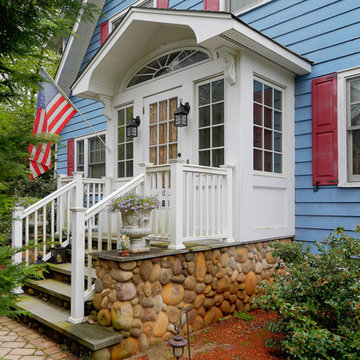
In this small but quaint project, the owners wanted to build a new front entry vestibule to their existing 1920's home. Keeping in mind the period detailing, the owners requested a hand rendering of the proposed addition to help them visualize their new entry space. Due to existing lot constraints, the project required approval by the local Zoning Board of Appeals, which we assisted the homeowner in obtaining. The new addition, when completed, added the finishing touch to the homeowner's meticulous restoration efforts.
Photo: Amy M. Nowak-Palmerini
 Dianne Davant and Associates
Kevin Meechan, Meechan Photography
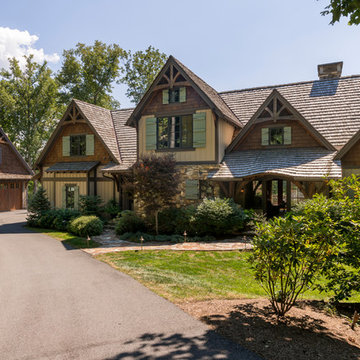
Inspiration for a transitional home design remodel in Charlotte
Inspiration for a transitional home design remodel in Charlotte
Find the right local pro for your project
 Alexander Enterprises Constr. & Dev. Company, Inc.
Mark Boisclair Photography
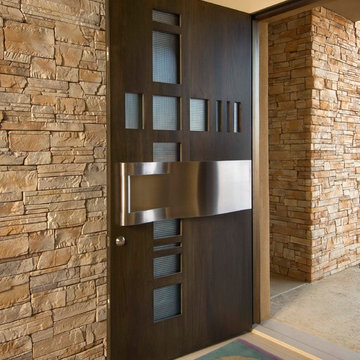
Inspiration for a huge contemporary porcelain tile front door remodel in Phoenix with a dark wood front door
Inspiration for a huge contemporary porcelain tile front door remodel in Phoenix with a dark wood front door
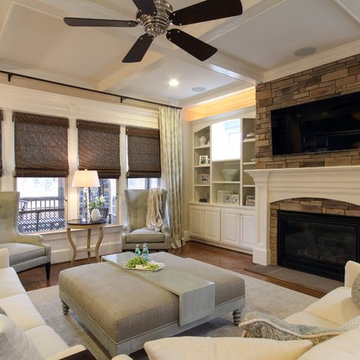
 Southern Studio Interior Design
Tad Davis Photography
Inspiration for a timeless living room remodel in Raleigh
Inspiration for a timeless living room remodel in Raleigh
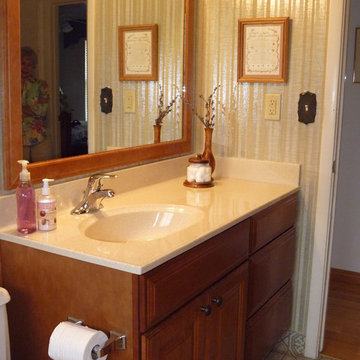
 Procast Marble
Bathroom Vanity and Cultured Marble Top
Bathroom - mid-sized traditional 3/4 bathroom idea in Salt Lake City with an integrated sink, raised-panel cabinets, medium tone wood cabinets and granite countertops
Bathroom - mid-sized traditional 3/4 bathroom idea in Salt Lake City with an integrated sink, raised-panel cabinets, medium tone wood cabinets and granite countertops
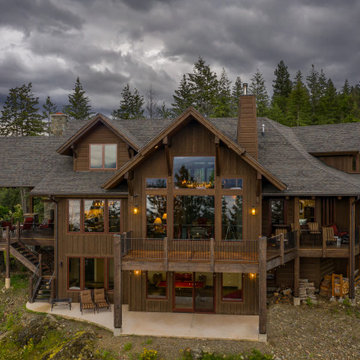
 Selle Valley Construction, Inc.
Large Sierra Pacific windows capture the view of the lake.
Cedar siding and cultured stone wainscotting from Mutual Materials, Glacier Stone Supply in "Loon Lake." Garage doors are custom made rough sawn cedar and stained to match siding.
Roofing is Owens Corning Oakridge shingles in "Peppermill Gray".
Cedar decking is stained in "Old Dragons Breath" and metal railing is custom made from local, Mark Richardson Metals.
Sponsored
Delaware, OH

Buckeye Basements, Inc.
Central Ohio's Basement Finishing ExpertsBest Of Houzz '13-'21
 UpperKey
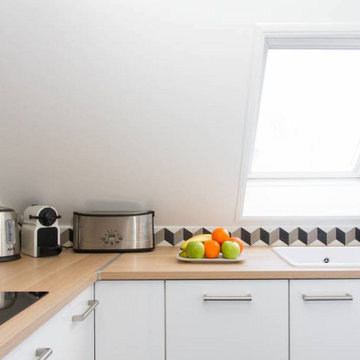
Another unique aspect of Parisian apartment kitchens is their emphasis on fresh, local ingredients. Parisians are known for their love of fresh produce, meats, and cheeses, and many apartment kitchens are designed to make it easy to cook with these ingredients. For example, some kitchens may have built-in spice racks or herb gardens, while others may feature special appliances for making fresh juices or coffee. This focus on using fresh, local ingredients is a key part of the city's culinary culture and is reflected in the many farmers' markets and specialty food shops found throughout Paris.
 Sound Design
Meet the Pros: Sound Design
To celebrate it's 20th anniversary, Sound Design built a 6,500-square-foot showroom in Horseshoe Bay, Texas to demo technology in a "relaxing, luxurious ambience that appeals to our local clientele."
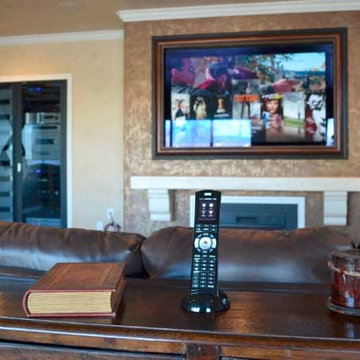
“We’ve learned a lot over the years, and our experience helped us design the new showroom in a way that presents a relaxing, luxurious ambience that appeals to our local clientele,” says Sound Design owner Chris Bean. “We used the best-of-the-best in every category, from the Runco 63-inch plasma TV framed and hidden by a VisionArt motorized art print to the ultra-high-end CAT MBX Sequoia speakers and of course the ELAN g! system.”
The showroom’s entrance living room features A/V and lighting control from an Elan TS10 10-inch in-wall touchscreen, an Elan TS2 in-wall touchscreen and Elan HR2 handheld remote. The system distributes audio and video content to a system consisting of a Runco V63 63-inch plasma display, a Planar 2×3 Matrix Wall with six 46-inch panels, a Planar Mosaic wall with four 46-inch panels and four 15-inch square panels, a two-channel audio system that uses two 7-foot-tall CAT MBX Sequoia’s, and a surround system that includes an Integra DTR 50.4 receiver, Newport speakers and two Sunfire HRS-12 subwoofers.
“Many of our clients are tech-savvy homeowners who have become mobile tech enthusiasts through their everyday interactions with iPhones and tablets, and they want that same instant satisfaction to apply to their household media and home functions,” says Bean. “Just a few years ago, the most common client request was for an amazing home theater to enjoy the newest DVDs or Blu-rays. Consumer culture is now moving beyond just high-quality audio and video and our clients are demanding easy, fast, total control of everything in the home from their touch panels, smartphone or tablet.”
The most unique part of the new showroom, Bean says, will be the 640-square-foot simulation room, which is still under construction. Featuring AboutGolf’s newest three-projector continuous curve screen golf simulator, a LaserShot shooting simulator with five-channel surround and 30 competitive games for two players, and a VRX iMotion triple-LCD display driving & flight simulator, this room is a virtual playground.
“The simulation room is a step forward for CI showroom design and for our company, and it allows us to open the imagination of our clients to show them that anything is possible,” says Bean. “Homeowners in Horseshoe Bay are all about recreation and a luxury lifestyle, so we wanted to show the unique ways people could enhance their home’s fun factor. From controlling lighting, heating and surveillance cameras on an iPhone to a hyper-realistic golf simulator that makes you feel like you’re really teeing off on the course, our Horseshoe Bay showroom is as state-of-the-art as it can be.”
Sound Design also built a commercial-quality home theater that uses a Display Development HD3 projector, a 184-inch Stewart Filmscreen Luxus Deluxe screen, a Kaleidescape M300 player connected to a Kaleidescape CinemaOne server in the lobby, a Theta Casablanca III preamp/processor, Theta Compli-blu Blu-ray player, a PrimaCinema server, and a bevy of California Audio Technology speakers, subwoofers and amplifiers.
 Holiday Maldives
Combine ancient temples with overwater villas for the trip of a lifetime
There's a reason savvy travellers are increasingly looking beyond single-destination holidays. The Sri Lanka Maldives multi-centre trip has emerged as one of the most sought-after combinations in tropical travel—and it's easy to understand why. These two Indian Ocean neighbours couldn't be more different, yet together they create a holiday experience that satisfies every type of wanderlust.
Why Combine Sri Lanka and the Maldives?
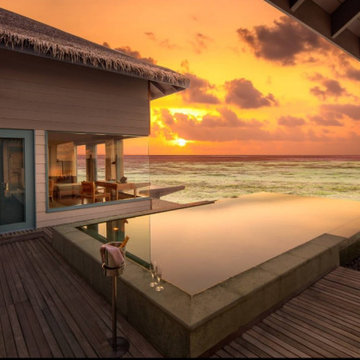
Sri Lanka offers what the Maldives doesn't: lush highlands carpeted in tea plantations, ancient cities steeped in 2,500 years of history, wildlife safaris where leopards roam free, and a culinary scene that'll have you dreaming of hoppers and kottu for years to come. The Maldives, meanwhile, delivers what Sri Lanka can't: those iconic overwater bungalows, some of the planet's most pristine coral reefs, and the kind of barefoot luxury where your biggest decision is whether to have your massage on the beach or in your private villa.
A Sri Lanka and Maldives twin centre holiday lets you experience the thrill of exploration followed by pure, unadulterated relaxation. It's the best of both worlds—literally.
The Perfect Itinerary Balance
Most travellers find that spending 7-10 days in Sri Lanka followed by 4-7 days in the Maldives creates the ideal rhythm. Sri Lanka demands more time because there's simply so much ground to cover. You might start in Colombo, travel through the Cultural Triangle to explore Sigiriya's ancient rock fortress and Dambulla's cave temples, wind through the tea country around Ella, and perhaps end with a safari in Yala National Park before catching your flight to Malé.
Then comes the reward: touching down in the Maldives, boarding a speedboat or seaplane, and watching the stress of everyday life disappear as those famous turquoise lagoons come into view. After days of early morning temple visits and winding mountain roads, there's nothing quite like sinking into a lounger with nothing on the agenda but deciding which shade of blue you're looking at.
Logistics Made Simple
One of the best aspects of this combination is how geographically convenient it is. Colombo and Malé are just over an hour apart by air, with multiple daily flights connecting the two capitals. This proximity means minimal travel fatigue and maximum time enjoying your destinations.Find More here https://holiday.com.mv/sri-lanka-and-maldives-twin-centre-holidays/
For those considering expanding their Indian Ocean adventure even further, Maldives multi-centre holidays open up possibilities beyond Sri Lanka. Dubai, Singapore, and various Indian cities all serve as excellent add-on destinations, turning an already incredible trip into a true odyssey.
Planning Considerations for 2026
Timing matters with this combination. The Maldives enjoys fairly consistent weather year-round, but Sri Lanka has two distinct monsoon seasons affecting different coasts at different times. Generally speaking, December through April works beautifully for both destinations, making it the peak season for this twin-centre route.
Budget-wise, expect Sri Lanka to be significantly more affordable than the Maldives. Many travellers use this to their advantage, opting for boutique hotels and authentic local experiences in Sri Lanka, then splurging on a premium resort for their Maldives finale. It's a strategy that delivers exceptional value without sacrificing that once-in-a-lifetime overwater villa experience.
The Verdict
A Sri Lanka Maldives multi-centre holiday isn't just about ticking two countries off a list. It's about crafting a journey with genuine contrast and emotional arc—adventure followed by serenity, cultural immersion followed by indulgent escape. For couples, honeymooners, families, and solo travellers alike, this combination consistently ranks among the most satisfying itineraries the Indian Ocean has to offer.
If you've been dreaming of ancient ruins at sunrise and sunset cocktails on a private deck over crystalline waters, this might just be your year to make it happen.
Ready to start planning your twin-centre adventure? Work with specialists who know both destinations intimately to create an itinerary that matches your travel style and budget.Find More here https://holiday.com.mv/maldives-multi-centre-holidays/
 UpperKey
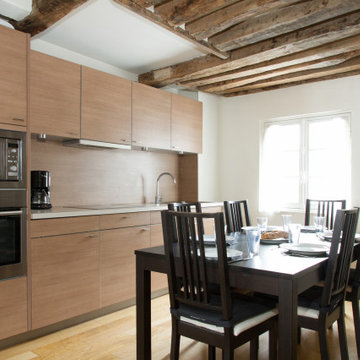
Parisian kitchens in apartments are known for their compact size due to the narrow buildings and staircases in the city. However, they are still fully functional and equipped with all the essential appliances needed for cooking, such as a stove, a sink, a refrigerator, and some cabinets for storage. To make the most of the limited space, Parisians often invest in high-quality cookware and utensils that will last a lifetime, prioritizing quality over quantity.
Parisians value fresh ingredients and make use of local markets and specialty shops to purchase them. The kitchen is an essential part of Parisian culinary culture, serving not just as a place to prepare meals but also as a social hub for family and friends. Despite the small size of many Parisian kitchens, they are an important part of daily life in the city and reflect the city's love of good food and quality ingredients.
Parisians often decorate their kitchens with colorful tiles, vintage accessories, and fresh flowers to make them visually appealing. Many Parisians prefer to cook and eat at home, rather than dining out at restaurants. Parisian kitchens are cozy and charming places to prepare meals and entertain guests, reflecting the city's rich culinary culture.

 Mountain + Beach Interiors - Schonewill Int'l
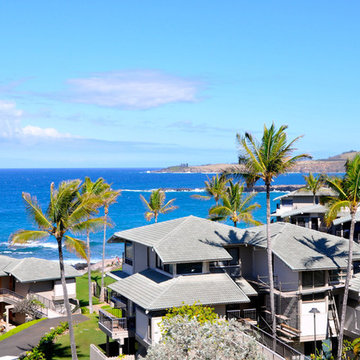
The Kapalua Bay ocean front Bay Villas are sought after by many. They are large units up to four bedrooms and 3.5 baths. This is a plantation tropical mixed Asian and west indies style. Local artists showing the Hawaiian culture and many natural materials to enhance the local experience of this magical place.
Sponsored
Delaware, OH
Buckeye Basements, Inc.
Central Ohio's Basement Finishing ExpertsBest Of Houzz '13-'21
 Akara Design Studio
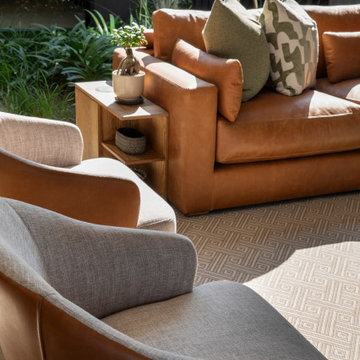
Shiviko Lodge, near Kruger National Park within the Elephant Point development, is a luxurious 2500 sqm retreat designed by BLOC Architects and styled by Akara Design Studio. The lodge's sleek architecture harmonizes with nature through natural stone cladding, burnt black wood, and rooftop landscaping. Akara’s role encompassed full interior architecture, custom furniture design, décor, and cultural elements inspired by South African heritage. With a focus on local craftsmanship, Akara curated bespoke furniture, selected finishes, and integrated commissioned art, creating an immersive, high-end experience that reflects the surrounding landscape and cultural roots.
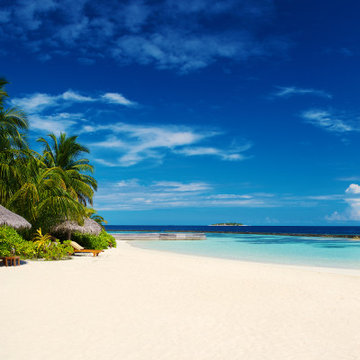 Holiday Maldives
Combine ancient temples with overwater villas for the trip of a lifetime
There's a reason savvy travellers are increasingly looking beyond single-destination holidays. The Sri Lanka Maldives multi-centre trip has emerged as one of the most sought-after combinations in tropical travel—and it's easy to understand why. These two Indian Ocean neighbours couldn't be more different, yet together they create a holiday experience that satisfies every type of wanderlust.
Why Combine Sri Lanka and the Maldives?
Sri Lanka offers what the Maldives doesn't: lush highlands carpeted in tea plantations, ancient cities steeped in 2,500 years of history, wildlife safaris where leopards roam free, and a culinary scene that'll have you dreaming of hoppers and kottu for years to come. The Maldives, meanwhile, delivers what Sri Lanka can't: those iconic overwater bungalows, some of the planet's most pristine coral reefs, and the kind of barefoot luxury where your biggest decision is whether to have your massage on the beach or in your private villa.
A Sri Lanka and Maldives twin centre holiday lets you experience the thrill of exploration followed by pure, unadulterated relaxation. It's the best of both worlds—literally.
The Perfect Itinerary Balance
Most travellers find that spending 7-10 days in Sri Lanka followed by 4-7 days in the Maldives creates the ideal rhythm. Sri Lanka demands more time because there's simply so much ground to cover. You might start in Colombo, travel through the Cultural Triangle to explore Sigiriya's ancient rock fortress and Dambulla's cave temples, wind through the tea country around Ella, and perhaps end with a safari in Yala National Park before catching your flight to Malé.
Then comes the reward: touching down in the Maldives, boarding a speedboat or seaplane, and watching the stress of everyday life disappear as those famous turquoise lagoons come into view. After days of early morning temple visits and winding mountain roads, there's nothing quite like sinking into a lounger with nothing on the agenda but deciding which shade of blue you're looking at.
Logistics Made Simple
One of the best aspects of this combination is how geographically convenient it is. Colombo and Malé are just over an hour apart by air, with multiple daily flights connecting the two capitals. This proximity means minimal travel fatigue and maximum time enjoying your destinations.
For those considering expanding their Indian Ocean adventure even further, Maldives multi-centre holidays open up possibilities beyond Sri Lanka. Dubai, Singapore, and various Indian cities all serve as excellent add-on destinations, turning an already incredible trip into a true odyssey.
Planning Considerations for 2026
Timing matters with this combination. The Maldives enjoys fairly consistent weather year-round, but Sri Lanka has two distinct monsoon seasons affecting different coasts at different times. Generally speaking, December through April works beautifully for both destinations, making it the peak season for this twin-centre route.
Budget-wise, expect Sri Lanka to be significantly more affordable than the Maldives. Many travellers use this to their advantage, opting for boutique hotels and authentic local experiences in Sri Lanka, then splurging on a premium resort for their Maldives finale. It's a strategy that delivers exceptional value without sacrificing that once-in-a-lifetime overwater villa experience.
The Verdict
A Sri Lanka Maldives multi-centre holiday isn't just about ticking two countries off a list. It's about crafting a journey with genuine contrast and emotional arc—adventure followed by serenity, cultural immersion followed by indulgent escape. For couples, honeymooners, families, and solo travellers alike, this combination consistently ranks among the most satisfying itineraries the Indian Ocean has to offer.
If you've been dreaming of ancient ruins at sunrise and sunset cocktails on a private deck over crystalline waters, this might just be your year to make it happen.
Ready to start planning your twin-centre adventure? Work with specialists who know both destinations intimately to create an itinerary that matches your travel style and budget.Find more https://holiday.com.mv/sri-lanka-and-maldives-twin-centre-holidays/
 Sound Design
By Steve Crowe, March 08, 2013
Sound Design Builds State-of-the-Art Showroom for 20th Anniversary
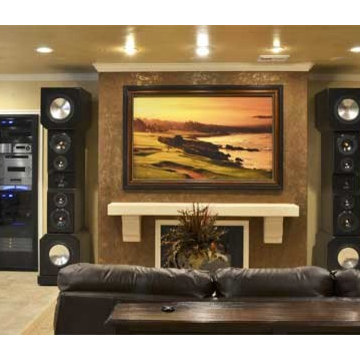
To celebrate it's 20th anniversary, Sound Design built a 6,500-square-foot showroom in Horseshoe Bay, Texas to demo technology in a "relaxing, luxurious ambience that appeals to our local clientele."
Sound Design, a custom installer with offices in Horseshoe Bay and Lakeway, Texas, is celebrating its 20th anniversary in a big way: with the opening of a 4,500-square-foot showroom on April 1, 2013.
The state-of-the-art space will be a “veritable candy land” that includes Elan g!, Planar, Runco, Sunfire and many more top-of-the-line brands.
“We’ve learned a lot over the years, and our experience helped us design the new showroom in a way that presents a relaxing, luxurious ambience that appeals to our local clientele,” says Sound Design owner Chris Bean. “We used the best-of-the-best in every category, from the Runco 63-inch plasma TV framed and hidden by a VisionArt motorized art print to the ultra-high-end CAT MBX Sequoia speakers and of course the ELAN g! system.”
The showroom’s entrance living room features A/V and lighting control from an Elan TS10 10-inch in-wall touchscreen, an Elan TS2 in-wall touchscreen and Elan HR2 handheld remote. The system distributes audio and video content to a system consisting of a Runco V63 63-inch plasma display, a Planar 2x3 Matrix Wall with six 46-inch panels, a Planar Mosaic wall with four 46-inch panels and four 15-inch square panels, a two-channel audio system that uses two 7-foot-tall CAT MBX Sequoia’s, and a surround system that includes an Integra DTR 50.4 receiver, Newport speakers and two Sunfire HRS-12 subwoofers.
“Many of our clients are tech-savvy homeowners who have become mobile tech enthusiasts through their everyday interactions with iPhones and tablets, and they want that same instant satisfaction to apply to their household media and home functions,” says Bean. “Just a few years ago, the most common client request was for an amazing home theater to enjoy the newest DVDs or Blu-rays. Consumer culture is now moving beyond just high-quality audio and video and our clients are demanding easy, fast, total control of everything in the home from their touch panels, smartphone or tablet.”
The most unique part of the new showroom, Bean says, will be the 640-square-foot simulation room, which is still under construction. Featuring AboutGolf’s newest three-projector continuous curve screen golf simulator, a LaserShot shooting simulator with five-channel surround and 30 competitive games for two players, and a VRX iMotion triple-LCD display driving & flight simulator, this room is a virtual playground.
“The simulation room is a step forward for CI showroom design and for our company, and it allows us to open the imagination of our clients to show them that anything is possible,” says Bean. “Homeowners in Horseshoe Bay are all about recreation and a luxury lifestyle, so we wanted to show the unique ways people could enhance their home’s fun factor. From controlling lighting, heating and surveillance cameras on an iPhone to a hyper-realistic golf simulator that makes you feel like you’re really teeing off on the course, our Horseshoe Bay showroom is as state-of-the-art as it can be.”
Sound Design also built a commercial-quality home theater that uses a Display Development HD3 projector, a 184-inch Stewart Filmscreen Luxus Delux screen, a Kaleidescape M300 player connected to a Kaleidescape CinemaOne server in the lobby, a Theta Casablanca III preamp/processor, Theta Compli-blu Blu-ray player, a PrimaCinema server, and a bevy of California Audio Technology speakers, subwoofers and amplifiers.
 UpperKey
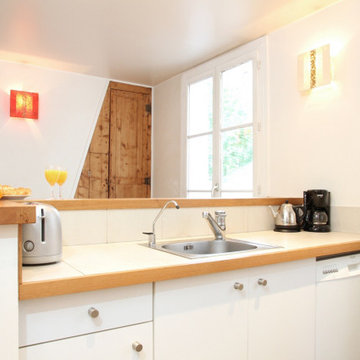
Parisian kitchens in apartments are often small and compact due to the narrow buildings and staircases in the city. However, they are still fully functional and equipped with all the essential appliances needed for cooking, such as a stove, a sink, a refrigerator, and some cabinets for storage. To make the most of the limited space, Parisians often invest in high-quality cookware and utensils that will last a lifetime, prioritizing quality over quantity.
Parisians value fresh ingredients and make use of local markets and specialty shops to purchase them. The kitchen is an essential part of Parisian culinary culture, serving not just as a place to prepare meals but also as a social hub for family and friends. Despite the small size of many Parisian kitchens, they are an important part of daily life in the city and reflect the city's love of good food and quality ingredients. Parisian kitchens are cozy and charming places to prepare meals and entertain guests, showcasing the city's rich culinary culture.
Sponsored
Columbus, OH

Trish Takacs Design
Award Winning & Highly Skilled Kitchen & Bath Designer in Columbus
 Jonathan McGrath Construction, LLC
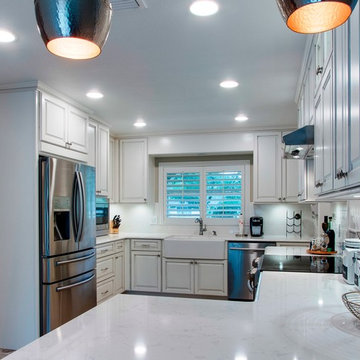
Beautifully remodeled with white maple cabinets with platinum glazing, travertine flooring, farm sink, stainless steel appliances, and under counter lighting
Since 1984, Jonathan McGrath Construction, a design build custom builder and remodeling company has provided solutions for their client's building needs in the Central Florida area. Jack McGrath, State Certified Building Contractor, applies his extensive custom building and remodeling expertise, creative design concepts and passion for transformation to every project and has earned a reputation for being a true remodeling specialist and custom home builder.
Recognized for excellence in the building industry, Jonathan McGrath Construction, has been the recipient of multiple Parade of Homes, MAME and Chrysalis awards. They also received the prestigious ‘Big 50′ Award from Remodeling Magazine for their outstanding business expertise, exemplary customer services and their ability to stand as a dynamic company role model for the building and remodeling industry. In addition, the company has won numerous other local and national awards.
The company supports their local, state and national building association. Marion McGrath served as the 2011 President of the Home Builder's Association of Orlando (HBA) now known as the Orlando Builder's Association (GOBA). She was the second woman and remodeler to serve as President in the association's 60 year history.
 kimberly peck architect
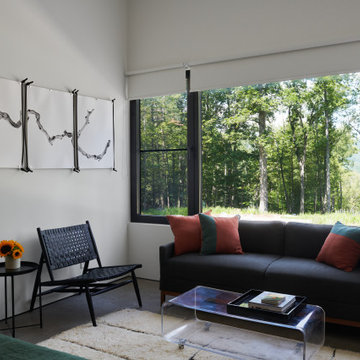
PA soft neutral-toned couch sits beneath expansive curtain glass, offering a restful view of the landscape. Local artworks add personality and a quiet cultural layer to this serene bedroom retreat.
 Solid Rock Custom Homes
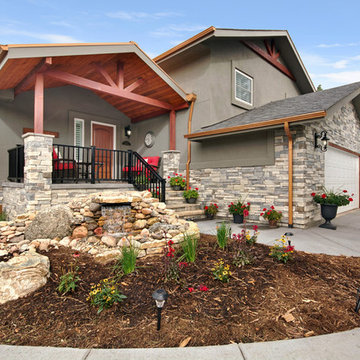
Inspiration for a transitional gray split-level stucco house exterior remodel in Denver with a shingle roof
13