
Search results for "Midland real" in Home Design Ideas
 Unique Home Solutions Inc.
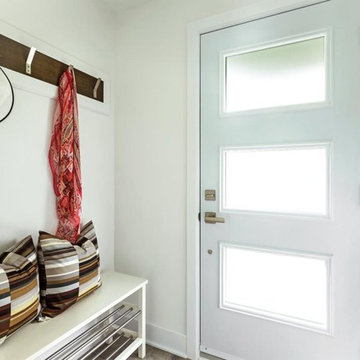
This property sold immediately and the buyer came from Instagram. She saw the house and fell in love with it.
If you are looking to sell your home or would like to have some help making it look fantastic, give us a call. We will make your renovation look cozy or transform the home you live in and give it a brand new look.
 Rocky Tops Granite & Marble LLC
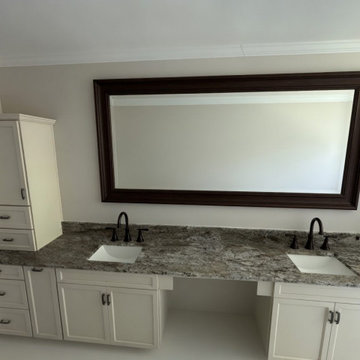
Blue Dunes granite is a striking choice for a bathroom vanity, and this one in Columbia shows why. The stone carries a deep blue-gray base with movement that shifts from soft charcoal to cooler blue tones depending on the light in the room. It's the kind of slab that reads almost like natural stone artwork more than a countertop, which matters in a bathroom where you're standing close to it every morning and evening.
Granite works well here because a vanity top takes a real beating over the years. Water sits on it, makeup and skincare products get set down and wiped up, and it needs to hold up without staining or dulling. Blue Dunes has the density and low porosity you want in that spot. Sealed properly, it resists moisture and everyday spills without much fuss, and it keeps its polish for years with basic care.
Fabricating a double or single vanity top out of a stone like this means paying attention to the slab before it's ever cut. We template the vanity to the exact cabinet dimensions, then lay out the cut so the veining and color movement land where they'll actually be seen, not just where they happen to fall. With a stone that has as much personality as Blue Dunes, that layout work makes the difference between a top that looks intentional and one that looks like an afterthought.
The edge on this one is eased, which keeps the look clean and doesn't fight with the stone's natural pattern. It's a small detail but it's the right call for a vanity where the visual weight should sit with the granite itself.
Day to day, this top will handle exactly what a bathroom throws at it. It won't scratch from normal use, it wipes clean easily, and the color stays consistent whether the bathroom's lit by daylight or a vanity light at night. For a Columbia home, it's a solid, good-looking upgrade that fits right into the kind of work we do across the Midlands, matching the right stone to the right room and making sure it's built to last.
 Rocky Tops Granite & Marble LLC
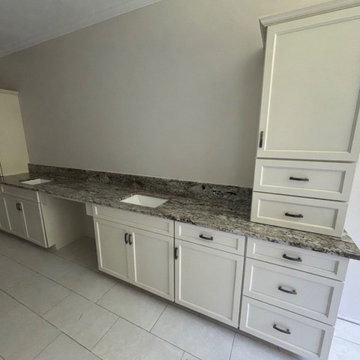
Blue Dunes granite is a striking choice for a bathroom vanity, and this one in Columbia shows why. The stone carries a deep blue-gray base with movement that shifts from soft charcoal to cooler blue tones depending on the light in the room. It's the kind of slab that reads almost like natural stone artwork more than a countertop, which matters in a bathroom where you're standing close to it every morning and evening.
Granite works well here because a vanity top takes a real beating over the years. Water sits on it, makeup and skincare products get set down and wiped up, and it needs to hold up without staining or dulling. Blue Dunes has the density and low porosity you want in that spot. Sealed properly, it resists moisture and everyday spills without much fuss, and it keeps its polish for years with basic care.
Fabricating a double or single vanity top out of a stone like this means paying attention to the slab before it's ever cut. We template the vanity to the exact cabinet dimensions, then lay out the cut so the veining and color movement land where they'll actually be seen, not just where they happen to fall. With a stone that has as much personality as Blue Dunes, that layout work makes the difference between a top that looks intentional and one that looks like an afterthought.
The edge on this one is eased, which keeps the look clean and doesn't fight with the stone's natural pattern. It's a small detail but it's the right call for a vanity where the visual weight should sit with the granite itself.
Day to day, this top will handle exactly what a bathroom throws at it. It won't scratch from normal use, it wipes clean easily, and the color stays consistent whether the bathroom's lit by daylight or a vanity light at night. For a Columbia home, it's a solid, good-looking upgrade that fits right into the kind of work we do across the Midlands, matching the right stone to the right room and making sure it's built to last.
Find the right local pro for your project
 Rocky Tops Granite & Marble LLC
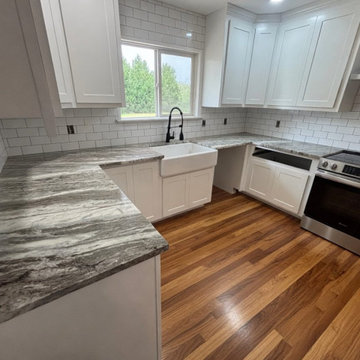
Fantasy Brown Leathered dolomite went into this West Columbia kitchen, and it's the kind of stone that changes how a room feels the second the light hits it. Leathered finish instead of polished, so you get texture under your hand instead of a mirror flat surface. It softens the brown and cream movement in the stone, gives it a low sheen, and hides fingerprints and water spots a lot better than a honed or polished slab would in a kitchen that actually gets used.
Dolomite has that soft, warm background movement, browns and creams drifting through each other, and it holds up well against everyday acids and scratching in a working kitchen. It's still a natural stone, so we sealed it properly, and the leathered texture actually helps there, it hides the wear that would show up fast on a glass-smooth surface.
Getting the veining to read right across the seams is the real work on a stone like this. We template the room, lay the slabs out, and take our time matching the movement across the corners and the seams before anything gets cut, so the pattern keeps flowing instead of jumping when you walk from one stretch of counter to the next. It's slower than pushing straight into fabrication, but it's the difference between a kitchen that looks like one slab and one that looks like pieces.
Edge came out eased, clean and simple, which is the right call on a stone with this much going on in the surface. You don't need a fancy profile competing with the leathering and the movement in the dolomite, the material carries the room on its own.
Day to day it lives well. Set a hot pan down and it takes it fine, though a trivet never hurts. It'll take the knocks of a working kitchen better than people expect, and the leathered texture keeps it looking good years in instead of showing every little scuff. That's the kind of project we like doing around West Columbia and the rest of the Midlands, matching the right stone to a kitchen that's going to get lived in, not just looked at.
 Rocky Tops Granite & Marble LLC
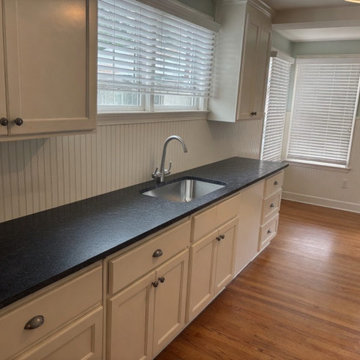
This kitchen in Forest Acres came together around a solid granite countertop, and it's the kind of stone that does the quiet work of holding a whole room together. Granite's been the go-to for kitchen counters for decades because it earns it. It's igneous rock, formed under heat and pressure, and that history is why it laughs off the stuff a real kitchen throws at it. Hot pans, knife work, everyday spills, granite takes it and keeps looking good.
We went with an eased edge on this one, which is the clean, simple line that a lot of Midlands homeowners want. It's not flashy, but that's the point. An eased edge softens the sharp corner just enough to be comfortable to lean against and easy to wipe down, and it lets the granite itself, the movement, the flecks, the depth in the stone, do the talking instead of a fussy edge profile competing for attention.
Getting a countertop like this right starts before the stone ever gets cut. We template the kitchen precisely, accounting for the cabinets, the appliances, and any out-of-square walls that always show up in real houses. Then it's cut, the edges are worked by hand to get that eased profile even and consistent around every corner, and the seams, if there are any, get lined up so the pattern reads as close to continuous as we can get it. Granite doesn't forgive sloppy fabrication. Every joint and cutout has to be tight because the stone's not going anywhere once it's set.
Day to day, this is a countertop that's built for actual cooking and actual life, not just for photos. Granite resists scratching, it handles heat better than almost anything else you'd put in a kitchen, and with a good sealer it shrugs off staining from wine, oil, or lemon juice. It's low maintenance once it's in, just a wipe down and, depending on the specific granite, a reseal every year or two to keep it performing at its best.
Forest Acres has a good mix of older homes getting updated and newer builds going in, and granite fits both. It's a material that's stood the test of time in kitchens across the Midlands, and this one's a solid, honest example of why. Clean lines, real stone, and a countertop that's going to outlast most everything else in that kitchen.
 Rocky Tops Granite & Marble LLC
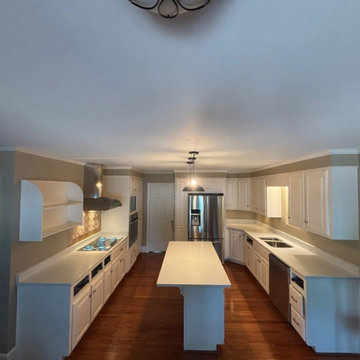
Spectrum Quartz Splendid went into this kitchen in West Columbia, and it's the kind of stone that does a lot of the work in a room without shouting about it. It's an engineered quartz, so what you're looking at is a mix of ground quartz and resin, pressed and cured until it's hard, dense, and consistent from one end of the slab to the other. The background reads soft and light, with a scatter of movement through it that keeps the surface from looking flat under kitchen lighting.
We templated the counters the way we do every job, laser measuring the base cabinets so the slabs come back from the shop cut to the exact lines of that kitchen. With quartz, that precision matters a lot, because the pattern repeats in a controlled way and you can plan your layout and your seams instead of chasing anything. That's part of why quartz suits a working kitchen so well. What you see in the showroom is what you get on the counter, corner to corner, with the pattern lining up the way it should.
Day to day, this material is about as forgiving as it gets. It doesn't need sealing, ever, because it's non-porous straight out of the fabrication shop. Wine, coffee, tomato sauce, none of it soaks in if you wipe it up in a reasonable time. It stands up to knives and daily wear better than most kitchen surfaces, though we still tell folks to use a trivet, since quartz doesn't love direct heat from a hot pan sitting right on it. Scratches aren't something you have to worry about with normal use in a busy kitchen.
We set the counters with an eased edge, clean and simple, which is what most of our customers land on once they see it doesn't take anything away from the stone itself.
Jobs like this one are what keep us busy across the Midlands. West Columbia kitchens see a lot of quartz these days, and Spectrum Quartz Splendid is a slab that holds up to real cooking and real family life while still looking sharp enough to notice the first time you walk into the room.
 Rocky Tops Granite & Marble LLC
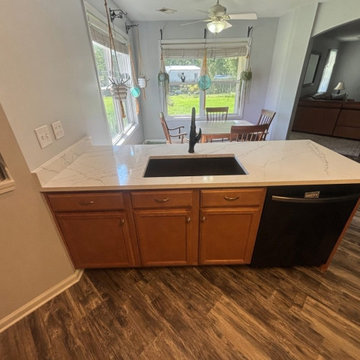
This kitchen in Elgin came together in engineered quartz, Calacatta Viraldi, and it's the kind of stone that does a lot of the work in a room without shouting about it. The white background stays clean and bright, and the veining moves through it in soft grays and golds. For a kitchen that gets used every day, that's the whole point.
Quartz is engineered stone, ground quartz mixed with resin under pressure, so it comes out of the plant with a consistent pattern from slab to slab. That consistency matters when you're templating a kitchen. We can match the veining across a seam or carry it around a corner without hunting for the right spot on the slab, because the pattern's already built in that way. Calacatta Viraldi reads soft and bright in a kitchen, which is exactly why it gets picked for spaces where people actually cook.
Getting a countertop like this in is still a craft even with a manufactured material. We template the kitchen precisely, cut the slabs to fit the cabinets and the sink cutout, and dress the edges by hand. Here we kept the edge eased, a clean, simple detail that lets the stone itself stay the focus instead of the profile. Seams get set tight and leveled so your eye reads the counter as one continuous surface, not pieced-together sections.
Day to day, this is a low-maintenance surface. Quartz doesn't need sealing, since the resin already closes it off from stains, and it resists scratches and everyday acids from cooking better than a lot of other surfaces. It handles the daily bumps of a real kitchen without much fuss. Heat's the one thing to watch, a hot pan straight off the stove can shock the resin, so a trivet's a smart habit, but that's a small price for a counter that otherwise shrugs off wine, coffee, and citrus without a second thought.
It's a good look for Elgin and for the kind of Midlands kitchens we build these for, bright, durable, and built to actually get used instead of just looked at.
Sponsored
Sunbury, OH

J.Holderby - Renovations
Franklin County's Leading General Contractors - 2X Best of Houzz!
 Rocky Tops Granite & Marble LLC
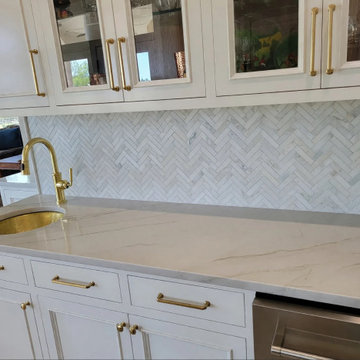
This project in Northeast Columbia brought together three different stones across the house, and that's not something we get to do every day. Marble in one space, quartzite in another, dolomite doing its own quiet work somewhere else. It's the kind of job that makes you slow down and think about where each material actually belongs instead of just picking one slab and running it everywhere.
The kitchen called for something that could handle the daily grind while still looking like a piece of natural stone should look, full of movement and depth. Quartzite earns its keep here. It reads like marble with all that soft veining and cool background color, but it's far harder and more resistant to etching from citrus, wine, or vinegar splashing around a busy counter. We templated it carefully to keep the veining moving in a way that feels natural across the runs, not chopped up or mismatched at the seams. That takes patience on the slab yard picking the right book match before it ever hits a saw.
The bathroom vanity is where the marble gets to shine. Marble on a vanity top makes sense in a way it doesn't always in a kitchen. Less traffic, less acid exposure, and it gets to just look good day after day with the veining catching the light over the sink. We kept the edge eased throughout the project, a simple softened line that doesn't compete with the stone itself. An eased edge is subtle, it just takes the sharp corner off the top so it feels comfortable under your hand and doesn't chip as easy as a square edge would over the years.
Dolomite showed up in the other space, and it's one of our favorite stones to work with because it splits the difference. It looks a lot like marble, softer tones, that same classic veining, but it's a good bit tougher and more stain resistant, which makes it a smart call anywhere you want that marble look without babying it constantly. Sealing still matters with all three of these stones. A good penetrating sealer keeps them looking right for years and makes cleanup simple, no special stuff needed, just soap and water day to day.
Jobs like this are why we like working across the Midlands. Northeast Columbia homes run the gamut from new builds to older houses getting a real refresh, and getting to move between marble, quartzite, and dolomite in one project keeps the work honest. Every stone got fabricated and set the way it should be, tight seams, clean eased edges, and a finish that'll hold up to real life in that kitchen and that bath for a long time to come.
 Rocky Tops Granite & Marble LLC
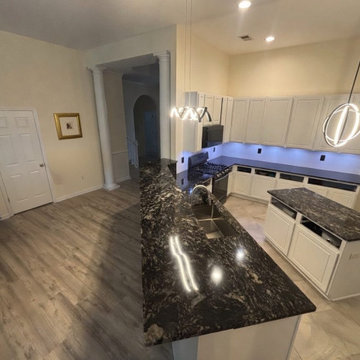
Blue Fantasy granite is one of those stones that stops people in the kitchen doorway. It's got that deep blue-gray base with soft movement running through it, flecks of white and darker gray scattered across the surface, and enough depth to it that it reads different depending on the light hitting it. In this Irmo kitchen it works as the anchor for the whole room, the kind of stone that doesn't need anything else dressing it up.
Granite like this comes out of the ground with real mineral variation, and that's part of why we like working with it. Every slab has its own character, so when we template a kitchen like this one we're not just measuring cabinets, we're looking at how the pattern will fall across the counters and figuring out where the seams need to land so the movement in the stone keeps flowing instead of getting chopped up at a corner. That's the part of the job that takes patience more than anything else.
Blue Fantasy is a hard, dense granite, and that's exactly what you want in a kitchen that gets used every day. It shrugs off heat, it resists scratching better than most surfaces you'll put a knife near, and it holds up to the kind of daily abuse a real kitchen dishes out. We sealed it before we left so it stays easy to wipe down and keeps its color from picking up any staining, and that's about the only maintenance it'll ever ask for. We kept the edge eased on this one, simple and clean, which lets the stone itself do the talking instead of competing with it.
Jobs like this are why we like working around Irmo and the rest of the Midlands. Every kitchen brings its own layout, its own light, its own slab pulled off the yard, and getting it right means paying attention to the details that don't show up in a photo, tight seams, a level install, an edge that doesn't fight the stone. This one came together the way we like to see them, a granite with real presence doing exactly what a kitchen counter should do for years to come.
 Rocky Tops Granite & Marble LLC
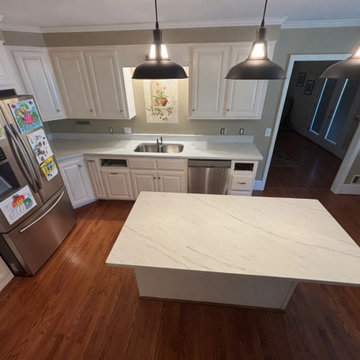
Spectrum Quartz Splendid went into this kitchen in West Columbia, and it's the kind of stone that does a lot of the work in a room without shouting about it. It's an engineered quartz, so what you're looking at is a mix of ground quartz and resin, pressed and cured until it's hard, dense, and consistent from one end of the slab to the other. The background reads soft and light, with a scatter of movement through it that keeps the surface from looking flat under kitchen lighting.
We templated the counters the way we do every job, laser measuring the base cabinets so the slabs come back from the shop cut to the exact lines of that kitchen. With quartz, that precision matters a lot, because the pattern repeats in a controlled way and you can plan your layout and your seams instead of chasing anything. That's part of why quartz suits a working kitchen so well. What you see in the showroom is what you get on the counter, corner to corner, with the pattern lining up the way it should.
Day to day, this material is about as forgiving as it gets. It doesn't need sealing, ever, because it's non-porous straight out of the fabrication shop. Wine, coffee, tomato sauce, none of it soaks in if you wipe it up in a reasonable time. It stands up to knives and daily wear better than most kitchen surfaces, though we still tell folks to use a trivet, since quartz doesn't love direct heat from a hot pan sitting right on it. Scratches aren't something you have to worry about with normal use in a busy kitchen.
We set the counters with an eased edge, clean and simple, which is what most of our customers land on once they see it doesn't take anything away from the stone itself.
Jobs like this one are what keep us busy across the Midlands. West Columbia kitchens see a lot of quartz these days, and Spectrum Quartz Splendid is a slab that holds up to real cooking and real family life while still looking sharp enough to notice the first time you walk into the room.
 Rocky Tops Granite & Marble LLC
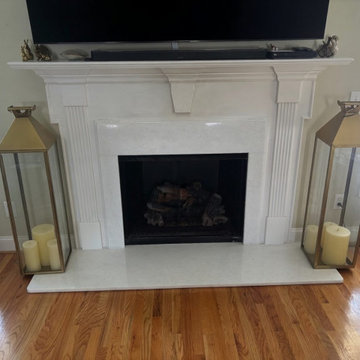
Hanoi White marble makes a fireplace surround the centerpiece of a room instead of just a backdrop for the TV. This one went into a home in Blythewood, and it's the kind of stone that earns that spot. White marble with soft gray veining has been the go-to for fireplaces for a reason: it catches light off to either side of the mantel and gives the whole wall a calm, finished look that paint or tile just can't match.
Marble takes a mellower polish than a lot of other stones, and the veining moves in loose, natural patterns that give it a warmer feel to the eye even though the stone itself stays cool to the touch. For a surround, we're not dealing with knife cuts or hot pans, so the wear concerns people sometimes bring up with marble in a kitchen don't really apply here. It's decorative and structural at the same time, built to frame a firebox and take the heat that comes off it without any trouble.
Fabricating a surround like this means getting the slab selection right before anything else. You want the veining to read well across the face and up the legs, not fight itself at the seams. We templated this one to the fireplace opening and cut it so the pattern carries through cleanly, then set it with an eased edge, simple and out of the way so the stone itself stays the focus. That's really the right call on a piece like this. Anything fussier on the edge would just compete with what the marble's already doing.
Day to day, a surround like this asks for very little. It's not a work surface, so scratching isn't a real concern, and a light sealing keeps it looking the way it did on install day for years. It'll take the ambient heat from the firebox fine, it wipes clean, and it holds up as the kind of feature you don't think about, you just enjoy.
Jobs like this are why we like doing this kind of work around Blythewood and the rest of the Midlands. A fireplace wall is one of the first things people see walking into a room, and Hanoi White marble with an eased edge gives this one a quiet, finished presence that's going to hold up for a long time.
 Rocky Tops Granite & Marble LLC
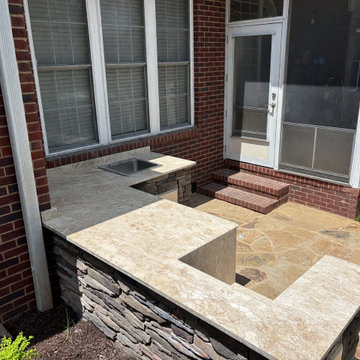
This outdoor kitchen in Lexington is built around 3cm unfilled travertine, and that's a material choice that says a lot about what this space is meant to do. Unfilled travertine keeps its natural pits and texture instead of having them smoothed over with resin, which means the surface reads as raw and organic rather than polished. Out here, under open sky and full sun, that texture works in the stone's favor. It doesn't glare back at you at midday and it doesn't get slick when a hose or a rain shower hits it.
The layout is an L-shaped countertop set over a stacked stone veneer base, with stainless steel drawers and cabinets tucked underneath and a built-in grill anchoring one leg of the L. There's a cutout in the counter for a sink or a cooler, which is the kind of detail that takes real planning at the template stage. You can't cut that opening freehand on site and expect clean lines. We measure twice, dry-fit the appliance or basin, and cut the stone to match before it ever leaves the shop.
Travertine outdoors is a practical call as much as a good-looking one. It handles heat well, which matters right next to a grill, and it won't crack or discolor the way some engineered materials can when they take direct sun for years. Unfilled travertine in particular breathes a little more than the filled version, so it doesn't trap moisture the way a sealed slab might. We finished the edges eased, which keeps the whole thing feeling soft and unfussy, no sharp lines to bang a hip on when you're moving between the grill and the prep space.
Outdoor kitchens take a beating that indoor ones never see: pollen, humidity, the occasional hard freeze here in the Midlands, direct sun for months at a stretch. Travertine's been used outdoors for centuries for exactly that reason, it ages instead of failing. Sealing it now and then keeps water from sitting in the pits, but even bare it holds up. This one in Lexington is set up to be used hard, grilled on, gathered around, and to look better for the wear rather than worse.
 Rocky Tops Granite & Marble LLC
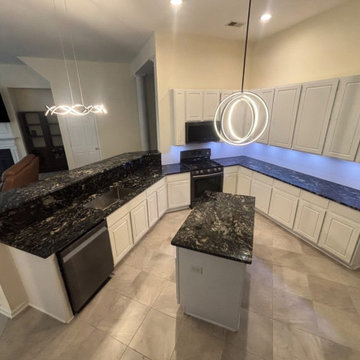
Blue Fantasy granite is one of those stones that stops people in the kitchen doorway. It's got that deep blue-gray base with soft movement running through it, flecks of white and darker gray scattered across the surface, and enough depth to it that it reads different depending on the light hitting it. In this Irmo kitchen it works as the anchor for the whole room, the kind of stone that doesn't need anything else dressing it up.
Granite like this comes out of the ground with real mineral variation, and that's part of why we like working with it. Every slab has its own character, so when we template a kitchen like this one we're not just measuring cabinets, we're looking at how the pattern will fall across the counters and figuring out where the seams need to land so the movement in the stone keeps flowing instead of getting chopped up at a corner. That's the part of the job that takes patience more than anything else.
Blue Fantasy is a hard, dense granite, and that's exactly what you want in a kitchen that gets used every day. It shrugs off heat, it resists scratching better than most surfaces you'll put a knife near, and it holds up to the kind of daily abuse a real kitchen dishes out. We sealed it before we left so it stays easy to wipe down and keeps its color from picking up any staining, and that's about the only maintenance it'll ever ask for. We kept the edge eased on this one, simple and clean, which lets the stone itself do the talking instead of competing with it.
Jobs like this are why we like working around Irmo and the rest of the Midlands. Every kitchen brings its own layout, its own light, its own slab pulled off the yard, and getting it right means paying attention to the details that don't show up in a photo, tight seams, a level install, an edge that doesn't fight the stone. This one came together the way we like to see them, a granite with real presence doing exactly what a kitchen counter should do for years to come.
Sponsored
Sunbury, OH
J.Holderby - Renovations
Franklin County's Leading General Contractors - 2X Best of Houzz!
 Rocky Tops Granite & Marble LLC
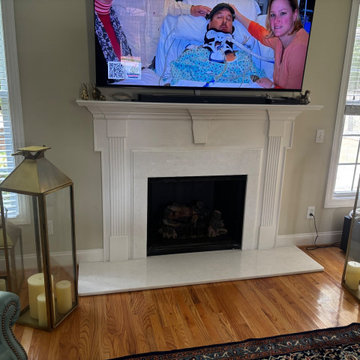
Hanoi White marble makes a fireplace surround the centerpiece of a room instead of just a backdrop for the TV. This one went into a home in Blythewood, and it's the kind of stone that earns that spot. White marble with soft gray veining has been the go-to for fireplaces for a reason: it catches light off to either side of the mantel and gives the whole wall a calm, finished look that paint or tile just can't match.
Marble takes a mellower polish than a lot of other stones, and the veining moves in loose, natural patterns that give it a warmer feel to the eye even though the stone itself stays cool to the touch. For a surround, we're not dealing with knife cuts or hot pans, so the wear concerns people sometimes bring up with marble in a kitchen don't really apply here. It's decorative and structural at the same time, built to frame a firebox and take the heat that comes off it without any trouble.
Fabricating a surround like this means getting the slab selection right before anything else. You want the veining to read well across the face and up the legs, not fight itself at the seams. We templated this one to the fireplace opening and cut it so the pattern carries through cleanly, then set it with an eased edge, simple and out of the way so the stone itself stays the focus. That's really the right call on a piece like this. Anything fussier on the edge would just compete with what the marble's already doing.
Day to day, a surround like this asks for very little. It's not a work surface, so scratching isn't a real concern, and a light sealing keeps it looking the way it did on install day for years. It'll take the ambient heat from the firebox fine, it wipes clean, and it holds up as the kind of feature you don't think about, you just enjoy.
Jobs like this are why we like doing this kind of work around Blythewood and the rest of the Midlands. A fireplace wall is one of the first things people see walking into a room, and Hanoi White marble with an eased edge gives this one a quiet, finished presence that's going to hold up for a long time.
 Rocky Tops Granite & Marble LLC
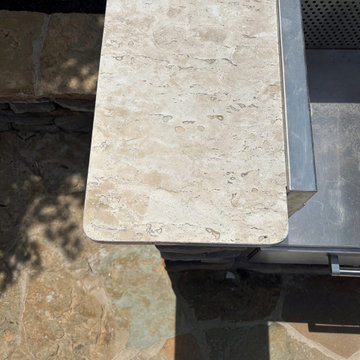
This outdoor kitchen in Lexington is built around 3cm unfilled travertine, and that's a material choice that says a lot about what this space is meant to do. Unfilled travertine keeps its natural pits and texture instead of having them smoothed over with resin, which means the surface reads as raw and organic rather than polished. Out here, under open sky and full sun, that texture works in the stone's favor. It doesn't glare back at you at midday and it doesn't get slick when a hose or a rain shower hits it.
The layout is an L-shaped countertop set over a stacked stone veneer base, with stainless steel drawers and cabinets tucked underneath and a built-in grill anchoring one leg of the L. There's a cutout in the counter for a sink or a cooler, which is the kind of detail that takes real planning at the template stage. You can't cut that opening freehand on site and expect clean lines. We measure twice, dry-fit the appliance or basin, and cut the stone to match before it ever leaves the shop.
Travertine outdoors is a practical call as much as a good-looking one. It handles heat well, which matters right next to a grill, and it won't crack or discolor the way some engineered materials can when they take direct sun for years. Unfilled travertine in particular breathes a little more than the filled version, so it doesn't trap moisture the way a sealed slab might. We finished the edges eased, which keeps the whole thing feeling soft and unfussy, no sharp lines to bang a hip on when you're moving between the grill and the prep space.
Outdoor kitchens take a beating that indoor ones never see: pollen, humidity, the occasional hard freeze here in the Midlands, direct sun for months at a stretch. Travertine's been used outdoors for centuries for exactly that reason, it ages instead of failing. Sealing it now and then keeps water from sitting in the pits, but even bare it holds up. This one in Lexington is set up to be used hard, grilled on, gathered around, and to look better for the wear rather than worse.
 Rocky Tops Granite & Marble LLC
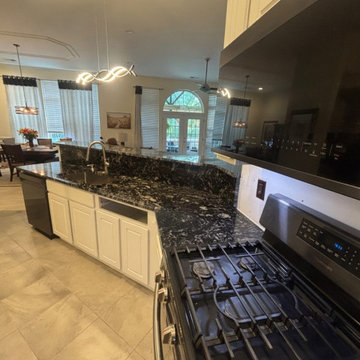
Blue Fantasy granite is one of those stones that stops people in the kitchen doorway. It's got that deep blue-gray base with soft movement running through it, flecks of white and darker gray scattered across the surface, and enough depth to it that it reads different depending on the light hitting it. In this Irmo kitchen it works as the anchor for the whole room, the kind of stone that doesn't need anything else dressing it up.
Granite like this comes out of the ground with real mineral variation, and that's part of why we like working with it. Every slab has its own character, so when we template a kitchen like this one we're not just measuring cabinets, we're looking at how the pattern will fall across the counters and figuring out where the seams need to land so the movement in the stone keeps flowing instead of getting chopped up at a corner. That's the part of the job that takes patience more than anything else.
Blue Fantasy is a hard, dense granite, and that's exactly what you want in a kitchen that gets used every day. It shrugs off heat, it resists scratching better than most surfaces you'll put a knife near, and it holds up to the kind of daily abuse a real kitchen dishes out. We sealed it before we left so it stays easy to wipe down and keeps its color from picking up any staining, and that's about the only maintenance it'll ever ask for. We kept the edge eased on this one, simple and clean, which lets the stone itself do the talking instead of competing with it.
Jobs like this are why we like working around Irmo and the rest of the Midlands. Every kitchen brings its own layout, its own light, its own slab pulled off the yard, and getting it right means paying attention to the details that don't show up in a photo, tight seams, a level install, an edge that doesn't fight the stone. This one came together the way we like to see them, a granite with real presence doing exactly what a kitchen counter should do for years to come.
 Rocky Tops Granite & Marble LLC
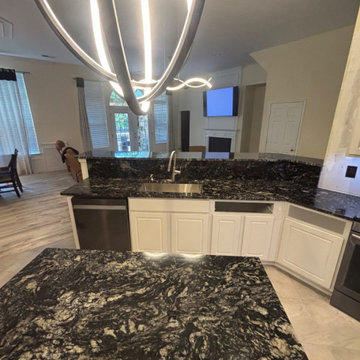
Blue Fantasy granite is one of those stones that stops people in the kitchen doorway. It's got that deep blue-gray base with soft movement running through it, flecks of white and darker gray scattered across the surface, and enough depth to it that it reads different depending on the light hitting it. In this Irmo kitchen it works as the anchor for the whole room, the kind of stone that doesn't need anything else dressing it up.
Granite like this comes out of the ground with real mineral variation, and that's part of why we like working with it. Every slab has its own character, so when we template a kitchen like this one we're not just measuring cabinets, we're looking at how the pattern will fall across the counters and figuring out where the seams need to land so the movement in the stone keeps flowing instead of getting chopped up at a corner. That's the part of the job that takes patience more than anything else.
Blue Fantasy is a hard, dense granite, and that's exactly what you want in a kitchen that gets used every day. It shrugs off heat, it resists scratching better than most surfaces you'll put a knife near, and it holds up to the kind of daily abuse a real kitchen dishes out. We sealed it before we left so it stays easy to wipe down and keeps its color from picking up any staining, and that's about the only maintenance it'll ever ask for. We kept the edge eased on this one, simple and clean, which lets the stone itself do the talking instead of competing with it.
Jobs like this are why we like working around Irmo and the rest of the Midlands. Every kitchen brings its own layout, its own light, its own slab pulled off the yard, and getting it right means paying attention to the details that don't show up in a photo, tight seams, a level install, an edge that doesn't fight the stone. This one came together the way we like to see them, a granite with real presence doing exactly what a kitchen counter should do for years to come.
5