
Search results for "Nitrogen" in Home Design Ideas



 Honeycomb Heating and Cooling
AC Replacement San Antonio — New Goodman Heat Pump in New Braunfels
Client: John
Location: New Braunfels, TX (78132)
Scope of Work: Goodman 4-ton single-stage heat pump (15.2 SEER2), matched air handler and 15 kW heat kit, Honeywell 4-inch media filter, new condenser pad, new disconnect box and breaker, P-trap replacement, condensate overflow safety switches, permits and city inspections
AC Replacement San Antonio on short notice: John needed a full system replacement quickly, and our team got it done.
We installed a Goodman 4-ton single-stage heat pump (GLZS4BA4810A) with an AMST48CU1300A multi-speed air handler and a 15 kW heat kit, running R-32 refrigerant and rated 15.2 SEER2. Nitrogen pressure test on the refrigerant connections, deep vacuum to 300 microns, new liquid-line filter drier, Armaflex insulation on the refrigerant lines, new condensate overflow safety switches, replacement P-trap, and a new electrical disconnect with a properly sized breaker. A Honeywell 4-inch media filter went in for better filtration and longer filter life than a standard 1-inch.
We pulled the permits and welcome city inspections. An inspector verifying the work is the simplest proof it was done right.
John, thank you for trusting us on short notice. Backed by a 10-year parts warranty, a 2-year labor warranty, and 2 years of seasonal tune-ups included.
And thank you for the 5-star review! Short-notice jobs are where a team shows what it's made of.

 GS Construction
Example of a small classic 3/4 white tile and stone tile mosaic tile floor alcove shower design in Chicago with an undermount sink, recessed-panel cabinets, black cabinets, quartzite countertops, a two-piece toilet and gray walls
Find the right local pro for your project

 Jack Calderone
This bedroom and full bathroom are part of an adventuresome project my wife and I embarked upon to create a complete apartment in the basement of our townhouse. We designed a floor plan that creatively and efficiently used all of the 385-square-foot-space, without sacrificing beauty, comfort or function – and all without breaking the bank! To maximize our budget, we did the work ourselves and added everything from thrift store finds to DIY wall art to bring it all together.
A partial double closet bar adds a little extra space while still leaving room for longer hanging clothes.
 Pennsylvania Landscape & Nursery Association
u2014 ALE: Wayne Rain Garden
Pennsylvania Landscape & Nursery Association
u2014 ALE: Wayne Rain Garden
Terren Landscapes http://www.terrenlandscapes.com
2014 PLNA Awards for Landscape Excellence winner
Category: Residential Up to $15,000
Award Level: Gold
Project Description:
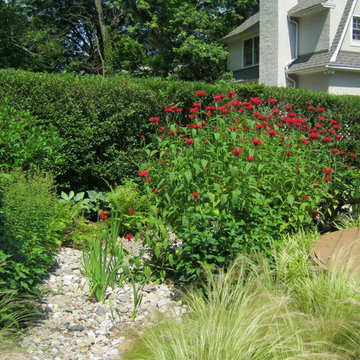
Our company was contracted by the client to provide a creative solution to an ongoing drainage problem. Their property is located within 30 feet of a local stream that collects storm water from the surrounding area. The nearby stream and high water table caused the lawn area at the side of their home to flood and to remain waterlogged for a few days after each storm. The client not only had difficulty growing plants in the existing conditions, but also had a problem with mosquitoes due to standing water.
Our goal was to design a self-contained, naturalistic rain garden that slowed storm water runoff, allowed for percolation, and promoted infiltration while permitting excess clean water to enter the nearby stream with diminished force. As designed, the rain garden allows the earth to slowly and more naturally
absorb excess storm water while filtering out toxins such as excess nitrogen and phosphorous which are frequently found in the landscape, therefore reducing the contaminants entering the stream.
A percolation test was conducted with criteria of absorbing a one-inch rainstorm within four hours without overflow. The one-inch storm calculation included an existing downspout from the home, which would be piped into the rain garden to reduce roof runoff. The first test failed due to a deep layer of high clay-content soil. Excavation continued until a layer of sandy loam was reached, the percolation test was repeated, and a successful test result was achieved. Next, the entire rain garden basin was excavated to the sandy loam layer and the soil amended with compost and sand to create a highly porous planting media.
Geotextile fabric was placed to help reduce migration of the surface stone into the soil and allow for minimal maintenance. Gravel, river stone and small boulders were carefully placed to achieve the look of a natural streambed.
A palette of mostly native plants with a few non-invasive ornamentals were chosen for their ability to survive in extreme conditions ranging from floods to drought and were placed according to their specific preferences.
Wetland plants were chosen for the lowest portion of the rain garden as that area remains saturated for longer periods of time, with a Chionanthus virginicus as a focal point surrounded by irises and ferns at the lowest depth.
Plants tolerant of drier conditions were chosen for the upper edges of the garden. The beautiful colors of Monarda, Ligularia, Eupatorium, Solidago, Chelone, and Rudbeckia were scattered within the upper edge, while movement and softness were incorporated by use of the graceful Nassella that lines the border. Finally, winter interest was provided with a backdrop of Cornus sericea.
As built, this small rain garden creates tremendous impact by decreasing the amount of storm water runoff not only on our client's property, but also in the neighboring stream. It serves as a means of slowing the water and providing an area for infiltration back into the earth. The plants provide a habitat for birds, butterflies, and insects, working in harmony with nature and providing beautiful visual interest year-round.
Photo Credit:
Lisa C. Falls
 Pennsylvania Landscape & Nursery Association
u2014 ALE: Wayne Rain Garden
Pennsylvania Landscape & Nursery Association
u2014 ALE: Wayne Rain Garden
Terren Landscapes http://www.terrenlandscapes.com
2014 PLNA Awards for Landscape Excellence winner
Category: Residential Up to $15,000
Award Level: Gold
Project Description:
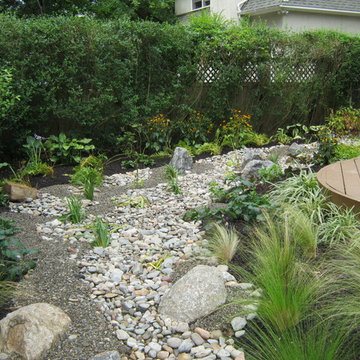
Our company was contracted by the client to provide a creative solution to an ongoing drainage problem. Their property is located within 30 feet of a local stream that collects storm water from the surrounding area. The nearby stream and high water table caused the lawn area at the side of their home to flood and to remain waterlogged for a few days after each storm. The client not only had difficulty growing plants in the existing conditions, but also had a problem with mosquitoes due to standing water.
Our goal was to design a self-contained, naturalistic rain garden that slowed storm water runoff, allowed for percolation, and promoted infiltration while permitting excess clean water to enter the nearby stream with diminished force. As designed, the rain garden allows the earth to slowly and more naturally
absorb excess storm water while filtering out toxins such as excess nitrogen and phosphorous which are frequently found in the landscape, therefore reducing the contaminants entering the stream.
A percolation test was conducted with criteria of absorbing a one-inch rainstorm within four hours without overflow. The one-inch storm calculation included an existing downspout from the home, which would be piped into the rain garden to reduce roof runoff. The first test failed due to a deep layer of high clay-content soil. Excavation continued until a layer of sandy loam was reached, the percolation test was repeated, and a successful test result was achieved. Next, the entire rain garden basin was excavated to the sandy loam layer and the soil amended with compost and sand to create a highly porous planting media.
Geotextile fabric was placed to help reduce migration of the surface stone into the soil and allow for minimal maintenance. Gravel, river stone and small boulders were carefully placed to achieve the look of a natural streambed.
A palette of mostly native plants with a few non-invasive ornamentals were chosen for their ability to survive in extreme conditions ranging from floods to drought and were placed according to their specific preferences.
Wetland plants were chosen for the lowest portion of the rain garden as that area remains saturated for longer periods of time, with a Chionanthus virginicus as a focal point surrounded by irises and ferns at the lowest depth.
Plants tolerant of drier conditions were chosen for the upper edges of the garden. The beautiful colors of Monarda, Ligularia, Eupatorium, Solidago, Chelone, and Rudbeckia were scattered within the upper edge, while movement and softness were incorporated by use of the graceful Nassella that lines the border. Finally, winter interest was provided with a backdrop of Cornus sericea.
As built, this small rain garden creates tremendous impact by decreasing the amount of storm water runoff not only on our client's property, but also in the neighboring stream. It serves as a means of slowing the water and providing an area for infiltration back into the earth. The plants provide a habitat for birds, butterflies, and insects, working in harmony with nature and providing beautiful visual interest year-round.
Photo Credit:
Lisa C. Falls


 Good Earth Design
This peach tree was nearly dead in an abandoned corner of the landscape. Peaches like more water and
'cool' feet than is available here in the high mountain desert. I revived this tree by adding deep mulch out past its drip line and planting a non-spreading variety of comfrey all around. Comfrey is one of the most amazing beneficial plants in the garden, it deserves an article, even a book of its own. In addition to herbal and medical properties comfrey is a powerful dynamic accumulator and mulch plant, it brings a variety of nutrients from deep in the ground and accumulates them on the surface in its leaves. The leaves break down quickly into rich black soil.

 All Surface Restoration
Paver Gloss Sealer is a professional grade wet look exposed aggregate sealer that adds a rich, glossy appearance. It is a wet look/satin sheen acrylic sealer designed for use on all types of exterior concrete and pavers. Its pure acrylic formula allows for superior penetration and bonding. The durable finish left behind is UV stable and will not yellow. It offers superior resistance to rain, the sun, cold and hot climates, stains, and more. When applied to dull or faded exposed aggregate it will help to enhance the original coloring.
Applications: Exposed aggregate driveways, sidewalks and walkways, patios and pool decks and more.
It contains 20% acrylic solids & creates a lasting wet look. Esthetically pleasing, it beautifies and enriches the colors of the aggregate stones while protecting concrete. It forms a protective film, preventing the penetration of oil, water dirt & stains from the environment. This solvent base clear acrylic sealer penetrates to creating a lasting finish that will resist the assaults of elements such as the freeze-thaw cycles, sun, rain, and snow. It’s a great choice for high traffic area’s, which require maximum protection.
Paver Gloss Sealer can be purchased in 5 Gallon pails shipped via UPS ground to all 48 U.S. States EXCEPT Alaska & Hawaii at http://surfacerestoration.com/shop
 User
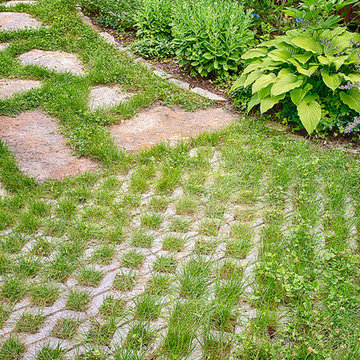
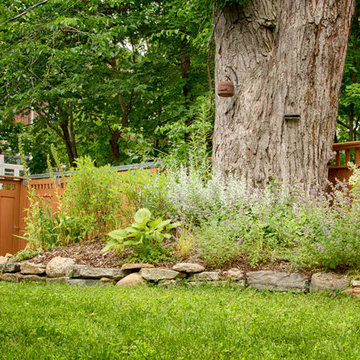
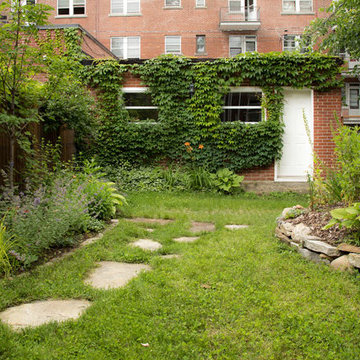
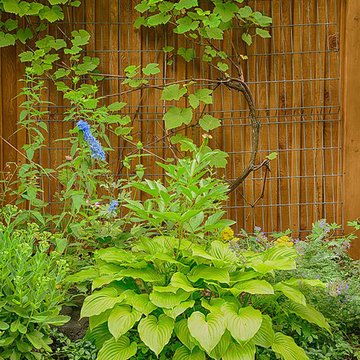
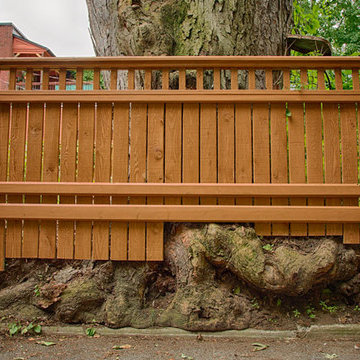
Situé dans un quartier résidentiel historique de Westmount, ce jardin naturel est une oasis intime, à l’allure d’un paysage champêtre au centre d’un milieu urbain occupé. Les espaces de jardin, avec leurs pierres naturelles et plantations indigènes et naturalisés (qui se trouvent dans des prés et forêts de sous-bois), s’agencent harmonieusement avec les éléments de clôtures, barrières et balcon personnalisés, construites à partir de matériel de bois de pruche et mélèze provenant de scieries locales. Le système de plantation comprend également une sélection de plantes pollinisateurs, indigènes et fixatrices d’azote, conçues pour attirer des espèces locales d’insectes et d’oiseaux bénéfiques. Tandis que les éléments construits, dont les clôtures, barrières et le balcon, complémentent et respectent le style architectural de la résidence historique. La pelouse du jardin arrière, plantée avec une couverture de trèfle, comprend également un espace de stationnement privé vert, construit à partir de pavés de pelouse perméables (surface également plantés de trèfle), qui sert de système de gestion des eaux pluviales.
Located in an historic residential neighborhood of Westmount, this natural garden is an intimate oasis, offering a slice of nature and the country in the middle of a busy urban setting. The garden spaces, with their natural stones and plantings (indigenous and naturalized) found in meadows and understory forests alike, combine with and compliment the custom designed fences, gates and balcony built from locally milled hemlock and larch wood materials. Jardin naturel urbain - WestmountThe planting scheme also includes a selection of pollinator, indigenous and nitrogen-fixing plants, all designed to attract local insect and bird species, while the built elements, the fences and balcony, compliment and respect the architectural style of the historic residence. The back court garden lawn is planted with a clover cover and also includes a green private parking space, built with permeable grass pavers (also planted with clover), which serves as a water management system.
Photos: Daniel Renaud - 2017

 Steve Masley Consulting and Design
'Carmello' tomatoes growing in a large terra-cotta pot. Photo by Steve Masley
Photo of an eclectic landscaping in San Francisco.
Photo of an eclectic landscaping in San Francisco.



 ReVision Design + Build
© Ascendant Imaging
Inspiration for a large transitional master white tile and porcelain tile porcelain tile, beige floor, double-sink and wallpaper freestanding bathtub remodel in Charlotte with furniture-like cabinets, green cabinets, a two-piece toilet, white walls, an undermount sink, quartz countertops, a hinged shower door, white countertops, a niche and a built-in vanity
Inspiration for a large transitional master white tile and porcelain tile porcelain tile, beige floor, double-sink and wallpaper freestanding bathtub remodel in Charlotte with furniture-like cabinets, green cabinets, a two-piece toilet, white walls, an undermount sink, quartz countertops, a hinged shower door, white countertops, a niche and a built-in vanity
 User
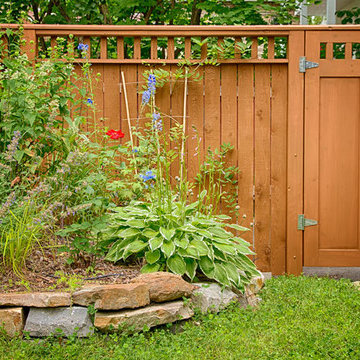
Situé dans un quartier résidentiel historique de Westmount, ce jardin naturel est une oasis intime, à l’allure d’un paysage champêtre au centre d’un milieu urbain occupé. Les espaces de jardin, avec leurs pierres naturelles et plantations indigènes et naturalisés (qui se trouvent dans des prés et forêts de sous-bois), s’agencent harmonieusement avec les éléments de clôtures, barrières et balcon personnalisés, construites à partir de matériel de bois de pruche et mélèze provenant de scieries locales. Le système de plantation comprend également une sélection de plantes pollinisateurs, indigènes et fixatrices d’azote, conçues pour attirer des espèces locales d’insectes et d’oiseaux bénéfiques. Tandis que les éléments construits, dont les clôtures, barrières et le balcon, complémentent et respectent le style architectural de la résidence historique. La pelouse du jardin arrière, plantée avec une couverture de trèfle, comprend également un espace de stationnement privé vert, construit à partir de pavés de pelouse perméables (surface également plantés de trèfle), qui sert de système de gestion des eaux pluviales.
Located in an historic residential neighborhood of Westmount, this natural garden is an intimate oasis, offering a slice of nature and the country in the middle of a busy urban setting. The garden spaces, with their natural stones and plantings (indigenous and naturalized) found in meadows and understory forests alike, combine with and compliment the custom designed fences, gates and balcony built from locally milled hemlock and larch wood materials. Jardin naturel urbain - WestmountThe planting scheme also includes a selection of pollinator, indigenous and nitrogen-fixing plants, all designed to attract local insect and bird species, while the built elements, the fences and balcony, compliment and respect the architectural style of the historic residence. The back court garden lawn is planted with a clover cover and also includes a green private parking space, built with permeable grass pavers (also planted with clover), which serves as a water management system.
Photos: Daniel Renaud - 2017
 User
Situé dans un quartier résidentiel historique de Westmount, ce jardin naturel est une oasis intime, à l’allure d’un paysage champêtre au centre d’un milieu urbain occupé. Les espaces de jardin, avec leurs pierres naturelles et plantations indigènes et naturalisés (qui se trouvent dans des prés et forêts de sous-bois), s’agencent harmonieusement avec les éléments de clôtures, barrières et balcon personnalisés, construites à partir de matériel de bois de pruche et mélèze provenant de scieries locales. Le système de plantation comprend également une sélection de plantes pollinisateurs, indigènes et fixatrices d’azote, conçues pour attirer des espèces locales d’insectes et d’oiseaux bénéfiques. Tandis que les éléments construits, dont les clôtures, barrières et le balcon, complémentent et respectent le style architectural de la résidence historique. La pelouse du jardin arrière, plantée avec une couverture de trèfle, comprend également un espace de stationnement privé vert, construit à partir de pavés de pelouse perméables (surface également plantés de trèfle), qui sert de système de gestion des eaux pluviales.
Located in an historic residential neighborhood of Westmount, this natural garden is an intimate oasis, offering a slice of nature and the country in the middle of a busy urban setting. The garden spaces, with their natural stones and plantings (indigenous and naturalized) found in meadows and understory forests alike, combine with and compliment the custom designed fences, gates and balcony built from locally milled hemlock and larch wood materials. Jardin naturel urbain - WestmountThe planting scheme also includes a selection of pollinator, indigenous and nitrogen-fixing plants, all designed to attract local insect and bird species, while the built elements, the fences and balcony, compliment and respect the architectural style of the historic residence. The back court garden lawn is planted with a clover cover and also includes a green private parking space, built with permeable grass pavers (also planted with clover), which serves as a water management system.
Photos: Daniel Renaud - 2017
 User
Situé dans un quartier résidentiel historique de Westmount, ce jardin naturel est une oasis intime, à l’allure d’un paysage champêtre au centre d’un milieu urbain occupé. Les espaces de jardin, avec leurs pierres naturelles et plantations indigènes et naturalisés (qui se trouvent dans des prés et forêts de sous-bois), s’agencent harmonieusement avec les éléments de clôtures, barrières et balcon personnalisés, construites à partir de matériel de bois de pruche et mélèze provenant de scieries locales. Le système de plantation comprend également une sélection de plantes pollinisateurs, indigènes et fixatrices d’azote, conçues pour attirer des espèces locales d’insectes et d’oiseaux bénéfiques. Tandis que les éléments construits, dont les clôtures, barrières et le balcon, complémentent et respectent le style architectural de la résidence historique. La pelouse du jardin arrière, plantée avec une couverture de trèfle, comprend également un espace de stationnement privé vert, construit à partir de pavés de pelouse perméables (surface également plantés de trèfle), qui sert de système de gestion des eaux pluviales.
Located in an historic residential neighborhood of Westmount, this natural garden is an intimate oasis, offering a slice of nature and the country in the middle of a busy urban setting. The garden spaces, with their natural stones and plantings (indigenous and naturalized) found in meadows and understory forests alike, combine with and compliment the custom designed fences, gates and balcony built from locally milled hemlock and larch wood materials. Jardin naturel urbain - WestmountThe planting scheme also includes a selection of pollinator, indigenous and nitrogen-fixing plants, all designed to attract local insect and bird species, while the built elements, the fences and balcony, compliment and respect the architectural style of the historic residence. The back court garden lawn is planted with a clover cover and also includes a green private parking space, built with permeable grass pavers (also planted with clover), which serves as a water management system.
Photos: Daniel Renaud - 2017
 User
Situé dans un quartier résidentiel historique de Westmount, ce jardin naturel est une oasis intime, à l’allure d’un paysage champêtre au centre d’un milieu urbain occupé. Les espaces de jardin, avec leurs pierres naturelles et plantations indigènes et naturalisés (qui se trouvent dans des prés et forêts de sous-bois), s’agencent harmonieusement avec les éléments de clôtures, barrières et balcon personnalisés, construites à partir de matériel de bois de pruche et mélèze provenant de scieries locales. Le système de plantation comprend également une sélection de plantes pollinisateurs, indigènes et fixatrices d’azote, conçues pour attirer des espèces locales d’insectes et d’oiseaux bénéfiques. Tandis que les éléments construits, dont les clôtures, barrières et le balcon, complémentent et respectent le style architectural de la résidence historique. La pelouse du jardin arrière, plantée avec une couverture de trèfle, comprend également un espace de stationnement privé vert, construit à partir de pavés de pelouse perméables (surface également plantés de trèfle), qui sert de système de gestion des eaux pluviales.
Located in an historic residential neighborhood of Westmount, this natural garden is an intimate oasis, offering a slice of nature and the country in the middle of a busy urban setting. The garden spaces, with their natural stones and plantings (indigenous and naturalized) found in meadows and understory forests alike, combine with and compliment the custom designed fences, gates and balcony built from locally milled hemlock and larch wood materials. Jardin naturel urbain - WestmountThe planting scheme also includes a selection of pollinator, indigenous and nitrogen-fixing plants, all designed to attract local insect and bird species, while the built elements, the fences and balcony, compliment and respect the architectural style of the historic residence. The back court garden lawn is planted with a clover cover and also includes a green private parking space, built with permeable grass pavers (also planted with clover), which serves as a water management system.
Photos: Daniel Renaud - 2017
 User
Situé dans un quartier résidentiel historique de Westmount, ce jardin naturel est une oasis intime, à l’allure d’un paysage champêtre au centre d’un milieu urbain occupé. Les espaces de jardin, avec leurs pierres naturelles et plantations indigènes et naturalisés (qui se trouvent dans des prés et forêts de sous-bois), s’agencent harmonieusement avec les éléments de clôtures, barrières et balcon personnalisés, construites à partir de matériel de bois de pruche et mélèze provenant de scieries locales. Le système de plantation comprend également une sélection de plantes pollinisateurs, indigènes et fixatrices d’azote, conçues pour attirer des espèces locales d’insectes et d’oiseaux bénéfiques. Tandis que les éléments construits, dont les clôtures, barrières et le balcon, complémentent et respectent le style architectural de la résidence historique. La pelouse du jardin arrière, plantée avec une couverture de trèfle, comprend également un espace de stationnement privé vert, construit à partir de pavés de pelouse perméables (surface également plantés de trèfle), qui sert de système de gestion des eaux pluviales.
Located in an historic residential neighborhood of Westmount, this natural garden is an intimate oasis, offering a slice of nature and the country in the middle of a busy urban setting. The garden spaces, with their natural stones and plantings (indigenous and naturalized) found in meadows and understory forests alike, combine with and compliment the custom designed fences, gates and balcony built from locally milled hemlock and larch wood materials. Jardin naturel urbain - WestmountThe planting scheme also includes a selection of pollinator, indigenous and nitrogen-fixing plants, all designed to attract local insect and bird species, while the built elements, the fences and balcony, compliment and respect the architectural style of the historic residence. The back court garden lawn is planted with a clover cover and also includes a green private parking space, built with permeable grass pavers (also planted with clover), which serves as a water management system.
Photos: Daniel Renaud - 2017
 Tile Doctor Ltd
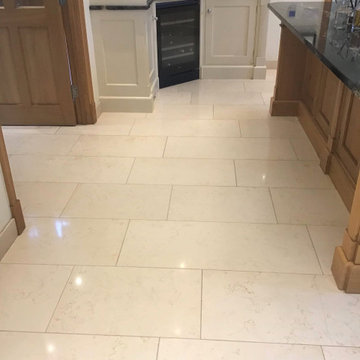
These photos are of a four-year-old Limestone kitchen floor at a property in Boughton that the customer was finding hard to keep clean and maintain a shine. Part of the problem was he owned two dogs and we often warn about the problems of dog urine on sealed tile and stone due to it being high in nitrogen.
On my initial visit I was able to ascertain that the sealer had almost completely worn off, leaving the stone vulnerable to dirt becoming ingrained into the pores of the stone. I come across this problem a lot, in my experience when stone floors are installed by tilers, they generally apply a single coat of sealant which wears off over time, and as discussed earlier can be prematurely degraded by strong chemicals.
My quote to renovate the Limestone floor was accepted and included a deep clean to the stone and grout, stone polish and then re-seal.
I arrived on site on the arranged date and began by scrubbing all the grout lines with Tile Doctor grout brushes and a 3:1 dilution of Tile Doctor Pro-Clean. I then moved on to a small handheld polishing machine to clean around the tile edges using 800 and 1500 grit diamond encrusted burnishing pad to achieve a deep clean.
The process was then repeated throughout the rest of the area using larger 17” burnishing pads fitted to a floor polishing machine. The burnishing pads I used come in a set of four starting with 400-grit and moving up to 800, 1500 and 3000 grit, after each pad is applied the floor is rinsed with water and the soil extracted with a wet vacuum.
It took me much of the day to complete this stage of the renovation and the floor was still damp so once done I left for the day, allowing the floor to dry off overnight.
I returned the following day to complete the final polish using the 3000-grit burnishing pad, this gave a high polished finish which the customer had requested. This last pad is applied dry with only a little water splashed onto the tile, a process we call a spray burnish.
The floor was then sealed with three applications of Tile Doctor Ultra Seal Sealant to protect the newly restored and polished tiles. Ultra-Seal is a penetrating sealer that soaks into those recently cleaned pores in the stone, occupying the space and preventing any dirt from becoming ingrained there. It’s also a natural look sealer so it doesn’t change the colour of the stone in anyway and is almost indetectable once applied.
“Hard work from Philip has left us with a kitchen floor brought back to life – cleaned and sealed in little over 24 hours – brilliant job – Thanks”
Before leaving I gave the customer some tips on maintenance and a complimentary bottle of Tile Doctor Stone Soap to enable him to keep the floor looking its best, this product works well with the sealant we applied and is PH neutral so won’t degrade the new sealer.
Phil Vissian
Northamptonshire Tile Doctor
 Pennsylvania Landscape & Nursery Association
u2014 ALE: Wayne Rain Garden
Pennsylvania Landscape & Nursery Association
u2014 ALE: Wayne Rain Garden
Terren Landscapes http://www.terrenlandscapes.com
2014 PLNA Awards for Landscape Excellence winner
Category: Residential Up to $15,000
Award Level: Gold
Project Description:
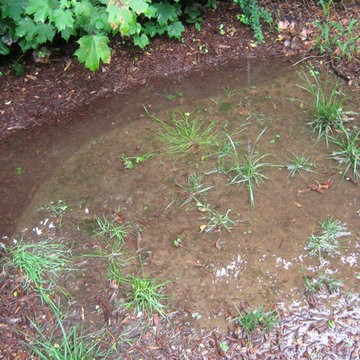
Our company was contracted by the client to provide a creative solution to an ongoing drainage problem. Their property is located within 30 feet of a local stream that collects storm water from the surrounding area. The nearby stream and high water table caused the lawn area at the side of their home to flood and to remain waterlogged for a few days after each storm. The client not only had difficulty growing plants in the existing conditions, but also had a problem with mosquitoes due to standing water.
Our goal was to design a self-contained, naturalistic rain garden that slowed storm water runoff, allowed for percolation, and promoted infiltration while permitting excess clean water to enter the nearby stream with diminished force. As designed, the rain garden allows the earth to slowly and more naturally
absorb excess storm water while filtering out toxins such as excess nitrogen and phosphorous which are frequently found in the landscape, therefore reducing the contaminants entering the stream.
A percolation test was conducted with criteria of absorbing a one-inch rainstorm within four hours without overflow. The one-inch storm calculation included an existing downspout from the home, which would be piped into the rain garden to reduce roof runoff. The first test failed due to a deep layer of high clay-content soil. Excavation continued until a layer of sandy loam was reached, the percolation test was repeated, and a successful test result was achieved. Next, the entire rain garden basin was excavated to the sandy loam layer and the soil amended with compost and sand to create a highly porous planting media.
Geotextile fabric was placed to help reduce migration of the surface stone into the soil and allow for minimal maintenance. Gravel, river stone and small boulders were carefully placed to achieve the look of a natural streambed.
A palette of mostly native plants with a few non-invasive ornamentals were chosen for their ability to survive in extreme conditions ranging from floods to drought and were placed according to their specific preferences.
Wetland plants were chosen for the lowest portion of the rain garden as that area remains saturated for longer periods of time, with a Chionanthus virginicus as a focal point surrounded by irises and ferns at the lowest depth.
Plants tolerant of drier conditions were chosen for the upper edges of the garden. The beautiful colors of Monarda, Ligularia, Eupatorium, Solidago, Chelone, and Rudbeckia were scattered within the upper edge, while movement and softness were incorporated by use of the graceful Nassella that lines the border. Finally, winter interest was provided with a backdrop of Cornus sericea.
As built, this small rain garden creates tremendous impact by decreasing the amount of storm water runoff not only on our client's property, but also in the neighboring stream. It serves as a means of slowing the water and providing an area for infiltration back into the earth. The plants provide a habitat for birds, butterflies, and insects, working in harmony with nature and providing beautiful visual interest year-round.
Photo Credit:
Lisa C. Falls
4