
Search results for "Officially optimized" in Home Design Ideas
 Kazi Family
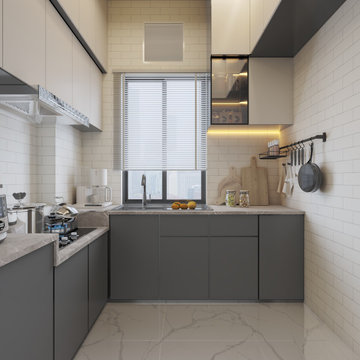
We are proud to showcase this modern kitchen interior design in Bangladesh, combining elegance, functionality, and smart space planning. The design focuses on maximizing storage, using premium materials, and creating a bright, welcoming atmosphere.
Key features of this kitchen design include:
Custom wall and base cabinets for optimal storage
Sleek countertops with durable finishes
Modern lighting solutions to enhance ambiance
Thoughtful layout for cooking and dining convenience
This project reflects our commitment to innovative and practical kitchen interiors tailored for Bangladeshi homes.
For more details about our interior design services or to see more projects, visit our official website: www.kazifamilybd.com
 FineLine Kitchens, Inc.
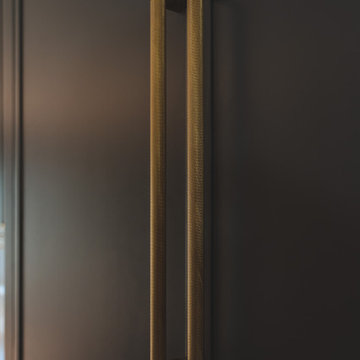
Our designer has achieved a stylish look by combining dark cabinets and light-colored marbles.
 User
UserPhoto: Ten Ten Creative
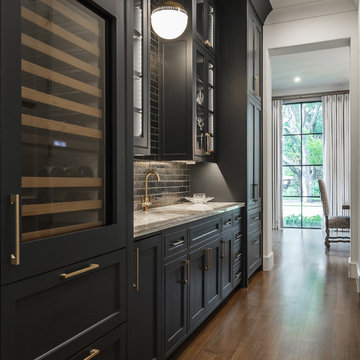
Wet bar - transitional single-wall dark wood floor and brown floor wet bar idea in Dallas with shaker cabinets, black cabinets, black backsplash, subway tile backsplash and gray countertops
Wet bar - transitional single-wall dark wood floor and brown floor wet bar idea in Dallas with shaker cabinets, black cabinets, black backsplash, subway tile backsplash and gray countertops
Find the right local pro for your project
 Boyenga Team / Compass
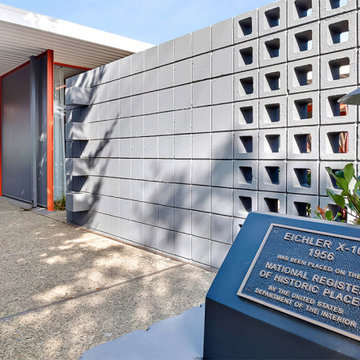
Eichler X-100: A Nationally Recognized Architectural Landmark
The Eichler X-100 holds a rare distinction in residential real estate—it is listed on the National Register of Historic Places, recognizing it as a property of exceptional architectural and cultural significance in the United States.
This designation places the X-100 among a select group of homes that have not only endured over time, but have helped define the evolution of modern living.
What the National Register Means
The National Register of Historic Places is the official list of the nation’s most important historic resources—properties that embody significant contributions to architecture, history, and culture.
For the Eichler X-100, this recognition affirms:
Its role as a groundbreaking experimental prototype
Its importance within the broader movement of California Modernism
Its association with visionary figures like Joseph Eichler, A. Quincy Jones, and Frederick Emmons
It is not simply a well-designed home—it is a documented piece of architectural history.
A Rare Level of Integrity
One of the key factors in the X-100’s designation is its remarkable level of preservation. Over the decades, the home has been carefully maintained and thoughtfully updated to respect its original vision.
Important defining features remain intact, including:
The steel-frame structural system
The open, garden-centered floor plan
Skylights and natural light strategies
Signature material palette of steel, glass, and laminate
This continuity allows the home to be experienced today much as it was in 1956.
Preservation Without Limitation
A common misconception is that National Register status restricts ownership—but for private residences, this is not the case.
The designation:
Does not limit private ownership or resale
Does not impose federal restrictions on modifications (unless federal funding is involved)
May offer potential incentives or recognition for preservation efforts
Instead, it serves primarily as a recognition of significance, elevating the property’s status in both cultural and real estate contexts.
A Collector-Level Opportunity
For buyers, National Register status adds a layer of meaning that goes beyond square footage or location. It signals that the property is:
Architecturally important
Historically documented
Extremely rare within the marketplace
Homes like the Eichler X-100 are often viewed as “trophy properties”—assets that combine lifestyle, design, and long-term cultural value.
Stewardship of a Legacy
Owning a National Register home like the Eichler X-100 is not just about possession—it’s about participation in a larger story.
It means becoming part of a lineage of stewards who understand the importance of:
Preserving architectural intent
Respecting design integrity
Carrying forward a vision that helped shape modern living
The Significance Today
Nearly 70 years after its debut, the Eichler X-100 continues to stand as a symbol of innovation, optimism, and design excellence.
Its listing on the National Register of Historic Places ensures that its story is recognized—but its future will always depend on those who choose to own and care for it.
The Eichler X-100 is not just a home on a list.
It is a recognized landmark of modern architecture—now ready for its next chapter. Image Sabrina Huang

 Nar Design Group
This fun classic kitchen in Gold River features Columbia frameless cabinets in Sandy Hook grey. A green glass backsplash in a random matte and polished pattern complements the cabinets which are faced with both painted wood and frosted glass. The Silestone countertops in the Lyra finish have an ogee bullnose edge. The floors are finished in a rich brown porcelain tile of varying sizes that are made to resemble distressed wood.
Photo Credit: Nar Fine Carpentry, Inc
 Highland Builders LLC
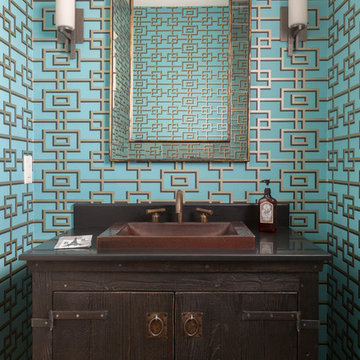
Powder room with glam geometric wallpaper complimented with a vessel sink rustic vanity with riveted hardware. Counter top is quartz Viatera - Truffle. Mirror framed wall mirror.
Ryan Hainey
 Custom Surface Solutions
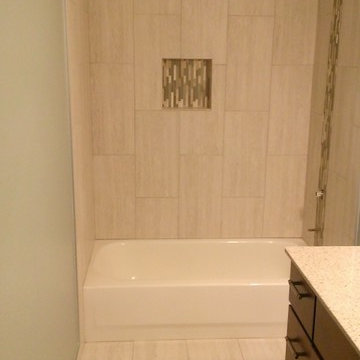
Custom Surface Solutions (www.css-tile.com) - Owner Craig Thompson (512) 430-1215. This project shows new 12 x 24 tile installed vertically with offset layout pattern on wall and floor. Includes shower box with linear glass accent tile back and vertical glass accent band. Tile edges are finished with Schluter Jolly satin aluminum profile edge trim.
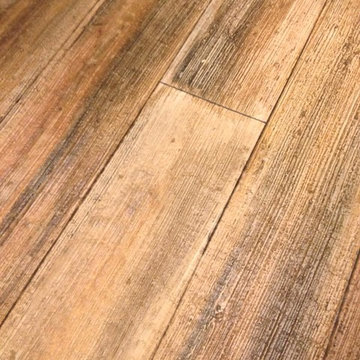
 Ky-Kan Coatings
Concrete can be made to look like any substance. Tile, stone, wood, brick, etc. With unlimited color options, Ky-Kan Coatings can transform any room in your home or business using lightweight, beautiful concrete.
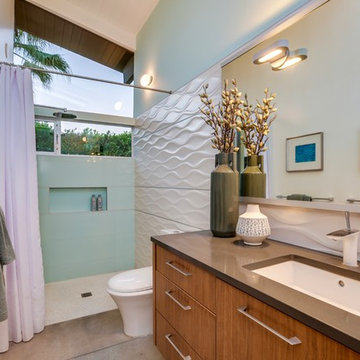
 Moderne Builders
Gorgeous master bath with dramatic retro "wave" tile. Peak Photography
Example of a 1950s bathroom design in Los Angeles
Example of a 1950s bathroom design in Los Angeles

 Miller-Roodell Architects Ltd
Set in Montana's tranquil Shields River Valley, the Shilo Ranch Compound is a collection of structures that were specifically built on a relatively smaller scale, to maximize efficiency. The main house has two bedrooms, a living area, dining and kitchen, bath and adjacent greenhouse, while two guest homes within the compound can sleep a total of 12 friends and family. There's also a common gathering hall, for dinners, games, and time together. The overall feel here is of sophisticated simplicity, with plaster walls, concrete and wood floors, and weathered boards for exteriors. The placement of each building was considered closely when envisioning how people would move through the property, based on anticipated needs and interests. Sustainability and consumption was also taken into consideration, as evidenced by the photovoltaic panels on roof of the garage, and the capability to shut down any of the compound's buildings when not in use.
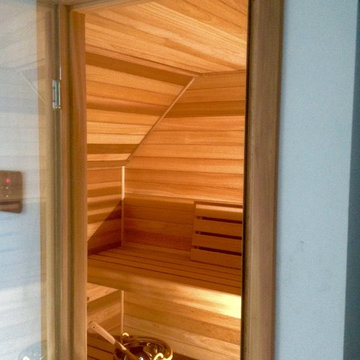
 Warm Timber Saunas & Wine Cellars
This previously unused attic space is now a sauna/yoga room. The left sauna wall follows the attic rafters down diagonally to allow a wider space for leg room on the twin sauna benches.
 Electronic Design & Consulting, Inc.
This article is posted here with the consent of the author. The views and opinions expressed in this article are those of the author and do not necessarily reflect the official policy, position, view, or opinion of Crestron Electronics, Inc., or of any of its employees. Crestron Electronics is not responsible for, and does not verify the accuracy of, any of the information contained in this article.
By Jeff Singer
The “smart” revolution began several years ago with smartphones (a.k.a phones) and has extended in recent years to thermostats, doorbells, alarm systems, and kitchen appliances. Smart devices are so ubiquitous that the term “smart” is overused to the point that it is almost meaningless. Companies are eager to jump on the bandwagon and claim their products are “smart,” and consumers proudly claim they have a smart home because they have lighting control. Misconceptions about smart homes are prevalent and create confusion in the marketplace. This can have deleterious effects on businesses and underserve consumers. Here are seven of the most popular misconceptions about smart homes:
1. Apps are smart
Apps are convenient and easy to use. Yes, it seems there’s an app for everything. People expect to be able to download an app and do just about anything. App developers and many companies do not disavow consumers of this myth. On the contrary, they promote this idea with carefully worded descriptions. The promise of having the world at your fingertips for $1.99 is very enticing. Although it sounds too good to be true, it is also too good to pass up for many people. This leads to undervaluing home control and disappointment when the apps don’t work, which undermines confidence in our industry. The fact is that apps are not smart. They do not control anything. They must connect to and communicate with a control system or cloud service that processes, prioritizes, and executes commands. That’s the real magic and what most people do not understand.
2. Smart devices work together
With so many smart appliances and devices on the market today, it’s understandable that the average consumer might think that they actually communicate and work together. This is simply not the case. Smart devices are not that smart. They are designed and manufactured by different, often competing, companies. There are no national or industry standards governing these products. Even if they all operate using Wi-Fi® communications, that doesn’t mean they work together. Some companies promote a home control platform, which unites different devices from different companies – in theory. The platform is yet another third-party software totally dependent on other companies developing APIs and writing control modules for their hardware to run on that piece of software. The devices are not independently compatible. Also, when updates are made to either the hardware or the software, functionality may be affected for some period. That’s a nice way of saying the device or system won’t work and there’s no way of knowing for how long.
3. It’s a DIY project
Which brings us to the next myth, which is that the average person can do it themselves. Unless you are a skilled professional, I would not advise taking on a smart home project. You want to make a light turn on and off with your Alexa® or Google Assistant™ virtual assistant software, go for it. A smart home takes much more planning and expertise. I have no problem changing a light bulb or hanging a light fixture in my dining room; however, I am not going to rewire my house. I may change the flush valve in my toilet, but I’m not going to replace the pipes in my house. You get it. Integrating devices and systems, establishing different zones, creating scenes, designing the UI with a balance between control, feedback, and simplicity – all takes experience and skill.
4. Need a programmer to make changes
Early adopters may have experienced the pain of trying to make a simple change or update to their home control system. Years ago, if the cable provider changed the channel line-up, the homeowner would have to call the dealer or programmer to make an appointment for them to come out to the house to reprogram the system. The system wouldn’t work as expected until it was updated, which often took several days and beaucoup bucks. Not anymore. Technology has evolved so now it’s easy for system owners to change favorite channels, create scenes, rename buttons, update images, and more. While a professional is needed for the initial installation and setup, the system is easy to manage once it’s up and running. This makes life so much easier for both dealer and customer.
5. Tech becomes obsolete quickly
Similar to updating the UI, updating firmware or hardware used to be a stressful process. A smart home should be intelligent enough to update itself. Apps don’t become obsolete. Updates are constantly pushed out from the cloud, making them better all the time. The same is true for a good smart home system. New features, functions, and device support gets added in the background consistently, so the system you installed (or purchased) yesterday gets better over time. Swapping out decorative elements, such as keypads, dimmers, and touch screens is also seamless. When a new device is added, all the settings are pulled down from the cloud and it just works. No system interruptions. No sunk costs. No imposing house calls. No surprise bills.
6. Lighting control saves energy and money
Lighting control is one of the most popular smart systems, but it takes more than just one system to make a home smart. On the surface, it makes sense that if you dim the lights ten percent, then you save ten percent of energy costs. If the shades are raised during the day to take advantage of sunlight so the lights don’t need to be on (or at least not 100%), but that causes the room temperature to rise a few degrees, which triggers the air conditioner to run longer and more often, was energy usage (or cost) reduced? A smart home integrates all the various systems and technology to optimize comfort, convenience, safety, and sometimes energy.
7. Home technology is easy to hack
Security is at the forefront of people’s minds these days. Personal identities are stolen; email accounts hacked; private photos publicized; and more. A smart home must outsmart those who don’t respect privacy. Crestron control systems adhere to the strictest security standards. The same Crestron control system that goes into a home is also installed in secure government and military facilities, global banking institutions, hospitals, and other mission critical applications. When installed correctly by a trained professional, a Crestron smart home is the gold standard for security, comfort, and convenience.

 Trilogy Construction Company
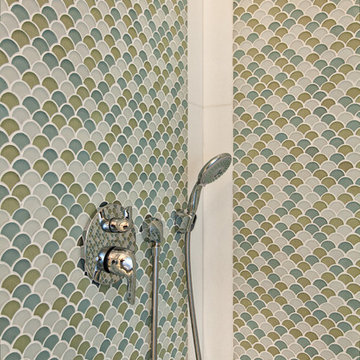
Great glass scallop tile detail. This tile is bordered by slabs of white marble.
Bathroom - modern bathroom idea in Miami
Bathroom - modern bathroom idea in Miami


 Whitt Carpet One Floor & Home
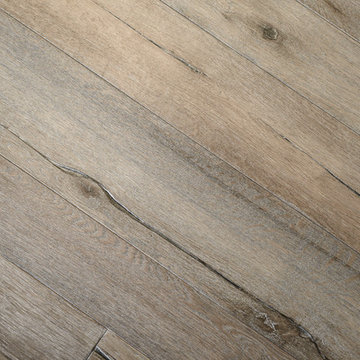
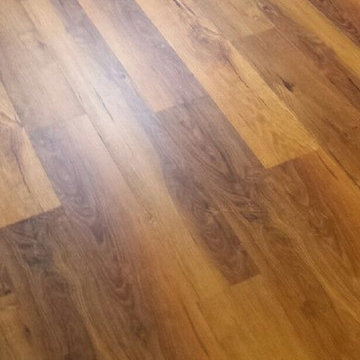
Mannington Adura LVT Napa, color Tanin
Elegant vinyl floor bedroom photo
Elegant vinyl floor bedroom photo


1