
Search results for "Periodicals offer" in Home Design Ideas
 Steinberg Custom Designs
1730s Farmhouse Kitchen Renovation
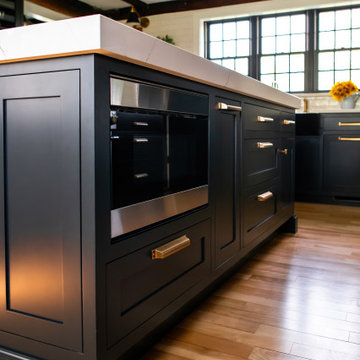
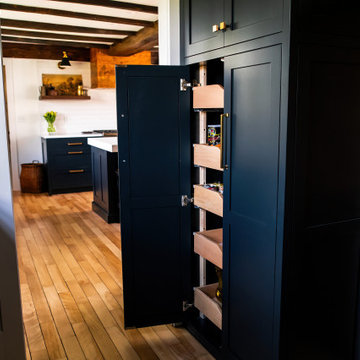
This kitchen renovation thoughtfully blends historic charm with modern functionality in a beautifully preserved 1730s farmhouse. Central to the redesign was the addition of a walk-in pantry, seamlessly integrated to enhance storage while maintaining the home’s vintage character.
At the heart of the kitchen, the original antique slate farm sink was carefully restored and reused, grounding the space with an authentic period touch. The layout was opened up with the addition and strategic relocation of windows, inviting in natural light and offering views of the surrounding landscape.
A reclaimed barn board wood hood anchors the cooking area with rustic warmth, paired with full inset Shaker-style cabinets painted in Benjamin Moore’s “Inkwell” — a deep, moody blue in a soft, dull finish. Countertops in white engineered quartz with navy blue veining offer a crisp contrast and subtle elegance.
Satin brass hardware and light fixtures add a refined, modern edge, while distressed pine floating shelves bring a casual, lived-in feel that honors the farmhouse’s heritage. The result is a timeless kitchen that celebrates its past while serving the needs of today.

 Tom Brzoskwinia
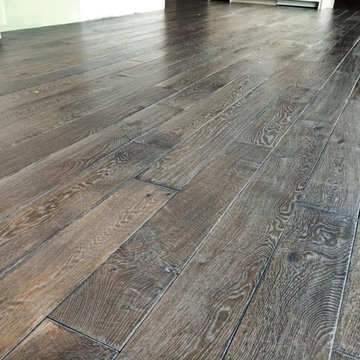
One of the most popular hardwood floor finishing which offers Tom & Peter Flooring is provided by WOCA. If you’ve decided that you want a natural looking wooden floor that is lacquer-free, then the likelihood is that you’ve chosen oil as your way of protecting your wood and making your floor look great at the same time. WOCA for wood flooring comes in various forms and is a great way of making sure that your wood is protected, but at the same time looks natural. A highly popular as well as effective way of treating wood floors, oils effectively penetrate into the wood and in some cases harden into the surface of the floor to stop damage and to maintain the wood in its optimum condition.
WOCA Oil finish hardwood flooring has taken the United States market by in 2014 and shows no signs of slowing down in 2016 and now. Here are some of the most common questions we have regarding this type of finish which we will I’m to answer in today’s my blog:
Is oil finish as durable as traditional factory urethane finishes with aluminum oxide?
When it comes to durability, oil finish flooring tackles the issue with a completely different method. The penetrating oil serves as protection from moisture and wear while allowing the user to feel the wood grains in their bare feet. If compared directly to factory finished aluminum oxide finish, the oil finish flooring will not perform as well to abrasion and impact. However, the beauty of this finish is the fact that it will camouflage any scratches which will inevitably accumulate over time.
Will this finish evaporate over time and will this be harmful for indoor air quality?
Another concern for oil finished floors its effect on indoor air quality. For on-site applications, some varieties suggest several coats which typically require the residents to be out of the home due to mild odors. However, there are factory finished UV-cured or single coat applications which lessen the downtime. Despite the odors produced during the drying process, oil finish floors rank amongst the lowest for VOC (volatile organic compound) emissions. Certain brands even boast true zero VOC. This fact alone makes oil finished floors one of the best options for green building solutions.
“WOCA products are certified by independent laboratories, the German Institute for Biological Building Materials, and are in accordance with DIN–Norm 53–160. WOCA WoodCare Denmark products meet or exceed the most stringent U.S. standards for volatile organic compounds.” –WOCA Oil Finish Manufacture
Does this type of finish require additional maintenance which I am not familiar with?
For weekly cleaning, oiled floors use a special cleaner which contains an oil and soap mixture. After a period of 12-18 months some oil may evaporate causing the wood grains to appear dry. An additional layer of oil can be reapplied to keep the floor looking fresh. Although oil finished floors require more involvement in periodic maintenance in high traffic areas, this maintenance can be done much easier than the equivalent of an onsite sand and refinish.
WOCA Master Color Oil contains pigment, which provides a single-step hardwood floor staining process. Laying down the stain and the finish in one step.
This product comes 14 different colors, from Black to Extra White, and you can mix them freely to create various color palettes that will meet the demands of any job.
Below are some pictures of the finished job…
Find the right local pro for your project
 Steinberg Custom Designs
1730s Farmhouse Kitchen Renovation
This kitchen renovation thoughtfully blends historic charm with modern functionality in a beautifully preserved 1730s farmhouse. Central to the redesign was the addition of a walk-in pantry, seamlessly integrated to enhance storage while maintaining the home’s vintage character.
At the heart of the kitchen, the original antique slate farm sink was carefully restored and reused, grounding the space with an authentic period touch. The layout was opened up with the addition and strategic relocation of windows, inviting in natural light and offering views of the surrounding landscape.
A reclaimed barn board wood hood anchors the cooking area with rustic warmth, paired with full inset Shaker-style cabinets painted in Benjamin Moore’s “Inkwell” — a deep, moody blue in a soft, dull finish. Countertops in white engineered quartz with navy blue veining offer a crisp contrast and subtle elegance.
Satin brass hardware and light fixtures add a refined, modern edge, while distressed pine floating shelves bring a casual, lived-in feel that honors the farmhouse’s heritage. The result is a timeless kitchen that celebrates its past while serving the needs of today.
 Steinberg Custom Designs
1730s Farmhouse Kitchen Renovation
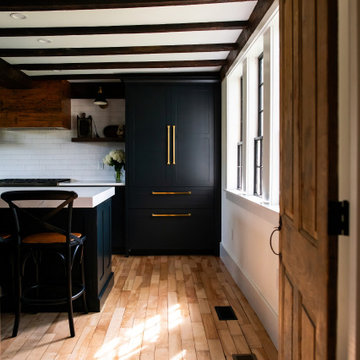
This kitchen renovation thoughtfully blends historic charm with modern functionality in a beautifully preserved 1730s farmhouse. Central to the redesign was the addition of a walk-in pantry, seamlessly integrated to enhance storage while maintaining the home’s vintage character.
At the heart of the kitchen, the original antique slate farm sink was carefully restored and reused, grounding the space with an authentic period touch. The layout was opened up with the addition and strategic relocation of windows, inviting in natural light and offering views of the surrounding landscape.
A reclaimed barn board wood hood anchors the cooking area with rustic warmth, paired with full inset Shaker-style cabinets painted in Benjamin Moore’s “Inkwell” — a deep, moody blue in a soft, dull finish. Countertops in white engineered quartz with navy blue veining offer a crisp contrast and subtle elegance.
Satin brass hardware and light fixtures add a refined, modern edge, while distressed pine floating shelves bring a casual, lived-in feel that honors the farmhouse’s heritage. The result is a timeless kitchen that celebrates its past while serving the needs of today.
 Steinberg Custom Designs
1730s Farmhouse Kitchen Renovation
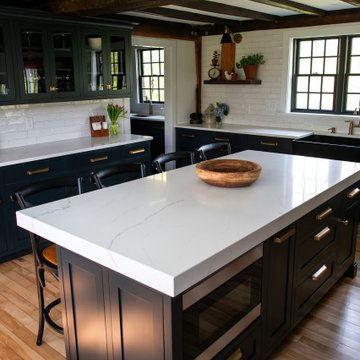
This kitchen renovation thoughtfully blends historic charm with modern functionality in a beautifully preserved 1730s farmhouse. Central to the redesign was the addition of a walk-in pantry, seamlessly integrated to enhance storage while maintaining the home’s vintage character.
At the heart of the kitchen, the original antique slate farm sink was carefully restored and reused, grounding the space with an authentic period touch. The layout was opened up with the addition and strategic relocation of windows, inviting in natural light and offering views of the surrounding landscape.
A reclaimed barn board wood hood anchors the cooking area with rustic warmth, paired with full inset Shaker-style cabinets painted in Benjamin Moore’s “Inkwell” — a deep, moody blue in a soft, dull finish. Countertops in white engineered quartz with navy blue veining offer a crisp contrast and subtle elegance.
Satin brass hardware and light fixtures add a refined, modern edge, while distressed pine floating shelves bring a casual, lived-in feel that honors the farmhouse’s heritage. The result is a timeless kitchen that celebrates its past while serving the needs of today.
 Steinberg Custom Designs
1730s Farmhouse Kitchen Renovation
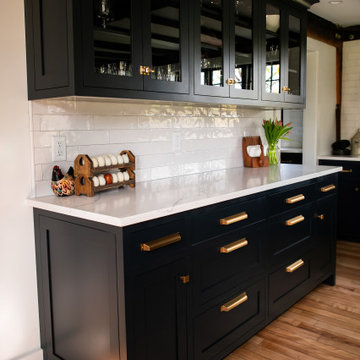
This kitchen renovation thoughtfully blends historic charm with modern functionality in a beautifully preserved 1730s farmhouse. Central to the redesign was the addition of a walk-in pantry, seamlessly integrated to enhance storage while maintaining the home’s vintage character.
At the heart of the kitchen, the original antique slate farm sink was carefully restored and reused, grounding the space with an authentic period touch. The layout was opened up with the addition and strategic relocation of windows, inviting in natural light and offering views of the surrounding landscape.
A reclaimed barn board wood hood anchors the cooking area with rustic warmth, paired with full inset Shaker-style cabinets painted in Benjamin Moore’s “Inkwell” — a deep, moody blue in a soft, dull finish. Countertops in white engineered quartz with navy blue veining offer a crisp contrast and subtle elegance.
Satin brass hardware and light fixtures add a refined, modern edge, while distressed pine floating shelves bring a casual, lived-in feel that honors the farmhouse’s heritage. The result is a timeless kitchen that celebrates its past while serving the needs of today.

 Steinberg Custom Designs
1730s Farmhouse Kitchen Renovation
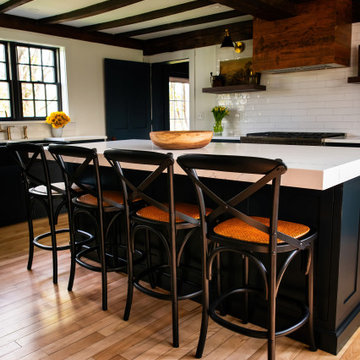
This kitchen renovation thoughtfully blends historic charm with modern functionality in a beautifully preserved 1730s farmhouse. Central to the redesign was the addition of a walk-in pantry, seamlessly integrated to enhance storage while maintaining the home’s vintage character.
At the heart of the kitchen, the original antique slate farm sink was carefully restored and reused, grounding the space with an authentic period touch. The layout was opened up with the addition and strategic relocation of windows, inviting in natural light and offering views of the surrounding landscape.
A reclaimed barn board wood hood anchors the cooking area with rustic warmth, paired with full inset Shaker-style cabinets painted in Benjamin Moore’s “Inkwell” — a deep, moody blue in a soft, dull finish. Countertops in white engineered quartz with navy blue veining offer a crisp contrast and subtle elegance.
Satin brass hardware and light fixtures add a refined, modern edge, while distressed pine floating shelves bring a casual, lived-in feel that honors the farmhouse’s heritage. The result is a timeless kitchen that celebrates its past while serving the needs of today.
 Arciform
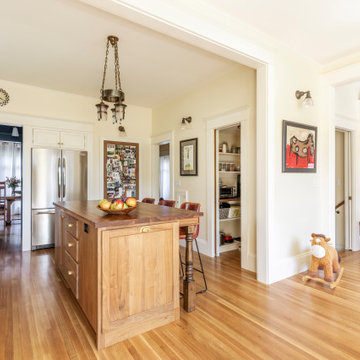
The kitchen is now the hub of the house with its roomier, more open layout, natural light and improved flow. Flooring is new top nailed White Oak to match the existing floor. New perimeter cabinets are painted white with unlacquered brass hardware. The custom island is Walnut and offers plenty of seating for casual dining or catching up with the cook. A walk-in pantry offers plenty of storage for drygoods. All cabinetry is custom made by Arciform. Counters are topped with 3cm Soapstone from Pental Surfaces. Most of the light fixtures are salvaged and restored, and represent the general time period of the house.
 Steinberg Custom Designs
1730s Farmhouse Kitchen Renovation
This kitchen renovation thoughtfully blends historic charm with modern functionality in a beautifully preserved 1730s farmhouse. Central to the redesign was the addition of a walk-in pantry, seamlessly integrated to enhance storage while maintaining the home’s vintage character.
At the heart of the kitchen, the original antique slate farm sink was carefully restored and reused, grounding the space with an authentic period touch. The layout was opened up with the addition and strategic relocation of windows, inviting in natural light and offering views of the surrounding landscape.
A reclaimed barn board wood hood anchors the cooking area with rustic warmth, paired with full inset Shaker-style cabinets painted in Benjamin Moore’s “Inkwell” — a deep, moody blue in a soft, dull finish. Countertops in white engineered quartz with navy blue veining offer a crisp contrast and subtle elegance.
Satin brass hardware and light fixtures add a refined, modern edge, while distressed pine floating shelves bring a casual, lived-in feel that honors the farmhouse’s heritage. The result is a timeless kitchen that celebrates its past while serving the needs of today.
 Tom Brzoskwinia
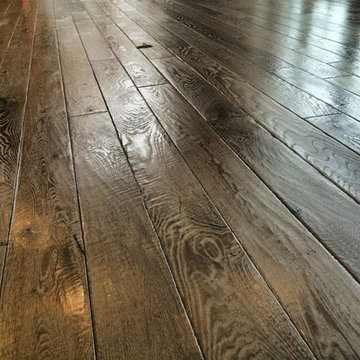
One of the most popular hardwood floor finishing which offers Tom & Peter Flooring is provided by WOCA. If you’ve decided that you want a natural looking wooden floor that is lacquer-free, then the likelihood is that you’ve chosen oil as your way of protecting your wood and making your floor look great at the same time. WOCA for wood flooring comes in various forms and is a great way of making sure that your wood is protected, but at the same time looks natural. A highly popular as well as effective way of treating wood floors, oils effectively penetrate into the wood and in some cases harden into the surface of the floor to stop damage and to maintain the wood in its optimum condition.
WOCA Oil finish hardwood flooring has taken the United States market by in 2014 and shows no signs of slowing down in 2016 and now. Here are some of the most common questions we have regarding this type of finish which we will I’m to answer in today’s my blog:
Is oil finish as durable as traditional factory urethane finishes with aluminum oxide?
When it comes to durability, oil finish flooring tackles the issue with a completely different method. The penetrating oil serves as protection from moisture and wear while allowing the user to feel the wood grains in their bare feet. If compared directly to factory finished aluminum oxide finish, the oil finish flooring will not perform as well to abrasion and impact. However, the beauty of this finish is the fact that it will camouflage any scratches which will inevitably accumulate over time.
Will this finish evaporate over time and will this be harmful for indoor air quality?
Another concern for oil finished floors its effect on indoor air quality. For on-site applications, some varieties suggest several coats which typically require the residents to be out of the home due to mild odors. However, there are factory finished UV-cured or single coat applications which lessen the downtime. Despite the odors produced during the drying process, oil finish floors rank amongst the lowest for VOC (volatile organic compound) emissions. Certain brands even boast true zero VOC. This fact alone makes oil finished floors one of the best options for green building solutions.
“WOCA products are certified by independent laboratories, the German Institute for Biological Building Materials, and are in accordance with DIN–Norm 53–160. WOCA WoodCare Denmark products meet or exceed the most stringent U.S. standards for volatile organic compounds.” –WOCA Oil Finish Manufacture
Does this type of finish require additional maintenance which I am not familiar with?
For weekly cleaning, oiled floors use a special cleaner which contains an oil and soap mixture. After a period of 12-18 months some oil may evaporate causing the wood grains to appear dry. An additional layer of oil can be reapplied to keep the floor looking fresh. Although oil finished floors require more involvement in periodic maintenance in high traffic areas, this maintenance can be done much easier than the equivalent of an onsite sand and refinish.
WOCA Master Color Oil contains pigment, which provides a single-step hardwood floor staining process. Laying down the stain and the finish in one step.
This product comes 14 different colors, from Black to Extra White, and you can mix them freely to create various color palettes that will meet the demands of any job.
Below are some pictures of the finished job…
 ONE Design
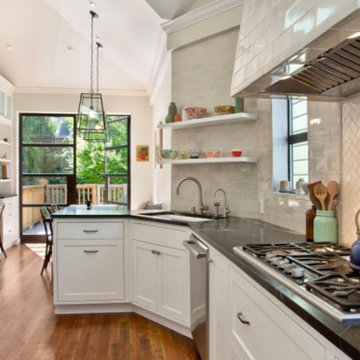
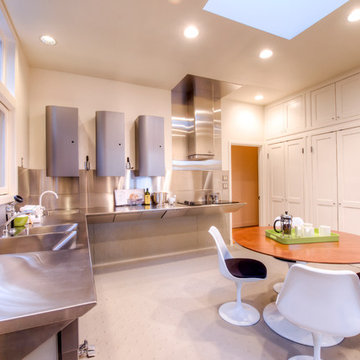
This charming top floor condo in Ashbury Heights had beautiful Victorian period details and like all homes of the period, the kitchen was an afterthought. The goal of this project was to reunite the living spaces and introduce them to the outdoors. The rear yard, which was previously accessible only through a dank laundry room, was invited in and integrated with the new dining room and kitchen.
The hidden gem in this home was the fantastic attic space. Removing the ceiling joists and exposing the sloping roof to create a cathedral ceiling, the structure provided this new kitchen and dining room with the breathing space it needed. With the south facing exposure now accessible, the space was transformed, bringing light to where before there was little. Careful detailing by the interior designer ensured the traditional qualities this home has to offer were blended in elegantly while respecting the original charm.
 User
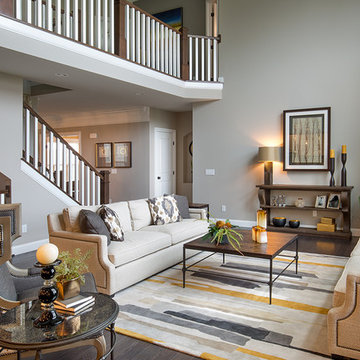
UserArchitecturally significant 1930's art deco jewel designed by noted architect Hervey Clark, whose projects include the War Memorial in the Presidio, the US Consulate in Japan, and several buildings on the Stanford campus. Situated on just over 3 acres with 4,435 sq. ft. of living space, this elegant gated property offers privacy, expansive views of Ross Valley, Mt Tam, and the bay. Other features include deco period details, inlaid hardwood floors, dramatic pool, and a large partially covered deck that offers true indoor/outdoor living.
 User
UserArchitecturally significant 1930's art deco jewel designed by noted architect Hervey Clark, whose projects include the War Memorial in the Presidio, the US Consulate in Japan, and several buildings on the Stanford campus. Situated on just over 3 acres with 4,435 sq. ft. of living space, this elegant gated property offers privacy, expansive views of Ross Valley, Mt Tam, and the bay. Other features include deco period details, inlaid hardwood floors, dramatic pool, and a large partially covered deck that offers true indoor/outdoor living.
 Steinberg Custom Designs
1730s Farmhouse Kitchen Renovation
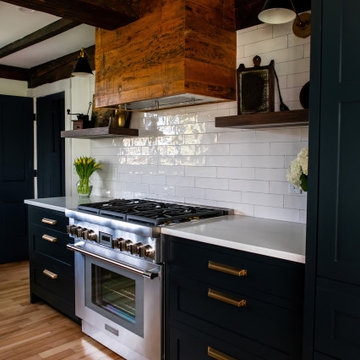
This kitchen renovation thoughtfully blends historic charm with modern functionality in a beautifully preserved 1730s farmhouse. Central to the redesign was the addition of a walk-in pantry, seamlessly integrated to enhance storage while maintaining the home’s vintage character.
At the heart of the kitchen, the original antique slate farm sink was carefully restored and reused, grounding the space with an authentic period touch. The layout was opened up with the addition and strategic relocation of windows, inviting in natural light and offering views of the surrounding landscape.
A reclaimed barn board wood hood anchors the cooking area with rustic warmth, paired with full inset Shaker-style cabinets painted in Benjamin Moore’s “Inkwell” — a deep, moody blue in a soft, dull finish. Countertops in white engineered quartz with navy blue veining offer a crisp contrast and subtle elegance.
Satin brass hardware and light fixtures add a refined, modern edge, while distressed pine floating shelves bring a casual, lived-in feel that honors the farmhouse’s heritage. The result is a timeless kitchen that celebrates its past while serving the needs of today.
 Steinberg Custom Designs
1730s Farmhouse Kitchen Renovation
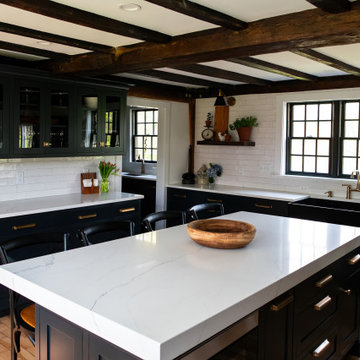
This kitchen renovation thoughtfully blends historic charm with modern functionality in a beautifully preserved 1730s farmhouse. Central to the redesign was the addition of a walk-in pantry, seamlessly integrated to enhance storage while maintaining the home’s vintage character.
At the heart of the kitchen, the original antique slate farm sink was carefully restored and reused, grounding the space with an authentic period touch. The layout was opened up with the addition and strategic relocation of windows, inviting in natural light and offering views of the surrounding landscape.
A reclaimed barn board wood hood anchors the cooking area with rustic warmth, paired with full inset Shaker-style cabinets painted in Benjamin Moore’s “Inkwell” — a deep, moody blue in a soft, dull finish. Countertops in white engineered quartz with navy blue veining offer a crisp contrast and subtle elegance.
Satin brass hardware and light fixtures add a refined, modern edge, while distressed pine floating shelves bring a casual, lived-in feel that honors the farmhouse’s heritage. The result is a timeless kitchen that celebrates its past while serving the needs of today.
 Tom Brzoskwinia
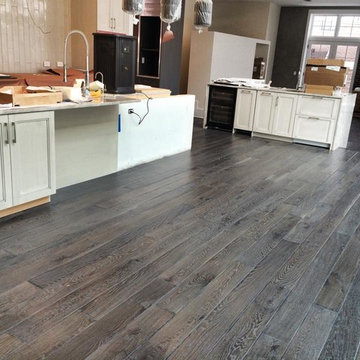
One of the most popular hardwood floor finishing which offers Tom & Peter Flooring is provided by WOCA. If you’ve decided that you want a natural looking wooden floor that is lacquer-free, then the likelihood is that you’ve chosen oil as your way of protecting your wood and making your floor look great at the same time. WOCA for wood flooring comes in various forms and is a great way of making sure that your wood is protected, but at the same time looks natural. A highly popular as well as effective way of treating wood floors, oils effectively penetrate into the wood and in some cases harden into the surface of the floor to stop damage and to maintain the wood in its optimum condition.
WOCA Oil finish hardwood flooring has taken the United States market by in 2014 and shows no signs of slowing down in 2016 and now. Here are some of the most common questions we have regarding this type of finish which we will I’m to answer in today’s my blog:
Is oil finish as durable as traditional factory urethane finishes with aluminum oxide?
When it comes to durability, oil finish flooring tackles the issue with a completely different method. The penetrating oil serves as protection from moisture and wear while allowing the user to feel the wood grains in their bare feet. If compared directly to factory finished aluminum oxide finish, the oil finish flooring will not perform as well to abrasion and impact. However, the beauty of this finish is the fact that it will camouflage any scratches which will inevitably accumulate over time.
Will this finish evaporate over time and will this be harmful for indoor air quality?
Another concern for oil finished floors its effect on indoor air quality. For on-site applications, some varieties suggest several coats which typically require the residents to be out of the home due to mild odors. However, there are factory finished UV-cured or single coat applications which lessen the downtime. Despite the odors produced during the drying process, oil finish floors rank amongst the lowest for VOC (volatile organic compound) emissions. Certain brands even boast true zero VOC. This fact alone makes oil finished floors one of the best options for green building solutions.
“WOCA products are certified by independent laboratories, the German Institute for Biological Building Materials, and are in accordance with DIN–Norm 53–160. WOCA WoodCare Denmark products meet or exceed the most stringent U.S. standards for volatile organic compounds.” –WOCA Oil Finish Manufacture
Does this type of finish require additional maintenance which I am not familiar with?
For weekly cleaning, oiled floors use a special cleaner which contains an oil and soap mixture. After a period of 12-18 months some oil may evaporate causing the wood grains to appear dry. An additional layer of oil can be reapplied to keep the floor looking fresh. Although oil finished floors require more involvement in periodic maintenance in high traffic areas, this maintenance can be done much easier than the equivalent of an onsite sand and refinish.
WOCA Master Color Oil contains pigment, which provides a single-step hardwood floor staining process. Laying down the stain and the finish in one step.
This product comes 14 different colors, from Black to Extra White, and you can mix them freely to create various color palettes that will meet the demands of any job.
Below are some pictures of the finished job…
 Steinberg Custom Designs
1730s Farmhouse Kitchen Renovation
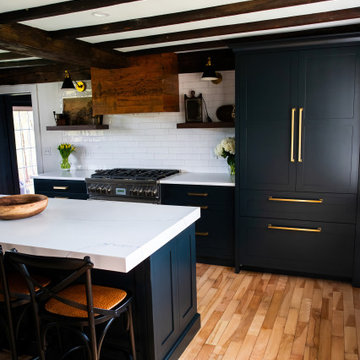
This kitchen renovation thoughtfully blends historic charm with modern functionality in a beautifully preserved 1730s farmhouse. Central to the redesign was the addition of a walk-in pantry, seamlessly integrated to enhance storage while maintaining the home’s vintage character.
At the heart of the kitchen, the original antique slate farm sink was carefully restored and reused, grounding the space with an authentic period touch. The layout was opened up with the addition and strategic relocation of windows, inviting in natural light and offering views of the surrounding landscape.
A reclaimed barn board wood hood anchors the cooking area with rustic warmth, paired with full inset Shaker-style cabinets painted in Benjamin Moore’s “Inkwell” — a deep, moody blue in a soft, dull finish. Countertops in white engineered quartz with navy blue veining offer a crisp contrast and subtle elegance.
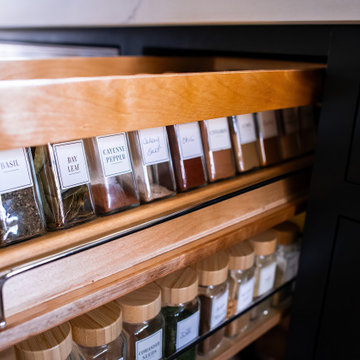
Satin brass hardware and light fixtures add a refined, modern edge, while distressed pine floating shelves bring a casual, lived-in feel that honors the farmhouse’s heritage. The result is a timeless kitchen that celebrates its past while serving the needs of today.
 Steinberg Custom Designs
1730s Farmhouse Kitchen Renovation
This kitchen renovation thoughtfully blends historic charm with modern functionality in a beautifully preserved 1730s farmhouse. Central to the redesign was the addition of a walk-in pantry, seamlessly integrated to enhance storage while maintaining the home’s vintage character.
At the heart of the kitchen, the original antique slate farm sink was carefully restored and reused, grounding the space with an authentic period touch. The layout was opened up with the addition and strategic relocation of windows, inviting in natural light and offering views of the surrounding landscape.
A reclaimed barn board wood hood anchors the cooking area with rustic warmth, paired with full inset Shaker-style cabinets painted in Benjamin Moore’s “Inkwell” — a deep, moody blue in a soft, dull finish. Countertops in white engineered quartz with navy blue veining offer a crisp contrast and subtle elegance.
Satin brass hardware and light fixtures add a refined, modern edge, while distressed pine floating shelves bring a casual, lived-in feel that honors the farmhouse’s heritage. The result is a timeless kitchen that celebrates its past while serving the needs of today.
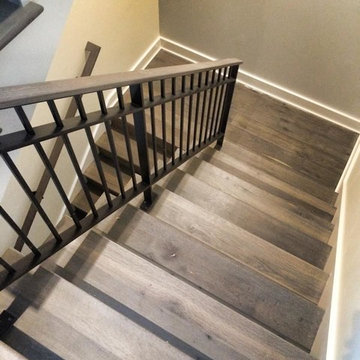 Tom Brzoskwinia
One of the most popular hardwood floor finishing which offers Tom & Peter Flooring is provided by WOCA. If you’ve decided that you want a natural looking wooden floor that is lacquer-free, then the likelihood is that you’ve chosen oil as your way of protecting your wood and making your floor look great at the same time. WOCA for wood flooring comes in various forms and is a great way of making sure that your wood is protected, but at the same time looks natural. A highly popular as well as effective way of treating wood floors, oils effectively penetrate into the wood and in some cases harden into the surface of the floor to stop damage and to maintain the wood in its optimum condition.
WOCA Oil finish hardwood flooring has taken the United States market by in 2014 and shows no signs of slowing down in 2016 and now. Here are some of the most common questions we have regarding this type of finish which we will I’m to answer in today’s my blog:
Is oil finish as durable as traditional factory urethane finishes with aluminum oxide?
When it comes to durability, oil finish flooring tackles the issue with a completely different method. The penetrating oil serves as protection from moisture and wear while allowing the user to feel the wood grains in their bare feet. If compared directly to factory finished aluminum oxide finish, the oil finish flooring will not perform as well to abrasion and impact. However, the beauty of this finish is the fact that it will camouflage any scratches which will inevitably accumulate over time.
Will this finish evaporate over time and will this be harmful for indoor air quality?
Another concern for oil finished floors its effect on indoor air quality. For on-site applications, some varieties suggest several coats which typically require the residents to be out of the home due to mild odors. However, there are factory finished UV-cured or single coat applications which lessen the downtime. Despite the odors produced during the drying process, oil finish floors rank amongst the lowest for VOC (volatile organic compound) emissions. Certain brands even boast true zero VOC. This fact alone makes oil finished floors one of the best options for green building solutions.
“WOCA products are certified by independent laboratories, the German Institute for Biological Building Materials, and are in accordance with DIN–Norm 53–160. WOCA WoodCare Denmark products meet or exceed the most stringent U.S. standards for volatile organic compounds.” –WOCA Oil Finish Manufacture
Does this type of finish require additional maintenance which I am not familiar with?
For weekly cleaning, oiled floors use a special cleaner which contains an oil and soap mixture. After a period of 12-18 months some oil may evaporate causing the wood grains to appear dry. An additional layer of oil can be reapplied to keep the floor looking fresh. Although oil finished floors require more involvement in periodic maintenance in high traffic areas, this maintenance can be done much easier than the equivalent of an onsite sand and refinish.
WOCA Master Color Oil contains pigment, which provides a single-step hardwood floor staining process. Laying down the stain and the finish in one step.
This product comes 14 different colors, from Black to Extra White, and you can mix them freely to create various color palettes that will meet the demands of any job.
Below are some pictures of the finished job…
13