
Search results for "Protected deep freeze" in Home Design Ideas

 Berry Built and Design, inc.
Inspiration for a large rustic master brown tile and porcelain tile porcelain tile freestanding bathtub remodel in Seattle with shaker cabinets, dark wood cabinets, a one-piece toilet, beige walls, an undermount sink and quartz countertops


 CUSTOM METALS INC
This luxurious, custom metal deck railing and spiral staircase overlook an in-ground pool. Contrasted metal color stands out tastefully against the brick home and stamped concrete.
Find the right local pro for your project

 U.S. Frameless Glass Shower Door
Example of a mid-sized classic ceramic tile alcove shower design in Newark with beige walls

 Tile Doctor Ltd
During an inspection for alteration work, this customer from Cheshunt discovered what appeared to be an original encaustic tiled floor under the hallway carpet. Keen to work out what it was, and have it restored, I was asked to pop round and look.
I went over as requested to survey the hallway floor and confirm their suspicions. The carpet had been secured with gripper rods glued onto the floor and that came away easily enough. Underneath, the tiles had been covered with self-levelling cement which had to be carefully scraped away to reveal the tiles.
I ran a test to see if the cement leveller could be easily removed and using a combination of a scraper with Tile Doctor Pro-Clean, I was able to confirm the tiled floor was indeed salvageable. The house was Edwardian, and the tiles had been laid in a classic black and white geometric pattern typical of the period so I suspect the floor was indeed original.
I worked out a quote to restore the whole floor including the removal of the cement, deep cleaning and then sealing the tiles. Without removing all the cement, it would be difficult to price for replacing broken tiles, but I suspected there may be a few as its quite usual for a floor of this age. Keen to have the floor restored we were given the go-ahead and a date scheduled for the work to start.
The first step was to remove all the carpet and gripper rod so we could see the full extent of the self-levelling screed. Once done it was a case of carefully chipping and scraping away to break up the cement until the tiled floor had been fully revealed. Its slow and detailed work but quite rewarding when the tiled floor is finally revealed. The tiles had survived well under the carpet and cement but as suspected a few repairs and replacement would be needed.
With all the cement brushed away work moved onto cleaning which started with a strong dilution of Tile Doctor Pro-Clean applied to the floor and left to soak in for fifteen minutes the scrubbed in with a rotary machine fitted with a Black pad. A lot of soiling is generated from this which is rinsed off with water and extracted with a wet vacuum. The floor was then inspected and the process repeated where required.
The next step was to treat the tiles to an acid wash using Tile Doctor Grout Clean-up. This is applied as before and has several benefits including dissolving the remaining cement residue and neutralising the pH of the floor after the use of Tile Doctor Pro-Clean which is a strong alkaline.
The floor was then inspected and the broken tiles carefully removed so they could be replaced. This is delicate work as lifting a tile can sometimes upset its neighbour and before you know it the size of the work has tripled. Replacement tiles were then cut to fit the existing geometric pattern and secured into place with a rapid set adhesive and grouted in.
Once the replacement tile and grout had set, the floor was given a light clean using Tile Doctor Neutral Tile Cleaner and then left to dry out overnight.
The next day the tiles were sealed using a single coat of Tile Doctor Colour Grow and the followed up with give coats of Tile Doctor Seal & Go. Colour Grow is an impregnator that soaks into the pores of the tile protecting it from within and improving colour, where as Seal and Go adds a nice subtle sheen to the tiles. Both products are breathable which is an important feature with old floors that don’t have a damp proof membrane.
For aftercare I recommended Neutral Tile Cleaner which is a gentle but effective tile cleaning product that won’t damage the sealer.
Robert Voyce
Hertfordshire TIle Doctor

 Water's Edge Outdoor Living
© Javier Guillen Photo
Inspiration for a small timeless side yard stone and rectangular hot tub remodel in Houston
Inspiration for a small timeless side yard stone and rectangular hot tub remodel in Houston
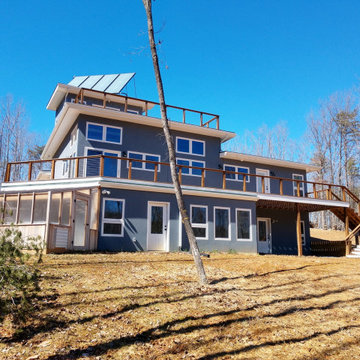
 Øesch Environmental Design
Energy Efficiency:
Every effort has been utilized to reduce and minimize energy use through an effective strategy of both passive heating and cooling, as well as state-of-the-art active solar thermal and photovoltaic on site off-grid energy production. Optimal solar orientation with an attached thermal mass food production greenhouse on the Lower Floor enables hot air to be introduced into the house during the winter, and rise via. a thermal chimney “stack effect” and distributed throughout the house. In the summer the same thermal chimney is used to channel hot air to rise up to the Upper Loft vegetated Roof Terrace, where it is exhausted. This condition provides a positive air pressure in the Winter, and a negative pressure in the summer, drawing in cooler outside air from every open window. In addition carefully proportioned roof eave overhangs provide deep passive solar gain and additional day lighting in the winter, and cooling shade in the summer.
Active mechanical systems include solar thermal which produces domestic hot water and is integrated into hydronic radiant heated floors. This is supplemented with a multi-split heatpump, on demand backup hot water, and an ERV, which collectively provide active heating, cooling, dehumidification, and healthful indoor air quality. The entire house and detached Barn are off-grid with a 14.4 kW solar array, whole-house batteries, and backup generator. Further, the home is super insulated and extremely tight with high energy performing windows and doors and LED lighting throughout, and even a high efficiency woodstove.
Integrated Design:
From the beginning and throughout construction, this home demonstrates a close collaboration between the Architect, Contractor, and Owners. Healthful materials and finishes standards, autonomy and energy efficiency, and environmental impact and sustainability were primary goals and stressed throughout. Careful attention was paid to finishes which will require minimal long term maintenance such as the galvalume metal roof (which also provides for rainwater harvesting) and fiber cement siding for longevity.
Resource Efficiency / Conservation:
Resource conservation began with Schematic Design which utilizes a 2 ft. grid of modular components, thereby optimizing construction efficiency and minimizing on site waste. The site was cleared with the trees stockpiled for future lumber harvesting and firewood. The foundation walls are “Ideal Walls” which use less than half the concrete of a conventional poured wall or block, and do not require extensive concrete footings, exterior insulation, or waterproofing. These panels are prefabricated off site and set in only a few days, which further reduces on site impact and construction lead time.
Resiliency:
Respect for climate change and mitigating its impact were primary considerations in the design and selection of materials and systems. The home is sited high on a south facing slope as protection from high water or flood and to optimize both passive and active solar opportunity. With remarkably tight construction and super insulation the interior is buffered from both outdoor heat and cold extremes. The metal roof and fiber cement siding are fireproof and resistant to the impact of high winds. And these materials are specified for minimal maintenance and longevity. Further, the attached Greenhouse and Upper Roof Terrace is landscaped and suitable for a vegetable garden with abundant sunshine, easy to water, and with no need for fencing to keep deer at bay. All this being a notable case study for Regenerative Design.
Innovation:
This home exemplifies Biophilic Design principles to facilitate symbiotic living in harmony with Nature. This incorporates careful attention to natural day lighting, indoor air quality, rainwater catchment and wastewater reclamation, garden food production with vegetated roofs, the home hearth and fire, and connected interaction with the weather and the surrounding natural ecosystems.
Community Impact:
This EcoHome project has already been presented at several Sustainable Building lectures as a model case study for “Green Building”, including USGBC at Brock Environmental Center in Virginia Beach, VA. Plans are underway for an Open House tour for area Architects and students.
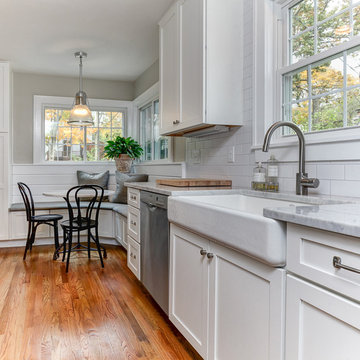
Sponsored
Columbus, OH

Hope Restoration & General Contracting
Columbus Design-Build, Kitchen & Bath Remodeling, Historic Renovations
 Øesch Environmental Design
Energy Efficiency:
Every effort has been utilized to reduce and minimize energy use through an effective strategy of both passive heating and cooling, as well as state-of-the-art active solar thermal and photovoltaic on site off-grid energy production. Optimal solar orientation with an attached thermal mass food production greenhouse on the Lower Floor enables hot air to be introduced into the house during the winter, and rise via. a thermal chimney “stack effect” and distributed throughout the house. In the summer the same thermal chimney is used to channel hot air to rise up to the Upper Loft vegetated Roof Terrace, where it is exhausted. This condition provides a positive air pressure in the Winter, and a negative pressure in the summer, drawing in cooler outside air from every open window. In addition carefully proportioned roof eave overhangs provide deep passive solar gain and additional day lighting in the winter, and cooling shade in the summer.
Active mechanical systems include solar thermal which produces domestic hot water and is integrated into hydronic radiant heated floors. This is supplemented with a multi-split heatpump, on demand backup hot water, and an ERV, which collectively provide active heating, cooling, dehumidification, and healthful indoor air quality. The entire house and detached Barn are off-grid with a 14.4 kW solar array, whole-house batteries, and backup generator. Further, the home is super insulated and extremely tight with high energy performing windows and doors and LED lighting throughout, and even a high efficiency woodstove.
Integrated Design:
From the beginning and throughout construction, this home demonstrates a close collaboration between the Architect, Contractor, and Owners. Healthful materials and finishes standards, autonomy and energy efficiency, and environmental impact and sustainability were primary goals and stressed throughout. Careful attention was paid to finishes which will require minimal long term maintenance such as the galvalume metal roof (which also provides for rainwater harvesting) and fiber cement siding for longevity.
Resource Efficiency / Conservation:
Resource conservation began with Schematic Design which utilizes a 2 ft. grid of modular components, thereby optimizing construction efficiency and minimizing on site waste. The site was cleared with the trees stockpiled for future lumber harvesting and firewood. The foundation walls are “Ideal Walls” which use less than half the concrete of a conventional poured wall or block, and do not require extensive concrete footings, exterior insulation, or waterproofing. These panels are prefabricated off site and set in only a few days, which further reduces on site impact and construction lead time.
Resiliency:
Respect for climate change and mitigating its impact were primary considerations in the design and selection of materials and systems. The home is sited high on a south facing slope as protection from high water or flood and to optimize both passive and active solar opportunity. With remarkably tight construction and super insulation the interior is buffered from both outdoor heat and cold extremes. The metal roof and fiber cement siding are fireproof and resistant to the impact of high winds. And these materials are specified for minimal maintenance and longevity. Further, the attached Greenhouse and Upper Roof Terrace is landscaped and suitable for a vegetable garden with abundant sunshine, easy to water, and with no need for fencing to keep deer at bay. All this being a notable case study for Regenerative Design.
Innovation:
This home exemplifies Biophilic Design principles to facilitate symbiotic living in harmony with Nature. This incorporates careful attention to natural day lighting, indoor air quality, rainwater catchment and wastewater reclamation, garden food production with vegetated roofs, the home hearth and fire, and connected interaction with the weather and the surrounding natural ecosystems.
Community Impact:
This EcoHome project has already been presented at several Sustainable Building lectures as a model case study for “Green Building”, including USGBC at Brock Environmental Center in Virginia Beach, VA. Plans are underway for an Open House tour for area Architects and students.

 Birdseye Design
Inspiration for a mid-sized gray one-story wood gable roof remodel in Burlington with a metal roof

 Sea Green Designs
Shannon Willey
Example of a mid-sized beach style 3/4 porcelain tile bathroom design in New York with white cabinets, a two-piece toilet and multicolored walls
Example of a mid-sized beach style 3/4 porcelain tile bathroom design in New York with white cabinets, a two-piece toilet and multicolored walls

 The Nielsen Collection
Photography by Christi Nielsen
Large trendy formal and open concept ceramic tile living room photo in Dallas with white walls, a standard fireplace, a tile fireplace and no tv
Large trendy formal and open concept ceramic tile living room photo in Dallas with white walls, a standard fireplace, a tile fireplace and no tv


 Scott Mehaffey, landscape architect
Inspiration for a mid-sized mid-century modern partial sun courtyard stone garden path in Chicago for spring.
Inspiration for a mid-sized mid-century modern partial sun courtyard stone garden path in Chicago for spring.
Sponsored
Sunbury, OH

J.Holderby - Renovations
Franklin County's Leading General Contractors - 2X Best of Houzz!

 Colony Pool Service of Delaware, Inc.
Pool was drained and prepped for new tile and resurfacing.
Glass Tile: Valencia
Resurface: Pebble Tec Bead Crete. Color: Sapphire
Pool - mid-sized traditional backyard rectangular lap pool idea in Wilmington
Pool - mid-sized traditional backyard rectangular lap pool idea in Wilmington

 Counter Dimensions
Daniel Lawson, Susan McGee
Example of a large transitional galley medium tone wood floor eat-in kitchen design in Birmingham with an undermount sink, flat-panel cabinets, white cabinets, granite countertops, white backsplash, ceramic backsplash, paneled appliances, gray walls and two islands
Example of a large transitional galley medium tone wood floor eat-in kitchen design in Birmingham with an undermount sink, flat-panel cabinets, white cabinets, granite countertops, white backsplash, ceramic backsplash, paneled appliances, gray walls and two islands

 Raykon Construction
SubZero refrigerator with custom panels
Inspiration for a transitional kitchen remodel in Salt Lake City
Inspiration for a transitional kitchen remodel in Salt Lake City

 cedar ridge design
Custom walk-in pantry. Perfect spot for storing dry goods, appliances, cookbooks, and all of the not often used party essentials.
Cabinets and shelving crafted by Dick Lawrence and Production II ( http://production2.com ), flush mount from Circa Lighting ( https://www.circalighting.com. ) Farrow and Ball Green Smoke beadboard-paneled walls are among the many enviable features of this traditional pantry.
Cabinet hardware - Rejuvenation.com
Sponsored
Sunbury, OH
J.Holderby - Renovations
Franklin County's Leading General Contractors - 2X Best of Houzz!



 safe ZOnea
Every year, the same thing happens. The first real snowfall arrives, demand for de-icing materials spikes overnight, and the businesses that waited too long find themselves scrambling for supply at the worst possible moment. Facility managers, property owners, contractors, and municipalities all depend on a steady supply of salt and ice melt to keep their properties safe and operational through winter. The ones who plan ahead sail through. The ones who don't pay more, wait longer, and take on real risk.
Sourcing de-icing materials well is not complicated, but it does require thinking ahead and understanding the options. The choices you make about what to buy, how to buy it, and who to buy it from have a direct effect on your costs, your reliability, and your ability to keep people safe when conditions turn dangerous. This article lays out what matters.
Why Your Choice of Supplier Matters More Than You Think
It is easy to treat de-icing material as a commodity, something you grab whenever you need it without much thought about where it comes from. That works fine until the moment it doesn't, usually in the middle of a storm when everyone needs supply at once and the casual sources have run dry. At that point, the relationships you built before the season become the difference between staying stocked and being stuck.
Reliable supply is the whole game in winter operations. A property that runs out of ice melt during a storm faces safety hazards, liability exposure, and disruption, none of which can wait for a back-ordered shipment. This is why establishing relationships with dependable rock salt suppliers before the season starts is one of the smartest moves a facility manager or contractor can make. It locks in supply, often locks in better pricing, and removes a major source of mid-winter stress.
The lesson here is to treat sourcing as a planning decision rather than a last-minute errand. The businesses that come through winter smoothly are almost always the ones that secured their supply chain early, chose suppliers who could actually deliver when it counted, and never had to gamble on finding material during a shortage. Reliability bought in advance is far cheaper than scarcity paid for in a crisis.
Bagged or Bulk: Matching the Material to the Job
One of the first practical decisions is whether to buy de-icing material in bags or in bulk, and the right answer depends entirely on the operation. Each format has clear advantages, and many operations end up using both for different purposes.
Bagged material offers convenience, control, and easy storage. It is simple to handle, easy to distribute to different locations or crews, straightforward to store without special equipment, and convenient for spot application by hand. It suits smaller properties, businesses without bulk storage, and situations where portion control and tidiness matter. Bulk material, on the other hand, tends to make sense for large operations that go through high volumes, where buying in quantity lowers the per-unit cost and the operation has the equipment and space to store and handle it. The tradeoff is between the convenience and flexibility of bags and the volume economics of bulk.
For many operations, the right approach is a mix: bulk for the high-volume core of the work and bags for flexibility, spot treatment, and locations where bulk handling is impractical. The key is to match the format to how the material will actually be stored, moved, and applied, rather than defaulting to one or the other out of habit. Thinking this through in advance avoids both the waste of over-buying bulk you can't handle and the expense of relying entirely on bags for a large operation.
Rock Salt Is Not Your Only Option
Rock salt, or sodium chloride, is the workhorse of winter de-icing for good reason. It is effective, widely available, and cost-efficient, which makes it the default choice for most operations most of the time. But it has limits, and understanding the alternatives helps you choose the right material for the conditions you actually face.
The most important limitation is temperature. Rock salt becomes less effective as temperatures drop, and in genuinely cold conditions it can struggle to do the job at all. This is where alternatives come in. Calcium chloride, for instance, works at much lower temperatures than rock salt and acts quickly, which makes it valuable when conditions are severe or when fast melting matters. Operations that face hard freezes or need dependable performance in extreme cold often keep calcium chloride for sale on hand for exactly those situations, using it alongside rock salt rather than instead of it.
The practical approach is to understand the conditions your property faces and stock accordingly. For many operations, rock salt handles the bulk of the work while a faster, colder-rated material like calcium chloride covers the extreme days when ordinary salt falls short. Matching the material to the temperature and the urgency of the situation is what separates an operation that stays ahead of winter from one that is constantly reacting to it.
Securing Your Supply Before the Season
Knowing what to buy is only half the equation. The other half is making sure you can actually get it when you need it, which means securing your supply before winter arrives rather than after it has already started. Timing is one of the most underrated factors in winter operations.
The logic is simple. Demand for de-icing materials is highly seasonal and spikes sharply during storms, when everyone needs supply simultaneously. Prices and availability both move against the buyer at exactly those moments. By contrast, planning ahead, estimating your needs and arranging supply before the season, puts you in a far stronger position. Working with established rock salt suppliers ahead of time means your material is accounted for before the rush, often at better pricing and with the confidence that it will be there when the first storm hits.
This kind of planning also lets you think clearly rather than react under pressure. You can estimate your seasonal needs based on your property and past winters, decide on the right mix of materials and formats, and arrange storage in advance. Operations that do this consistently spend less, worry less, and never find themselves making frantic calls during a storm. The effort of planning ahead is modest, and the payoff in reliability and cost savings is substantial.
Storing and Handling What You Buy
Securing supply is not much use if the material degrades before you can use it, which makes proper storage and handling an important and often overlooked part of the equation. De-icing materials are sensitive to moisture, and poor storage can turn a good supply into a clumped, hardened mess that is difficult to apply.
The fundamentals are straightforward. Keep material dry and protected from moisture, since salt and ice melt readily absorb water and can harden if exposed. Store it in a way that suits the format, whether that means a proper bulk storage area or a dry space for stacked bags. Keep it accessible, so crews can get to it quickly when a storm hits and time is short. And handle it with the right equipment for the format and volume, which protects both the material and the people working with it. None of this is complicated, but neglecting it can undermine even a well-planned supply.
Good storage practices protect the investment you made in securing supply early. There is little point in arranging your materials ahead of the season only to have them degrade before use. Treating storage and handling as part of the overall plan, rather than an afterthought, ensures that the material you secured is actually usable when the moment comes. It is the final link in a supply chain built to perform under winter conditions.
Estimating How Much You Actually Need
One question trips up operations of every size: how much de-icing material to buy. Order too little and you risk running short during a storm. Order too much and you tie up money and storage space in material you may not use. Getting the estimate reasonably right is a meaningful part of sourcing well.
Several factors shape the answer. The size and type of the areas you treat, sidewalks, lots, entrances, and drive lanes, set the baseline for how much material each application consumes. The local climate matters too, since colder regions and those with frequent snowfall go through far more material than milder ones. Application frequency depends on how often storms hit and how quickly surfaces need to be cleared, which varies with the kind of property and the expectations of the people who use it. And the type of material plays a role, since different products are applied at different rates.
Past experience is often the best guide. Operations that track what they used in previous winters, adjusted for the size of the property and the severity of the season, can estimate their needs with reasonable confidence. For newer operations without that history, it helps to plan conservatively and to work with a supplier who can replenish stock reliably, so that a low estimate does not turn into a mid-storm shortage.
The goal is not perfect precision but a sound, slightly cautious estimate paired with a dependable supply relationship. That combination lets an operation keep enough material on hand to handle the season without over-committing to volume it cannot store or use. Thinking this through before winter, rather than guessing during it, is one more way that planning ahead pays off when the snow starts to fall.
The Bottom Line
Sourcing de-icing materials well comes down to a few straightforward principles: plan ahead, choose reliable suppliers before the season, match your materials and formats to your actual needs and conditions, and store what you buy properly. The operations that follow these principles move through winter with confidence, while those that improvise pay more and take on needless risk.
Winter is predictable in one respect: it arrives every year, and demand for de-icing material spikes the moment it does. The businesses that prepare for that reality, rather than being surprised by it, are the ones that keep their properties safe, their costs controlled, and their operations running no matter what the season throws at them. A little foresight before the first snowfall pays off through every storm that follows.

 Kurco Construction, Inc
Inspiration for a large coastal light wood floor open concept kitchen remodel in Jacksonville with granite countertops, blue backsplash, glass tile backsplash and an island
92