
Search results for "Provinces" in Home Design Ideas

 Muna Home
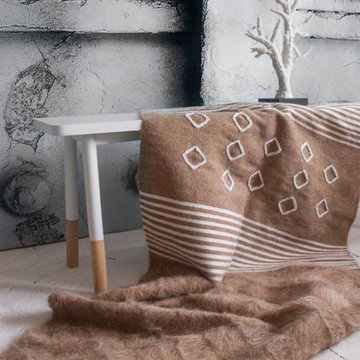
These luxury authentic flat-weave collection represent an ancient method of creating a faux animal hair pile which was widespread amongst nomads from Central Asia to Turkey. Woven with cotton warps and Angora goat hair wefts. The goat hair creates the long haired fur-like look. Angora goats are named after the Turkish province of their origin, Ankara and these goats produce the fibre known as mohair. The lustrous hair of the angora goat occurs in every natural shade ranging from black through browns to white, thus making possible a wide variety of colour-schemes with no dyes.
More about Mohair…
Mohair is one of the oldest textile fibres in use. The Angora goat is thought to originate from the mountains of Tibet, reaching Turkey in the 16th century. Mohair is warm in winter as it has great insulating properties, while remaining cool in summer due to its moisture wicking properties. It’s possible to use double-side, hairy side for winter, woven side for summer. It is durable, naturally elastic, flame resistant, crease resistant, and does not felt.
It is a luxury fiber, like cashmere, angora and silk, and is more expensive than most wools that comes from sheep. Mohair is composed mostly of keratin, a protein found in the hair, wool, horns and skin of all mammals.

 Art by Katy Karnes
Birch Trees, 48" x 48", Original Painting, by Katy Karnes
This is a stunning, elegant feeling painting. It is large enough to fill a wall nicely, behind a couch, above a fireplace or bed. The trees are painted around the sides, so the painting does not need to be framed. Enjoy it for years.
If you like this painting, you may also enjoy these: https://www.etsy.com/shop/ArtByKaty?section_id=15594884&ref=shopsection_leftnav_3
Painted on 1.5" thick gallery canvas.
Extra Large painting of birch trees. Red leaves, hints of silver add depth, tree trunks are textured.
Katy is well known for her uplifting, highly textured, nature inspired art. Katy sells her art in numerous galleries and retail stores in the Maritime provinces of Canada, and the United States. She has also shown her art in New York City. She paints for organizations such as The Atlantic Salmon Federation, The Miramichi Salmon Association.
Katy works closely with interior designers, to create art for both home and corporate environments. Katy's paintings are popular as a gift.
Custom orders are available, any size.
For more information, please visit Katy's website: http://www.artbykaty.ca
Like on Facebook:
Art by Katy Karnes http://www.facebook.com/artbykatykarnes
Find the right local pro for your project
 Muna Home
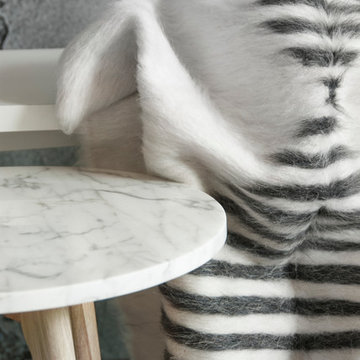
These luxury authentic flat-weave collection represent an ancient method of creating a faux animal hair pile which was widespread amongst nomads from Central Asia to Turkey. Woven with cotton warps and Angora goat hair wefts. The goat hair creates the long haired fur-like look. Angora goats are named after the Turkish province of their origin, Ankara and these goats produce the fibre known as mohair. The lustrous hair of the angora goat occurs in every natural shade ranging from black through browns to white, thus making possible a wide variety of colour-schemes with no dyes.
More about Mohair…
Mohair is one of the oldest textile fibres in use. The Angora goat is thought to originate from the mountains of Tibet, reaching Turkey in the 16th century. Mohair is warm in winter as it has great insulating properties, while remaining cool in summer due to its moisture wicking properties. It’s possible to use double-side, hairy side for winter, woven side for summer. It is durable, naturally elastic, flame resistant, crease resistant, and does not felt.
It is a luxury fiber, like cashmere, angora and silk, and is more expensive than most wools that comes from sheep. Mohair is composed mostly of keratin, a protein found in the hair, wool, horns and skin of all mammals.
 Art by Katy Karnes
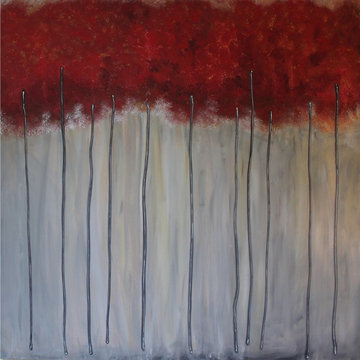
Birch Trees, 48" x 48", Original Painting, by Katy Karnes
This is a stunning, elegant feeling painting. It is large enough to fill a wall nicely, behind a couch, above a fireplace or bed. The trees are painted around the sides, so the painting does not need to be framed. Enjoy it for years.
If you like this painting, you may also enjoy these:
https://www.etsy.com/shop/ArtByKaty?section_id=15594884&ref=shopsection_leftnav_3
Painted on 1.5" thick gallery canvas.
Extra Large painting of birch trees. Red leaves, hints of silver add depth, tree trunks are textured.
Katy is well known for her uplifting, highly textured, nature inspired art. Katy sells her art in numerous galleries and retail stores in the Maritime provinces of Canada, and the United States. She has also shown her art in New York City. She paints for organizations such as The Atlantic Salmon Federation, The Miramichi Salmon Association.
Katy works closely with interior designers, to create art for both home and corporate environments. Katy's paintings are popular as a gift.
Custom orders are available, any size.
For more information, please visit Katy's website:
http://www.artbykaty.ca
Like on Facebook:
Art by Katy Karnes
http://www.facebook.com/artbykatykarnes
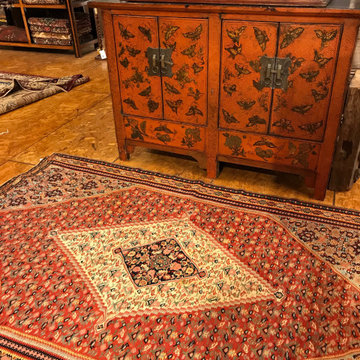
 Santa Barbara Design Center
Circa 1870
4’2" X 6’7"
It has tapestry slit technique
All saturated natural dyes
Preserved in mint conditions
Beautiful rust, ivory, green and salmon
Antique Senneh Kelim masterfully hand made from all natural wool and organic dyes.
This Antique Senneh Killim design carries two different types of tiny Love Birds (Morgh-e-Eshgh) and Fishes (Mahi/Herati). The Mahies are turning around the globe which in Persian history symbolistically is the sigh of stability and peace.
Sanandaj is the capital city of Kurdistan a province located in the western part of Iran. Sanandaj is the today name of Senneh. In carpet context the older name of the city is still used, Senneh.
Rugs from the city of Senneh gives an elegant impression with a fine design and tasteful patterns. The Senneh pattern consists mostly of beautiful Botteh or Herati. This Senneh Kilim is dominated by Herati (Mahi) pattern and burnt sienna, and rear green field color.
Come and see this beautiful Antique Senneh Kelim at the world famous Rugs and More in the Santa Barbara Design Center.
 Muna Home
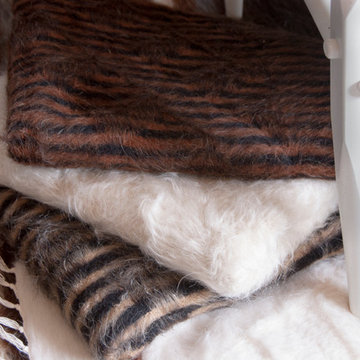
These luxury authentic flat-weave collection represent an ancient method of creating a faux animal hair pile which was widespread amongst nomads from Central Asia to Turkey. Woven with cotton warps and Angora goat hair wefts. The goat hair creates the long haired fur-like look. Angora goats are named after the Turkish province of their origin, Ankara and these goats produce the fibre known as mohair. The lustrous hair of the angora goat occurs in every natural shade ranging from black through browns to white, thus making possible a wide variety of colour-schemes with no dyes.
More about Mohair…
Mohair is one of the oldest textile fibres in use. The Angora goat is thought to originate from the mountains of Tibet, reaching Turkey in the 16th century. Mohair is warm in winter as it has great insulating properties, while remaining cool in summer due to its moisture wicking properties. It’s possible to use double-side, hairy side for winter, woven side for summer. It is durable, naturally elastic, flame resistant, crease resistant, and does not felt.
It is a luxury fiber, like cashmere, angora and silk, and is more expensive than most wools that comes from sheep. Mohair is composed mostly of keratin, a protein found in the hair, wool, horns and skin of all mammals.
 Muna Home
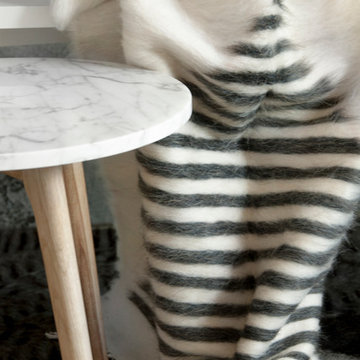
These luxury authentic flat-weave collection represent an ancient method of creating a faux animal hair pile which was widespread amongst nomads from Central Asia to Turkey. Woven with cotton warps and Angora goat hair wefts. The goat hair creates the long haired fur-like look. Angora goats are named after the Turkish province of their origin, Ankara and these goats produce the fibre known as mohair. The lustrous hair of the angora goat occurs in every natural shade ranging from black through browns to white, thus making possible a wide variety of colour-schemes with no dyes.
More about Mohair…
Mohair is one of the oldest textile fibres in use. The Angora goat is thought to originate from the mountains of Tibet, reaching Turkey in the 16th century. Mohair is warm in winter as it has great insulating properties, while remaining cool in summer due to its moisture wicking properties. It’s possible to use double-side, hairy side for winter, woven side for summer. It is durable, naturally elastic, flame resistant, crease resistant, and does not felt.
It is a luxury fiber, like cashmere, angora and silk, and is more expensive than most wools that comes from sheep. Mohair is composed mostly of keratin, a protein found in the hair, wool, horns and skin of all mammals.
 Ngoc Duong Bamboo Architecture
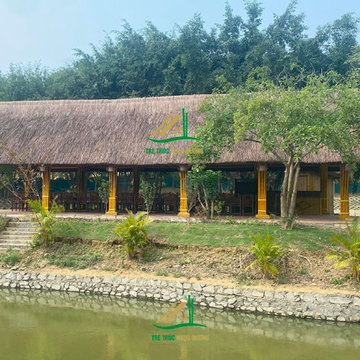
Located not far from the capital city of Hanoi, the beautiful bamboo house project that Tre truc Ngoc Duong proudly presents to our valued customers is the complex of Bamboo Houses, situated in the Khai Quang Industrial Zone, Vinh Yen City, Vinh Phuc Province, VietNam. This project is not only a symbol of creativity and sophistication in bamboo architecture but also an ideal destination for those who love cool, green spaces close to nature. This project was constructed by us in 2022
Situated within a vast garden, the first bamboo house realized by Ngoc Duong Bamboo in this project is located in an extremely prime location, amidst a lake within the spacious grounds of Mr. Tuan and Mrs. Dung’s family. With its unique architecture combining bamboo and thatched roofs (vaulted, tiered), this house creates a friendly and intimate living space close to nature. Meticulously curved bamboo columns combined with thatched roofs create a harmonious and impressive natural picture.
The architecture of the thatched bamboo house in this bamboo house project is meticulously crafted by the talented team of architects at Ngoc Duong Bamboo. Using 12 meticulously curved bamboo column frames, combined with sturdy concrete pillars and unique thatched roofs, these structures not only bring beauty but also ensure the highest level of durability and load-bearing capacity.


 Muna Home
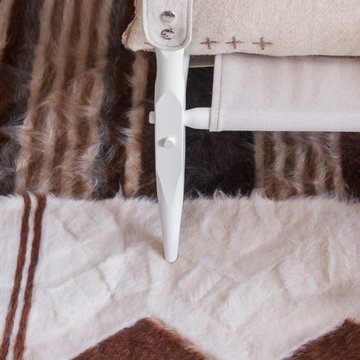
These luxury authentic flat-weave collection represent an ancient method of creating a faux animal hair pile which was widespread amongst nomads from Central Asia to Turkey. Woven with cotton warps and Angora goat hair wefts. The goat hair creates the long haired fur-like look. Angora goats are named after the Turkish province of their origin, Ankara and these goats produce the fibre known as mohair. The lustrous hair of the angora goat occurs in every natural shade ranging from black through browns to white, thus making possible a wide variety of colour-schemes with no dyes.
More about Mohair…
Mohair is one of the oldest textile fibres in use. The Angora goat is thought to originate from the mountains of Tibet, reaching Turkey in the 16th century. Mohair is warm in winter as it has great insulating properties, while remaining cool in summer due to its moisture wicking properties. It’s possible to use double-side, hairy side for winter, woven side for summer. It is durable, naturally elastic, flame resistant, crease resistant, and does not felt.
It is a luxury fiber, like cashmere, angora and silk, and is more expensive than most wools that comes from sheep. Mohair is composed mostly of keratin, a protein found in the hair, wool, horns and skin of all mammals.
 Muna Home
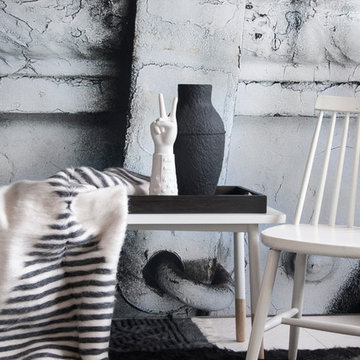
These luxury authentic flat-weave collection represent an ancient method of creating a faux animal hair pile which was widespread amongst nomads from Central Asia to Turkey. Woven with cotton warps and Angora goat hair wefts. The goat hair creates the long haired fur-like look. Angora goats are named after the Turkish province of their origin, Ankara and these goats produce the fibre known as mohair. The lustrous hair of the angora goat occurs in every natural shade ranging from black through browns to white, thus making possible a wide variety of colour-schemes with no dyes.
More about Mohair…
Mohair is one of the oldest textile fibres in use. The Angora goat is thought to originate from the mountains of Tibet, reaching Turkey in the 16th century. Mohair is warm in winter as it has great insulating properties, while remaining cool in summer due to its moisture wicking properties. It’s possible to use double-side, hairy side for winter, woven side for summer. It is durable, naturally elastic, flame resistant, crease resistant, and does not felt.
It is a luxury fiber, like cashmere, angora and silk, and is more expensive than most wools that comes from sheep. Mohair is composed mostly of keratin, a protein found in the hair, wool, horns and skin of all mammals.
 J & J Services
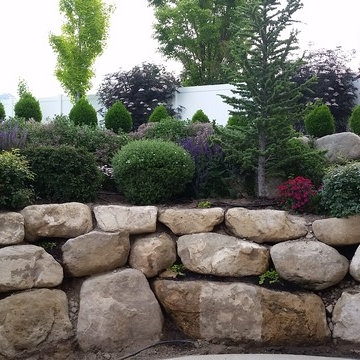
Inspiration for a mid-sized traditional partial sun backyard retaining wall landscape in Salt Lake City.
 Muna Home
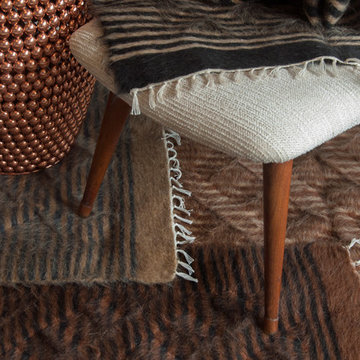
These luxury authentic flat-weave collection represent an ancient method of creating a faux animal hair pile which was widespread amongst nomads from Central Asia to Turkey. Woven with cotton warps and Angora goat hair wefts. The goat hair creates the long haired fur-like look. Angora goats are named after the Turkish province of their origin, Ankara and these goats produce the fibre known as mohair. The lustrous hair of the angora goat occurs in every natural shade ranging from black through browns to white, thus making possible a wide variety of colour-schemes with no dyes.
More about Mohair…
Mohair is one of the oldest textile fibres in use. The Angora goat is thought to originate from the mountains of Tibet, reaching Turkey in the 16th century. Mohair is warm in winter as it has great insulating properties, while remaining cool in summer due to its moisture wicking properties. It’s possible to use double-side, hairy side for winter, woven side for summer. It is durable, naturally elastic, flame resistant, crease resistant, and does not felt.
It is a luxury fiber, like cashmere, angora and silk, and is more expensive than most wools that comes from sheep. Mohair is composed mostly of keratin, a protein found in the hair, wool, horns and skin of all mammals.
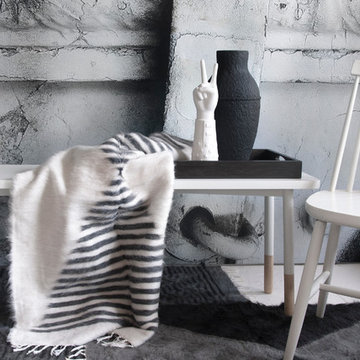 Muna Home
These luxury authentic flat-weave collection represent an ancient method of creating a faux animal hair pile which was widespread amongst nomads from Central Asia to Turkey. Woven with cotton warps and Angora goat hair wefts. The goat hair creates the long haired fur-like look. Angora goats are named after the Turkish province of their origin, Ankara and these goats produce the fibre known as mohair. The lustrous hair of the angora goat occurs in every natural shade ranging from black through browns to white, thus making possible a wide variety of colour-schemes with no dyes.
More about Mohair…
Mohair is one of the oldest textile fibres in use. The Angora goat is thought to originate from the mountains of Tibet, reaching Turkey in the 16th century. Mohair is warm in winter as it has great insulating properties, while remaining cool in summer due to its moisture wicking properties. It’s possible to use double-side, hairy side for winter, woven side for summer. It is durable, naturally elastic, flame resistant, crease resistant, and does not felt.
It is a luxury fiber, like cashmere, angora and silk, and is more expensive than most wools that comes from sheep. Mohair is composed mostly of keratin, a protein found in the hair, wool, horns and skin of all mammals.
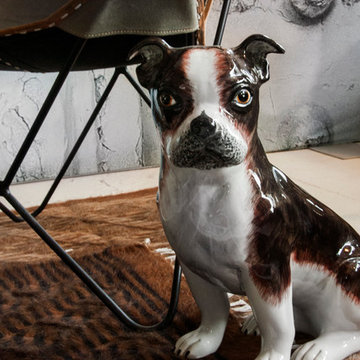 Muna Home
These luxury authentic flat-weave collection represent an ancient method of creating a faux animal hair pile which was widespread amongst nomads from Central Asia to Turkey. Woven with cotton warps and Angora goat hair wefts. The goat hair creates the long haired fur-like look. Angora goats are named after the Turkish province of their origin, Ankara and these goats produce the fibre known as mohair. The lustrous hair of the angora goat occurs in every natural shade ranging from black through browns to white, thus making possible a wide variety of colour-schemes with no dyes.
More about Mohair…
Mohair is one of the oldest textile fibres in use. The Angora goat is thought to originate from the mountains of Tibet, reaching Turkey in the 16th century. Mohair is warm in winter as it has great insulating properties, while remaining cool in summer due to its moisture wicking properties. It’s possible to use double-side, hairy side for winter, woven side for summer. It is durable, naturally elastic, flame resistant, crease resistant, and does not felt.
It is a luxury fiber, like cashmere, angora and silk, and is more expensive than most wools that comes from sheep. Mohair is composed mostly of keratin, a protein found in the hair, wool, horns and skin of all mammals.
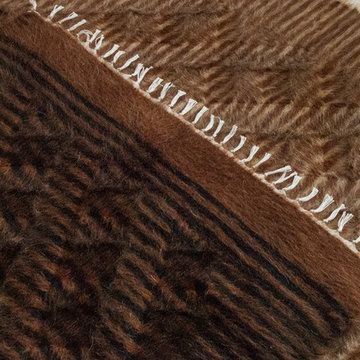 Muna Home
These luxury authentic flat-weave collection represent an ancient method of creating a faux animal hair pile which was widespread amongst nomads from Central Asia to Turkey. Woven with cotton warps and Angora goat hair wefts. The goat hair creates the long haired fur-like look. Angora goats are named after the Turkish province of their origin, Ankara and these goats produce the fibre known as mohair. The lustrous hair of the angora goat occurs in every natural shade ranging from black through browns to white, thus making possible a wide variety of colour-schemes with no dyes.
More about Mohair…
Mohair is one of the oldest textile fibres in use. The Angora goat is thought to originate from the mountains of Tibet, reaching Turkey in the 16th century. Mohair is warm in winter as it has great insulating properties, while remaining cool in summer due to its moisture wicking properties. It’s possible to use double-side, hairy side for winter, woven side for summer. It is durable, naturally elastic, flame resistant, crease resistant, and does not felt.
It is a luxury fiber, like cashmere, angora and silk, and is more expensive than most wools that comes from sheep. Mohair is composed mostly of keratin, a protein found in the hair, wool, horns and skin of all mammals.
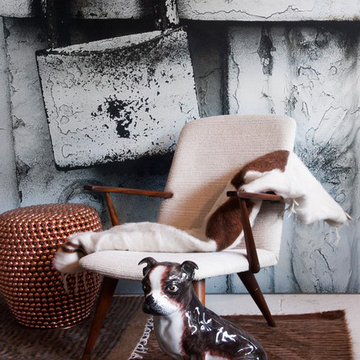 Muna Home
These luxury authentic flat-weave collection represent an ancient method of creating a faux animal hair pile which was widespread amongst nomads from Central Asia to Turkey. Woven with cotton warps and Angora goat hair wefts. The goat hair creates the long haired fur-like look. Angora goats are named after the Turkish province of their origin, Ankara and these goats produce the fibre known as mohair. The lustrous hair of the angora goat occurs in every natural shade ranging from black through browns to white, thus making possible a wide variety of colour-schemes with no dyes.
More about Mohair…
Mohair is one of the oldest textile fibres in use. The Angora goat is thought to originate from the mountains of Tibet, reaching Turkey in the 16th century. Mohair is warm in winter as it has great insulating properties, while remaining cool in summer due to its moisture wicking properties. It’s possible to use double-side, hairy side for winter, woven side for summer. It is durable, naturally elastic, flame resistant, crease resistant, and does not felt.
It is a luxury fiber, like cashmere, angora and silk, and is more expensive than most wools that comes from sheep. Mohair is composed mostly of keratin, a protein found in the hair, wool, horns and skin of all mammals.
 Muna Home
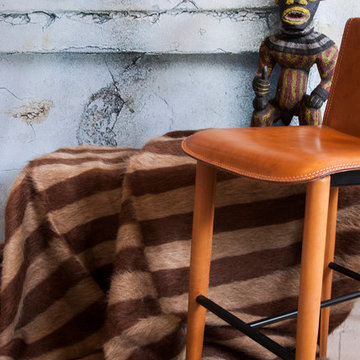
These luxury authentic flat-weave collection represent an ancient method of creating a faux animal hair pile which was widespread amongst nomads from Central Asia to Turkey. Woven with cotton warps and Angora goat hair wefts. The goat hair creates the long haired fur-like look. Angora goats are named after the Turkish province of their origin, Ankara and these goats produce the fibre known as mohair. The lustrous hair of the angora goat occurs in every natural shade ranging from black through browns to white, thus making possible a wide variety of colour-schemes with no dyes.
More about Mohair…
Mohair is one of the oldest textile fibres in use. The Angora goat is thought to originate from the mountains of Tibet, reaching Turkey in the 16th century. Mohair is warm in winter as it has great insulating properties, while remaining cool in summer due to its moisture wicking properties. It’s possible to use double-side, hairy side for winter, woven side for summer. It is durable, naturally elastic, flame resistant, crease resistant, and does not felt.
It is a luxury fiber, like cashmere, angora and silk, and is more expensive than most wools that comes from sheep. Mohair is composed mostly of keratin, a protein found in the hair, wool, horns and skin of all mammals.
 ARTifacts/Shanghai Green Antiques
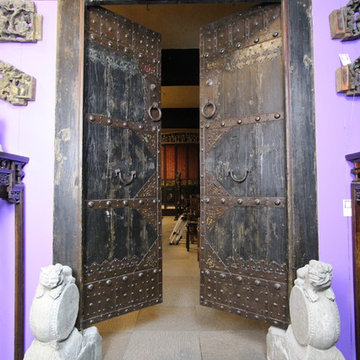
Extraordinary Chinese Antique Doors ( Late Qing Dynasty ). Set of 4. Material: Fir; Origin: Zhejiang province; Size ( cm ): L 52, W 6, H 320
GREEN ANTIQUES holds one of the largest collections of Chinese antique doors in the world, including literally thousands of sets of antique Chinese folding screens, room dividers, temple doors, courtyard entrance gates, courtyard doors, village gates, entrance doors, interior doors and every other shape and style of door imaginable.
GREEN ANTIQUES is one of China's largest antiques shop, with a 100,000 sq.ft. showroom containing thousands of Chinese antique cabinets; interior and exterior courtyard doors; windows; carvings; tables; chairs; beds; wood and stone Buddhist, Taoist, Animist, and other statues; corbels, ceilings, beams and other architectural elements; horse carts; stone hitching posts; ancestor portraits and Buddhist / Taoist paintings; ancient shrines, thrones and wedding palanquins; antique embroidery, purses and hats from many of the 56 minority tribes of China; and a large collection of boxes, baskets, chests, pots, vases and other items.
The GREEN ANTIQUES design and development team have designed, built and remodeled dozens of high end homes in China and the United States, each and every one loaded with antique Chinese architectural elements, statues and furniture. They would be happy to help you to achieve your design goals.
32