
Search results for "Rabbits" in Home Design Ideas


 Flemming Interiors
This bathroom was carefully thought-out for great function and design for 2 young girls. We completely gutted the bathroom and made something that they both could grow in to. Using soft blue concrete Moroccan tiles on the floor and contrasted it with a dark blue vanity against a white palette creates a soft feminine aesthetic. The white finishes with chrome fixtures keep this design timeless.
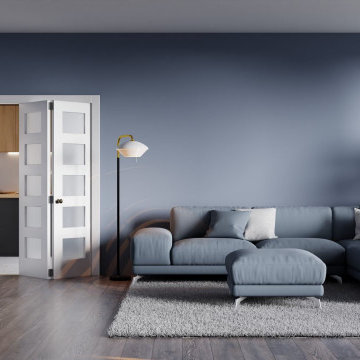
 Almesedoors
FINISH: PRIMED
The advantages of this approach – of this type of interior door finish – are fairly obvious. Pick a color, any color that suits your projects best. Mix and apply. Re- coat whenever you feel it is necessary to do so. Touch it up. It gives you, the proud owner of these interior doors, complete freedom of choice, and the significant savings, especially where it comes to bulk orders, can be a true source of joy.
As Kurt Vonnegut mentions in one of his novels (Bluebeard, unless I’m mistaken … check it out when you get a chance), the thrill of laying on colors is a large part of the artist’s professional satisfaction. In other words, a keen pleasure.
When back in the remote past visual arts became a field dominated by professionals rather than hobbyists, the main problem of “just laying on paint” became obvious: you can’t.
The medium of choice back then was egg tempera, a permanent, fast-drying substance consisting of colored pigments mixed with a water-soluble binder medium, usually glutinous material such as egg yolk. Portraits and ornaments were executed in this medium, and the wood panel was the surface of choice. One of tempera’s interesting features is that it is not as easily absorbed by wood as other mediums. Some sort of primer was necessary, of course, but pretty much any substance that dried evenly could be used.
The drawbacks of tempera, or pintura al temple, as the Spanish call it, only became obvious with the advent of the Renaissance, when the leading representatives of the trade turned to oil (and interior doors suddenly became a great deal less crude, but that’s a story for another day).
Oil painting is the process of “painting with pigments with a medium of drying oil as the binder.” Commonly used types include linseed (highly preferable in art, though not necessarily in interior doors, mind you), poppy seed, walnut, and safflower.
Today, five hundred years later, it is safe to say that oil is more versatile than pintura al temple – by orders of magnitude. Specifically, the contrasts achieved through the former are much greater, the darks are far deeper, and three- dimensional, highly realistic images are much easier to achieve. Next time you visit a museum, take a closer look at pintura al temple portraits. All of them, without exception, come off as a bit “flat” as opposed to their latter-day counterparts.
Also, where glazing is concerned …
Glazing: a painting technique in which a transparent layer, with just a touch of pigment, is laid over a previously painted surface, allowing light to travel through the glaze and be reflected back off of the opaque layer below. Gentle shadows, subtle changes of color, smooth transitions – all these can be achieved through glazing, which was used by all artists up until the middle of the Nineteenth Century, when artist tubes were invented, revolutionizing the field, and other techniques began to be explored.
Tempera enthusiasts (it takes all kinds to make a world) will assure you that glazing is not just possible in pintura al temple but is actually the basis of the whole enterprise. Well, what are you going to do? They’re enthusiasts.
Anyway, la peinture à l'huile, as the French call it, re-introduced the ancient problem of most surface’s propensity to absorb dipingere, as the Italians call the stuff. Wood or canvas, it is all the same: you’re not going to get very far without a good primer.
Experiments were conducted, and soon rabbit skin glue emerged as the least expensive and most effective solution. It was easy to apply. It dried evenly. It made the application of the l’huile stuff on top of it a walk in the park.
There were drawbacks. Today, rabbit skin glue is considered to be a major cause of cracking by most modern conservators. (Remember, when you visited the Metropolitan Museum of Art – and did you see those interior doors? … some of them are quite something … - most “old masters” pictures are completely covered with a cobweb of cracks? There you go). Because the glue is hygroscopic, it continually absorbs moisture from the atmosphere, causing the glue to swell and shrink as ambient humidity levels change. Over many humidity cycles, this repeated flexing causes the brittle oily layers to crack.
To combat this problem, modern primers are made of acrylic materials which are guaranteed not to cause any damage to the dipingere. No bubbling, no cracks. Your interior doors are safe.
Find the right local pro for your project


 Le jardinet
Blue flowers of Ajuga repens 'Catlin's Giant' in spring
Le jardinet
Design ideas for a traditional landscaping in Seattle.
Design ideas for a traditional landscaping in Seattle.

 Village Home Stores
Full-overlay Rustic Beech cabinets in the "Charleston" door style and "Briarwood" finish.
Village Home Stores
Example of a large mountain style kitchen design in Chicago
Example of a large mountain style kitchen design in Chicago

 Charmean Neithart Interiors
www.erikabiermanphotography.com
Inspiration for a large mediterranean guest medium tone wood floor bedroom remodel in Los Angeles with beige walls
Inspiration for a large mediterranean guest medium tone wood floor bedroom remodel in Los Angeles with beige walls

 Ashley Martin Home
Bedroom - large transitional master light wood floor and brown floor bedroom idea in Orlando with white walls, a standard fireplace and a tile fireplace

 Missouri Botanical Garden
Courtesy Missouri Botanical Garden PlantFinder
Wild type of Hydrangea arborescens. Note the flowers are smaller and essentially all of them are fertile, there may be one a few of the large sterile florets in this image.

 Redhead Design
Light filled coastal living and dining rooms in blue, white, and coral color palette. Stephanie London Photography
Living room - mid-sized transitional open concept medium tone wood floor living room idea in Baltimore with gray walls, no fireplace and no tv
Living room - mid-sized transitional open concept medium tone wood floor living room idea in Baltimore with gray walls, no fireplace and no tv


 OSMOND DESIGNS
Master bedroom by Osmond Designs.
Small transitional guest carpeted bedroom photo in Salt Lake City with gray walls and no fireplace
Small transitional guest carpeted bedroom photo in Salt Lake City with gray walls and no fireplace


 Hanneman Design
John Hanneman
This is an example of a mid-sized mediterranean drought-tolerant and partial sun backyard brick garden path in San Francisco.
This is an example of a mid-sized mediterranean drought-tolerant and partial sun backyard brick garden path in San Francisco.

 L Star Murals
Custom hand painted Animal Constellation nursery mural in Los Angeles, CA
Nursery - contemporary nursery idea in Los Angeles
Nursery - contemporary nursery idea in Los Angeles

 Pink Door Designs
Living room outfitted by Bernhardt and West Elm furnishings with concrete end tables, black and white pillow accents and area rug with natural wood lamps for nice accent light. Cast Stone fireplace surround with sphere balls.


 Sunrise Design LLC
Large elegant l-shaped enclosed kitchen photo with an undermount sink, recessed-panel cabinets, green cabinets, quartz countertops, black appliances, an island and beige countertops

 User
The Cleome plant, also called the Spider Flower (Cleomaceae) is heat and drought resistant. It is also deer proof with a sticky stem and numerous pods far reaching on all sides. Deer HATE them. Hummingbirds, on the other hand, love them and they come in many lovely colors. With luck, you will have this plant from late June through September/early October in zones 6B. A bonus is that it also seeds. This photo is from a seedling from the year before. Totally awesome!

 Vernon Wentz
This is a wonderful lap pool that has a taste of modern with the clean lines and cement cabana that also has a flair of the rustic with wood beams and a hill country stone bench. It also has a simple grass lawn that has very large planters as signature statements to once again give it a modern feel. Photography by Vernon Wentz of Ad Imagery
95