
Search results for "Real human" in Home Design Ideas
 Envision Web
Stuart Wade, Envision Virtual Tours
The second-largest and most developed of Georgia's barrier islands, St. Simons is approximately twelve miles long and nearly three miles wide at its widest stretch (roughly the size of Manhattan Island in New York). The island is located in Glynn County on Georgia's coast and lies east of Brunswick (the seat of Glynn County), south of Little St. Simons Island and the Hampton River, and north of Jekyll Island. The resort community of Sea Island is separated from St. Simons on the east by the Black Banks River. Known for its oak tree canopies and historic landmarks, St. Simons is both a tourist destination and, according to the 2010 U.S. census, home to 12,743 residents.
Early History
The earliest
St. Simons Island Village
record of human habitation on the island dates to the Late Archaic Period, about 5,000 to 3,000 years ago. Remnants of shell rings left behind by Native Americans from this era survive on many of the barrier islands, including St. Simons. Centuries later, during the period known by historians as the chiefdom era, the Guale Indians established a chiefdom centered on St. Catherines Island and used St. Simons as their hunting and fishing grounds. By 1500 the Guale had established a permanent village of about 200 people on St. Simons, which they called Guadalquini.
Beginning in 1568, the Spanish attempted to create missions along the Georgia coast. Catholic missions were the primary means by which Georgia's indigenous Native American chiefdoms were assimilated into the Spanish colonial system along the northern frontier of greater Spanish Florida. In the 1600s St. Simons became home to two Spanish missions: San Buenaventura de Guadalquini, on the southern tip of the island, and Santo Domingo de Asao (or Asajo), on the northern tip. Located on the inland side of the island were the pagan refugee villages of San Simón, the island's namesake, and Ocotonico. In 1684 pirate raids left the missions and villages largely abandoned.
Colonial History
As
Fort Frederica
early as 1670, with Great Britain's establishment of the colony of Carolina and its expansion into Georgia territory, Spanish rule was threatened by the English. The Georgia coast was considered "debatable land" by England and Spain, even though Spain had fully retreated from St. Simons by 1702. Thirty-one years later General James Edward Oglethorpe founded the English settlement of Savannah. In 1736 he established Fort Frederica, named after the heir to the British throne, Frederick Louis, prince of Wales, on the west side of St. Simons Island to protect Savannah and the Carolinas from the Spanish threat.
Between 1736 and 1749 Fort Frederica was the hub of British military operations along the Georgia frontier. A town of the same name grew up around the fort and was of great importance to the new colony. By 1740 Frederica's population was 1,000. In 1736 the congregation of what would become Christ Church was organized within Fort Frederica as a mission of the Church of England. Charles Wesley led the first services. In 1742 Britain's decisive victory over Spain in the Battle of Bloody Marsh, during the War of Jenkins' Ear, ended the Spanish threat to the Georgia coast. When the British regimen disbanded in 1749, most of the townspeople relocated to the mainland. Fort Frederica went into decline and, except for a short time of prosperity during the 1760s and 1770s under the leadership of merchant James Spalding, never fully recovered. Today the historic citadel's tabby ruins are maintained by the National Park Service.
Plantation Era
By the start of the American Revolution (1775-83), Fort Frederica was obsolete, and St. Simons was left largely uninhabited as most of its residents joined the patriot army. Besides hosting a small Georgia naval victory on the Fort Frederica River, providing guns from its famous fort for use at Fort Morris in Sunbury, and serving as an arena for pillaging by privateers and British soldiers, the island played almost no role in the war.
Following the war, many of the townspeople, their businesses destroyed, turned to agriculture. The island was transformed into fourteen cotton plantations after acres of live oak trees were cleared for farm land and used for building American warships, including the famous USS Constitution, or "Old Ironsides." Although rice was the predominant crop along the neighboring Altamaha River, St. Simons was known for its production of long-staple cotton, which soon came to be known as Sea Island cotton.
Between
Ebos Landing
the 1780s and the outbreak of the Civil War (1861-65), St. Simons's plantation culture flourished. The saline atmosphere and the availability of cheap slave labor proved an ideal combination for the cultivation of Sea Island cotton. In 1803 a group of Ebo slaves who survived the Middle Passage and arrived on the west side of St. Simons staged a rebellion and drowned themselves. The sacred site is known today as Ebos Landing.
One of the largest owners of land and slaves on St. Simons was Pierce Butler, master of Hampton Point Plantation, located on the northern end of the island. By 1793 Butler owned more than 500 slaves, who cultivated 800 acres of cotton on St. Simons and 300 acres of rice on Butler's Island in the Altamaha River delta. Butler's grandson, Pierce Mease Butler, who at the age of sixteen inherited a share of his grandfather's estate in 1826, was responsible for the largest sale of human beings in the history of the United States: in 1859, to restore his squandered fortune, he sold 429 slaves in Savannah for more than $300,000. The British actress and writer Fanny Kemble, whose tumultuous marriage to Pierce ended in divorce in 1849, published an eyewitness account of the evils of slavery on St. Simons in her book Journal of a Residence on a Georgian Plantation in 1838-1839 (1863).
Another
Retreat Plantation
large owner of land and slaves on St. Simons was Major William Page, a friend and employee of Pierce Butler Sr. Before purchasing Retreat Plantation on the southwestern tip of the island in 1804, Page managed the Hampton plantation and Butler's Island. Upon Page's death in 1827, Thomas Butler King inherited the land together with his wife, Page's daughter, Anna Matilda Page King. King expanded his father-in-law's planting empire on St. Simons as well as on the mainland, and by 1835 Retreat Plantation alone was home to as many as 355 slaves.
The center of life during the island's plantation era was Christ Church, Frederica. Organized in 1807 by a group of island planters, the Episcopal church is the second oldest in the Diocese of Georgia. Embargoes imposed by the War of 1812 (1812-15) prevented the parishioners from building a church structure, so they worshiped in the home of John Beck, which stood on the site of Oglethorpe's only St. Simons residence, Orange Hall.
The first Christ Church building, finished on the present site in 1820, was ruined by occupying Union troops during the Civil War. In 1884 the Reverend Anson Dodge Jr. rebuilt the church as a memorial to his first wife, Ellen. The cruciform building with a trussed gothic roof and stained-glass windows remains active today as Christ Church.
Civil War and Beyond
The
St. Simons Island Lighthouse
outbreak of the Civil War in 1861 put a sudden end to St. Simons's lucrative plantation era. In January of that year, Confederate troops were stationed at the south end of the island to guard the entrance to Brunswick Harbor. Slaves from Retreat Plantation, owned by Thomas Butler King, built earthworks and batteries. Plantation residents were scattered—the men joined the Confederate army and their families moved to the mainland. Cannon fire was heard on the island in December 1861, and Confederate troops retreated in February 1862, after dynamiting the lighthouse to keep its beacon from aiding Union troops. Soon thereafter, Union troops occupied the island, which was used as a camp for freed slaves. By August 1862 more than 500 former slaves lived on St. Simons, including Susie King Taylor, who organized a school for freed slave children. But in November the ex-slaves were taken to Hilton Head, South Carolina, and Fernandina, Florida, leaving the island abandoned.
After the Civil War the island never returned to its status as an agricultural community. The plantations lay dormant because there were no slaves to work the fields. After Union general William T. Sherman's January 1865 Special Field Order No. 15 —a demand that former plantations be divided and distributed to former slaves—was overturned by U.S. president Andrew Johnson less than a year later, freedmen and women were forced to work as sharecroppers on the small farms that dotted the land previously occupied by the sprawling plantations.
By
St. Simons Lumber Mills
1870 real economic recovery began with the reestablishment of the timber industry. Norman Dodge and Titus G. Meigs of New York set up lumber mill operations at Gascoigne Bluff, formerly Hamilton Plantation. The lumber mills provided welcome employment for both blacks and whites and also provided mail and passenger boats to the mainland. Such water traffic, together with the construction of a new lighthouse in 1872, designed by architect Charles B. Cluskey, marked the beginning of St. Simons's tourism industry. The keeper of the lighthouse created a small amusement park, which drew many visitors, as did the seemingly miraculous light that traveled from the top of the lighthouse tower to the bottom. The island became a summer retreat for families from the mainland, particularly from Baxley, Brunswick, and Waycross.
The island's resort industry was thriving by the 1880s. Beachfront structures, such as a new pier and grand hotel, were built on the southeastern end of the island and could be accessed by ferry. Around this time wealthy northerners began vacationing on the island.
Twentieth Century
The
St. Simons Island Pier and Village
opening in 1924 of the Brunswick–St. Simons Highway, today known as the Torras Causeway, was a milestone in the development of resorts in the area. St. Simons's beaches were now easily accessible to locals and tourists alike. More than 5,000 automobiles took the short drive from Brunswick to St. Simons via the causeway on its opening day, paving the way for convenient residential and resort development.
In 1926 automotive pioneer Howard Coffin of Detroit, Michigan, bought large tracts of land on St. Simons, including the former Retreat Plantation, and constructed a golf course, yacht club, paved roads, and a residential subdivision. Although the causeway had brought large numbers of summer people to the island, St. Simons remained a small community with only a few hundred permanent residents until the 1940s.
The
St. Simons Island
outbreak of World War II (1941-45) brought more visitors and residents to St. Simons. Troops stationed at Jacksonville, Florida; Savannah; and nearby Camp Stewart took weekend vacations on the island, and a new naval air base and radar school became home to even more officers and soldiers. The increased wartime population brought the island its first public school. With a major shipyard for the production of Liberty ships in nearby Brunswick, the waters of St. Simons became active with German U-boats. In April 1942, just off the coast, the Texas Company oil tanker S. S. Oklahoma and the S. S. Esso Baton Rouge were torpedoed by the Germans, bringing the war very close to home for island residents.
Due in large part to the military's improvement of the island's infrastructure during the war, development on the island boomed in the 1950s and 1960s. More permanent homes and subdivisions were built, and the island was no longer just a summer resort but also a thriving community. In 1950 the Methodist conference and retreat center Epworth by the Sea opened on Gascoigne Bluff. In 1961 novelist Eugenia Price visited St. Simons and began work on her first works of fiction, known as the St. Simons Trilogy. Inspired by real events on the island, Price's trilogy renewed interest in the history of Georgia's coast, and the novelist herself relocated to the island in 1965 and lived there for thirty-one years. St. Simons is also home to contemporary Georgia writer Tina McElroy Ansa.
Since
Epworth by the Sea
1980 St. Simons's population has doubled. The island's continued status as a vacation destination and its ongoing development boom have put historic landmarks and natural areas at risk. While such landmarks as the Fort Frederica ruins and the Battle of Bloody Marsh site are preserved and maintained by the National Park Service, and while the historic lighthouse is maintained by the Coastal Georgia Historical Society, historic Ebos Landing has been taken over by a sewage treatment plant.
Several coastal organizations have formed in recent years to save natural areas on the island. The St. Simons Land Trust, for example, has received donations of large tracts of land and plans to protect property in the island's three traditional African American neighborhoods. Despite its rapid growth and development, St. Simons remains one of the most beautiful and important islands on the Georgia coast.
 Sierra Living Concepts Inc
Dimension:
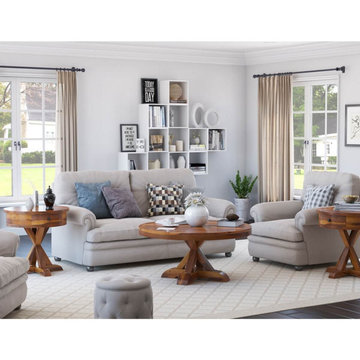
Coffee Table: 40" L X 40" D X 19" H
End Table: 24" L X 24" D X 24" H
Round, rustic and gorgeous, our Floreo Solid Wood 3 Piece Round Coffee Table Set is definitely one of a kind.
Comprising of a round coffee table and 2 matching end tables with drawers – both handcrafted from 100% solid Rosewood – this coffee table set features an unusual aesthetic. The bright, natural finish lends it a rustic edge while the circular table tops set them apart from typical contemporary living room furniture. With its sturdy craftsmanship and an excellent heirloom quality, the cross-legged underside of this coffee table set is another one of its defining qualities. The end tables have one drawer each that has been built into the front of the circular table tops. The overall effect of its design is absolutely stunning and distinct.
Lasting impressions aside, this 3 piece coffee table set is also complemented with an amazing visual versatility. It has the ability to be set up in a number of unique interior design styles. You’ll definitely be able to pair it up with traditional, transitional, rustic and even contemporary style interior designs!
Special Features:
• 100% Handcrafted
• Solid Rosewood craftsmanship
• Rustic style design
• Round coffee table
• 2 end tables with one drawer each
• Cross-legged table design
• Smooth rustic finish
• Heirloom quality
• Visually versatile
• Easy maintenance and cleaning
Note: Real wood is a product of nature, and as such, no two pieces are alike. Variations in solid wood grain patterns are to be expected and make each furniture uniquely beautiful, just like us humans.
 Sierra Living Concepts Inc
Dimension:
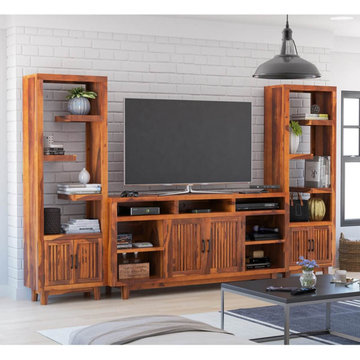
124"L X 14"D X 76"H
Looking for a change from the traditional flimsy media stands? Our Fowlerton Solid Wood Entertainment Center with Bookshelves is just the change up your home ensemble needs, touting a rich, multi-grain aesthetic with robust solid wood construction!
This streamlined wooden entertainment center is the perfect solution for all of your media accoutrements. Flanked by stylish contemporary alternating open shelved bookcases, this rustic media unit is a fine place to display your book collections, DVDs, or decor paraphernalia. Two small cabinets at the base of each bookshelf offer extra storage for items you'd rather tuck out of sight, such as game controllers or spare cords. The main media unit is perfectly sturdy and ready to accommodate your flat screen TV, while beneath is an array of open shelving for your DVD and other media players. Two larger cabinet doors with shelves up the storage capacity to hold more substantial etceteras neatly behind closed doors.
Richly grained in a natural finish, this gorgeous solid rosewood entertainment center is a glorious focal point to any room of the house. It is handcrafted using the finest old world woodworking techniques and tools to assure the high standards and timeless beauty of treasured antique furniture, but with a more contemporary appeal and purpose.
Special Features:
• 100% Handcrafted
• Made of solid wood
• Natural, multi-grain finish
• Two bookshelves with alternating open shelves and cabinet storage
• Media unit with seven shelves and cabinet storage
• Black metal handles and hardware
• A beautiful piece for your flat screen TV, collectibles, and decor pieces
• A rustic transitional piece with contemporary functionality
Note: Real wood is a product of nature, and as such, no two pieces are alike. Variations in solid wood grain patterns are to be expected and make each furniture uniquely beautiful, just like us humans.
Find the right local pro for your project
 Sierra Living Concepts Inc
Dimension:
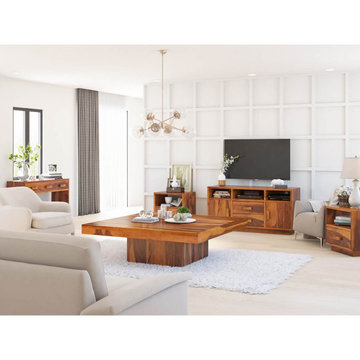
Coffee Table: 55"L X 55"D X 18"H
End Table (Set of 2): 22"L X 18"D X 22"H
Media Console: 54"L X 18"D X 27"H
Console Tables: 44"L X 15"D X 30"H
The Brocton Rustic Solid Wood 5 Piece Living Room Set includes a square coffee table, console table, media console cabinet and two end tables. All pieces in the set are expertly handcrafted from solid wood. Hand joinery and hand applied finishes on each piece offer an additional level of charm. This living room set fits nicely in both rustic and modern settings and with fabric or leather living room furniture.
The pedestal base square coffee table makes a lovely centerpiece with large top ideal for holding an impromptu dinner or playing games. The twin 2-tier end tables with platform base can hold lamps and drink close at hand with open cubby under the top and drawer below. The 2-tier console table has three drawers and open lower shelf with ample top surface for holding decorative items or lighting. The media console boasts 3 cubbies, 2 drawers, and a wide top so the TV can sit on top of the cabinet or be hung on the wall to allow for decorative items.
Special Features:
• 100% Handcrafted using solid wood
• 5 -pieces for full functionality
• Works nicely with other modern or rustic style elements
• 2 tier designed console with 3 drawers
• 2 end tables with two tiers each
• Platform bases on all pieces
• Sleek styling with contemporary edge
• 1-year warranty
Note: Real wood is a product of nature, and as such, no two pieces are alike. Variations in solid wood grain patterns are to be expected and make each furniture uniquely beautiful, just like us humans.
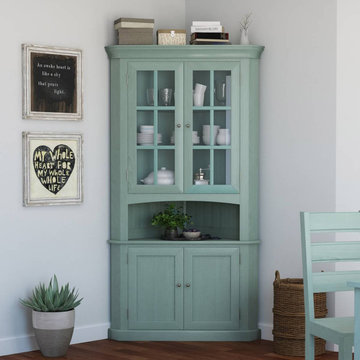 Sierra Living Concepts Inc
Dimension:
46"L X 25"D X 83"H
Let the enchanting presence of our Bremerton Solid Mahogany Wood Blue Corner Hutch with Glass Doors be the inspiration for your home.
This blue corner hutch is a remarkable work of craftsmanship with an absolutely charming charisma that will brighten the mood of any room in which it is stationed. There is a nice balance of closed and open storage in addition to a glass-front display for showing off your heirloom china or other collections. At the base of the hutch is a double door cabinet that reveals interior shelving for stashing anything from off-season decor to extra dishes for easy in-a-pinch entertaining. The open middle shelf is perfect for setting out a tea caddy or a peaceful scene with plants and a fruit bowl. The upper portion of the hutch is fitted with two paneled glass front cabinet doors with interior shelving in which to arrange an organized presentation of your most favored pieces. The top is trimmed in beautiful molding, with a flat top that can further be utilized to stash a tidy stack of heirloom cookbooks, decorative boxes, or other cherished curios.
This mahogany wood dining corner hutch is artistically handcrafted in the Old World style and technique of woodworking to bring your household an heirloom prestige.
Special Features:
• 100% Handcrafted, Dining Room Corner Hutch
• Made of solid mahogany wood
• Base cabinet with interior shelving
• Open middle shelf
• Glass-front cabinet with interior shelving
• Beautiful trimwork detail
• Heirloom quality
Note: Our furniture is made of solid wood (not wood veneer over plywood). It is handcrafted by Master Artisans. Real wood is a product of nature, and as such, no two pieces are alike. Variations in solid wood grain patterns are to be expected and make each furniture uniquely beautiful, just like us humans.
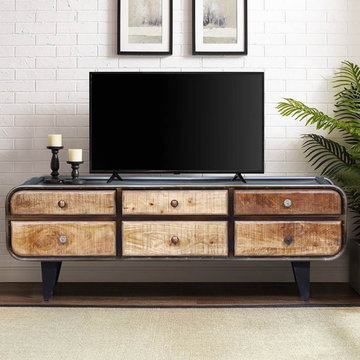 Sierra Living Concepts Inc
Dimension:
55" L X 16" D X 21" H
If you’re a fan of the retro-industrial aesthetic, then you’ll definitely appreciate the unique visuals of our Varnamtown Reclaimed Wood & Iron Industrial TV Media Console.
The compact body, edgy appeal, and effortless grace of this media console sets it apart from the rest. But what’s even better is that it has been handcrafted and assembled out of a sturdy combination of iron and solid reclaimed wood. So at the end of the day, it not only warrants an amazing heirloom quality but is also eco-friendly to boot.
The design and make of our wood and iron media console is very distinct. It features the best of metal accents on distressed wood. It starts with a horizontally oriented body with round edges. You can place your LCD screen or other decorative items on the top surface. The main façade consists of 6 pullout drawers whose edges have been filigreed with iron bands. You can place a number of items here, including but not limited to extra wires, small speakers, magazines, remotes, and more. The tapered feet at all four corners provide excellent support and complement the overall design beautifully.
Special Features:
• 100% handcrafted
• Solid reclaimed wood and iron craftsmanship
• Artfully distressed finish
• Compact body with round edges
• 6 pullout drawers with iron filigree
• Tapered feet
• Heirloom quality
• Visually versatile
• Easy maintenance
Note: Custom Options such as Size, Shape, Shade & Design are not applicable to this item. Furniture is subjected to have Slight Variations. Real wood is a product of nature, and as such, no two pieces are alike. Variations in solid wood grain patterns are to be expected and make each furniture uniquely beautiful, just like us humans.
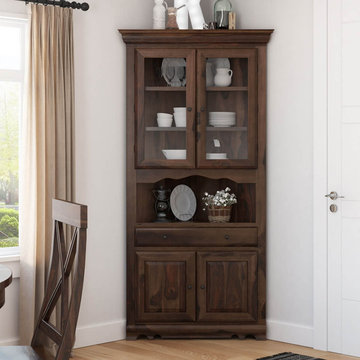 Sierra Living Concepts Inc
Dimension:
39" L X 18" D X 78" H
When space is at a premium, but storage and style are top of your list, our Tiverton Rustic Solid Wood Corner Hutch with Glass Doors saves the day!
This space-saving corner hutch commands minimal floor space while delivering ample storage with rustic style. Adorned in delicate trimwork, the details of this wooden hutch continue in the organic motif of grains and bands that naturally stamp the solid wood. When it comes to storage, this hutch has it all. At its base, double doors open upon interior shelving for enclosed organization. Just above, a single drawer slides open to accommodate anything from silverware to table linens. For the collector or individual looking for a little extra surface space, the open middle shelf creates a nice little nook to suit just about any purpose. Topping these features is the glass-front double door cabinet. Ample shelf space provides a proper place to display your cherished heirlooms or dinnerware.
This rustic corner hutch is a quality constructed treasure that will delight generations to come in solid wood born from Old World techniques and trades. Timeless in appeal with that distinct heirloom charm, this hearty piece of furniture will complement your home in effortless style.
Special Features:
• 100% Handcrafted
• Made of solid wood
• Cabinet with solid doors and shelf space
• Cabinet with display glass and shelf space
• Open shelf
• Single drawer
Note: Real wood is a product of nature, and as such, no two pieces are alike. Variations in solid wood grain patterns are to be expected and make each furniture uniquely beautiful, just like us humans.
Sponsored
Sunbury, OH

J.Holderby - Renovations
Franklin County's Leading General Contractors - 2X Best of Houzz!
 Envision Web
Stuart Wade, Envision Virtual Tours
The second-largest and most developed of Georgia's barrier islands, St. Simons is approximately twelve miles long and nearly three miles wide at its widest stretch (roughly the size of Manhattan Island in New York). The island is located in Glynn County on Georgia's coast and lies east of Brunswick (the seat of Glynn County), south of Little St. Simons Island and the Hampton River, and north of Jekyll Island. The resort community of Sea Island is separated from St. Simons on the east by the Black Banks River. Known for its oak tree canopies and historic landmarks, St. Simons is both a tourist destination and, according to the 2010 U.S. census, home to 12,743 residents.
Early History
The earliest
St. Simons Island Village
record of human habitation on the island dates to the Late Archaic Period, about 5,000 to 3,000 years ago. Remnants of shell rings left behind by Native Americans from this era survive on many of the barrier islands, including St. Simons. Centuries later, during the period known by historians as the chiefdom era, the Guale Indians established a chiefdom centered on St. Catherines Island and used St. Simons as their hunting and fishing grounds. By 1500 the Guale had established a permanent village of about 200 people on St. Simons, which they called Guadalquini.
Beginning in 1568, the Spanish attempted to create missions along the Georgia coast. Catholic missions were the primary means by which Georgia's indigenous Native American chiefdoms were assimilated into the Spanish colonial system along the northern frontier of greater Spanish Florida. In the 1600s St. Simons became home to two Spanish missions: San Buenaventura de Guadalquini, on the southern tip of the island, and Santo Domingo de Asao (or Asajo), on the northern tip. Located on the inland side of the island were the pagan refugee villages of San Simón, the island's namesake, and Ocotonico. In 1684 pirate raids left the missions and villages largely abandoned.
Colonial History
As
Fort Frederica
early as 1670, with Great Britain's establishment of the colony of Carolina and its expansion into Georgia territory, Spanish rule was threatened by the English. The Georgia coast was considered "debatable land" by England and Spain, even though Spain had fully retreated from St. Simons by 1702. Thirty-one years later General James Edward Oglethorpe founded the English settlement of Savannah. In 1736 he established Fort Frederica, named after the heir to the British throne, Frederick Louis, prince of Wales, on the west side of St. Simons Island to protect Savannah and the Carolinas from the Spanish threat.
Between 1736 and 1749 Fort Frederica was the hub of British military operations along the Georgia frontier. A town of the same name grew up around the fort and was of great importance to the new colony. By 1740 Frederica's population was 1,000. In 1736 the congregation of what would become Christ Church was organized within Fort Frederica as a mission of the Church of England. Charles Wesley led the first services. In 1742 Britain's decisive victory over Spain in the Battle of Bloody Marsh, during the War of Jenkins' Ear, ended the Spanish threat to the Georgia coast. When the British regimen disbanded in 1749, most of the townspeople relocated to the mainland. Fort Frederica went into decline and, except for a short time of prosperity during the 1760s and 1770s under the leadership of merchant James Spalding, never fully recovered. Today the historic citadel's tabby ruins are maintained by the National Park Service.
Plantation Era
By the start of the American Revolution (1775-83), Fort Frederica was obsolete, and St. Simons was left largely uninhabited as most of its residents joined the patriot army. Besides hosting a small Georgia naval victory on the Fort Frederica River, providing guns from its famous fort for use at Fort Morris in Sunbury, and serving as an arena for pillaging by privateers and British soldiers, the island played almost no role in the war.
Following the war, many of the townspeople, their businesses destroyed, turned to agriculture. The island was transformed into fourteen cotton plantations after acres of live oak trees were cleared for farm land and used for building American warships, including the famous USS Constitution, or "Old Ironsides." Although rice was the predominant crop along the neighboring Altamaha River, St. Simons was known for its production of long-staple cotton, which soon came to be known as Sea Island cotton.
Between
Ebos Landing
the 1780s and the outbreak of the Civil War (1861-65), St. Simons's plantation culture flourished. The saline atmosphere and the availability of cheap slave labor proved an ideal combination for the cultivation of Sea Island cotton. In 1803 a group of Ebo slaves who survived the Middle Passage and arrived on the west side of St. Simons staged a rebellion and drowned themselves. The sacred site is known today as Ebos Landing.
One of the largest owners of land and slaves on St. Simons was Pierce Butler, master of Hampton Point Plantation, located on the northern end of the island. By 1793 Butler owned more than 500 slaves, who cultivated 800 acres of cotton on St. Simons and 300 acres of rice on Butler's Island in the Altamaha River delta. Butler's grandson, Pierce Mease Butler, who at the age of sixteen inherited a share of his grandfather's estate in 1826, was responsible for the largest sale of human beings in the history of the United States: in 1859, to restore his squandered fortune, he sold 429 slaves in Savannah for more than $300,000. The British actress and writer Fanny Kemble, whose tumultuous marriage to Pierce ended in divorce in 1849, published an eyewitness account of the evils of slavery on St. Simons in her book Journal of a Residence on a Georgian Plantation in 1838-1839 (1863).
Another
Retreat Plantation
large owner of land and slaves on St. Simons was Major William Page, a friend and employee of Pierce Butler Sr. Before purchasing Retreat Plantation on the southwestern tip of the island in 1804, Page managed the Hampton plantation and Butler's Island. Upon Page's death in 1827, Thomas Butler King inherited the land together with his wife, Page's daughter, Anna Matilda Page King. King expanded his father-in-law's planting empire on St. Simons as well as on the mainland, and by 1835 Retreat Plantation alone was home to as many as 355 slaves.
The center of life during the island's plantation era was Christ Church, Frederica. Organized in 1807 by a group of island planters, the Episcopal church is the second oldest in the Diocese of Georgia. Embargoes imposed by the War of 1812 (1812-15) prevented the parishioners from building a church structure, so they worshiped in the home of John Beck, which stood on the site of Oglethorpe's only St. Simons residence, Orange Hall.
The first Christ Church building, finished on the present site in 1820, was ruined by occupying Union troops during the Civil War. In 1884 the Reverend Anson Dodge Jr. rebuilt the church as a memorial to his first wife, Ellen. The cruciform building with a trussed gothic roof and stained-glass windows remains active today as Christ Church.
Civil War and Beyond
The
St. Simons Island Lighthouse
outbreak of the Civil War in 1861 put a sudden end to St. Simons's lucrative plantation era. In January of that year, Confederate troops were stationed at the south end of the island to guard the entrance to Brunswick Harbor. Slaves from Retreat Plantation, owned by Thomas Butler King, built earthworks and batteries. Plantation residents were scattered—the men joined the Confederate army and their families moved to the mainland. Cannon fire was heard on the island in December 1861, and Confederate troops retreated in February 1862, after dynamiting the lighthouse to keep its beacon from aiding Union troops. Soon thereafter, Union troops occupied the island, which was used as a camp for freed slaves. By August 1862 more than 500 former slaves lived on St. Simons, including Susie King Taylor, who organized a school for freed slave children. But in November the ex-slaves were taken to Hilton Head, South Carolina, and Fernandina, Florida, leaving the island abandoned.
After the Civil War the island never returned to its status as an agricultural community. The plantations lay dormant because there were no slaves to work the fields. After Union general William T. Sherman's January 1865 Special Field Order No. 15 —a demand that former plantations be divided and distributed to former slaves—was overturned by U.S. president Andrew Johnson less than a year later, freedmen and women were forced to work as sharecroppers on the small farms that dotted the land previously occupied by the sprawling plantations.
By
St. Simons Lumber Mills
1870 real economic recovery began with the reestablishment of the timber industry. Norman Dodge and Titus G. Meigs of New York set up lumber mill operations at Gascoigne Bluff, formerly Hamilton Plantation. The lumber mills provided welcome employment for both blacks and whites and also provided mail and passenger boats to the mainland. Such water traffic, together with the construction of a new lighthouse in 1872, designed by architect Charles B. Cluskey, marked the beginning of St. Simons's tourism industry. The keeper of the lighthouse created a small amusement park, which drew many visitors, as did the seemingly miraculous light that traveled from the top of the lighthouse tower to the bottom. The island became a summer retreat for families from the mainland, particularly from Baxley, Brunswick, and Waycross.
The island's resort industry was thriving by the 1880s. Beachfront structures, such as a new pier and grand hotel, were built on the southeastern end of the island and could be accessed by ferry. Around this time wealthy northerners began vacationing on the island.
Twentieth Century
The
St. Simons Island Pier and Village
opening in 1924 of the Brunswick–St. Simons Highway, today known as the Torras Causeway, was a milestone in the development of resorts in the area. St. Simons's beaches were now easily accessible to locals and tourists alike. More than 5,000 automobiles took the short drive from Brunswick to St. Simons via the causeway on its opening day, paving the way for convenient residential and resort development.
In 1926 automotive pioneer Howard Coffin of Detroit, Michigan, bought large tracts of land on St. Simons, including the former Retreat Plantation, and constructed a golf course, yacht club, paved roads, and a residential subdivision. Although the causeway had brought large numbers of summer people to the island, St. Simons remained a small community with only a few hundred permanent residents until the 1940s.
The
St. Simons Island
outbreak of World War II (1941-45) brought more visitors and residents to St. Simons. Troops stationed at Jacksonville, Florida; Savannah; and nearby Camp Stewart took weekend vacations on the island, and a new naval air base and radar school became home to even more officers and soldiers. The increased wartime population brought the island its first public school. With a major shipyard for the production of Liberty ships in nearby Brunswick, the waters of St. Simons became active with German U-boats. In April 1942, just off the coast, the Texas Company oil tanker S. S. Oklahoma and the S. S. Esso Baton Rouge were torpedoed by the Germans, bringing the war very close to home for island residents.
Due in large part to the military's improvement of the island's infrastructure during the war, development on the island boomed in the 1950s and 1960s. More permanent homes and subdivisions were built, and the island was no longer just a summer resort but also a thriving community. In 1950 the Methodist conference and retreat center Epworth by the Sea opened on Gascoigne Bluff. In 1961 novelist Eugenia Price visited St. Simons and began work on her first works of fiction, known as the St. Simons Trilogy. Inspired by real events on the island, Price's trilogy renewed interest in the history of Georgia's coast, and the novelist herself relocated to the island in 1965 and lived there for thirty-one years. St. Simons is also home to contemporary Georgia writer Tina McElroy Ansa.
Since
Epworth by the Sea
1980 St. Simons's population has doubled. The island's continued status as a vacation destination and its ongoing development boom have put historic landmarks and natural areas at risk. While such landmarks as the Fort Frederica ruins and the Battle of Bloody Marsh site are preserved and maintained by the National Park Service, and while the historic lighthouse is maintained by the Coastal Georgia Historical Society, historic Ebos Landing has been taken over by a sewage treatment plant.
Several coastal organizations have formed in recent years to save natural areas on the island. The St. Simons Land Trust, for example, has received donations of large tracts of land and plans to protect property in the island's three traditional African American neighborhoods. Despite its rapid growth and development, St. Simons remains one of the most beautiful and important islands on the Georgia coast.
 Sierra Living Concepts Inc
Dimension:
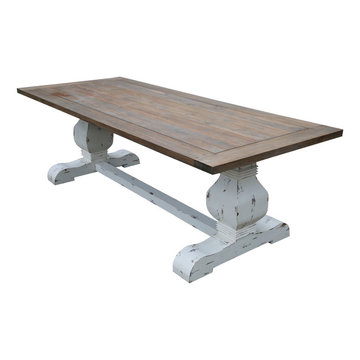
94.5" L X 39.5" D X 30" H
Host your summer lunch or dinner with the Greenville Two Tone Teak Wood Trestle Pedestal Dining Table. Handcrafted exquisitely, the table features a sleek yet sturdy Teak wood top, supported by solid trestle pedestal base, made out of solid wood finished in white. The table exudes a blend of contemporary and traditional design as the top gives it a modern flair while the base brings back the old world charm through its classic trestle pedestal base in a distressed finish. Pull up some chairs and add them to this lovely piece of furniture for a stylish display on your patio, poolside, or lawn.
Materials: This dining table is completely handcrafted from Teak wood and solid wood that makes it ideal for outside use as both the woods have the capability to withstand different weather conditions. The piece offers years of durability and superb visual appeal.
Special Features:
• 100% Handcrafted
• Solid wood and Teak wood construction
• Sturdy trestle pedestal base
Note: Real wood is a product of nature, and as such, no two pieces are alike. Variations in solid wood grain patterns are to be expected and make each furniture uniquely beautiful, just like us humans.
 Sierra Living Concepts Inc
Dimension:
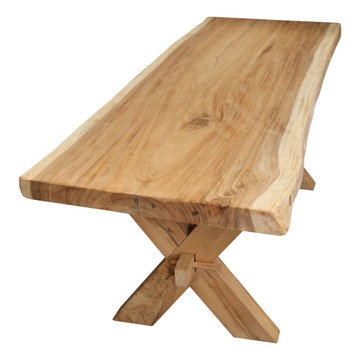
79" L X 32" D X 31.5" H
Exuding stylish appearance, the Single Slab Live Edge Seneca Natural X Base Solid Wood Dining Table anchors the decor of your dining room perfectly. The live edge table is handcrafted with smooth single slab top, supported by a sturdy cross base with a tier attached to both the sides for additional support. The trestle design offers the perfect balance between organic and contemporary looks that can complement a variety of decor.
Materials: The dining table is handcrafted from suar wood, which makes the furniture item look distinctive. It also makes this dining table incredibly durable.
Suar, also known as the majestic "rain tree" is the giant tropical rainforest tree. It is a hardwood known for its beautiful straight grains, durability, strength and is often used as a substitute for hardwoods like Walnut and Mahogany. With such properties, the beauty of the Suar wood furniture is easy to retain for years.
Special Features:
• 100% Handcrafted
• Suar wood construction
• Live edge with natural finish
• Live Edge Table Top thickness ranges from 4" - 6"
Note: Real wood is a product of nature, and as such, no two pieces are alike. Variations in solid wood grain patterns are to be expected and make each furniture uniquely beautiful, just like us humans.
 Sierra Living Concepts Inc
Dimension:
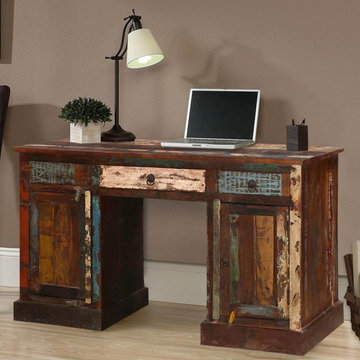
54" L X 22" D X 31" H
Big Drawer: 18" L X 18" D X 2" H
Small Drawer: 11" L X 19" D X 2" H
Cabinet: 12" L X 9" DX 21" H
Are you planning to organize a small office at home or set up a study area for your kids? Then the Venus 3 drawer desk would be the best option. This desk comes with a spacious desktop for your laptop, three drawers – one big and two small - on the top for storing stationery and two bottom cabinets for books and other essentials. Made of reclaimed wood, the beauty of this rustic furniture is enhanced by the contrast colors on the drawers and the polished black iron handle.
Because of the dark tint of the wood, this desk blends in well with all other furniture in your room. It can be placed in the home office and even in the living room as per your requirement. This solid wood furniture is highly functional and can ease your work life like never before.
Since the Venus three drawer desk is made of 100% reclaimed wood, it is environment-friendly. Moreover, the desk is made more stable by the low moisture content. Because of this, it is long lasting and can be put to rough usage.
Special Features:
• Made of 100% reclaimed wood
• 3 drawers with two shelves
• Total Dimension: 54" L X 22" D X 31" 0048
• Big Drawer: 18" L X 18" D X 2" H
• Small Drawer: 11" L X 19" D X 2" H
• Cabinet: 12" L X 9" DX 21" H
Note: Real wood is a product of nature, and as such, no two pieces are alike. Variations in solid wood grain patterns are to be expected and make each furniture uniquely beautiful, just like us humans.
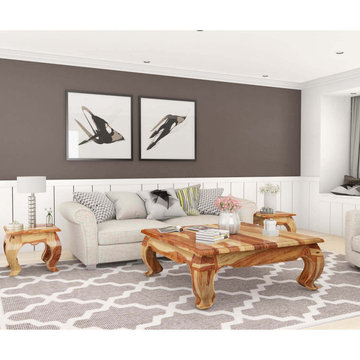 Sierra Living Concepts Inc
Dimension:
Coffee Table: 48" L X 48" D X 18" H
End Table: 20" L X 20" D X 18" H
Give your living rooms a completely holistic makeover with our unique, trendy and amazing Halfeti Contemporary Rustic Solid Wood 3 Piece Opium Coffee Table Set.
A mixture of timelessly classic and edgy rustic, this solid Rosewood coffee table set defies typical aesthetics and wows with its strong personality and qualitative design. It consists of 2 end tables and a centralized coffee table. The wood grain gives the whole set a lot of character, which blends in well with its stocky, square-ish design. The claw-foot inspired leg design is a contemporary intervention that complements the overall rustic characteristics of this set. Handcrafted from solid Rosewood, Halfeti coffee table set warrants long-lasting, durable and resilient heirloom quality.
If you’re looking for a coffee table set that would add both character and style to your living rooms, then this one is definitely it. The distinct, individualistic visuals ensure that this solid wood coffee table set would make your space as eye-catching as possible. You can embellish the center table by topping it off with artfully haphazard books, or a beautiful dry arrangement or even a blooming vase of flowers. As for the side tables, you can go for mismatched accessories like photo-frames, table lamps, stationary and baubles.
You can pair off this solid Rosewood coffee table set with a number of different interior design styles. Its unique, mismatched edginess would look stunning in either rustic or industrial style living rooms. You can make it a focal point in a cozy Scandinavian style design. Or you can set it up in a contemporary style living room to enhance its distinguished appeal.
Special Features:
• 100% Handcrafted
• Solid Rosewood craftsmanship
• Contemporary Rustic style
• Square shape opium coffee table
• 2 end tables
• Claw-foot inspired legs
• Elegant and distinctive wood grain
• Smooth finish
• Aesthetically versatile
• Heirloom quality
• Easy maintenance
Note: Real wood is a product of nature, and as such, no two pieces are alike. Variations in solid wood grain patterns are to be expected and make each furniture uniquely beautiful, just like us humans.
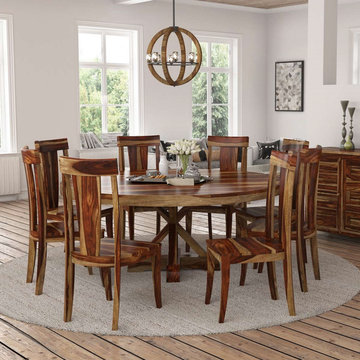 Sierra Living Concepts Inc
Dimension:
Dining Table: 72" L X 72" D X 30" H
Dining Chair: 19.5" L X 17.25" D X 42" H
The Bedford X Pedestal Rustic 72" Round Dining Table With 8 Chairs Set is a perfect place to enjoy casual weekend breakfasts or formal dinners. The dining table set features 8 stylishly constructed chairs and a round dining table with natural wood grain pattern in deep brown and beige making it a gorgeous addition to your transitional or modern dining space. The stylish base features a cluster of planks ending in a cross base that gives it a timeless look while the distinctive single vertical slat back at the center of chair back adds a breezy finesse to the ensemble.
Materials: This round dining table set is beautifully handcrafted from solid Rosewood that provides the set with exceptional sturdiness and visual appeal to last many years.
Special Features:
• 100% Handcrafted
• Rustic Solid Rosewood construction
• Seats 8 people comfortably
• Heirloom quality
Note: Real wood is a product of nature, and as such, no two pieces are alike. Variations in solid wood grain patterns are to be expected and make each furniture uniquely beautiful, just like us humans.
Sponsored
Sunbury, OH
J.Holderby - Renovations
Franklin County's Leading General Contractors - 2X Best of Houzz!
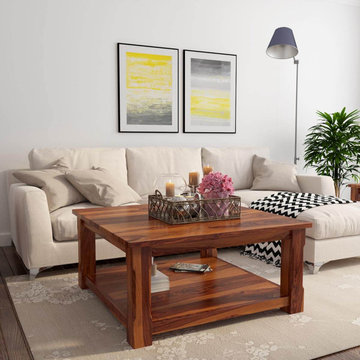 Sierra Living Concepts Inc
Dimension:
40" L X 40" D X 19" H
Influenced by modern design, this Rustic Solid Wood Sierra Nevada 2-Tier Square Shaker Coffee Table is a wonderful combination of great looks and usability.
The rustic square coffee table is handcrafted with Solid Wood. It features beautiful grains of the Rosewood which ensures it gets everyone's attention. The bottom shelf offers extra space for games or reading material and the large square top provides plenty of surface space for today’s active families.
Special Features:
• 100% Handcrafted
• Solid Wood construction
• Extended top frame
• Square coffee table
• 2 tier design
• Features dynamic wood grains
• Hand rubbed stain and finish
Note: Real wood is a product of nature, and as such, no two pieces are alike. Variations in solid wood grain patterns are to be expected and make each furniture uniquely beautiful, just like us humans.
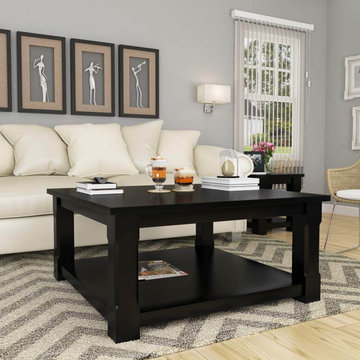 Sierra Living Concepts Inc
Dimension:
40" L X 40" D X 19" H
Influenced by modern design, this Rustic Solid Wood Black 2-Tier Square Shaker Coffee Table is a wonderful combination of great looks and usability.
The rustic coffee table is crafted with Solid Wood. The bottom shelf offers extra space for games or reading the material and the large square top provides plenty of surface space for today’s active families.
Special Features:
• 100% Handcrafted, Rustic Solid Wood Furniture
• Solid Wood construction
• Solid Wood coffee table’s top is designed in a way that it is extended.
• It has a long-lasting finish as special wax and seasoning process is used.
Note: Real wood is a product of nature, and as such, no two pieces are alike. Variations in solid wood grain patterns are to be expected and make each furniture uniquely beautiful, just like us humans.
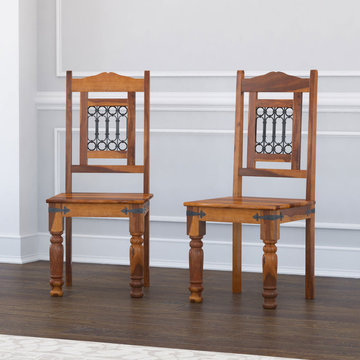 Sierra Living Concepts Inc
Dimension:
18" L X 18" D X 41.5" H
Craftsmanship and traditional styling define our set of two handmade high back dining room chairs with arms. These classic handmade chairs are part of our San Francisco Collection. Each chair is constructed of Solid Wood, a superior hardwood. The wood's strength and durability make is a smart choice for high use furniture. Each chair features an ornate iron grillwork panel framed in the chair's back, decorative iron brackets on the corner of the seat frame and country column front legs.
Special Features:
• Custom stain shades are available at no extra charge
• Stain is mixed in small batches for best results
• Hand rubbed stain and finish
Note: Custom Options such as Size, Shape, Shade & Design are not applicable to this item. Real wood is a product of nature, and as such, no two pieces are alike. Variations in solid wood grain patterns are to be expected and make each furniture uniquely beautiful, just like us humans.
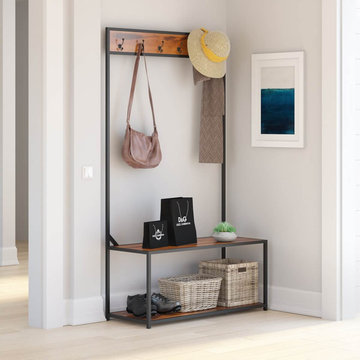 Sierra Living Concepts Inc
Dimension:
40" L X 16" D X 71" H
Outfit your formal entry or mudroom in the alluring industrial design of our Kelso Solid Wood Open Back Industrial Entryway Hall Tree Bench.
Instantly tidy up and de-clutter your hallway or entry with this rustic industrial hall tree. It's the perfect companion for hanging your outdoor attire including hats, coats or umbrellas, but it's also great for stashing footwear or decorative baskets filled with winter gear. Six hooks above, open shelving below, and a roomy bench in the middle round out a truly efficient and attractive way to transition from the outdoors to the indoors and vice versa! The high-grade solid wood, along with the robust iron frame, come together to create an inspired industrial design.
You'll easily have a place to keep household essentials up and off of the floor with this stylish rustic tree hall. Perfectly practical, the look of this tree hall bench utilizes a mixed media of materials including solid hardwood with rich array grains as well as sturdy iron frame. The handcrafted designation of the piece fits right at home with a rustic or commercial-inspired space, assuring reliable function that is made to last through the long haul. Highly skilled craftsmen who have finely honed their skills in the old world art of woodworking have made this a time-honored piece to stun through the generations.
Special Features:
• 100% Handcrafted
• Solid hardwood construction
• Iron frame
• Open shelving
• Built-in bench
• Six hanging hooks
Note: Real wood is a product of nature, and as such, no two pieces are alike. Variations in solid wood grain patterns are to be expected and make each furniture uniquely beautiful, just like us humans.
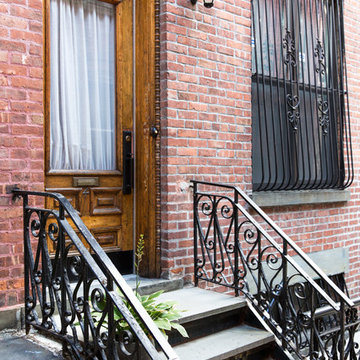
 designs by human.
A classic brownstone building entrance featuring a warm wooden door, rich red brick facade, and elegant black wrought iron railings leading up to the iconic stoop. This image captures the timeless charm and architectural detail of historic city living, perfect for real estate, urban design, or historical architecture themes.

 Sureeco
Modern Retreat | Safety Habitat, Perched at Heart.
Living in solitude is the lofty ideal of ancient and modern human. The source of Chinese Seclusion Culture is streamed from far away: “As I pick chrysanthemums beneath the eastern fence, my eyes fall leisurely on the Southern Mountain." A paradise-like life lets innumerable people in longing. Looking at current day, privacy has become the expression of an attitude, a lifestyle choice. The real privacy is not about where one lives, but in the internal, physical and mental fatigue that can be placed in a home.
Modern Retreat should be hidden in the heart. For modern people, if one maintains a self-sustaining practice of perseverance, follow morality and good conscience, abstinence, one can also be retained out of a pure world without being in a deep secluded valley .
Real privacy is not to hideaway. The most essential element is the freedom of mind and tranquility. If people can do the things they enjoy, they are quite complete in a perfect world of their own.
The spiritual world, is self-purification, under certain conditions, as long as their individually initiated. The environmental impact can be changed on their own, and can be found everywhere in the joy of life.
In each city, people have a heart over normalized horticultural habitat. Enjoying the quality life does not mean deliberately escaping from the city, across thousands of miles. In the most cosmopolitan cities, it is a bucolic refuge in the midst of a great bustling city. The comfort of a home will expand into the neighbourhood when you meet acquaintances everywhere around where you live.
Modern Retreat should be hidden within the city. The architectural design would have an indoor planting garden of choice. People would go to work, but once they are home and close their doors, it is their own private life where they can pretend that they are sitting in the mountain forests. For a Yin Yang disposition, ambition and pursuing righteousness fit together perfectly.
One house is one world. “Home” is where we can stop to rest and relax, the place one can return to. For home design, it must go beyond being livable, the concept of the “Happy Home” is advanced to the peaceful realm.
To live comfortably and privately at your own home, it is necessary for the modern home to be arranged in a "less is more" philosophy. Home goods should be simple and elegant yet practical, but without losing the taste and style, so that residents of the home can find clear air and quiet freedom. No matter how busy or tiring work is, we will be able to find peace and quiet from your home to heal and release the pressure.
Modern Retreat is not the Valley of Orchards, the seclusion is not free, personalized, romantic and the ideal of Walden, but it is conceptual to the peace of mind and family atmosphere.
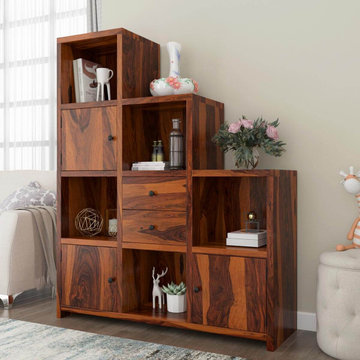 Sierra Living Concepts Inc
Dimension:
50" L X 15.5 D X 62" H
Imbue your home interiors with infinite charisma and personality by choosing our gorgeous Proctorville Rustic Wood Stair Step Cube Bookcase With Doors & Drawers!
The very contemporary aesthetics of this cube bookcase combine visuals and pragmatics with the utmost grace. It features a step-ladder style design that has been fully handcrafted from the strongest solid Rosewood pieces. As a result, it offers an amazing heirloom quality and is visually versatile enough to be featured in a variety of different interior design styles.
This stair step bookcase has 5 cubicles, 3 closed cabinets, and 2 pullout drawers in the middle. The entire unit has been assembled in a block formation that is arranged in tiered columns to enhance its visual value. The lowest tier starts off at the right and comprises of an open and a closed compartment for both storage and decoration. The second one has 3 compartments with alternating locations for featuring trinkets and versatile organization. The last one has 4 and stands the tallest, and once again you can alternate between storage and decor. The top of each tier has a smooth surface which can also be used to put some decorations on. The bottom is supported on sidelined platform feet that complement the modern aesthetics of this solid wood bookcase pretty well.
Special Features:
• 100% handcrafted
• Solid Rosewood craftsmanship
• Tiered design with step-like formation
• 5 cubicles
• 3 closed cabinets
• 2 pullout drawers
• Gorgeous hand-rubbed stain
• Fully pragmatic
• Heirloom quality
• Visually versatile
• Easy maintenance
Note: Real wood is a product of nature, and as such, no two pieces are alike. Variations in solid wood grain patterns are to be expected and make each furniture uniquely beautiful, just like us humans.
7