
Search results for "Real time text" in Home Design Ideas
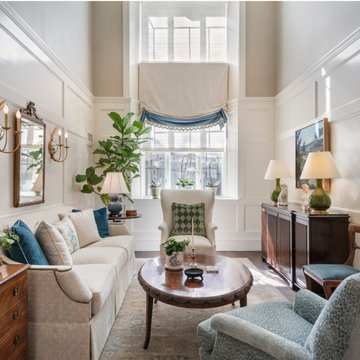
 MBA Builders
This project has real spring vibes! Though we're known for our custom new home builds, we really love smaller renovation projects like this gorgeous jewel box condo in Beacon Hill. Magnificent decor flourishes from @ManchesterInteriors and successful design collaboration with MBA resulted in the graceful millwork embellishing this home, finished just in time to celebrate Easter.
#BostonHome #bostonma #customhomes #propertyservices #homebuilders #designers


 Design Shop Interiors
Modern farmhouse living room
Family room - transitional family room idea in Sacramento
Family room - transitional family room idea in Sacramento
Find the right local pro for your project

 M.N. Reale
 Construction converted three separate, dated rooms into a magnificent, modern master bath. We installed custom tile on the floors and up the walls in each room visually tying them together. Six Marvin casement windows were installed in the tub area, which features a claw foot tub from Portugal, showering the room with natural light. The large 5 x 7 foot walk-in shower features three showerheads, and a rolling glass door. The custom cabinet in the powder room has His and Hers sinks with a beautiful quartz countertop. The homeowners now love to relax and spend time in their new master bath.
Neil Landino Photography

 SYNC Technology Integration, LLC
This is a 4-TV system where all 4 TVs can be displaying something different or even the same thing! The center TV is a 60", the 2 on the sides are 40" and the bar TV is a 32". All devices are in a rack on the other side of the main TV wall. It is all controlled by a re-chargeable universal remote.
There is a real-time sports ticker that displays up-to-date scores for all major sports and even shows teams' logos!
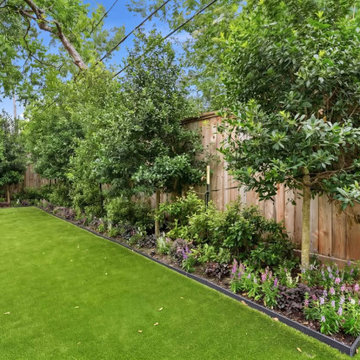
 Texan Landscape Group LLC
Most backyards look flat because they're missing one thing: Plant Layering
Here's how we designed this Houston backyard to create privacy, depth, and year-round color:
? **Screening Trees** — Tall evergreens along the fence create privacy and soften the hard fence line, making the space feel enclosed and relaxing.
? **Evergreen Shrubs** — Layered beneath the trees to keep beds looking full and textured through every season.
? **Flowering Perennials** — Pops of purple break up the greenery and add seasonal color without overcrowding the space.
? **Contrast Foliage** — Darker-leafed plants make the lighter greens and flowers around them stand out even more.
⚡ **Steel Bed Edging** — Clean, crisp lines that separate turf from planting beds and make maintenance much easier.
The best landscapes aren't just planted — they're **designed in layers.** Canopy, mid-level shrubs, groundcover, and seasonal color work together to create something that matures beautifully over time.
If you're ready to transform your backyard, we'll build a custom planting plan tailored to your property.
? Call/Text: 832-230-7277
? landscapedesignhouston.com/contact/
#HoustonLandscapeDesign #BackyardLandscaping #OutdoorLiving #LandscapeArchitecture #TexanLandscapeGroup

 Design Builders, Inc.
Double entry doors to the screened porch. They are capable of opening at the same time to accommodate heavy and frequent traffic. Their glass windows pull down to reveal screens.
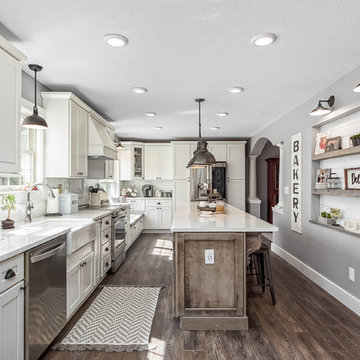
Sponsored
Sunbury, OH

J.Holderby - Renovations
Franklin County's Leading General Contractors - 2X Best of Houzz!
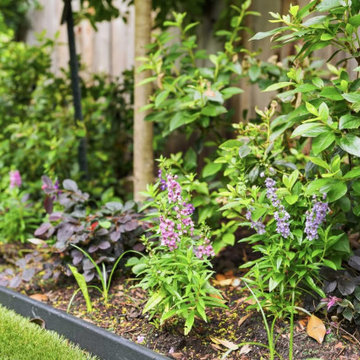 Texan Landscape Group LLC
Most backyards look flat because they're missing one thing: Plant Layering
Here's how we designed this Houston backyard to create privacy, depth, and year-round color:
? **Screening Trees** — Tall evergreens along the fence create privacy and soften the hard fence line, making the space feel enclosed and relaxing.
? **Evergreen Shrubs** — Layered beneath the trees to keep beds looking full and textured through every season.
? **Flowering Perennials** — Pops of purple break up the greenery and add seasonal color without overcrowding the space.
? **Contrast Foliage** — Darker-leafed plants make the lighter greens and flowers around them stand out even more.
⚡ **Steel Bed Edging** — Clean, crisp lines that separate turf from planting beds and make maintenance much easier.
The best landscapes aren't just planted — they're **designed in layers.** Canopy, mid-level shrubs, groundcover, and seasonal color work together to create something that matures beautifully over time.
If you're ready to transform your backyard, we'll build a custom planting plan tailored to your property.
? Call/Text: 832-230-7277
? landscapedesignhouston.com/contact/
#HoustonLandscapeDesign #BackyardLandscaping #OutdoorLiving #LandscapeArchitecture #TexanLandscapeGroup

 Tranquil Designs LLC
The client wanted this house to be designed similar to the model home that they saw. When I walked into their home for the first time, after speaking with them, I knew exactly what their design needs were. They wanted to keep the paint color but everything else was free game. I wanted each room to have its own personality without competing against each other. This room is the guest bedroom, so I wanted it to be tranquil and inviting. I used a simple beige headboard with nailheads. The side tables is made of metal and complemented the bed so well. I chose to use crystal lamps because of the beautiful accent wall behind the bed. I used off white drapery panels, with a bronze finish drapery rod. The room was not large enough to fit a dresser so I wanted to add a mirror that makes a statement. The rug has a gray background with an ivory texted pattern, it just pulled everything together. The bedding is a mixture of textures, patterns and neutrals. Last but not least, I brought this piece of art in that just completes the room.

 Performance Kitchens & Home
White range cabinetry and quartz counters frame the stainless steel cooking appliance beneath a chimney hood. The full-height blue Moroccan-inspired ceramic tile adds a patterned focal point, while the nearby island supplies another preparation surface. Clean cabinet fronts and wood flooring keep the contemporary design coordinated.
Text us at (484) 278-1764 or call (215) 482-0700 to explore your kitchen, bathroom or home transformation today.

 Garman Builders Inc.
Perspective changes everything. Photo Credit: Justin Tearney
Open concept kitchen - mid-sized modern u-shaped open concept kitchen idea with recessed-panel cabinets, white cabinets, gray backsplash, glass tile backsplash, stainless steel appliances and an island
Open concept kitchen - mid-sized modern u-shaped open concept kitchen idea with recessed-panel cabinets, white cabinets, gray backsplash, glass tile backsplash, stainless steel appliances and an island
 SYNC Technology Integration, LLC
This is a 4-TV system where all 4 TVs can be displaying something different or even the same thing! The center TV is a 60", the 2 on the sides are 40" and the bar TV is a 32". All devices are in a rack on the other side of the main TV wall. It is all controlled by a re-chargeable universal remote.
There is a real-time sports ticker that displays up-to-date scores for all major sports and even shows teams' logos!

 Alberta Outdoor Supply
Aquascape Stacked Slate Urns have all the natural beauty of real rock with the added durability and light weight benefits of fiberglass. Create a stunning focal point in nearly any outdoor setting with the Medium Stacked Slate Urn Landscape Fountain Kit
Save time and money with pre-packaged Aquascape Landscape Fountain Kits
Kit Includes:
Medium Stacked Slate Urn
AquaBasin™ 45
Pre-Cut Kink-Free Pipe 3/4" x 6'
Ultra™ 1100 Water Pump
Sponsored
Sunbury, OH
J.Holderby - Renovations
Franklin County's Leading General Contractors - 2X Best of Houzz!

 Ollin Stone
Everest Marble is a metamorphic rock, which is a rock that has been physically and chemically transformed over time due to intense heat and pressure.
 KL Designs Residential Landscape Planning LLC
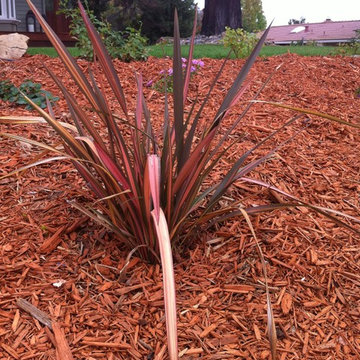
Phormiums or New Zealand Flax are great low water and low maintenance plants. This one is Phormium 'Maori Queen'. They offer year round color and add a dynamic interest with the blades reaching up and some of them then arch. The only real maintenance is to remove or prune back the dead leaves at the base. Do not crew cut this plant. Many gardeners do not spend the time to hand prune as this plant deserves to maintain its beauty year round. Chopping it takes away from its natural form and it takes a long time to get it back to its natural shape. once given a crew cut.

 Tammy Goodson Christian & Associates Real Estate
SOLD-128 S. Dartmouth- Wonderful well cared for home. You will enjoy all the space this home has to offer. Upstairs features 3 different living areas to include a great sun room that is heated and cooled. Master bedroom has hot tub room off of it. Lots of closet space through out. Downstairs has 2 more NC bedrooms, large family room and bath. Beautiful yard at any time of the year. Call or email Tammy to see. 785-587-5222 x 113 or tammy@tammygoodson.com
Christian & Associates Real Estate LLC
1006 Poyntz Ave
Manhattan KS 66502

 Gustavson Dundes Architecture & Design, LLP
Gustavson/Dundes, a 30-year-old architectural and design firm, was featured in the September 2012 issue of Elle Decor magazine and the August 12, 2012 New York Times Real Estate section for its innovative design concepts. Focusing primarily on the New York metropolitan area, the firm is known for its highly trained and experienced architects who provide focused attention and innovative design to both large and small commercial and residential projects. The Principals have developed a reputation for trust and for their hands-on commitment to each project.

 Compose Decor
Organization is the key. Having your belongings in the right place will help to find them every time is needed. An organized, ordered, and arranged place gives a sense of tranquility and serenity.
Compose Decor Team understand that each project is unique and customized to the customer’s specific tastes. Architects, builders, designers, real states agents, and homeowners trust us to bring their concepts to life, on time and within budget. Bring us your ideas and dreams and we’ll turn it into reality.
This project was in partnership with the interior designer Luciana Junqueira.

 Envision Web
Stuart Wade, Envision Virtual Tours
The second-largest and most developed of Georgia's barrier islands, St. Simons is approximately twelve miles long and nearly three miles wide at its widest stretch (roughly the size of Manhattan Island in New York). The island is located in Glynn County on Georgia's coast and lies east of Brunswick (the seat of Glynn County), south of Little St. Simons Island and the Hampton River, and north of Jekyll Island. The resort community of Sea Island is separated from St. Simons on the east by the Black Banks River. Known for its oak tree canopies and historic landmarks, St. Simons is both a tourist destination and, according to the 2010 U.S. census, home to 12,743 residents.
Early History
The earliest
St. Simons Island Village
record of human habitation on the island dates to the Late Archaic Period, about 5,000 to 3,000 years ago. Remnants of shell rings left behind by Native Americans from this era survive on many of the barrier islands, including St. Simons. Centuries later, during the period known by historians as the chiefdom era, the Guale Indians established a chiefdom centered on St. Catherines Island and used St. Simons as their hunting and fishing grounds. By 1500 the Guale had established a permanent village of about 200 people on St. Simons, which they called Guadalquini.
Beginning in 1568, the Spanish attempted to create missions along the Georgia coast. Catholic missions were the primary means by which Georgia's indigenous Native American chiefdoms were assimilated into the Spanish colonial system along the northern frontier of greater Spanish Florida. In the 1600s St. Simons became home to two Spanish missions: San Buenaventura de Guadalquini, on the southern tip of the island, and Santo Domingo de Asao (or Asajo), on the northern tip. Located on the inland side of the island were the pagan refugee villages of San Simón, the island's namesake, and Ocotonico. In 1684 pirate raids left the missions and villages largely abandoned.
Colonial History
As
Fort Frederica
early as 1670, with Great Britain's establishment of the colony of Carolina and its expansion into Georgia territory, Spanish rule was threatened by the English. The Georgia coast was considered "debatable land" by England and Spain, even though Spain had fully retreated from St. Simons by 1702. Thirty-one years later General James Edward Oglethorpe founded the English settlement of Savannah. In 1736 he established Fort Frederica, named after the heir to the British throne, Frederick Louis, prince of Wales, on the west side of St. Simons Island to protect Savannah and the Carolinas from the Spanish threat.
Between 1736 and 1749 Fort Frederica was the hub of British military operations along the Georgia frontier. A town of the same name grew up around the fort and was of great importance to the new colony. By 1740 Frederica's population was 1,000. In 1736 the congregation of what would become Christ Church was organized within Fort Frederica as a mission of the Church of England. Charles Wesley led the first services. In 1742 Britain's decisive victory over Spain in the Battle of Bloody Marsh, during the War of Jenkins' Ear, ended the Spanish threat to the Georgia coast. When the British regimen disbanded in 1749, most of the townspeople relocated to the mainland. Fort Frederica went into decline and, except for a short time of prosperity during the 1760s and 1770s under the leadership of merchant James Spalding, never fully recovered. Today the historic citadel's tabby ruins are maintained by the National Park Service.
Plantation Era
By the start of the American Revolution (1775-83), Fort Frederica was obsolete, and St. Simons was left largely uninhabited as most of its residents joined the patriot army. Besides hosting a small Georgia naval victory on the Fort Frederica River, providing guns from its famous fort for use at Fort Morris in Sunbury, and serving as an arena for pillaging by privateers and British soldiers, the island played almost no role in the war.
Following the war, many of the townspeople, their businesses destroyed, turned to agriculture. The island was transformed into fourteen cotton plantations after acres of live oak trees were cleared for farm land and used for building American warships, including the famous USS Constitution, or "Old Ironsides." Although rice was the predominant crop along the neighboring Altamaha River, St. Simons was known for its production of long-staple cotton, which soon came to be known as Sea Island cotton.
Between
Ebos Landing
the 1780s and the outbreak of the Civil War (1861-65), St. Simons's plantation culture flourished. The saline atmosphere and the availability of cheap slave labor proved an ideal combination for the cultivation of Sea Island cotton. In 1803 a group of Ebo slaves who survived the Middle Passage and arrived on the west side of St. Simons staged a rebellion and drowned themselves. The sacred site is known today as Ebos Landing.
One of the largest owners of land and slaves on St. Simons was Pierce Butler, master of Hampton Point Plantation, located on the northern end of the island. By 1793 Butler owned more than 500 slaves, who cultivated 800 acres of cotton on St. Simons and 300 acres of rice on Butler's Island in the Altamaha River delta. Butler's grandson, Pierce Mease Butler, who at the age of sixteen inherited a share of his grandfather's estate in 1826, was responsible for the largest sale of human beings in the history of the United States: in 1859, to restore his squandered fortune, he sold 429 slaves in Savannah for more than $300,000. The British actress and writer Fanny Kemble, whose tumultuous marriage to Pierce ended in divorce in 1849, published an eyewitness account of the evils of slavery on St. Simons in her book Journal of a Residence on a Georgian Plantation in 1838-1839 (1863).
Another
Retreat Plantation
large owner of land and slaves on St. Simons was Major William Page, a friend and employee of Pierce Butler Sr. Before purchasing Retreat Plantation on the southwestern tip of the island in 1804, Page managed the Hampton plantation and Butler's Island. Upon Page's death in 1827, Thomas Butler King inherited the land together with his wife, Page's daughter, Anna Matilda Page King. King expanded his father-in-law's planting empire on St. Simons as well as on the mainland, and by 1835 Retreat Plantation alone was home to as many as 355 slaves.
The center of life during the island's plantation era was Christ Church, Frederica. Organized in 1807 by a group of island planters, the Episcopal church is the second oldest in the Diocese of Georgia. Embargoes imposed by the War of 1812 (1812-15) prevented the parishioners from building a church structure, so they worshiped in the home of John Beck, which stood on the site of Oglethorpe's only St. Simons residence, Orange Hall.
The first Christ Church building, finished on the present site in 1820, was ruined by occupying Union troops during the Civil War. In 1884 the Reverend Anson Dodge Jr. rebuilt the church as a memorial to his first wife, Ellen. The cruciform building with a trussed gothic roof and stained-glass windows remains active today as Christ Church.
Civil War and Beyond
The
St. Simons Island Lighthouse
outbreak of the Civil War in 1861 put a sudden end to St. Simons's lucrative plantation era. In January of that year, Confederate troops were stationed at the south end of the island to guard the entrance to Brunswick Harbor. Slaves from Retreat Plantation, owned by Thomas Butler King, built earthworks and batteries. Plantation residents were scattered—the men joined the Confederate army and their families moved to the mainland. Cannon fire was heard on the island in December 1861, and Confederate troops retreated in February 1862, after dynamiting the lighthouse to keep its beacon from aiding Union troops. Soon thereafter, Union troops occupied the island, which was used as a camp for freed slaves. By August 1862 more than 500 former slaves lived on St. Simons, including Susie King Taylor, who organized a school for freed slave children. But in November the ex-slaves were taken to Hilton Head, South Carolina, and Fernandina, Florida, leaving the island abandoned.
After the Civil War the island never returned to its status as an agricultural community. The plantations lay dormant because there were no slaves to work the fields. After Union general William T. Sherman's January 1865 Special Field Order No. 15 —a demand that former plantations be divided and distributed to former slaves—was overturned by U.S. president Andrew Johnson less than a year later, freedmen and women were forced to work as sharecroppers on the small farms that dotted the land previously occupied by the sprawling plantations.
By
St. Simons Lumber Mills
1870 real economic recovery began with the reestablishment of the timber industry. Norman Dodge and Titus G. Meigs of New York set up lumber mill operations at Gascoigne Bluff, formerly Hamilton Plantation. The lumber mills provided welcome employment for both blacks and whites and also provided mail and passenger boats to the mainland. Such water traffic, together with the construction of a new lighthouse in 1872, designed by architect Charles B. Cluskey, marked the beginning of St. Simons's tourism industry. The keeper of the lighthouse created a small amusement park, which drew many visitors, as did the seemingly miraculous light that traveled from the top of the lighthouse tower to the bottom. The island became a summer retreat for families from the mainland, particularly from Baxley, Brunswick, and Waycross.
The island's resort industry was thriving by the 1880s. Beachfront structures, such as a new pier and grand hotel, were built on the southeastern end of the island and could be accessed by ferry. Around this time wealthy northerners began vacationing on the island.
Twentieth Century
The
St. Simons Island Pier and Village
opening in 1924 of the Brunswick–St. Simons Highway, today known as the Torras Causeway, was a milestone in the development of resorts in the area. St. Simons's beaches were now easily accessible to locals and tourists alike. More than 5,000 automobiles took the short drive from Brunswick to St. Simons via the causeway on its opening day, paving the way for convenient residential and resort development.
In 1926 automotive pioneer Howard Coffin of Detroit, Michigan, bought large tracts of land on St. Simons, including the former Retreat Plantation, and constructed a golf course, yacht club, paved roads, and a residential subdivision. Although the causeway had brought large numbers of summer people to the island, St. Simons remained a small community with only a few hundred permanent residents until the 1940s.
The
St. Simons Island
outbreak of World War II (1941-45) brought more visitors and residents to St. Simons. Troops stationed at Jacksonville, Florida; Savannah; and nearby Camp Stewart took weekend vacations on the island, and a new naval air base and radar school became home to even more officers and soldiers. The increased wartime population brought the island its first public school. With a major shipyard for the production of Liberty ships in nearby Brunswick, the waters of St. Simons became active with German U-boats. In April 1942, just off the coast, the Texas Company oil tanker S. S. Oklahoma and the S. S. Esso Baton Rouge were torpedoed by the Germans, bringing the war very close to home for island residents.
Due in large part to the military's improvement of the island's infrastructure during the war, development on the island boomed in the 1950s and 1960s. More permanent homes and subdivisions were built, and the island was no longer just a summer resort but also a thriving community. In 1950 the Methodist conference and retreat center Epworth by the Sea opened on Gascoigne Bluff. In 1961 novelist Eugenia Price visited St. Simons and began work on her first works of fiction, known as the St. Simons Trilogy. Inspired by real events on the island, Price's trilogy renewed interest in the history of Georgia's coast, and the novelist herself relocated to the island in 1965 and lived there for thirty-one years. St. Simons is also home to contemporary Georgia writer Tina McElroy Ansa.
Since
Epworth by the Sea
1980 St. Simons's population has doubled. The island's continued status as a vacation destination and its ongoing development boom have put historic landmarks and natural areas at risk. While such landmarks as the Fort Frederica ruins and the Battle of Bloody Marsh site are preserved and maintained by the National Park Service, and while the historic lighthouse is maintained by the Coastal Georgia Historical Society, historic Ebos Landing has been taken over by a sewage treatment plant.
Several coastal organizations have formed in recent years to save natural areas on the island. The St. Simons Land Trust, for example, has received donations of large tracts of land and plans to protect property in the island's three traditional African American neighborhoods. Despite its rapid growth and development, St. Simons remains one of the most beautiful and important islands on the Georgia coast.
 Tranquil Designs LLC
The client wanted this house to be designed similar to the model home that they saw. When I walked into their home for the first time, after speaking with them, I knew exactly what their design needs were. They wanted to keep the paint color but everything else was free game. I wanted each room to have its own personality without competing against each other. This room is the guest bedroom, so I wanted it to be tranquil and inviting. I used a simple beige headboard with nailheads. The side tables is made of metal and complemented the bed so well. I chose to use crystal lamps because of the beautiful accent wall behind the bed. I used off white drapery panels, with a bronze finish drapery rod. The room was not large enough to fit a dresser so I wanted to add a mirror that makes a statement. The rug has a gray background with an ivory texted pattern, it just pulled everything together. The bedding is a mixture of textures, patterns and neutrals. Last but not least, I brought this piece of art in that just completes the room.
99