
Search results for "Reduce wetlands" in Home Design Ideas
 Plan-it Earth Design
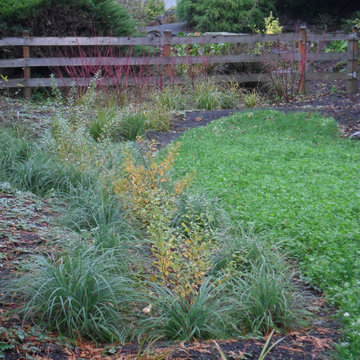
A string of small bioswales manages stormwater from the property higher on the hill, also from the slope of their own backyard. Native plants provide habitat while reducing erosion and slowing the movement of water across the property
 Pennsylvania Landscape & Nursery Association
u2014 ALE: Wayne Rain Garden
Pennsylvania Landscape & Nursery Association
u2014 ALE: Wayne Rain Garden
Terren Landscapes http://www.terrenlandscapes.com
2014 PLNA Awards for Landscape Excellence winner
Category: Residential Up to $15,000
Award Level: Gold
Project Description:
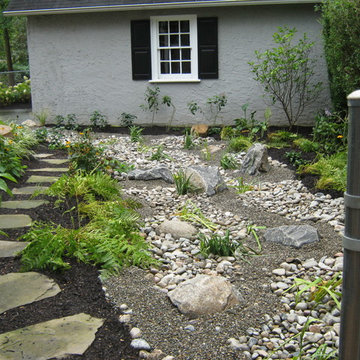
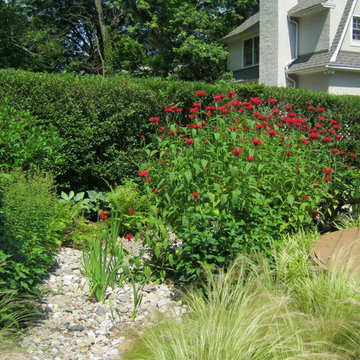
Our company was contracted by the client to provide a creative solution to an ongoing drainage problem. Their property is located within 30 feet of a local stream that collects storm water from the surrounding area. The nearby stream and high water table caused the lawn area at the side of their home to flood and to remain waterlogged for a few days after each storm. The client not only had difficulty growing plants in the existing conditions, but also had a problem with mosquitoes due to standing water.
Our goal was to design a self-contained, naturalistic rain garden that slowed storm water runoff, allowed for percolation, and promoted infiltration while permitting excess clean water to enter the nearby stream with diminished force. As designed, the rain garden allows the earth to slowly and more naturally
absorb excess storm water while filtering out toxins such as excess nitrogen and phosphorous which are frequently found in the landscape, therefore reducing the contaminants entering the stream.
A percolation test was conducted with criteria of absorbing a one-inch rainstorm within four hours without overflow. The one-inch storm calculation included an existing downspout from the home, which would be piped into the rain garden to reduce roof runoff. The first test failed due to a deep layer of high clay-content soil. Excavation continued until a layer of sandy loam was reached, the percolation test was repeated, and a successful test result was achieved. Next, the entire rain garden basin was excavated to the sandy loam layer and the soil amended with compost and sand to create a highly porous planting media.
Geotextile fabric was placed to help reduce migration of the surface stone into the soil and allow for minimal maintenance. Gravel, river stone and small boulders were carefully placed to achieve the look of a natural streambed.
A palette of mostly native plants with a few non-invasive ornamentals were chosen for their ability to survive in extreme conditions ranging from floods to drought and were placed according to their specific preferences.
Wetland plants were chosen for the lowest portion of the rain garden as that area remains saturated for longer periods of time, with a Chionanthus virginicus as a focal point surrounded by irises and ferns at the lowest depth.
Plants tolerant of drier conditions were chosen for the upper edges of the garden. The beautiful colors of Monarda, Ligularia, Eupatorium, Solidago, Chelone, and Rudbeckia were scattered within the upper edge, while movement and softness were incorporated by use of the graceful Nassella that lines the border. Finally, winter interest was provided with a backdrop of Cornus sericea.
As built, this small rain garden creates tremendous impact by decreasing the amount of storm water runoff not only on our client's property, but also in the neighboring stream. It serves as a means of slowing the water and providing an area for infiltration back into the earth. The plants provide a habitat for birds, butterflies, and insects, working in harmony with nature and providing beautiful visual interest year-round.
Photo Credit:
Lisa C. Falls
 Rain Garden Nursery LandscapeMakeoverDesignStaging
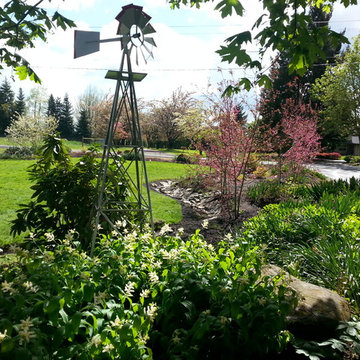
Scott & Catherine Buley. High Tech Turf & Trees , Rain Garden Nursery. Views literally "Around the Property", via our designed encircling Rain Garden with clustered trees, draw guests out into and throughout this site. Photo taken Spring 2014, immediately after trees were planted, and before final shrubs and groundcovers went in.
Find the right local pro for your project

 Till Gardens
This client's home backs up to a beautiful native Beech and Tulip woodland with an intermittent stream running through the middle of the site. After mistakenly over-clearing the natural forest saplings, the once lush woods was now bare. Called in to help re-vegetate the woodland, we designed and created a new path network through the woodland so that the client could enjoy and experience their new garden. Planted with large masses of native perennials, shade grasses and spring bulbs this back yard is now lush once again.
Design and Construction: Till Gardens (www.tillgardens.com - 201.767.5858)
Photography: John Knowlton/Till Gardens

 Mittendorf Quality Construction
Inspiration for a rustic brown one-story wood gable roof remodel in Seattle
 Pennsylvania Landscape & Nursery Association
u2014 ALE: Wayne Rain Garden
Pennsylvania Landscape & Nursery Association
u2014 ALE: Wayne Rain Garden
Terren Landscapes http://www.terrenlandscapes.com
2014 PLNA Awards for Landscape Excellence winner
Category: Residential Up to $15,000
Award Level: Gold
Project Description:
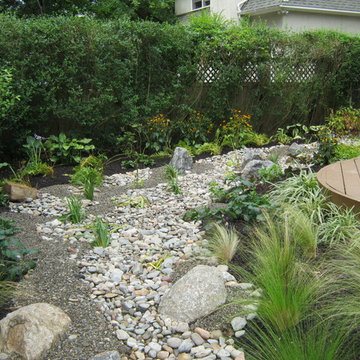
Our company was contracted by the client to provide a creative solution to an ongoing drainage problem. Their property is located within 30 feet of a local stream that collects storm water from the surrounding area. The nearby stream and high water table caused the lawn area at the side of their home to flood and to remain waterlogged for a few days after each storm. The client not only had difficulty growing plants in the existing conditions, but also had a problem with mosquitoes due to standing water.
Our goal was to design a self-contained, naturalistic rain garden that slowed storm water runoff, allowed for percolation, and promoted infiltration while permitting excess clean water to enter the nearby stream with diminished force. As designed, the rain garden allows the earth to slowly and more naturally
absorb excess storm water while filtering out toxins such as excess nitrogen and phosphorous which are frequently found in the landscape, therefore reducing the contaminants entering the stream.
A percolation test was conducted with criteria of absorbing a one-inch rainstorm within four hours without overflow. The one-inch storm calculation included an existing downspout from the home, which would be piped into the rain garden to reduce roof runoff. The first test failed due to a deep layer of high clay-content soil. Excavation continued until a layer of sandy loam was reached, the percolation test was repeated, and a successful test result was achieved. Next, the entire rain garden basin was excavated to the sandy loam layer and the soil amended with compost and sand to create a highly porous planting media.
Geotextile fabric was placed to help reduce migration of the surface stone into the soil and allow for minimal maintenance. Gravel, river stone and small boulders were carefully placed to achieve the look of a natural streambed.
A palette of mostly native plants with a few non-invasive ornamentals were chosen for their ability to survive in extreme conditions ranging from floods to drought and were placed according to their specific preferences.
Wetland plants were chosen for the lowest portion of the rain garden as that area remains saturated for longer periods of time, with a Chionanthus virginicus as a focal point surrounded by irises and ferns at the lowest depth.
Plants tolerant of drier conditions were chosen for the upper edges of the garden. The beautiful colors of Monarda, Ligularia, Eupatorium, Solidago, Chelone, and Rudbeckia were scattered within the upper edge, while movement and softness were incorporated by use of the graceful Nassella that lines the border. Finally, winter interest was provided with a backdrop of Cornus sericea.
As built, this small rain garden creates tremendous impact by decreasing the amount of storm water runoff not only on our client's property, but also in the neighboring stream. It serves as a means of slowing the water and providing an area for infiltration back into the earth. The plants provide a habitat for birds, butterflies, and insects, working in harmony with nature and providing beautiful visual interest year-round.
Photo Credit:
Lisa C. Falls
 Pennsylvania Landscape & Nursery Association
u2014 ALE: Wayne Rain Garden
Pennsylvania Landscape & Nursery Association
u2014 ALE: Wayne Rain Garden
Terren Landscapes http://www.terrenlandscapes.com
2014 PLNA Awards for Landscape Excellence winner
Category: Residential Up to $15,000
Award Level: Gold
Project Description:
Our company was contracted by the client to provide a creative solution to an ongoing drainage problem. Their property is located within 30 feet of a local stream that collects storm water from the surrounding area. The nearby stream and high water table caused the lawn area at the side of their home to flood and to remain waterlogged for a few days after each storm. The client not only had difficulty growing plants in the existing conditions, but also had a problem with mosquitoes due to standing water.
Our goal was to design a self-contained, naturalistic rain garden that slowed storm water runoff, allowed for percolation, and promoted infiltration while permitting excess clean water to enter the nearby stream with diminished force. As designed, the rain garden allows the earth to slowly and more naturally
absorb excess storm water while filtering out toxins such as excess nitrogen and phosphorous which are frequently found in the landscape, therefore reducing the contaminants entering the stream.
A percolation test was conducted with criteria of absorbing a one-inch rainstorm within four hours without overflow. The one-inch storm calculation included an existing downspout from the home, which would be piped into the rain garden to reduce roof runoff. The first test failed due to a deep layer of high clay-content soil. Excavation continued until a layer of sandy loam was reached, the percolation test was repeated, and a successful test result was achieved. Next, the entire rain garden basin was excavated to the sandy loam layer and the soil amended with compost and sand to create a highly porous planting media.
Geotextile fabric was placed to help reduce migration of the surface stone into the soil and allow for minimal maintenance. Gravel, river stone and small boulders were carefully placed to achieve the look of a natural streambed.
A palette of mostly native plants with a few non-invasive ornamentals were chosen for their ability to survive in extreme conditions ranging from floods to drought and were placed according to their specific preferences.
Wetland plants were chosen for the lowest portion of the rain garden as that area remains saturated for longer periods of time, with a Chionanthus virginicus as a focal point surrounded by irises and ferns at the lowest depth.
Plants tolerant of drier conditions were chosen for the upper edges of the garden. The beautiful colors of Monarda, Ligularia, Eupatorium, Solidago, Chelone, and Rudbeckia were scattered within the upper edge, while movement and softness were incorporated by use of the graceful Nassella that lines the border. Finally, winter interest was provided with a backdrop of Cornus sericea.
As built, this small rain garden creates tremendous impact by decreasing the amount of storm water runoff not only on our client's property, but also in the neighboring stream. It serves as a means of slowing the water and providing an area for infiltration back into the earth. The plants provide a habitat for birds, butterflies, and insects, working in harmony with nature and providing beautiful visual interest year-round.
Photo Credit:
Lisa C. Falls

 Richard P. Rauso, ASLA, Landscape Architects
Richard P. Rauso, ASLA
Design ideas for a small contemporary full sun front yard water fountain landscape.
Design ideas for a small contemporary full sun front yard water fountain landscape.
 Village Landscape Architecture
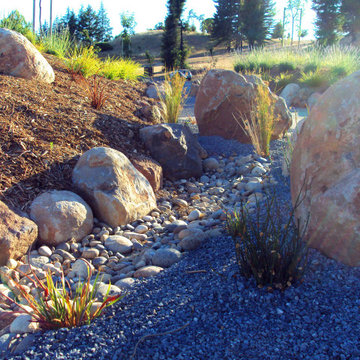
Cobbles with pebbles are blended to beautify a driveway swale (and also slow storm water, increase infiltration of storm water into soil and reduce downstream erosion issues). Evergreen rushes, irises and grasses soften the rock work and increase the riparian feel.
 Pennsylvania Landscape & Nursery Association
u2014 ALE: Wayne Rain Garden
Pennsylvania Landscape & Nursery Association
u2014 ALE: Wayne Rain Garden
Terren Landscapes http://www.terrenlandscapes.com
2014 PLNA Awards for Landscape Excellence winner
Category: Residential Up to $15,000
Award Level: Gold
Project Description:
Our company was contracted by the client to provide a creative solution to an ongoing drainage problem. Their property is located within 30 feet of a local stream that collects storm water from the surrounding area. The nearby stream and high water table caused the lawn area at the side of their home to flood and to remain waterlogged for a few days after each storm. The client not only had difficulty growing plants in the existing conditions, but also had a problem with mosquitoes due to standing water.
Our goal was to design a self-contained, naturalistic rain garden that slowed storm water runoff, allowed for percolation, and promoted infiltration while permitting excess clean water to enter the nearby stream with diminished force. As designed, the rain garden allows the earth to slowly and more naturally
absorb excess storm water while filtering out toxins such as excess nitrogen and phosphorous which are frequently found in the landscape, therefore reducing the contaminants entering the stream.
A percolation test was conducted with criteria of absorbing a one-inch rainstorm within four hours without overflow. The one-inch storm calculation included an existing downspout from the home, which would be piped into the rain garden to reduce roof runoff. The first test failed due to a deep layer of high clay-content soil. Excavation continued until a layer of sandy loam was reached, the percolation test was repeated, and a successful test result was achieved. Next, the entire rain garden basin was excavated to the sandy loam layer and the soil amended with compost and sand to create a highly porous planting media.
Geotextile fabric was placed to help reduce migration of the surface stone into the soil and allow for minimal maintenance. Gravel, river stone and small boulders were carefully placed to achieve the look of a natural streambed.
A palette of mostly native plants with a few non-invasive ornamentals were chosen for their ability to survive in extreme conditions ranging from floods to drought and were placed according to their specific preferences.
Wetland plants were chosen for the lowest portion of the rain garden as that area remains saturated for longer periods of time, with a Chionanthus virginicus as a focal point surrounded by irises and ferns at the lowest depth.
Plants tolerant of drier conditions were chosen for the upper edges of the garden. The beautiful colors of Monarda, Ligularia, Eupatorium, Solidago, Chelone, and Rudbeckia were scattered within the upper edge, while movement and softness were incorporated by use of the graceful Nassella that lines the border. Finally, winter interest was provided with a backdrop of Cornus sericea.
As built, this small rain garden creates tremendous impact by decreasing the amount of storm water runoff not only on our client's property, but also in the neighboring stream. It serves as a means of slowing the water and providing an area for infiltration back into the earth. The plants provide a habitat for birds, butterflies, and insects, working in harmony with nature and providing beautiful visual interest year-round.
Photo Credit:
Lisa C. Falls
 TN Nursery
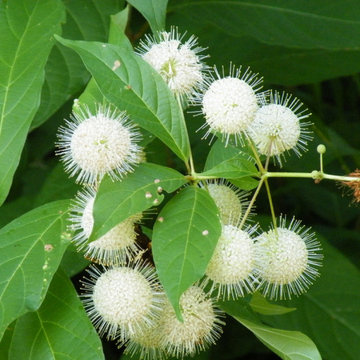
Homesteads are about function as much as beauty, and button bush delivers on both fronts. Its willingness to grow in wet areas makes it perfect for landscape spots that other plants avoid. Those damp corners aren’t wasted space when you plant button bush — they become intentional, lively parts of your yard.
The shrub’s dense form also doubles as a natural screen or border. Planted in groups, button bush makes a soft edge against lawns, gardens, or pathways. Its rounded shape and textured blooms maintain structure without feeling overly formal. That’s especially nice in landscapes that lean toward natural design.
But function doesn’t end there. In wetter areas, button bush helps reduce erosion and standing water. Its roots absorb moisture and give soil something to cling to, which makes it a practical choice in drainage swales or near water features. Pollinators and wildlife find value here too — that’s an added bonus that makes landscapes feel balanced and alive.
If your homestead includes gardens, fields, or natural plantings, button bush fits right in. It holds space well, supports life, and brings seasonal interest without demanding constant care — qualities that make it a smart, functional choice.
Get button bush here:
https://www.tnnursery.net/products/button-bush
https://treenurseryco.com/button-bush-shrub
https://www.onlineplantnursery.com/products/button-bush-live-stakes
https://www.wholesalenurseryco.com/products/button-bush
https://www.tennesseewholesalenursery.com/products/button-bush

 Matthew Giampietro Garden Design
Waterfall and garden ponds in this backyard features a stone bridge and large koi pond. Backyard Waterfall, water garden, garden design by Matthew Giampietro of Waterfalls Fountains & Gardens Inc.

 Kariouk Associates
A Family Retreat in Rural Ontario
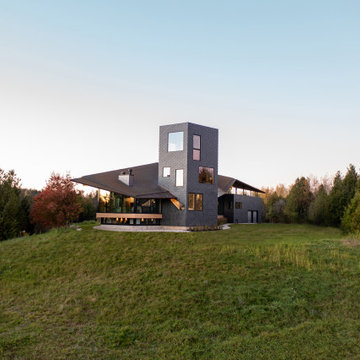
The clients for this project live abroad, and sought a Canadian homestead — an anchor — for their large, young family. During summer and winter holidays, the parents wanted their children immersed in an Ontario landscape like the one in which they were raised.
To this end, they requested a “rustic, modern retreat” for their 100-acre property of forest, wetland, and meadows.
The family sought a generous home to allow young teenagers and extended family to be comfortable in a remote area for long stays. They sought a casual, comfortable space for the family and their dogs that would encourage activities like hiking and snowshoeing — no fancy entertaining.
Under One Roof
The most powerful aspect of the design is the long, tent-like roof, which follows the site’s topography. The roof and its ridge beam became the design’s primary focus, shaping the circulation path through the home’s interior, ultimately extending a view toward the forest.
A primary technical challenge was the roof’s structure, which despite its 60-metre length needed to seem light. The folds and angles of the steel roof are supported by the meandering ridge-beam.
The roof cantilevers and tapers at all edges. At the entry side of the house, the roof lifts like a bird’s wing off the garage volume beneath, sheltering an outdoor terrace.
Playing with Heavy and Light
Monolithic slate-clad volumes anchor the home and define the space between the curtains of glass. These opaque volumes echo the property’s rock outcrops. The garage, bathrooms, stairs, and pantry are grouped inside, and appear to hold up the dynamic roof.
Steel construction was chosen to avoid using the expected material of heavy timber for this forest getaway. Being cognizant of the clients’ desire for a warm interior, it was also important to avoid modernist tendencies for box-like forms.
Because the main floor is lifted above the ground and the topography falls away, the main floor is in the treetops while simultaneously filling the lower recreation area with light.
A Contemporary Approach to Warmth and Closeness
The continuous space of the home, with only bedrooms and bathrooms closed off, is a layout that underscores closeness.
The family areas and parents’ area are on the main level. The kids’ bedrooms are bundled into a single slate-clad volume, suspended like a cocoon above the main floor from a 40’ steel beam and accessed by a catwalk.
Sustainability
To avoid cutting trees, the home was placed on an existing cleared ridge overlooking a wildflower meadow.
The home is heated and cooled via a geothermal unit with summer solar gain reduced by significant roof overhangs. The glass walls are triple-pane, and high-efficiency fixtures and equipment for the well and septic system help reduce the home’s environmental impact.
Historically, the Canadian identity has been defined by our relationship to the land. Fulfilling the client’s mandate, the home honours that emotional connection through visual and material harmonization with its surroundings.


 Bliss Garden Design, LLC
Bliss Garden Design
This is an example of a contemporary landscaping in Seattle.
This is an example of a contemporary landscaping in Seattle.

 Acorn Ponds & Waterfalls
, we install ponds, water features and low maintenance water gardens. Renovation, Repair and Maintenance are our specialties. Check out our website http://www.acornponds.com and give us a call 585.442.6373.
Ecosystem Pond Maintenace, Spring Pond or Water Garden Maintenance.
Acorn Ponds & Waterfalls Rochester, Monroe County NY.
585-442-6373 Contact us now to get on our spring pond maintenance schedule, or Please click here: http://www.acornponds.com/spring-maintenance.html
Spring Pond Maintenance, what should water garden and pond owners be doing in the spring? In general it is alway a good idea to do a complete pond clean out in the spring. Here in Monroe County, Rochester NY the winters can be harsh and we recommend to shut down the pond so there are no surprises in the spring. Early spring is the best time to perform your pond clean out ( before the beneficial bacteria become re-established). Once completed, you can enjoy your pond for the rest of the season with very little maintenance.
Keep your pond looking good and your fish healthy with regular pond clean out and maintenance in the spring.
First, drain the pond down to a few inches and pump some of the water into a storage tank for the fish. Now, we can catch the fish more easily, place them in the tank and cover them up.
Next, drain the pond down completely and remove all solids such as leaves and twigs. Take out all the filter media in the biofalls and skimmer. Once removed we then shop-vac out the biofalls and skimmer.
Pond Maintenance NY, Water Feature Maintenance, Pond Algae, Green Water Solutions Monroe County Rochester NY Pond Maintenance NY, Pond Cleaning NY, Koi and Fish Pond Cleaning and Maintenance NY by Acorn Ponds & Waterfalls of Rochester NY in, NY, Install Pond Skimmer, Install Pond Biofalls, Rochester NY, New York, Pond cleaning service Rochester NY, clean out ponds Rochester NY, Water Feature Service Rochester NY, algae control Rochester NY.
Algae problems, algae solutions, Fixing Algae in Fish Ponds, Water features NY, Service NY, Power wash landscape ponds Rochester NY, New York Pond Maintenance Rochester NY, Pond washing Rochester NY, Waterfalls Rochester NY, Ponds Rochester NY, pond design in Rochester NY, water garden service Rochester NY, backyard pond maintenance Rochester NY, pond Rochester NY, Water Garden Feature service Rochester NY, waterfall Rochester NY,
Pond construction Rochester NY, pond installation Rochester NY, Pondless waterfalls Rochester NY, pond building or Replace Rochester NY, landscape ponds Rochester NY, pond plants Rochester NY, pond ecosystem Rochester NY, pond filtration Rochester NY, Pond Fish Rochester NY, koi ponds Rochester NY, pond less waterfalls, pond waterfalls, watergarden design in Fairport, Webster, Brighton, Spencerport, Pittsford, Repair or Repairs Rochester NY.
Fix or Fixes Rochester NY, Re-do Rochester NY, Henrietta NY, Victor, Greece, Gates, East Rochester, Penfield, Pond less waterfalls Rochester NY Monroe County, Rain Water Collection Systems Rochester NY, Permeable Pavers Rochester NY, Rain Water Harvest Systems Rochester NY, Sustainable Gardens Rochester NY, Certified Aquascape Contractor of New York, Pond Designer
 Matthew Giampietro Garden Design
Waterfall and garden ponds in this backyard features a stone bridge and large koi pond. Backyard Waterfall, water garden, garden design by Matthew Giampietro of Waterfalls Fountains & Gardens Inc.
 Matthew Giampietro Garden Design
Waterfall and garden ponds in this backyard features a stone bridge and large koi pond. Backyard Waterfall, water garden, garden design by Matthew Giampietro of Waterfalls Fountains & Gardens Inc.


1