
Search results for "Self discipline" in Home Design Ideas
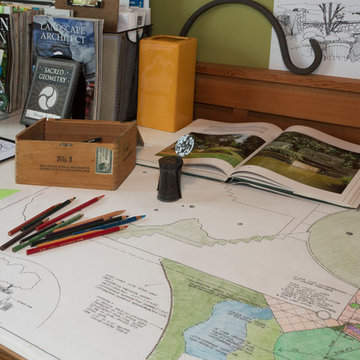
 Margot Hartford Photography
Photo: Margot Hartford © 2015 Houzz
Landscape Design: Chris Kukula
http://www.houzz.com/ideabooks/56354604/list/my-houzz-backyard-cottage-office-and-an-artful-low-water-garden
 Neumann & Rudy Architecture
**I. Spatial Composition & Architectural Volume**
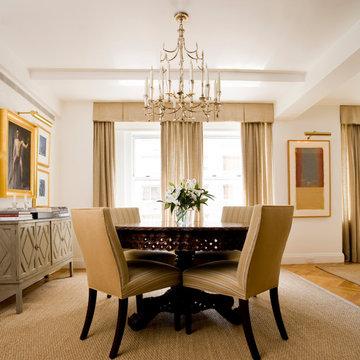
This is a pre-war Manhattan dining room whose proportions have been surgically clarified rather than reinvented. The room reads as a compressed rectilinear volume, its ceiling plane articulated by a shallow dropped soffit and a single exposed transverse beam — a candid acknowledgment of the building's structural grid, left legible rather than concealed behind a coved plaster surround. That beam performs a quiet spatial function: it registers the threshold between the dining zone and the adjoining passage at right, where a sliver of herringbone parquet and a second curtained aperture extend the sightline into a further room, relieving the enclosure and establishing a discreet enfilade. The composition is emphatically axial and symmetrical — chandelier, floral centerpiece, pedestal table and central window mullion align on a single spine — yet the symmetry is deliberately imperfect: the flanking chairs are turned inward on the diagonal, the sideboard weights the left wall, and the artwork on the right hangs off-axis. The result is a Beaux-Arts discipline softened by a decorator's asymmetry. Most consequential is the pelmet, a deep upholstered box valance carried nearly wall-to-wall, which annexes the window into a single monumental glazed field and visually raises the ceiling by drawing the eye above the actual head height of the sash.
**II. Materiality, Color & Texture**
The palette is a study in monochromatic warmth held within a narrow tonal band of buff, oatmeal, flax and champagne, with saturation kept deliberately low so that texture carries the burden of variety. Underfoot, a wall-to-wall seagrass or sisal matting with a coarse basketweave provides the room's tactile bass note — hard-wearing, faintly agricultural, and set in productive tension with the refined silk-and-linen sheen of the curtains and pelmet. The chairs are a masterstroke of dual upholstery: matte sand-toned fabric on the outside back and a subtle self-striped ottoman weave on the seat and inner face, a device that renders the seating both plush and graphic. Against this envelope of pale neutrals, two dark accents supply the necessary chromatic gravity: the deeply carved, pierced-apron rosewood or mahogany center table, almost Anglo-Indian in its fretwork and baluster pedestal, and the ebonized klismos-splayed chair legs that echo it. The left wall introduces a painted, dry-brushed Gustavian-style commode with lozenge-fretwork doors, its chalky grey-green a cool counterpoint, while gilt frames, a burnished picture light and the silvered chandelier thread a metallic warmth through the whole.
**III. Lighting, Atmosphere & Style Profile**
Daylight is the room's primary illuminant and it is handled with restraint: the curtains are dressed open but the roman-like sheer inner treatment diffuses the light into a milky, north-facing wash that flattens shadow and flatters the neutral surfaces. Artificial lighting is layered and entirely decorative in expression — the tall, attenuated candle-arm chandelier, hung low and generously scaled, functions as sculpture and as the room's compositional keystone, while two swing-arm brass picture lights provide directional accents that anchor the art as evening focal points. There is no visible downlighting or recessed apparatus; the mood is candlelit, hushed and faintly nocturnal even in daytime. Stylistically the room resolves into what might be termed **Refined Neutral Traditionalism** — an American-classical, Bilhuber-adjacent idiom that marries eighteenth-century Swedish and Anglo-colonial furniture archetypes with contemporary tailoring, tonal upholstery and humble natural-fiber flooring. Its sophistication lies precisely in that calibration: heirloom silhouettes stripped of pattern and color noise, so that carving, weave and gilding become the sole ornamental language.
 Neumann & Rudy Architecture
## I. Spatial Composition & Architectural Volume
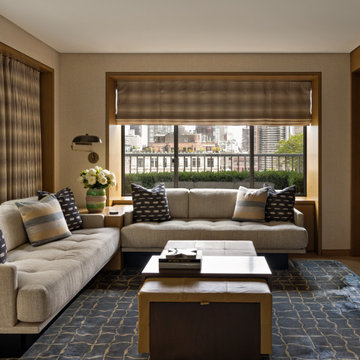
This is a compact urban salon organized with almost Miesian discipline around a single, decisive gesture: the L-configuration of low, tuxedo-armed banquette seating that hugs two perimeter walls and turns the room inward upon itself. The plan reads as a conversation pit without excavation—the seat heights are deliberately suppressed, the backs held low, so that the horizon of upholstery never competes with the aperture behind it. Above, a flat, unadorned plaster soffit-plane is held tight to the wall line, its perimeter reveal drawing a crisp shadow-gap that lets the ceiling appear to float free of the fabric-wrapped walls. The architectural protagonist is the millwork: a deep-jambed picture window recessed within a wide, radiused casing of pale rift-sawn oak, its returns thickened into a continuous window seat and low credenza that transitions seamlessly into flanking cabinetry. This joinery performs double duty as tectonic frame and furniture, resolving the corner where the sofa arm meets the wall with a fitted oak console rather than a leftover void. On the right, a taller oak portal—part case-goods, part passage—houses a monolithic dark media volume, its recessive blackness anchoring the composition's east edge and countering the pull of the glazing. Sightlines are carefully triangulated: the low furniture, the horizontal blind valance, and the parapet railing beyond stack into a series of registers that push the eye out over the rooftops, borrowing the cityscape as a fourth wall.
## II. Materiality, Color & Texture
The palette is a study in warm neutrality calibrated across a very narrow tonal band, where interest is generated by texture rather than chroma. Walls are sheathed in a woven grasscloth or linen-weave wallcovering in oatmeal-taupe, its subtle grain absorbing light and lending the envelope a matte, tactile softness that reads almost suede-like in raking illumination. Against this, the oak millwork supplies a honeyed mid-tone with visible cathedral figure, satin-lacquered rather than glossed, so the wood glows without reflecting. Upholstery is a heavy natural linen in flax, deeply channel-tufted and biscuit-quilted—an insistent geometry of dimples and seams that catches light and prevents the mass from flattening. The textile program is where the room permits itself wit: indigo-and-ecru ikat or resist-dyed pillows introduce the only true saturation and the only irregular, hand-made mark; a wool blanket-stripe cushion in wheat, dove, and slate mediates between them; and the tailored roman shade and pinch-pleat drapery, in a subtly striated ombré weave of bronze, sand, and pewter, act as a tonal bridge between wall and wood. Below, the field shifts cool—an abrasi or silk-and-wool rug in ink and petrol blue, overlaid with a sinuous ogee lattice in muted gold, whose viscose sheen produces directional shimmer against the room's otherwise matte disposition. Leather appears twice, in caramel-toned saddle upholstery on the twin benches and ottoman, its topstitched panels and strap-pull detailing offering the crispest edge in the room; the espresso-stained coffee table and plinths supply the necessary chromatic bass note. A single celadon-and-blush ceramic vessel, with its banded, glazed belly, functions as a deliberate polychrome accent—an object of arrested attention within a rigorously restrained field.
## III. Lighting, Atmosphere & Style Profile
Daylight is the primary luminaire and it is meticulously managed. The roman shade is dropped to roughly one-third, cropping the sky and glare while framing the mid-ground rooftops—a device that converts an ordinary window into a horizontal, cinematic panorama. Concealed cove or integrated LED lighting within the oak jamb washes the reveal from within, so the window surround reads as a self-illuminated frame and the transition from interior brightness to exterior daylight is softened rather than silhouetted; the same strategy grazes the wall panel behind the sofa, producing a gentle vertical gradient. Artificial light is otherwise almost entirely decorative and directional: a swing-arm wall sconce in antiqued brass with a domed, spun-metal shade cantilevers over the corner console, its low placement establishing a task-scaled pool of warmth and reinforcing the room's insistent horizontality. The resultant atmosphere is hushed, enveloping, and distinctly crepuscular—a lounge tuned for late-afternoon light and low conversation. Stylistically, the project synthesizes a mid-century modern armature—low-slung planar seating, tuxedo arms, brass and dark wood—with the tactile restraint of contemporary Warm Minimalism and a discernible strain of Japanese-influenced spatial editing: deep reveals, floating planes, an appreciation for the void, and objects placed with ikebana-like economy. One might classify it as Refined Urban Modernism, or a bespoke Warm Minimalism, in which luxury is expressed not through ornament but through the precision of joinery, the depth of the material palette, and the discipline with which the view is framed.
Find the right local pro for your project
 Luula
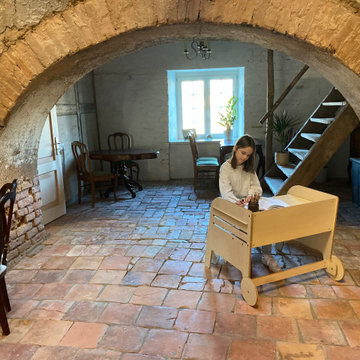
LuulaAttractive design from Italian designer Ezio Pescarori makes the set a special place for dreams and fantasy adventures!
The main advantage of the Wheel table and chair set is height adjustable. It meets the needs of children from the time the child is ready to sit up to a height of 150 cm (60 in). According to our latest product tester, Kurt, even people under the age of two are entitled to their individual space for creative activities. Comfortable, ergonomic, funny- place for create anything, whatever you want! According to Maria Montessori, the main goal is for the child to learn to learn with interest and joy. Self-motivation, self-discipline, self-discovery - children's ability to develop their potential, independence, systematic approach to problem solving, acquisition of knowledge and skills and at the same time increasing the joy of learning is not possible without an appropriate environment.

 DeVrye Renovations
Meet Chad Elgie. Lead Hand.
Chad is a hardworking and self-motivated carpenter. He is always enthusiastic about learning new skills and is disciplined in his execution. In his spare time Chad enjoys working on his home, fishing, and spending time with his Wife and friends.
1