
Search results for "Sole objective" in Home Design Ideas


 GS Construction
Example of a small classic 3/4 white tile and stone tile mosaic tile floor alcove shower design in Chicago with an undermount sink, recessed-panel cabinets, black cabinets, quartzite countertops, a two-piece toilet and gray walls

 Teakwoodcentral
Light fixture with direct emission, with fluorescent sources
• Available with base or fixed support (pivot) made up of mass-coloured concrete
• Diffuser in mass-pigmented polypropylene, screen in light-diffusing silkscreened methacrylate, reflector in painted aluminum
• Mobile-arm structure in extruded EN-AW-6060 aluminum with bright anodizing treat¬ment
• Polished-painted articulations in die-cast EN-AB 46100 aluminum
• Adjustment system in AISI 316 stainless steel
• Silicone seal gaskets
• Suitable for watertight connection
• Electronic ballast
• c.UL.us listed
Lead time: 2 - 4 weeks
Lamping explanation:
INC = incandescent FLU = fluorescent HAL = 120V halogen LV HAL = 12V halogen
MH = metal halide SBF = self-ballasted fluorescent LED = light emitting diode
All lamps are included with the fixtures
Artemide's design and research team focuses on developing quality and long-lasting products.
Utilization of recyclable materials is high priority in our process of conceiving new design.
80% of our lights are energy efficient fluorescent or LED lighting.
But what's more green than having a beautifully crafted light that continues to function well and looks stunning decades from now
The Artemide light has never been solely a function of seeing, or an opportunity for formal experimentation with lamps as objects. For more than forty years, Artemide has aimed to propose light as a companion to people, as a source of physical pleasure and mental comfort. Artemide has done so, with different work groups, searching through the whole design process, starting with a declaration of values - The human light.
Beyond the definition, the human light is intelligent light. A light that knows it has to relate to people, accompanying them in their daily activities. That is why Artemide's attention today is concentrated on the concept of the context of life, understood as a specific microenvironment in which an event occurs where one or more persons are the protagonist, every context of life can be associated with different light contexts, or the different atmospheres of light characterized by the activities that, at various moments of the day, have us as protagonists, starting from these contexts and the lighting conditions that characterize them, Artemide proposes products capable of meeting people's multiple needs and offering the light performance characteristics most suited to each moment of life, it is light that is flexible and adaptable, which produces the optimum visual precision, and consumes the minimum environmental resources, it is Artemide light.
The Artemide group, founded by Ernesto Gismondi in 1959, today operates throughout the world, with 16 subsidiaries and affiliated companies, and 35 exclusive distributors. They have production centers in Italy, France, Germany, the USA, Hungary and the Czech Republic. In a policy aimed at satisfying all lighting needs, the Artemide group has recently acquired companies that reinforce its position as a world leader and further diversifies the offerings. For contexts of life, Artemide offers not only lamps for moments of relaxation at home, but also large sophisticated installations for lighting public and private professional activities.
Technological and productive expertise is achieved through research and development centers, with the product planning and engineering section, laboratories for technical conformity and self-certification tests, and production units equipped with avant-garde processes. A production structure that can offer expertise in the processing of traditional materials such as glass, as well as the capacity for innovation with recently introduced materials such as titanium. Lighting performance characteristics extend from a light with atmosphere, variable, colored, to the most precise of lights for community environments. The vast range of options reflects the commitment of the whole organization to provide a product guaranteed by the Artemide brand, throughout the world, with an image that is strong and consistent - That of a leader in the lighting industry.
Rezek, an Artemide brand, with product development and manufacturing in the United States. Founded by designer Ron Rezek in 1978, the Rezek company has gained strong recognition and appreciation among the architectural and interior design community for the distinctly creative design and quality construction of its American made lighting products for residential and commercial applications.
Find the right local pro for your project
 Mr Shishir
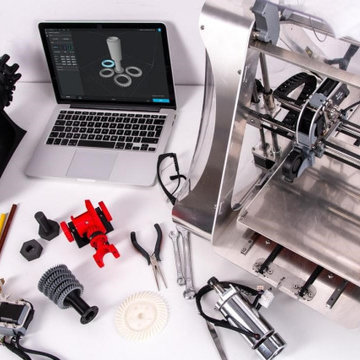
Computer numerical control or CNC machining is an automated manufacturing process used to make components of devices or appliances. It employs computer-aided software and codes to control complex machinery, including mills, grinders, lathes, and cutters. It is used to manufacture multiple parts from diverse raw materials such as aluminium, brass, acrylic, plastics, and wood.
It is a subtractive process in which a solid piece of material is carved into a 2D or 3D object of any shape or size. This enables the creation of prototypes for parts and finished products. It also enables automated mass production of parts such as fittings, housings, brackets, gears, fasteners, shafts, electrical contacts, and moulds using specific materials.
This process is a quick, safe, versatile, precise, and cost-effective production method. These advantages allow it to be used for various applications in industries ranging from healthcare and electronics to aerospace and the military. Moreover, it is used to create parts for several objects you use at home every day.
Here are 10 things in your house that you may not know are manufactured using CNC machining:
1. Kitchen Appliances
Several manufacturers employ CNC machines to create heavy-duty parts for durable kitchen appliances. Through pre-programmed software, the machine produces parts of different shapes, sizes, colours, and textures using a variety of materials like metals and plastic.
CNC-machined components of kitchen appliances include metal plates, covers, textured handles, pins, rings, and wires. These small but essential parts improve the utility of your everyday kitchen appliances such as the electric can opener, dishwasher, hand blender, grinder, and coffee brewing machine.
2. Electronic Devices
Components of electronic devices are usually small in size and have fine details and shapes that require precision machining. CNC machines offer the flexibility and efficiency to manufacture large and small parts of various shapes, sizes, and materials required to complete electronic appliances.
CNC machining enables accurate, computerized prototyping and the production of detailed, intricate, and sensitive parts from a wide range of metals. It can be used to produce parts such as connectors, housing, wires, heat sinks, semiconductors, and fixtures. It can also be used to create the chassis or the framework of various electronic appliances.
You can find CNC-machined parts in the following electronic home appliances:
- Laptops and Computers
- Mobile phones
- Cameras
- Television
- Speakers
- Keyboard
- Mouse
- Router
- Refrigerator
- Air conditioner
- Washing machine
- Fans, air purifiers, and humidifiers
- Robotic vacuum cleaners
- Remote control
 Neumann & Rudy Architecture
**Spatial Composition & Architectural Volume**
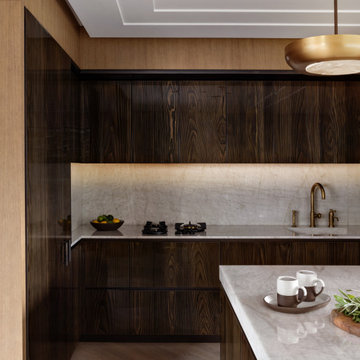
The kitchen is organized as a tightly disciplined L-configuration, with a perimeter run terminating against a full-height flanking volume of pale oak that functions less as cabinetry than as a piece of architecture — a plinth-like wall plane that crops the composition and establishes a deliberate foreground register. The photograph is constructed around this layered depth: a near-field vertical panel in figured, high-gloss timber, a middle ground of stone counter and backsplash, and a partial view of the island's marble slab entering from the right, its mitred waterfall edge implying a broader room beyond the frame. Overhead, a recessed coffer with a slender illuminated reveal introduces a subtractive geometry that lightens the ceiling plane and visually widens the volume, while a bronze-toned reveal band above the upper cabinetry acts as a horizontal datum, resolving the tall casework into a controlled cornice line. The millwork is resolutely frameless and handleless — grain-matched, push-latch or channel-pull, with a single elongated vertical bar as the sole legible hardware gesture — producing an unbroken rhythm of vertical joints that reads as continuous paneling rather than a sequence of doors. Sightlines are horizontal and calm, with the sink and cooktop absorbed into the counter plane so that no appliance disrupts the elevation's monolithic character.
**Materiality, Color & Texture**
The palette is a study in tonal wood contrast: a light, straight-grained rift-cut white oak with cool, slightly greyed undertones on the flanking wall and upper wall plane, set against a deeply fumed or shou-sugi-ban-inflected timber — likely charred cedar or ebonized ash — whose cathedral figuring erupts across the cabinet fronts in swirling, almost calligraphic pattern. The dark casework carries a lacquered or oiled sheen high enough to register soft specular reflection, an unexpected gloss that animates the grain and prevents the mass from reading as flat or inert. Countertops and the full-height backsplash are executed in a pale calcite or quartzite with a scratched, hairline-veined surface and a warm ivory-to-buff cast, honed rather than polished so that light diffuses rather than bounces. Metals are exclusively unlacquered brass in varying states of patina — the gooseneck faucet, cross-handle valves and pot-filler read as aged, almost archaeological, their warm amber oxidation echoed by the burnished spun-brass pendant. Accessory objects sustain the discipline: a dark turned-wood fruit bowl with citrus supplying the only chromatic accent, matte stoneware mugs in a two-tone glaze, and a raw olivewood board with sage — organic, low-saturation, tactile counterpoints to the machined precision of the joinery.
**Lighting, Atmosphere & Style Profile**
Illumination is almost entirely architectural and indirect. A concealed linear source beneath the upper cabinets grazes the stone backsplash, throwing a soft luminous gradient that dissolves upward and makes the slab appear internally lit — the room's principal light event and its emotional center. This is reinforced by the ceiling's perimeter reveal, which washes the plane without visible fixtures, and by the alabaster-diffused brass pendant, whose disc of translucent stone glows with a low-kelvin warmth entirely consonant with the metalwork below. Daylight appears to enter obliquely from beyond the frame, modelling the oak wall in a gentle falloff; the overall exposure is low-key and chiaroscuro-adjacent, with deep, velvety shadow permitted in the lower casework. The resulting atmosphere is hushed, cellar-cool yet materially warm — contemplative rather than performative. Stylistically, the project synthesizes into a refined **warm minimalism with distinct Japandi inheritance**: the reductive planarity and joint discipline of European modernist cabinetry married to a Japanese sensibility for charred timber, grain expression, and the elevation of patina and imperfection. It is a kitchen conceived as a quiet interior landscape — appliance-suppressed, ornament-free, and dependent for its richness entirely on the intrinsic character of its materials.

 Ehrlich Yanai Rhee Chaney Architects
The ground floor volumes wrapped in an elongated hand-fired brick, emphasizing the horizontality of the architecture that lays solidly on the land.
(Photography by: Matthew Millman)

 Borden Interiors & Associates
Riad Tile
Bathroom - contemporary cement tile floor and pink floor bathroom idea in Santa Barbara
Bathroom - contemporary cement tile floor and pink floor bathroom idea in Santa Barbara

 Trimlite
Inspiration for a mid-sized contemporary porcelain tile and multicolored floor hallway remodel in Vancouver with beige walls

 Supreme Pools
Hot tub - large southwestern backyard brick and rectangular lap hot tub idea in Phoenix


 CAVINESS LANDSCAPE DESIGN, INC.
Landscape Design and Construction by Caviness Landscape Design, Oklahoma
Photography by Jimmy Nix
Pool fountain - mid-sized traditional backyard stone and l-shaped lap pool fountain idea in Oklahoma City
Pool fountain - mid-sized traditional backyard stone and l-shaped lap pool fountain idea in Oklahoma City


 FINNE Architects
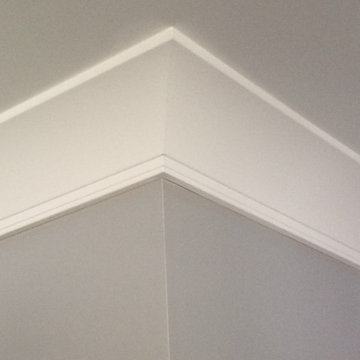
The master bath features stunning views of Puget Sound.
The glass walls between the bath and hall have a hand-drawn etched glass pattern.
Photo: Benjamin Benschneider

 T.A. French - Custom Builder
Example of a mid-sized transitional dark wood floor and brown floor double front door design in Austin with gray walls and a black front door

 The Artists Hands - Faux Finishes
This remodeled bedroom was upgraded to an elegant and sophisticated master retreat. Using metallic plasters and various techniques of application with this beautiful repeat stencil pattern, this accent wall is a stunning focal feature of this master bedroom. Copyright © 2016 The Artists Hands

 Charlen's Abstracts
This 30" x 24" abstract acrylic painting has been done in shades of cobalt blue, sky blue, citrine, chartreuse, white, soft sea green, and royal blue. Finished in gloss varnish to protect the piece from dust and UV light for years to come. Can be hung vertically or horizontally. Gorgeous vivid rich colors in a great contemporary style.



 Custom Surface Solutions
 (www.css-tile.com) - Owner Craig Thompson (512) 430-1215. This project shows the remodel of a small 1950's vintage home master bathroom. 8"" x 18" Calcutta gold marble tile was used on the shower walls and floor wall base and ceramic gray penny tile on the floor. Shower includes curbless pan / floor, dual shower boxes, frameless glass slider, trough duel fixture sink and chrome fixtures.
2