
Search results for "Steep garden slope" in Home Design Ideas


 Ambiance Garden Design, LLC
This home is extraordinary due to its panoramic views of the lake. It is, however, situated on a steep slope, which is tough gardening.
Inspiration for a traditional landscaping in Charlotte.
Inspiration for a traditional landscaping in Charlotte.


Find the right local pro for your project


 Mediterrasian Landscapes
The client wanted a garden that carried the spirit of her homeland — the forms, textures, and quiet drama of a Japanese garden — set down in a subdivision of Western-style homes enclosed by matching aluminum fences. The site itself posed the real challenge: a backyard on a 55% slope, with little natural sense of arrival or destination.
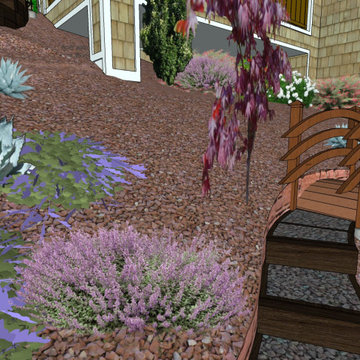
The design answers with a meandering gravel pathway that winds down, across, and up the grade through a series of distinct micro-environments, each defined by its own plant grouping. Hairpin turns and boulder retaining walls hold the banks in place, with beds of reddish mulch tying the slope together visually. An arched wooden footbridge, finished with copper post caps, serves as the garden's focal point and carries the design's Japanese sensibility — echoed in the curved, layered railings that continue along the stairways above and below it. A single Japanese maple stands as a deliberate nod to the tradition, set among a bolder planting of agaves, aloes, and other drought-tolerant succulents suited to the Bay Area climate — together transforming a steep, awkward backyard into a serene, immersive retreat.
The installation, by Arborist Now, has required the kind of grading, stonework, and structural skill a slope this steep demands — the craft is as much a part of the story as the design.
 Mediterrasian Landscapes
The client wanted a garden that carried the spirit of her homeland — the forms, textures, and quiet drama of a Japanese garden — set down in a subdivision of Western-style homes enclosed by matching aluminum fences. The site itself posed the real challenge: a backyard on a 55% slope, with little natural sense of arrival or destination.
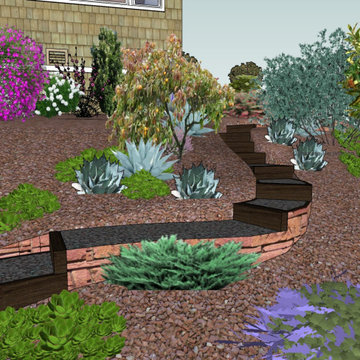
The design answers with a meandering gravel pathway that winds down, across, and up the grade through a series of distinct micro-environments, each defined by its own plant grouping. Hairpin turns and boulder retaining walls hold the banks in place, with beds of reddish mulch tying the slope together visually. An arched wooden footbridge, finished with copper post caps, serves as the garden's focal point and carries the design's Japanese sensibility — echoed in the curved, layered railings that continue along the stairways above and below it. A single Japanese maple stands as a deliberate nod to the tradition, set among a bolder planting of agaves, aloes, and other drought-tolerant succulents suited to the Bay Area climate — together transforming a steep, awkward backyard into a serene, immersive retreat.
The installation, by Arborist Now, has required the kind of grading, stonework, and structural skill a slope this steep demands — the craft is as much a part of the story as the design.
 Mediterrasian Landscapes
The client wanted a garden that carried the spirit of her homeland — the forms, textures, and quiet drama of a Japanese garden — set down in a subdivision of Western-style homes enclosed by matching aluminum fences. The site itself posed the real challenge: a backyard on a 55% slope, with little natural sense of arrival or destination.
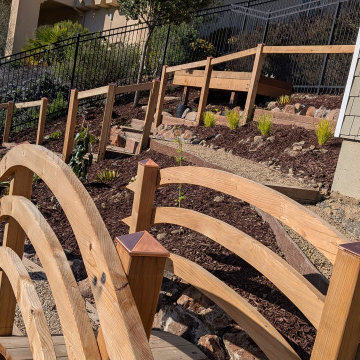
The design answers with a meandering gravel pathway that winds down, across, and up the grade through a series of distinct micro-environments, each defined by its own plant grouping. Hairpin turns and boulder retaining walls hold the banks in place, with beds of reddish mulch tying the slope together visually. An arched wooden footbridge, finished with copper post caps, serves as the garden's focal point and carries the design's Japanese sensibility — echoed in the curved, layered railings that continue along the stairways above and below it. A single Japanese maple stands as a deliberate nod to the tradition, set among a bolder planting of agaves, aloes, and other drought-tolerant succulents suited to the Bay Area climate — together transforming a steep, awkward backyard into a serene, immersive retreat.
The installation, by Arborist Now, has required the kind of grading, stonework, and structural skill a slope this steep demands — the craft is as much a part of the story as the design.
Sponsored
Columbus, OH
Free consultation for landscape design!

Peabody Landscape Group
Columbus' Reliable Landscape Design & Contracting
 Mediterrasian Landscapes
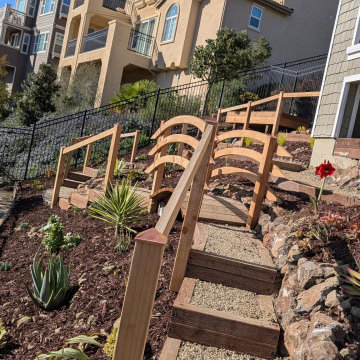
The client wanted a garden that carried the spirit of her homeland — the forms, textures, and quiet drama of a Japanese garden — set down in a subdivision of Western-style homes enclosed by matching aluminum fences. The site itself posed the real challenge: a backyard on a 55% slope, with little natural sense of arrival or destination.
The design answers with a meandering gravel pathway that winds down, across, and up the grade through a series of distinct micro-environments, each defined by its own plant grouping. Hairpin turns and boulder retaining walls hold the banks in place, with beds of reddish mulch tying the slope together visually. An arched wooden footbridge, finished with copper post caps, serves as the garden's focal point and carries the design's Japanese sensibility — echoed in the curved, layered railings that continue along the stairways above and below it. A single Japanese maple stands as a deliberate nod to the tradition, set among a bolder planting of agaves, aloes, and other drought-tolerant succulents suited to the Bay Area climate — together transforming a steep, awkward backyard into a serene, immersive retreat.
The installation, by Arborist Now, has required the kind of grading, stonework, and structural skill a slope this steep demands — the craft is as much a part of the story as the design.
 Mediterrasian Landscapes
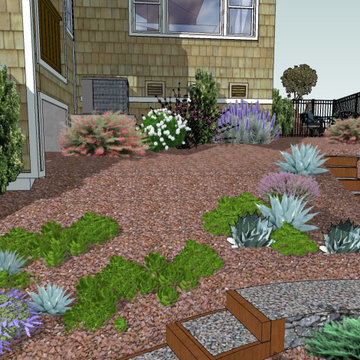
The client wanted a garden that carried the spirit of her homeland — the forms, textures, and quiet drama of a Japanese garden — set down in a subdivision of Western-style homes enclosed by matching aluminum fences. The site itself posed the real challenge: a backyard on a 55% slope, with little natural sense of arrival or destination.
The design answers with a meandering gravel pathway that winds down, across, and up the grade through a series of distinct micro-environments, each defined by its own plant grouping. Hairpin turns and boulder retaining walls hold the banks in place, with beds of reddish mulch tying the slope together visually. An arched wooden footbridge, finished with copper post caps, serves as the garden's focal point and carries the design's Japanese sensibility — echoed in the curved, layered railings that continue along the stairways above and below it. A single Japanese maple stands as a deliberate nod to the tradition, set among a bolder planting of agaves, aloes, and other drought-tolerant succulents suited to the Bay Area climate — together transforming a steep, awkward backyard into a serene, immersive retreat.
The installation, by Arborist Now, has required the kind of grading, stonework, and structural skill a slope this steep demands — the craft is as much a part of the story as the design.
 Mediterrasian Landscapes
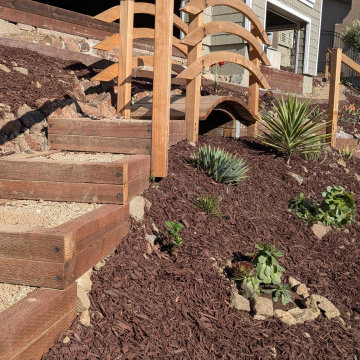
The client wanted a garden that carried the spirit of her homeland — the forms, textures, and quiet drama of a Japanese garden — set down in a subdivision of Western-style homes enclosed by matching aluminum fences. The site itself posed the real challenge: a backyard on a 55% slope, with little natural sense of arrival or destination.
The design answers with a meandering gravel pathway that winds down, across, and up the grade through a series of distinct micro-environments, each defined by its own plant grouping. Hairpin turns and boulder retaining walls hold the banks in place, with beds of reddish mulch tying the slope together visually. An arched wooden footbridge, finished with copper post caps, serves as the garden's focal point and carries the design's Japanese sensibility — echoed in the curved, layered railings that continue along the stairways above and below it. A single Japanese maple stands as a deliberate nod to the tradition, set among a bolder planting of agaves, aloes, and other drought-tolerant succulents suited to the Bay Area climate — together transforming a steep, awkward backyard into a serene, immersive retreat.
The installation, by Arborist Now, has required the kind of grading, stonework, and structural skill a slope this steep demands — the craft is as much a part of the story as the design.
 Mediterrasian Landscapes
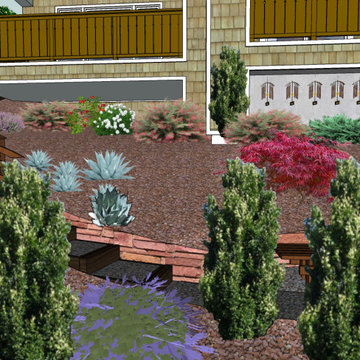
The client wanted a garden that carried the spirit of her homeland — the forms, textures, and quiet drama of a Japanese garden — set down in a subdivision of Western-style homes enclosed by matching aluminum fences. The site itself posed the real challenge: a backyard on a 55% slope, with little natural sense of arrival or destination.
The design answers with a meandering gravel pathway that winds down, across, and up the grade through a series of distinct micro-environments, each defined by its own plant grouping. Hairpin turns and boulder retaining walls hold the banks in place, with beds of reddish mulch tying the slope together visually. An arched wooden footbridge, finished with copper post caps, serves as the garden's focal point and carries the design's Japanese sensibility — echoed in the curved, layered railings that continue along the stairways above and below it. A single Japanese maple stands as a deliberate nod to the tradition, set among a bolder planting of agaves, aloes, and other drought-tolerant succulents suited to the Bay Area climate — together transforming a steep, awkward backyard into a serene, immersive retreat.
The installation, by Arborist Now, has required the kind of grading, stonework, and structural skill a slope this steep demands — the craft is as much a part of the story as the design.
 Mediterrasian Landscapes
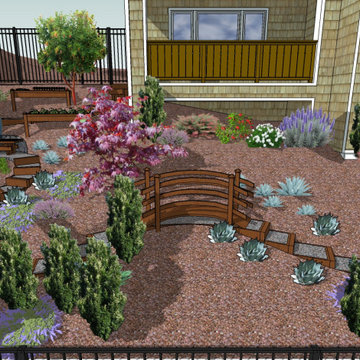
The client wanted a garden that carried the spirit of her homeland — the forms, textures, and quiet drama of a Japanese garden — set down in a subdivision of Western-style homes enclosed by matching aluminum fences. The site itself posed the real challenge: a backyard on a 55% slope, with little natural sense of arrival or destination.
The design answers with a meandering gravel pathway that winds down, across, and up the grade through a series of distinct micro-environments, each defined by its own plant grouping. Hairpin turns and boulder retaining walls hold the banks in place, with beds of reddish mulch tying the slope together visually. An arched wooden footbridge, finished with copper post caps, serves as the garden's focal point and carries the design's Japanese sensibility — echoed in the curved, layered railings that continue along the stairways above and below it. A single Japanese maple stands as a deliberate nod to the tradition, set among a bolder planting of agaves, aloes, and other drought-tolerant succulents suited to the Bay Area climate — together transforming a steep, awkward backyard into a serene, immersive retreat.
The installation, by Arborist Now, has required the kind of grading, stonework, and structural skill a slope this steep demands — the craft is as much a part of the story as the design.
 Mediterrasian Landscapes
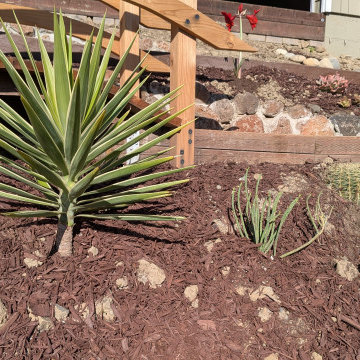
The client wanted a garden that carried the spirit of her homeland — the forms, textures, and quiet drama of a Japanese garden — set down in a subdivision of Western-style homes enclosed by matching aluminum fences. The site itself posed the real challenge: a backyard on a 55% slope, with little natural sense of arrival or destination.
The design answers with a meandering gravel pathway that winds down, across, and up the grade through a series of distinct micro-environments, each defined by its own plant grouping. Hairpin turns and boulder retaining walls hold the banks in place, with beds of reddish mulch tying the slope together visually. An arched wooden footbridge, finished with copper post caps, serves as the garden's focal point and carries the design's Japanese sensibility — echoed in the curved, layered railings that continue along the stairways above and below it. A single Japanese maple stands as a deliberate nod to the tradition, set among a bolder planting of agaves, aloes, and other drought-tolerant succulents suited to the Bay Area climate — together transforming a steep, awkward backyard into a serene, immersive retreat.
The installation, by Arborist Now, has required the kind of grading, stonework, and structural skill a slope this steep demands — the craft is as much a part of the story as the design.
Sponsored
Columbus, OH

Structural Remodeling
Franklin County's Heavy Timber Specialists | Best of Houzz 2020!
 Mediterrasian Landscapes
Existing Conditions:
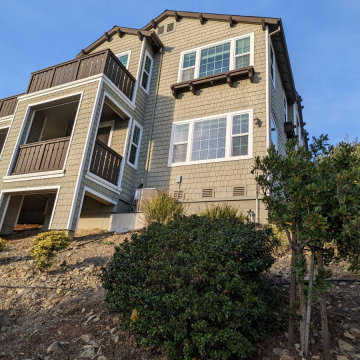
The client wanted a garden that carried the spirit of her homeland — the forms, textures, and quiet drama of a Japanese garden — set down in a subdivision of Western-style homes enclosed by matching aluminum fences. The site itself posed the real challenge: a backyard on a 55% slope, with little natural sense of arrival or destination.
The design answers with a meandering gravel pathway that winds down, across, and up the grade through a series of distinct micro-environments, each defined by its own plant grouping. Hairpin turns and boulder retaining walls hold the banks in place, with beds of reddish mulch tying the slope together visually. An arched wooden footbridge, finished with copper post caps, serves as the garden's focal point and carries the design's Japanese sensibility — echoed in the curved, layered railings that continue along the stairways above and below it. A single Japanese maple stands as a deliberate nod to the tradition, set among a bolder planting of agaves, aloes, and other drought-tolerant succulents suited to the Bay Area climate — together transforming a steep, awkward backyard into a serene, immersive retreat.
The installation, by Arborist Now, has required the kind of grading, stonework, and structural skill a slope this steep demands — the craft is as much a part of the story as the design.
 Mediterrasian Landscapes
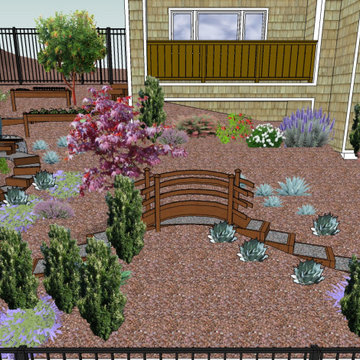
The client wanted a garden that carried the spirit of her homeland — the forms, textures, and quiet drama of a Japanese garden — set down in a subdivision of Western-style homes enclosed by matching aluminum fences. The site itself posed the real challenge: a backyard on a 55% slope, with little natural sense of arrival or destination.
The design answers with a meandering gravel pathway that winds down, across, and up the grade through a series of distinct micro-environments, each defined by its own plant grouping. Hairpin turns and boulder retaining walls hold the banks in place, with beds of reddish mulch tying the slope together visually. An arched wooden footbridge, finished with copper post caps, serves as the garden's focal point and carries the design's Japanese sensibility — echoed in the curved, layered railings that continue along the stairways above and below it. A single Japanese maple stands as a deliberate nod to the tradition, set among a bolder planting of agaves, aloes, and other drought-tolerant succulents suited to the Bay Area climate — together transforming a steep, awkward backyard into a serene, immersive retreat.
The installation, by Arborist Now, has required the kind of grading, stonework, and structural skill a slope this steep demands — the craft is as much a part of the story as the design.
 Mediterrasian Landscapes
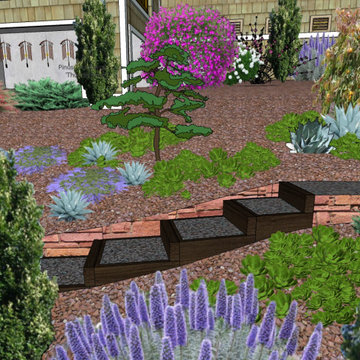
The client wanted a garden that carried the spirit of her homeland — the forms, textures, and quiet drama of a Japanese garden — set down in a subdivision of Western-style homes enclosed by matching aluminum fences. The site itself posed the real challenge: a backyard on a 55% slope, with little natural sense of arrival or destination.
The design answers with a meandering gravel pathway that winds down, across, and up the grade through a series of distinct micro-environments, each defined by its own plant grouping. Hairpin turns and boulder retaining walls hold the banks in place, with beds of reddish mulch tying the slope together visually. An arched wooden footbridge, finished with copper post caps, serves as the garden's focal point and carries the design's Japanese sensibility — echoed in the curved, layered railings that continue along the stairways above and below it. A single Japanese maple stands as a deliberate nod to the tradition, set among a bolder planting of agaves, aloes, and other drought-tolerant succulents suited to the Bay Area climate — together transforming a steep, awkward backyard into a serene, immersive retreat.
The installation, by Arborist Now, has required the kind of grading, stonework, and structural skill a slope this steep demands — the craft is as much a part of the story as the design.
 Mediterrasian Landscapes
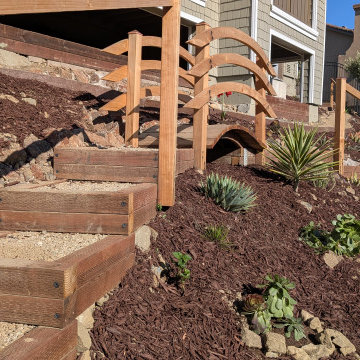
The client wanted a garden that carried the spirit of her homeland — the forms, textures, and quiet drama of a Japanese garden — set down in a subdivision of Western-style homes enclosed by matching aluminum fences. The site itself posed the real challenge: a backyard on a 55% slope, with little natural sense of arrival or destination.
The design answers with a meandering gravel pathway that winds down, across, and up the grade through a series of distinct micro-environments, each defined by its own plant grouping. Hairpin turns and boulder retaining walls hold the banks in place, with beds of reddish mulch tying the slope together visually. An arched wooden footbridge, finished with copper post caps, serves as the garden's focal point and carries the design's Japanese sensibility — echoed in the curved, layered railings that continue along the stairways above and below it. A single Japanese maple stands as a deliberate nod to the tradition, set among a bolder planting of agaves, aloes, and other drought-tolerant succulents suited to the Bay Area climate — together transforming a steep, awkward backyard into a serene, immersive retreat.
The installation, by Arborist Now, has required the kind of grading, stonework, and structural skill a slope this steep demands — the craft is as much a part of the story as the design.

 Mediterrasian Landscapes
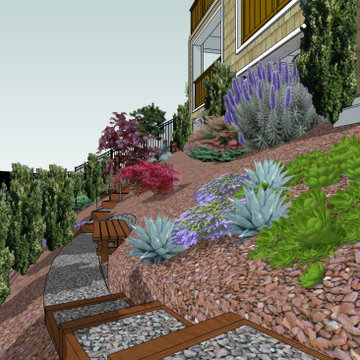
The client wanted a garden that carried the spirit of her homeland — the forms, textures, and quiet drama of a Japanese garden — set down in a subdivision of Western-style homes enclosed by matching aluminum fences. The site itself posed the real challenge: a backyard on a 55% slope, with little natural sense of arrival or destination.
The design answers with a meandering gravel pathway that winds down, across, and up the grade through a series of distinct micro-environments, each defined by its own plant grouping. Hairpin turns and boulder retaining walls hold the banks in place, with beds of reddish mulch tying the slope together visually. An arched wooden footbridge, finished with copper post caps, serves as the garden's focal point and carries the design's Japanese sensibility — echoed in the curved, layered railings that continue along the stairways above and below it. A single Japanese maple stands as a deliberate nod to the tradition, set among a bolder planting of agaves, aloes, and other drought-tolerant succulents suited to the Bay Area climate — together transforming a steep, awkward backyard into a serene, immersive retreat.
The installation, by Arborist Now, has required the kind of grading, stonework, and structural skill a slope this steep demands — the craft is as much a part of the story as the design.
 Mediterrasian Landscapes
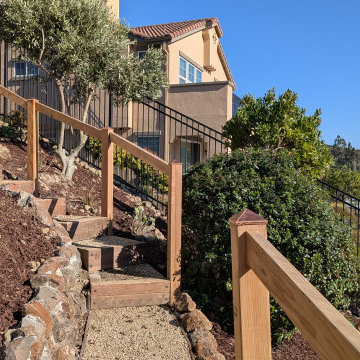
The client wanted a garden that carried the spirit of her homeland — the forms, textures, and quiet drama of a Japanese garden — set down in a subdivision of Western-style homes enclosed by matching aluminum fences. The site itself posed the real challenge: a backyard on a 55% slope, with little natural sense of arrival or destination.
The design answers with a meandering gravel pathway that winds down, across, and up the grade through a series of distinct micro-environments, each defined by its own plant grouping. Hairpin turns and boulder retaining walls hold the banks in place, with beds of reddish mulch tying the slope together visually. An arched wooden footbridge, finished with copper post caps, serves as the garden's focal point and carries the design's Japanese sensibility — echoed in the curved, layered railings that continue along the stairways above and below it. A single Japanese maple stands as a deliberate nod to the tradition, set among a bolder planting of agaves, aloes, and other drought-tolerant succulents suited to the Bay Area climate — together transforming a steep, awkward backyard into a serene, immersive retreat.
The installation, by Arborist Now, has required the kind of grading, stonework, and structural skill a slope this steep demands — the craft is as much a part of the story as the design.
 Mediterrasian Landscapes
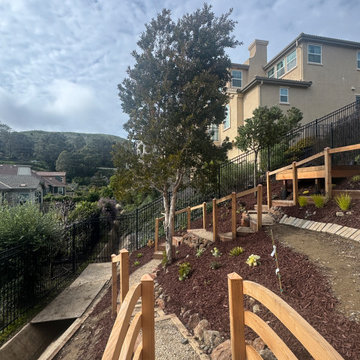
The client wanted a garden that carried the spirit of her homeland — the forms, textures, and quiet drama of a Japanese garden — set down in a subdivision of Western-style homes enclosed by matching aluminum fences. The site itself posed the real challenge: a backyard on a 55% slope, with little natural sense of arrival or destination.
The design answers with a meandering gravel pathway that winds down, across, and up the grade through a series of distinct micro-environments, each defined by its own plant grouping. Hairpin turns and boulder retaining walls hold the banks in place, with beds of reddish mulch tying the slope together visually. An arched wooden footbridge, finished with copper post caps, serves as the garden's focal point and carries the design's Japanese sensibility — echoed in the curved, layered railings that continue along the stairways above and below it. A single Japanese maple stands as a deliberate nod to the tradition, set among a bolder planting of agaves, aloes, and other drought-tolerant succulents suited to the Bay Area climate — together transforming a steep, awkward backyard into a serene, immersive retreat.
The installation, by Arborist Now, has required the kind of grading, stonework, and structural skill a slope this steep demands — the craft is as much a part of the story as the design.
1