
Search results for "System deposit" in Home Design Ideas

 Morell Landscape Associates
All the water from the 16,000 sq. ft. roof area and both roof decks gets collected and deposited into two Rainwater Harvesting Systems, giving the owner a free source of water to irrigate the landscaping and lawn.
 Azenco Outdoor
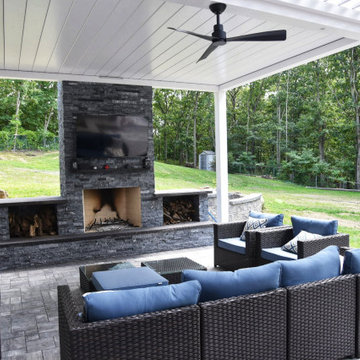
The homeowners also wanted to ensure the new sun shade pergola would feel like an extension of the home’s colonial style, while allowing then to move from the indoor space to the patio without getting wet. With no externally visible hardware, the clean exterior lines of the Azenco R-Blade blended perfectly with the home’s traditional colonial stylings. To ensure complete all-weather rain protection, the design team overlapped the pergola roof with the home’s roofline to provide the same seamless feel as a pergola attached to the house. Covering this massive patio also meant the captured rain waters needed to be dispersed to keep the patio below dry. To accommodate the heavy anticipated flow, the hidden internal gutter system split runoff from the six pergola zones and deposited it in numerous surrounding planter beds.
 Azenco Outdoor
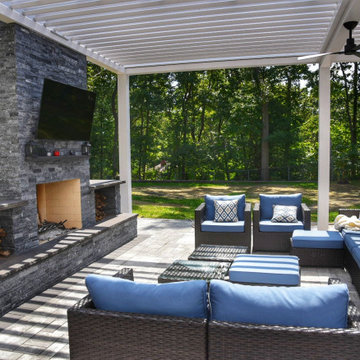
The homeowners also wanted to ensure the new sun shade pergola would feel like an extension of the home’s colonial style, while allowing then to move from the indoor space to the patio without getting wet. With no externally visible hardware, the clean exterior lines of the Azenco R-Blade blended perfectly with the home’s traditional colonial stylings. To ensure complete all-weather rain protection, the design team overlapped the pergola roof with the home’s roofline to provide the same seamless feel as a pergola attached to the house. Covering this massive patio also meant the captured rain waters needed to be dispersed to keep the patio below dry. To accommodate the heavy anticipated flow, the hidden internal gutter system split runoff from the six pergola zones and deposited it in numerous surrounding planter beds.
Find the right local pro for your project
 Azenco Outdoor
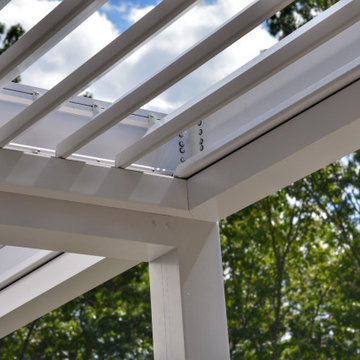
The homeowners also wanted to ensure the new sun shade pergola would feel like an extension of the home’s colonial style, while allowing then to move from the indoor space to the patio without getting wet. With no externally visible hardware, the clean exterior lines of the Azenco R-Blade blended perfectly with the home’s traditional colonial stylings. To ensure complete all-weather rain protection, the design team overlapped the pergola roof with the home’s roofline to provide the same seamless feel as a pergola attached to the house. Covering this massive patio also meant the captured rain waters needed to be dispersed to keep the patio below dry. To accommodate the heavy anticipated flow, the hidden internal gutter system split runoff from the six pergola zones and deposited it in numerous surrounding planter beds.
 Azenco Outdoor
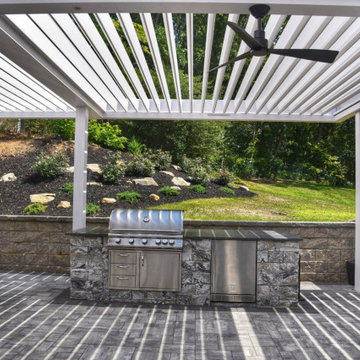
The homeowners also wanted to ensure the new sun shade pergola would feel like an extension of the home’s colonial style, while allowing then to move from the indoor space to the patio without getting wet. With no externally visible hardware, the clean exterior lines of the Azenco R-Blade blended perfectly with the home’s traditional colonial stylings. To ensure complete all-weather rain protection, the design team overlapped the pergola roof with the home’s roofline to provide the same seamless feel as a pergola attached to the house. Covering this massive patio also meant the captured rain waters needed to be dispersed to keep the patio below dry. To accommodate the heavy anticipated flow, the hidden internal gutter system split runoff from the six pergola zones and deposited it in numerous surrounding planter beds.
 SUPERIOR CHIMNEY SERVICES CORPORATION
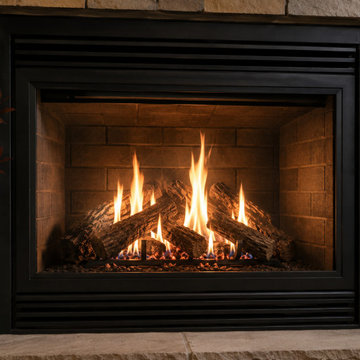
Standard annual or mechanical Chimney cleaning for gas and wood burning fireplaces typically works to remove any type of buildup as well as checking for the structural integrity of the chimney. Maintaining an annual chimney cleaning will meet the national safety standard set by the NFPA, CSIA, IRC and NCSG, helping homeowners avoid chimney fires and blockages.
Why does safety matter? Did you know that there was a chimney fire in Marengo in January? Or a chimney fire at a Peotone home at the end of March? Or a log cabin fire caused by the chimney in June? That’s just a few that happened in the past 7 months.
Why Does a Chimney Cleaning Matter?
Chimney sweeps also known as chimney cleanings, fireplace cleanings, or fireplace sweeps. Regardless of what you call it, it still means the same thing.
Chimney cleaning for gas and wood burning fireplaces serve 3 key purposes:
confirming structural integrity
removing flammable deposits and
obstruction-free assurance.
Homeowners with gas or wood burning fireplaces benefit from each of these safeguards.
The National Fire Protection Association addresses this directly through NFPA 211, a widely recognized fire safety code. The standard states that chimneys, fireplaces, and vents require inspection at least once a year for soundness, free from deposits, and correct clearances, with cleaning, maintenance, and repairs to be done whenever needed.
This annual requirement applies equally to gas and wood burning fireplaces. Organizations including the Chimney Safety Institute of America, the National Chimney Sweep Guild, International Residential code and the National Fire Protection Association each reference this standard as the requirement for home fire safety.
Free 14-Point Certified Written Inspection
Every chimney sweep completed through Superior Chimney includes a complimentary 14-point certified written inspection along with photo documentation delivered to you by email. This documentation gives homeowners a clear visual record of their chimney system.
The written report covers the condition of the flue liner, smoke chamber, smoke shelf, damper, firebox, chimney crown, and chimney cap, among other components examined during a standard visit. Photo documentation captures each area so homeowners can review the findings independently of the technician’s verbal summary. Written inspection reports allow families to track the condition of their fireplace chimney system over time.
Chimney Cleaning and Structural Integrity
A CSIA Certified Chimney Sweep technician, such as Superior Chimney technicians, visually examines the chimney from the top opening to the firebox below, gaining a full evaluation of the interior.
When chimney rods and brushes pass through the chimney system, loose pieces of fire clay tile, damaged tile joints, or crumbling brick sometimes fall down into the fireplace. This debris can mean there is an integrity problem. By knowing this is a problem, will protect families and their homes. Now it’s time to take care of it and call in a certified chimney technician.
Fireplace Cleaning and Creosote Removal
Creosote, is the technical name for soot. Soot forms as a natural byproduct of burning wood. Smoke traveling upward through the chimney and leaves deposits of creosote along the interior walls. With every fire, a little more gets built up.
The issue with creosote is that it is highly flammable and is the leading cause of chimney fires nationwide. Removing the buildup through regular chimney cleanings keeps a fireplace serviceable for continuous use throughout the spring, fall and winter seasons.
Standard and mechanical chimney cleanings pay close attention to the flue liner, smoke chamber, smoke shelf, damper, and firebox in a single service visit. Superior Chimney performs each fireplace chimney inspection using a no-mess process that protects the home during service. This keeps soot contained within specialized equipment rather than the living room.
An Obstruction Free Chimney
Several conditions create blockages within a chimney system. Bird, squirrel, bat and raccoon nesting material, feces, and debris frequently accumulate inside an unprotected flue, especially during spring and summer months when the fireplace sits unused.
Excessive creosote accumulation or a collapsed chimney liner can restrict proper airflow. Homeowners that address obstructions with a chimney inspection will be able to maintain proper draft and ventilation with their gas or wood burning fireplace. This will reduce the risk of smoke backing into the home.
Gas Chimney Cleaning Compared to Wood burning Chimney Cleaning
Gas and wood burning fireplaces share the same annual chimney inspection requirement. Whether you are burning wood, gas or a “pile of shirts” there is still heat and flame that requires worthy firewalls to protect the home from heat transfer. Fire worthiness and checking the firewall integrity is priority.
Wood burning fireplaces generate creosote that builds along the flue liner with every fire. Gas fireplace systems accumulate lighter deposits along with potential venting obstructions, since gas appliances rely heavily on venting for safe combustion byproduct release. Each system accumulates different residues that need attention.
A CSIA Certified Chimney Sweep technician from Superior Chimney adjusts the specific cleaning approach based on fuel type. However, the same core safety elements apply: structural integrity, deposit removal, and clear airflow.
What Happens During a Chimney Cleaning?
A typical chimney inspection begins with a walkthrough of the fireplace and the chimney on top of the roof, allowing the technician to record any visible concerns the homeowner reported in advance as well as any new findings.
The certified technician then covers the immediate hearth area with protective material before setting up specialized equipment designed to contain creosote throughout the cleaning and inspection.
Chimney rods and brushes pass through the flue liner to loosen and remove creosote deposits along the smoke chamber, smoke shelf, and damper. The certified technician inspects each section closely for loose or crumbling firewall, cracked joints, or other signs of weak structural damage.
A final walkthrough of the firebox and chimney completes the visual inspection. Photo documentation captures each component, and the certified written report is sent to the homeowner by email. This consistent process gives homeowners the documentation they need to compare year to year.
Chimney Cleaning Safety Standards
The table below summarizes the organizations that set national chimney safety standards, along with their specific requirements for fireplace chimney sweeps.
NFPA211
National Fire Protection Association
Annual inspection for soundness, deposit buildup, and correct clearances; cleaning and repairs completed as needed
CSIA
Chimney Safety Institute of America
Certifies technicians through testing on chimney and venting system knowledge
NCSG
National Chimney Sweep Guild
Establishes trade standards and best practices for chimney sweep professionals
How Often Should You Schedule a Chimney Cleaning and Inspection?
CSIA recommends scheduling chimney cleaning and inspection annually by CSIA Certified Chimney Sweeps. This recommendation applies to gas and wood burning fireplaces, regardless of how frequently a household uses the fireplace and especially in freeze/thaw geographic areas.
Regular chimney sweeps save lives, since a clean fireplace chimney rarely catches fire. CSIA encourages homeowners to rely on Certified Chimney Sweeps, as these technicians undergo regular testing on the complexities of chimney and venting systems throughout their careers.
Frequently Asked Questions
What is included in a chimney sweep? A chimney sweep includes the flue liner, smoke chamber, smoke shelf, damper, and firebox, removing creosote while checking for obstructions and structural concerns throughout the chimney system (NOT the ashpit).
How often should gas and wood burning fireplaces receive chimney sweeps? CSIA, NFPA, IRC and NCSG guidelines each call for chimney sweeps at least once a year for gas and wood burning fireplace systems.
Why does creosote removal matter for fireplace safety? Creosote is highly flammable and builds along the interior walls of a fireplace chimney with every fire, creating conditions that lead directly to chimney fires when left in place over time. Creosote is unburned particles from the combustion chamber.
Who should perform a fireplace chimney sweep? CSIA Certified Chimney Sweep technicians complete fireplace chimney sweeps after passing regular testing on chimney and venting system knowledge, meeting the certification standard recognized across the industry.
Does a fireplace chimney sweep remove animal nests and debris? No, a fireplace chimney sweep addresses soot and creosote, while significant nesting material, feces, or collapsed liner debris often calls for dedicated obstruction removal alongside the standard service.
What does the free 14-point inspection include? The complimentary 14-point certified written inspection documents the flue liner, smoke chamber, smoke shelf, damper, firebox, crown, and cap through photo evidence delivered directly by email for homeowner records.
Choose Superior Chimney for Your Certified Chimney Inspection
All service technicians completing chimney sweeps through Superior Chimney hold National Certification through the Chimney Safety Institute of America (CSIA), reflecting the training standard recommended by fire safety organizations nationwide.
Scheduling regular chimney sweeps to clean gas and wood burning fireplace systems protects a home from fire risk, preserves the structural integrity of the chimney, and keeps airflow clear for proper, continuous use throughout the year. Contact us today to schedule a chimney inspection at 877-244-6349.
 Azenco Outdoor
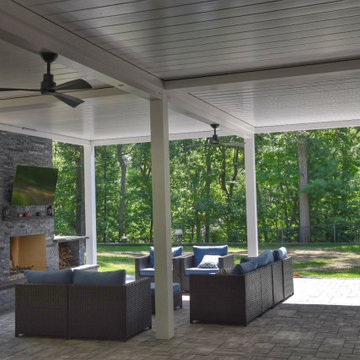
The homeowners also wanted to ensure the new sun shade pergola would feel like an extension of the home’s colonial style, while allowing then to move from the indoor space to the patio without getting wet. With no externally visible hardware, the clean exterior lines of the Azenco R-Blade blended perfectly with the home’s traditional colonial stylings. To ensure complete all-weather rain protection, the design team overlapped the pergola roof with the home’s roofline to provide the same seamless feel as a pergola attached to the house. Covering this massive patio also meant the captured rain waters needed to be dispersed to keep the patio below dry. To accommodate the heavy anticipated flow, the hidden internal gutter system split runoff from the six pergola zones and deposited it in numerous surrounding planter beds.

Sponsored
Columbus, OH

Hope Restoration & General Contracting
Columbus Design-Build, Kitchen & Bath Remodeling, Historic Renovations
 Azenco Outdoor
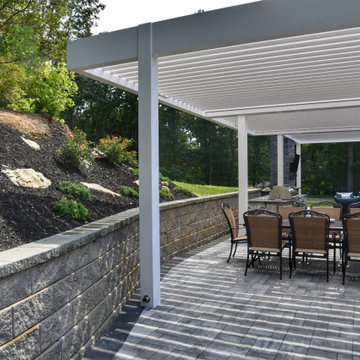
The homeowners also wanted to ensure the new sun shade pergola would feel like an extension of the home’s colonial style, while allowing then to move from the indoor space to the patio without getting wet. With no externally visible hardware, the clean exterior lines of the Azenco R-Blade blended perfectly with the home’s traditional colonial stylings. To ensure complete all-weather rain protection, the design team overlapped the pergola roof with the home’s roofline to provide the same seamless feel as a pergola attached to the house. Covering this massive patio also meant the captured rain waters needed to be dispersed to keep the patio below dry. To accommodate the heavy anticipated flow, the hidden internal gutter system split runoff from the six pergola zones and deposited it in numerous surrounding planter beds.
 Azenco Outdoor
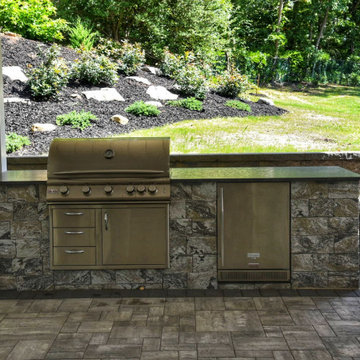
The homeowners also wanted to ensure the new sun shade pergola would feel like an extension of the home’s colonial style, while allowing then to move from the indoor space to the patio without getting wet. With no externally visible hardware, the clean exterior lines of the Azenco R-Blade blended perfectly with the home’s traditional colonial stylings. To ensure complete all-weather rain protection, the design team overlapped the pergola roof with the home’s roofline to provide the same seamless feel as a pergola attached to the house. Covering this massive patio also meant the captured rain waters needed to be dispersed to keep the patio below dry. To accommodate the heavy anticipated flow, the hidden internal gutter system split runoff from the six pergola zones and deposited it in numerous surrounding planter beds.

 LandWorks, Inc.
Our client’s stunning modern home is large, with a complex floor plan, involving several levels of entrances and exits, requiring a sprawling circulation plan of terraces, walks and staircases. We installed seven staircases and thousands of square feet of surfaces, as well as a highly involved draining system, with our goal being to tie everything together. We call this project “Multi-Level Magic” for obvious reasons: the result is gorgeous.
The staircases all had unique riser heights and tread depths with fine tuning and design revisions handled by our landscape architects. The pavers made of imported travertine - a form of limestone deposited by mineral hot springs - had to be installed on a precise grid, involving constant monitoring of joint placement, as the same paving material and pattern existed inside the home and, with large picture windows, the joint placement had to flow seamlessly inside to outside.
Our work was finished just in time for a huge moving-in party. This project was one of the most challenging installations our team had ever been involved with, and the client was very pleased in the end.
 SUPERIOR CHIMNEY SERVICES CORPORATION
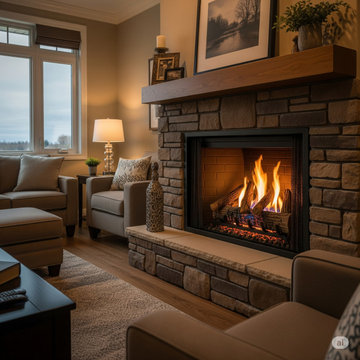
September 21st is the first day of Fall. I know we don’t want to think about it yet, but it is good to prepare and get the chimney swept early. Why? According to the Farmer’s Almanac, they are predicting a colder and snowier Winter. But you say, “eh, I got a gas fireplace.” Better yet, “I don’t use my fireplace, so why should I sweep it, and clean it early?” Let’s discuss why all types of chimneys and fireplaces need to be swept.
Why Do All Types of Chimney’s and Fireplaces Need to Be Swept?
When we think of the fireplace, we picture the real wood burning fireplace with the sounds of crackling wood. With regular use of the wood-burning fireplaces, a byproduct called creosote forms and over time, lines the side of the chimney flue. This needs to be swept at least once per year as creosote is flammable. However, all chimney’s, regardless of whether it burns wood or utilizes gas, needs to be professionally inspected and swept annually.
Many homeowners mistakenly believe that a gas or unused chimney is immune to problems since it doesn't produce a byproduct. However, these chimney systems face their own unique dangers. Gas fireplaces, especially those that are high-efficiency, can lead to the buildup of corrosive deposits. Over time, these deposits can degrade your chimney liner. Getting it inspected by a certified chimney technician will control this issue so it doesn’t turn into a problem.
4 Key Reasons to Prioritize Your Annual Chimney Inspection
The annual chimney inspection is more than just a sweep; it’s a comprehensive health check for your entire chimney system. We call it the 14 Point Inspection. A certified chimney technician will look for:
1. Fire Hazards: Again, for wood-burning chimneys, the removal of creosote is important to prevent a chimney fire. Gas fireplaces release corrosive deposits. If you don’t use the fireplace, you never know what debris may have settled in. If you want to use the fireplace, please be sure to have it professionally inspected and swept before use.
2. Obstructions: There’s a whole world outside of your home, and especially in the Fall, our little friends are searching for a warm place to stay. Your chimney looks pretty good. And, let’s not forget how the wind in the Chicagoland are does a great job of moving debris around that can get up and under the chimney cap or directly into the chimney if you don’t have a cap. These blockages need to be cleared for you and your home’s protection.
3. Structural Damage: A chimney technician will be able to spot cracks, water damage, or deterioration of the chimney and chimney liner that could compromise the system's safety.
4. Ventilation Issues: Ventilation is key for your home to breathe. The certified chimney technician will ensure proper draft and airflow, which is the best way to get rid of toxic gases.
NFPA
Remember, the National Fire Protection Association (NFPA) recommends an annual inspection for all chimney types. This simple, proactive maintenance can save you from costly repairs. Don't wait for a problem to become obvious.
Contact Superior Chimney today at 877-244-6349 to schedule a 14-Point Chimney inspection to ensure your home and family are protected.
 LandWorks, Inc.
Our client’s stunning modern home is large, with a complex floor plan, involving several levels of entrances and exits, requiring a sprawling circulation plan of terraces, walks and staircases. We installed seven staircases and thousands of square feet of surfaces, as well as a highly involved draining system, with our goal being to tie everything together. We call this project “Multi-Level Magic” for obvious reasons: the result is gorgeous.
The staircases all had unique riser heights and tread depths with fine tuning and design revisions handled by our landscape architects. The pavers made of imported travertine - a form of limestone deposited by mineral hot springs - had to be installed on a precise grid, involving constant monitoring of joint placement, as the same paving material and pattern existed inside the home and, with large picture windows, the joint placement had to flow seamlessly inside to outside.
Our work was finished just in time for a huge moving-in party. This project was one of the most challenging installations our team had ever been involved with, and the client was very pleased in the end.
 LandWorks, Inc.
Our client’s stunning modern home is large, with a complex floor plan, involving several levels of entrances and exits, requiring a sprawling circulation plan of terraces, walks and staircases. We installed seven staircases and thousands of square feet of surfaces, as well as a highly involved draining system, with our goal being to tie everything together. We call this project “Multi-Level Magic” for obvious reasons: the result is gorgeous.
The staircases all had unique riser heights and tread depths with fine tuning and design revisions handled by our landscape architects. The pavers made of imported travertine - a form of limestone deposited by mineral hot springs - had to be installed on a precise grid, involving constant monitoring of joint placement, as the same paving material and pattern existed inside the home and, with large picture windows, the joint placement had to flow seamlessly inside to outside.
Our work was finished just in time for a huge moving-in party. This project was one of the most challenging installations our team had ever been involved with, and the client was very pleased in the end.
Sponsored
Columbus, OH
Hope Restoration & General Contracting
Columbus Design-Build, Kitchen & Bath Remodeling, Historic Renovations

 Mary Dancey Interiors
Shower Stall With a View.
Mosaic tile used for the vanity backsplash was also installed in the shower surrounded by rows of soft white porcelain subway tile. A natural mosaic stone shower floor was installed with an infinity drain and a footrest doubles as a shelf. A glass enclosure and quartz clad skylight complete the look.
Lisa Piellusch Picture Your Life Photography


 RHEINZINK
 ROOF PANELS PLAY KEY ROLE IN UNIQUE RESIDENTIAL WATER COLLECTION SYSTEM
Located on a steeply sloped site in the central Texas hill country, visitors to the Cascading Creek House look down on the unique water-collection system of the house when entering from the street above. Descending the steps at the property’s entry, the experience begins with the structure’s paired zinc roofs. The northern roof collects rainwater from the sudden downpours that are characteristic of the area and deposits it into a central trough concealed by a line of solar thermal assemblies. The trough culminates in a giant scupper that feeds rainwater into an open cistern before being stored in a 30,000 gallon tank buried beside the house. The scupper can be run artificially as a fountain. The storage tank also collects runoff from the hardscape on the sloped lot. The stored water ties into an extensive climate conditioning system which utilizes water source heat pumps and radiant loops to supply both the heating and cooling for the residence.
Design for the project and its innovative technological features was done by Bercy Chen Studio, Austin. Principal Thomas Bercy selected RHEINZINK PrePATINA blue-grey Double Lock Standing Seam Panels to clad the 3,200 sq. ft. roof area. “We used the zinc for aesthetic purpose as well as durability,“ Bercy said. “We were looking for a natural color palette that would work with the other materials on the house. The grey of the RHEINZINK worked perfectly with the grey tones of the Lueder limestone. And I’ve always loved the patina that aged zinc presents.“
The RHEINZINK distributor on the project was MetalTech—USA, Peachtree City, GA.
Photographer: Tom Bardagjy


2