
Search results for "Treating conditions" in Home Design Ideas

 Pearl Remodeling
Mid-sized minimalist u-shaped light wood floor open concept kitchen photo in Los Angeles with an undermount sink, flat-panel cabinets, white cabinets, quartz countertops, multicolored backsplash, stainless steel appliances and a peninsula

 safe ZOnea
Every year, the same thing happens. The first real snowfall arrives, demand for de-icing materials spikes overnight, and the businesses that waited too long find themselves scrambling for supply at the worst possible moment. Facility managers, property owners, contractors, and municipalities all depend on a steady supply of salt and ice melt to keep their properties safe and operational through winter. The ones who plan ahead sail through. The ones who don't pay more, wait longer, and take on real risk.
Sourcing de-icing materials well is not complicated, but it does require thinking ahead and understanding the options. The choices you make about what to buy, how to buy it, and who to buy it from have a direct effect on your costs, your reliability, and your ability to keep people safe when conditions turn dangerous. This article lays out what matters.
Why Your Choice of Supplier Matters More Than You Think
It is easy to treat de-icing material as a commodity, something you grab whenever you need it without much thought about where it comes from. That works fine until the moment it doesn't, usually in the middle of a storm when everyone needs supply at once and the casual sources have run dry. At that point, the relationships you built before the season become the difference between staying stocked and being stuck.
Reliable supply is the whole game in winter operations. A property that runs out of ice melt during a storm faces safety hazards, liability exposure, and disruption, none of which can wait for a back-ordered shipment. This is why establishing relationships with dependable rock salt suppliers before the season starts is one of the smartest moves a facility manager or contractor can make. It locks in supply, often locks in better pricing, and removes a major source of mid-winter stress.
The lesson here is to treat sourcing as a planning decision rather than a last-minute errand. The businesses that come through winter smoothly are almost always the ones that secured their supply chain early, chose suppliers who could actually deliver when it counted, and never had to gamble on finding material during a shortage. Reliability bought in advance is far cheaper than scarcity paid for in a crisis.
Bagged or Bulk: Matching the Material to the Job
One of the first practical decisions is whether to buy de-icing material in bags or in bulk, and the right answer depends entirely on the operation. Each format has clear advantages, and many operations end up using both for different purposes.
Bagged material offers convenience, control, and easy storage. It is simple to handle, easy to distribute to different locations or crews, straightforward to store without special equipment, and convenient for spot application by hand. It suits smaller properties, businesses without bulk storage, and situations where portion control and tidiness matter. Bulk material, on the other hand, tends to make sense for large operations that go through high volumes, where buying in quantity lowers the per-unit cost and the operation has the equipment and space to store and handle it. The tradeoff is between the convenience and flexibility of bags and the volume economics of bulk.
For many operations, the right approach is a mix: bulk for the high-volume core of the work and bags for flexibility, spot treatment, and locations where bulk handling is impractical. The key is to match the format to how the material will actually be stored, moved, and applied, rather than defaulting to one or the other out of habit. Thinking this through in advance avoids both the waste of over-buying bulk you can't handle and the expense of relying entirely on bags for a large operation.
Rock Salt Is Not Your Only Option
Rock salt, or sodium chloride, is the workhorse of winter de-icing for good reason. It is effective, widely available, and cost-efficient, which makes it the default choice for most operations most of the time. But it has limits, and understanding the alternatives helps you choose the right material for the conditions you actually face.
The most important limitation is temperature. Rock salt becomes less effective as temperatures drop, and in genuinely cold conditions it can struggle to do the job at all. This is where alternatives come in. Calcium chloride, for instance, works at much lower temperatures than rock salt and acts quickly, which makes it valuable when conditions are severe or when fast melting matters. Operations that face hard freezes or need dependable performance in extreme cold often keep calcium chloride for sale on hand for exactly those situations, using it alongside rock salt rather than instead of it.
The practical approach is to understand the conditions your property faces and stock accordingly. For many operations, rock salt handles the bulk of the work while a faster, colder-rated material like calcium chloride covers the extreme days when ordinary salt falls short. Matching the material to the temperature and the urgency of the situation is what separates an operation that stays ahead of winter from one that is constantly reacting to it.
Securing Your Supply Before the Season
Knowing what to buy is only half the equation. The other half is making sure you can actually get it when you need it, which means securing your supply before winter arrives rather than after it has already started. Timing is one of the most underrated factors in winter operations.
The logic is simple. Demand for de-icing materials is highly seasonal and spikes sharply during storms, when everyone needs supply simultaneously. Prices and availability both move against the buyer at exactly those moments. By contrast, planning ahead, estimating your needs and arranging supply before the season, puts you in a far stronger position. Working with established rock salt suppliers ahead of time means your material is accounted for before the rush, often at better pricing and with the confidence that it will be there when the first storm hits.
This kind of planning also lets you think clearly rather than react under pressure. You can estimate your seasonal needs based on your property and past winters, decide on the right mix of materials and formats, and arrange storage in advance. Operations that do this consistently spend less, worry less, and never find themselves making frantic calls during a storm. The effort of planning ahead is modest, and the payoff in reliability and cost savings is substantial.
Storing and Handling What You Buy
Securing supply is not much use if the material degrades before you can use it, which makes proper storage and handling an important and often overlooked part of the equation. De-icing materials are sensitive to moisture, and poor storage can turn a good supply into a clumped, hardened mess that is difficult to apply.
The fundamentals are straightforward. Keep material dry and protected from moisture, since salt and ice melt readily absorb water and can harden if exposed. Store it in a way that suits the format, whether that means a proper bulk storage area or a dry space for stacked bags. Keep it accessible, so crews can get to it quickly when a storm hits and time is short. And handle it with the right equipment for the format and volume, which protects both the material and the people working with it. None of this is complicated, but neglecting it can undermine even a well-planned supply.
Good storage practices protect the investment you made in securing supply early. There is little point in arranging your materials ahead of the season only to have them degrade before use. Treating storage and handling as part of the overall plan, rather than an afterthought, ensures that the material you secured is actually usable when the moment comes. It is the final link in a supply chain built to perform under winter conditions.
Estimating How Much You Actually Need
One question trips up operations of every size: how much de-icing material to buy. Order too little and you risk running short during a storm. Order too much and you tie up money and storage space in material you may not use. Getting the estimate reasonably right is a meaningful part of sourcing well.
Several factors shape the answer. The size and type of the areas you treat, sidewalks, lots, entrances, and drive lanes, set the baseline for how much material each application consumes. The local climate matters too, since colder regions and those with frequent snowfall go through far more material than milder ones. Application frequency depends on how often storms hit and how quickly surfaces need to be cleared, which varies with the kind of property and the expectations of the people who use it. And the type of material plays a role, since different products are applied at different rates.
Past experience is often the best guide. Operations that track what they used in previous winters, adjusted for the size of the property and the severity of the season, can estimate their needs with reasonable confidence. For newer operations without that history, it helps to plan conservatively and to work with a supplier who can replenish stock reliably, so that a low estimate does not turn into a mid-storm shortage.
The goal is not perfect precision but a sound, slightly cautious estimate paired with a dependable supply relationship. That combination lets an operation keep enough material on hand to handle the season without over-committing to volume it cannot store or use. Thinking this through before winter, rather than guessing during it, is one more way that planning ahead pays off when the snow starts to fall.
The Bottom Line
Sourcing de-icing materials well comes down to a few straightforward principles: plan ahead, choose reliable suppliers before the season, match your materials and formats to your actual needs and conditions, and store what you buy properly. The operations that follow these principles move through winter with confidence, while those that improvise pay more and take on needless risk.
Winter is predictable in one respect: it arrives every year, and demand for de-icing material spikes the moment it does. The businesses that prepare for that reality, rather than being surprised by it, are the ones that keep their properties safe, their costs controlled, and their operations running no matter what the season throws at them. A little foresight before the first snowfall pays off through every storm that follows.

 Interlocking Concrete Pavement Institute
2018 HNA Awards Honorable Mention - Outdoor Living Features
Contractor: Artisan Exteriors
Producer: CST Pavers
Designer: Joey Hafner
Design: Slate pavers, in a rich Sierra Blend, coupled with Versa-Lok Standard wall units to create multiple outdoor living spaces; masterfully meeting the entertainment requirements of the homeowner. Pavers and wall units, through use of color and texture, provided both definition and an effortless flow – creating a true outdoor oasis.
Quality of Construction and Craftsmanship: Expert workmanship is showcased in the precise paver and wall integration with the pool, spa and outdoor living features. Having a large entertainment space was a must for the homeowners, so the team carved out elevated areas to separate spaces for the pool deck, stage, spa and outdoor kitchen.
Compatibility with Related Construction Materials and Systems: The pool and coping were in great condition but the existing aggregate concrete pool deck was dangerously damaged. Paver and wall units were selected to replace, complement and expand the outdoor living space. Curved steps, coming off the home’s morning room, were added for visual integration and a welcoming element.
Construction Innovation: Vents and basement windows provided several obstacles to construction. To accommodate, designers opted to incorporate a raised patio on a pressure treated lumber frame and utilize the Silca System. To capitalize on the elevation, a portable spa was incorporated into the raised patio.
Overall Excellence: What began as a refurbishment of an existing swimming pool; evolved into a total backyard transformation. Slate pavers and Versa-Lok wall units helped create an outdoor paradise for family and entertainment use with a new pool deck, raised fire pit, raised stage to host musicians, outdoor kitchen and more.
Find the right local pro for your project
 Tile Doctor Ltd
I was recently contacted by a client who lives in the small coastal town of Bridlington, East Yorkshire. Bridlington has a small sea fishing port known for its great shellfish.
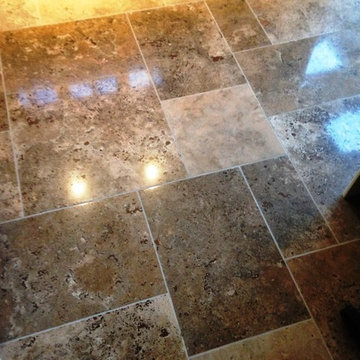
My client had a Limestone floor that was really in need of a fresh up: over the years the tiles had become dull and worn-looking, and she was keen to restore a nice shine to the surface. I was on hand to treat the floor to a much needed clean, polish and seal.
My first job was to strip off the old sealer. I did this using a coarse diamond burnishing pad fitted to a rotary machine. The floor was then given a thorough rinse with clean water to clear off any dirt and excess sealer. Following this, the excess water was quickly soaked up with a wet-dry vac machine to make sure there was no leftover moisture, as this could have potentially affected the performance of the new sealer (which I would apply at a later stage).
To polish the floor I continued with the system of burnishing pads, starting first with a medium burnishing pad, followed by the fine and very fine pads to achieve the desired effect. The result was a very nice overall sheen.
After cleaning and polishing, the only task remaining was to provide the floor with a durable seal. I did this using Tile Doctor Ultra Seal, which is a premium, natural-look penetrating sealer that is specially designed to provide maximum stain protection from within. This particular product is suitable for use on a range of different natural stone floors, including Limestone, Slate, Granite, Marble and Travertine.
Overall, my client was very happy with the results. As you can see from the photographs, the clean, polish and seal made a marked difference on the condition of the floor, turning the tiles from dull and lifeless to full of character and colour once again.


 Interlocking Concrete Pavement Institute
2018 HNA Awards Honorable Mention - Outdoor Living Features
Contractor: Artisan Exteriors
Producer: CST Pavers
Designer: Joey Hafner
Design: Slate pavers, in a rich Sierra Blend, coupled with Versa-Lok Standard wall units to create multiple outdoor living spaces; masterfully meeting the entertainment requirements of the homeowner. Pavers and wall units, through use of color and texture, provided both definition and an effortless flow – creating a true outdoor oasis.
Quality of Construction and Craftsmanship: Expert workmanship is showcased in the precise paver and wall integration with the pool, spa and outdoor living features. Having a large entertainment space was a must for the homeowners, so the team carved out elevated areas to separate spaces for the pool deck, stage, spa and outdoor kitchen.
Compatibility with Related Construction Materials and Systems: The pool and coping were in great condition but the existing aggregate concrete pool deck was dangerously damaged. Paver and wall units were selected to replace, complement and expand the outdoor living space. Curved steps, coming off the home’s morning room, were added for visual integration and a welcoming element.
Construction Innovation: Vents and basement windows provided several obstacles to construction. To accommodate, designers opted to incorporate a raised patio on a pressure treated lumber frame and utilize the Silca System. To capitalize on the elevation, a portable spa was incorporated into the raised patio.
Overall Excellence: What began as a refurbishment of an existing swimming pool; evolved into a total backyard transformation. Slate pavers and Versa-Lok wall units helped create an outdoor paradise for family and entertainment use with a new pool deck, raised fire pit, raised stage to host musicians, outdoor kitchen and more.

 Interlocking Concrete Pavement Institute
2018 HNA Awards Honorable Mention - Outdoor Living Features
Contractor: Artisan Exteriors
Producer: CST Pavers
Designer: Joey Hafner
Design: Slate pavers, in a rich Sierra Blend, coupled with Versa-Lok Standard wall units to create multiple outdoor living spaces; masterfully meeting the entertainment requirements of the homeowner. Pavers and wall units, through use of color and texture, provided both definition and an effortless flow – creating a true outdoor oasis.
Quality of Construction and Craftsmanship: Expert workmanship is showcased in the precise paver and wall integration with the pool, spa and outdoor living features. Having a large entertainment space was a must for the homeowners, so the team carved out elevated areas to separate spaces for the pool deck, stage, spa and outdoor kitchen.
Compatibility with Related Construction Materials and Systems: The pool and coping were in great condition but the existing aggregate concrete pool deck was dangerously damaged. Paver and wall units were selected to replace, complement and expand the outdoor living space. Curved steps, coming off the home’s morning room, were added for visual integration and a welcoming element.
Construction Innovation: Vents and basement windows provided several obstacles to construction. To accommodate, designers opted to incorporate a raised patio on a pressure treated lumber frame and utilize the Silca System. To capitalize on the elevation, a portable spa was incorporated into the raised patio.
Overall Excellence: What began as a refurbishment of an existing swimming pool; evolved into a total backyard transformation. Slate pavers and Versa-Lok wall units helped create an outdoor paradise for family and entertainment use with a new pool deck, raised fire pit, raised stage to host musicians, outdoor kitchen and more.
 G Michael's Restoration
Overview
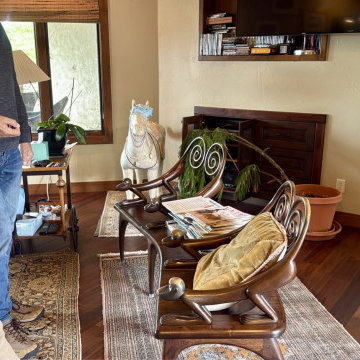
G. Michael’s Restoration was engaged to assess a Monkey Settee by Judy Kensley McKie on site, alongside John Sollo, appraiser for PBS’s Antiques Roadshow and a specialist in 20th century design. The settee is carved and joined walnut with cast bronze monkeys forming the arms and back supports, produced by McKie in a small numbered edition in the mid 1990s. Examples are held by the Smithsonian American Art Museum and the Carnegie Museum of Art, and the design has achieved six-figure results at auction.
Scope
This was an advisory visit rather than a shop project. The consultation addressed the condition of the piece, the appropriate approach to its care, and the principles that should govern any future intervention. The location and owner are confidential.
Technical Notes
A studio craft piece of this significance is treated as an artwork first and a piece of furniture second. The two materials age differently. Walnut carries a finish that can dull, craze, or wear at contact points; cast bronze develops a patina that is part of the object’s history and is not to be polished away. Any work on a piece like this starts with documentation, respects the artist’s original surfaces, and uses reversible methods wherever possible. The default position is restraint. Value on a piece like this lives in originality, and the restorer’s role is often to advise against work as much as to perform it.
Application
G. Michael’s Restoration consults on and conserves significant studio furniture, designer pieces, and high-value antiques for collectors, designers, and estates across Fort Collins, Northern Colorado, and the Denver metro area, including Boulder, Cherry Creek, and Greenwood Village. Discreet handling is available for clients who require it.
 Oxford Garden
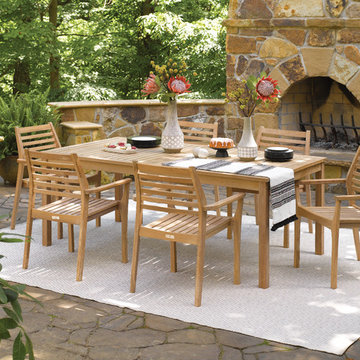
The Hampton Collection is a versatile solution to outdoor dining. and perfectly suited to pair with the clean lines of the Mera Stacking Armchair. Both are crafted from high quality shorea wood using commercial grade mortise and tenon joinery to provide durability and strength in the toughest dining environments.
Features:
Set includes (1) Hampton 76""x40"" Dining Table, Shorea Natural, (6) Mera Stacking Armchair, Shorea Natural
Slatted top and seats to prevent ponding
Removable plug allows for umbrella
Chairs ship preassembled
Ergonomic curves for maximum comfort
Mortise and tenon joint construction adds strength and longevity
Constructed of Shorea tropical hardwood - heavy, dense and resistant to rot and infestation
Will last for years in all weather conditions
Untreated, wood weathers to a warm gray, or treat with teak oil to maintain color
Seats 6
Optional cushion available
Set Dimensions:
(HA76TA) Table - 40.25""l x 75.75""w x 29.25""h. Weighs 125 lbs(MECH4) Chair - 24.25""l x 21""w x 34""h. Weighs 19 lbs(MECH2) Chair - 24.25""l x 21""w x 34""h. Weighs 19 lbs

 RetractableAwnings.com Inc.
PROJECT DESCRIPTION:
The client requested a large (19 foot wide by 15 foot projection) two-span retractable waterproof patio cover system to provide heavy rain, hail, heat, sun, glare and UV protection. This would allow our client to sit outside and enjoy their garden throughout the year, extending their outdoor entertainment space. For functionality they requested that water drain from the rear of the system into the front beam and down inside the right end post, exiting at the bottom from a tiny hole and draining into the flower beds thus preventing rain water from simply dropping off the front of the unit. The entire system used one continuous piece of fabric and one motor. The uprights and guides meet together at a smooth L-shaped angle, flush at the top for a perfectly smooth profile. The system has a Beaufort wind load rating Scale 10 (up to 63 mph) with the fabric fully extended and in use. A grey hood was also used to prevent rain water, debris and snow from collecting in the folds of fabric when not in use. A running profile from end to end in the rear of the unit was used to attach the Somfy RTS motor which is installed inside a motor safety box. Circular concrete footers were installed in the grassy area in front of the unit for mounting the 3 posts. To allow for a flat vertical mounting surface, a ledger board using pressure-treated wood was mounted the full 19-foot wall width, as the client’s house was made of uneven, thick stone.
PURPOSE OF THE PROJECT:
The client’s intention was for installation of a retractable waterproof patio cover system to provide heavy rain, hail, heat, sun, glare and UV protection for their backyard patio area.
What is unique or complex about the project?
This project was difficult for two main reasons: 1. Very large installation fasteners needed to be used to install through the above referenced ledger board and deep in to the stone structure of the house. 2. The motor cable needed to be placed through deeply drilled holes as the stone wall house wall is 15” thick. Drilling through en-even stone was definitely a challenge.
PROJECT RESULTS
The client was delighted with the results. The retractable patio cover system now makes it possible for the client to use a very large area in the rear of their house 24/7, 365 with the exclusion of snow. Since the client was very happy, they will be covering the ends, front and sides with our motorized vertical drop zippered awnings. Gable ends will also be covered with fixed fabric panels. Enclosing the entire area will allow the customer to heat the space in the winter and air condition the space in the summer.


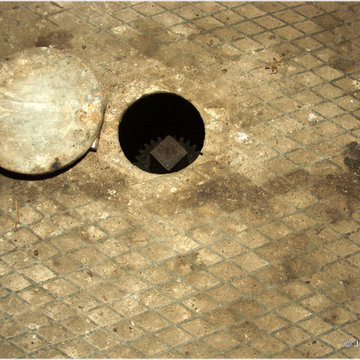 Best Possible Removal Service In London
What You Should Know About Fuel Tanks
Home heating solutions can encompass electrical, gas, solar and oil based systems. When one talks about oil tanks that are used as home heating systems, there are a few important things to keep in mind.
Start with the installer
A high-quality, professional and expert installer of oil or fuel tanks can certainly help you make the decision on which type of tank is the best for your property. When you decide on underground fuel tanks, you should make sure that they are:
• Compliant with all statutory requirements.
• Made of steel and polyurethane.
• Covered by guarantee.
• Supported by backfill material, leak detection systems and tank supports.
Aboveground fuel tanks are easier to maintain simply because they are more accessible. Even the smallest of oil or fuel leaks can be detected almost immediately. But even here, an installer should give you premium quality tanks. These tanks:
• Should have secondary containment.
• Should be corrosion resistant.
• Should have proper support as well.
Installation
Installation for both – underground and above ground tanks is a technical and complex process. The installation process for both will start with a technician visiting your home and making an assessment of aspects such as:
• Measuring the space.
• Taking stock of the distance from your home to the tank, pipes and so on.
• The supports needed for the tank and so on.
If it is an above ground tank, then it may also need bollards to protect it from vehicles. An underground tank will need containment sumps and drop tubes and so on.
The combination of components will be decided by the installer and you can certainly ask for a complete breakup of the same and get the costs for the same as well.
Remediation
Repair and remediation of above and underground tanks is a critical task. In fact, many problems associated with underground fuel storage tanks can be eliminated if the home owner invests time and resources into periodic analysis and examination of the same.
A fuel tank that has been installed above the ground will be easier to access but repair and remediation of both types of tanks will entail:
• Soil sampling.
• Extent of oil contamination.
• Assessment of leaks and the extent and number of the same.
• Drawing up a plan for dealing with all problem areas.
Removal
Every fuel tank has a shelf life. At some point of time or the other, the fuel tank will need to be removed. When it comes to above ground installations, the removal company will need to assess the type of fuel and the knowhow on emptying the tank completely.
The tank will also need to be cleaned completely before being loaded on to a vehicle that can take it away to a recycling unit or disposal unit. Underground tanks can be removed or closed or treated as abandoned depending on the condition of the tank and official licenses. For instance, a tank can be treated as closure in place if the removal of the same is going to compromise the safety of structures above the ground.

 Platt Builders
Greg Premru Photography, Inc
Craft room - large transitional built-in desk light wood floor craft room idea in Boston with beige walls
Craft room - large transitional built-in desk light wood floor craft room idea in Boston with beige walls

 Zelaya Properties LLC
We used: Custom cherry cabinetry in Arts & Crafts Shaker style by Kabinart in Boulder and Espresso stains. Liberty Hardware Venetian bronze 1-1/2" cabinet knobs. KitchenAid Architect II Series 22 CF counter-depth French door refrigerator. KitchenAid Architect Series II 27" convection single wall oven. KitchenAid 36" 6-burner dual fuel freestanding commercial-style range. KitchenAid Architect II Series 24" dishwasher. Sharp Insight Pro Series 24" built-in microwave drawer (Model #KB6524PS). Crystorama Solaris 12" wide pendant lights in English bronze. Granite countertops in Brown Fantasy. 3"x6" polished marble backsplash.
Paint colors:
Walls: Glidden Silver Cloud 30YY 63/024
Ceilings/Trims/Doors: Glidden Swan White GLC23
Robert B. Narod Photography
 Tile Doctor Ltd
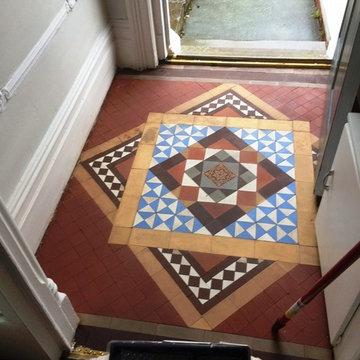
I was asked to take a look at restoring a Victorian Tiled Floor in the Cumbrian town of Barrow in Furness where the floor had been covered in black bitumen; the bitumen was so thick it was difficult to gauge the condition of the floor underneath. I did a test clean which came out well but I had to explain there could be tile damage and other hidden problems so very difficult to quote for however we agreed a date and price and I came back a couple of weeks later to do the job.
Removing Bitumen form Victorian Tiles
Removing the bitumen from the floor without damaging the tiles underneath was a slow process involving spraying on a strong solution of Tile Doctor Remove and Go, letting it soak in, applying steam and then carefully scraping off the bitumen. The floor was treated in this manner a small area at a time and a wet vacuum was used to rinse and remove the resulting slurry. This process took up the whole day and was completely successful at removing the bitumen, before finishing I gave the floor a thorough rinse with clean water and used the wet vacuum to dry the floor was much as possible before leaving.
Sealing a Victorian Tiled Floor
I had used a lot of water cleaning the floor so I agreed with the owner to leave the floor for a few days before sealing it so it could thoroughly dry out. When I did return I used Tile Doctor Colour Grow to seal the tiles, the customer had wanted a satin finish but having weighed up the options including the fact that there was a damp problem in the house I felt Colour Grow which is a penetrating and breathable sealer would have the best longevity.
The customers were very happy with the results and before leaving we discussed aftercare cleaning, with sealed surfaces you have to be careful not to use acidic products as this can reduce the life of the sealer.

 Steve Masley Consulting and Design
Jalapeño grown organically in a 7-gallon Smart Pot. This plant produced 69 jalapeños! Photo by Steve Masley
Example of an eclectic home design design in San Francisco
Example of an eclectic home design design in San Francisco

 Paradise Sharks Real Estate
From the moment you enter onto the screened front porch of this historical spanish mission style property you will know you have arrived at a special home. From the mosaic tile floor you are walking on to the pecky cypress ceiling overhead you know you are in for a special treat. Located in the College Park Historic District the three bedroom 2 1/2 bath home is one of the architectural treasures in this neighborhood and features rich period details. From the arched entry door to the private garden at each turn both inside and out this home has it all with close proximity to our beautiful beaches, restaurants and shopping. Just jump on your bike and you won't believe how quickly you will be playing in surf of the Atlantic Ocean or off to an amazing meal at La Bonne Bouche.
Custom touches throughout with the front bedroom featuring marble floors, a loft and soaring 18' ceiling. Gourmet kitchen featuring gas cook top and triple built in wall ovens overlooks the large family room featuring Saltillo tile floors and impact glass doors leading to outside spaces on each side of the residence. Traditional formal living room and dining room with period fireplace, parquet flooring and stained glass in the arched topped period windows. The master bedroom is tucked away on the second floor of the residence with rich wood flooring and large walk in closet with built in cabinetry. Three separate air conditioning zones just add to the comfort level of this amazing property. Outside the gardens are breathtaking with private deck adjoining the two separate one car garage spaces. If you are looking for a period home with all the special touches do not let this one pass you by.
Please feel free to contact Tom Priester at Paradise Sharks Real Estate for more information, to schedule a private tour of this home or for any of your real estate needs throughout Palm Beach County. Easy to reach it 561 308-0175 or tom@tompriester.com.
Fins up.........
Home Takes

 Moderne Builders
Gorgeous master bath with dramatic retro "wave" tile. Peak Photography
Example of a 1950s bathroom design in Los Angeles
Example of a 1950s bathroom design in Los Angeles

 Neil Kelly Company
The homeowners had a very specific vision for their large daylight basement. To begin, Neil Kelly's team, led by Portland Design Consultant Fabian Genovesi, took down numerous walls to completely open up the space, including the ceilings, and removed carpet to expose the concrete flooring. The concrete flooring was repaired, resurfaced and sealed with cracks in tact for authenticity. Beams and ductwork were left exposed, yet refined, with additional piping to conceal electrical and gas lines. Century-old reclaimed brick was hand-picked by the homeowner for the east interior wall, encasing stained glass windows which were are also reclaimed and more than 100 years old. Aluminum bar-top seating areas in two spaces. A media center with custom cabinetry and pistons repurposed as cabinet pulls. And the star of the show, a full 4-seat wet bar with custom glass shelving, more custom cabinetry, and an integrated television-- one of 3 TVs in the space. The new one-of-a-kind basement has room for a professional 10-person poker table, pool table, 14' shuffleboard table, and plush seating.
19