
Search results for "Understanding indicating" in Home Design Ideas
 Granger Remodel & Design
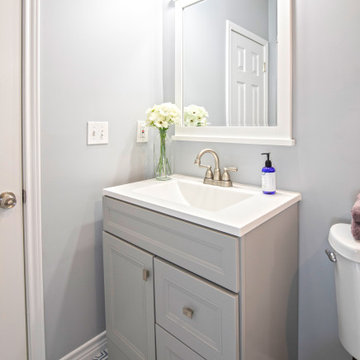
Inspiration for a small farmhouse 3/4 white tile and ceramic tile porcelain tile, multicolored floor and single-sink alcove shower remodel in Dallas with furniture-like cabinets, gray cabinets, a two-piece toilet, blue walls, an integrated sink, solid surface countertops, white countertops, a niche and a freestanding vanity

 Green Grounds Landscape Services
Example of a mid-sized trendy backyard concrete paver full sun deck design in Los Angeles with a fire pit and no cover

 Pheifers Custom Homes
A good way to assess the condition of a log home finish is to wait for the building to dry after being washed. Once dry you must understand what type of log home stain is on your building. If you have an oil based log home stain you should be looking at the knots and checks on the walls. These areas will turn blonde when the finish is wearing off and this indicates that you should apply one to two maintenance coats of stain. Some oil based stains now offer a clear maintenance coat and this is the better route to take but it only works if the stain is not worn to bare wood.
Find the right local pro for your project
 Samantha Stein Interiors
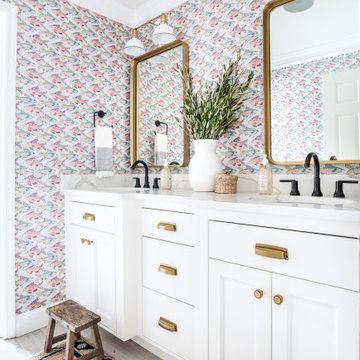
Bathroom - country gray floor bathroom idea in Nashville with recessed-panel cabinets, white cabinets, multicolored walls, an undermount sink and white countertops

 FineLine Kitchens, Inc.
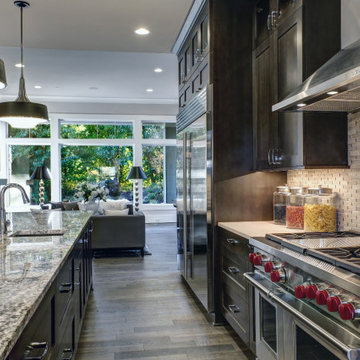
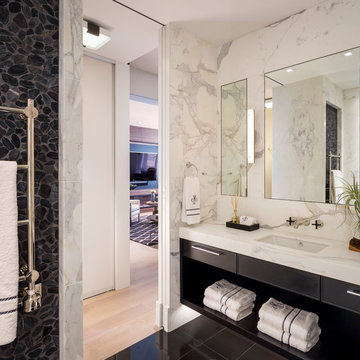
Our designer has achieved a stylish look by combining dark cabinets and light-colored marbles.
 Katie Rosenfeld Design
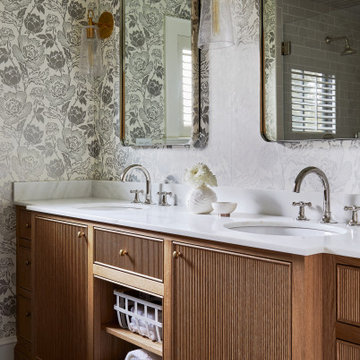
Transitional mosaic tile floor, black floor, double-sink and wallpaper bathroom photo in Boston with flat-panel cabinets, medium tone wood cabinets, gray walls, an undermount sink, white countertops and a built-in vanity
 safe ZOnea
 When it comes to home improvement projects, the contractor you choose can make all the difference. A skilled, reputable general contractor delivers quality work and a smooth experience, while a poor choice can lead to problems, frustration, and wasted money. For Chicago homeowners planning exterior improvements from siding to doors and beyond — understanding how to choose a good general contractor is essential. This guide covers what to look for and how to make a smart choice for your home improvement projects.
The role of a general contractor
A general contractor plays a central role in home improvement projects, overseeing and coordinating the work to bring a project to completion. For projects that involve multiple aspects or trades, a general contractor manages the process, ensuring the various pieces come together properly. This coordination and oversight are valuable, particularly for larger or more complex projects that involve numerous details and steps.
Working with a good general contractor offers several benefits. It provides a single point of responsibility for a project, brings expertise and coordination to the work, and helps ensure the project is completed properly. For homeowners, a quality general contractor can make the difference between a smooth, successful project and a stressful, problematic one. Homeowners planning projects often look for a general contractor chicago near me to handle their improvements. Understanding the role a general contractor plays helps homeowners appreciate the value of choosing a good one for their home improvement projects, especially larger or more involved ones.
Why the choice matters
The choice of general contractor has an enormous impact on a home improvement project. From the quality of the work to the smoothness of the process to the ultimate result, the contractor shapes every aspect of the project. A skilled, reputable contractor delivers quality results and a professional experience, while a poor choice can lead to shoddy work, delays, cost overruns, and frustration.
The stakes are significant, as home improvement projects represent substantial investments and affect a home that homeowners live in and value. A project done poorly can create problems that are costly to fix and diminish rather than enhance a home. This is why choosing the right contractor is so important — it's one of the most consequential decisions in any home improvement project. Homeowners do well to approach the choice carefully rather than simply hiring the first or cheapest option. Understanding why the choice of contractor matters helps homeowners give this decision the attention it deserves, recognizing its impact on the success of their project and their satisfaction with the result.
What to look for in a contractor
Choosing a good general contractor involves looking for several important qualities. Experience and a solid reputation are key indicators of a contractor's ability to deliver quality work. A contractor with a track record of successful projects and satisfied customers is generally a safer choice than an unknown quantity. Researching a contractor's reputation and past work helps in assessing their quality.
Beyond experience and reputation, other important qualities include quality workmanship, clear communication, professionalism, and reliability. A good contractor communicates clearly, provides a clear understanding of the project and its costs, treats customers professionally, and follows through reliably. These qualities contribute to both a quality result and a positive experience. Homeowners considering exterior projects, such as new vinyl siding chicago installation, do well to evaluate contractors on these factors. Understanding what to look for in a contractor helps homeowners identify professionals likely to deliver quality work and a good experience for their projects.
Considering the specific project
When choosing a contractor, it's also important to consider the specific project and whether the contractor is well-suited to it. Different projects have different requirements, and a contractor experienced in the particular type of work is often a better choice. Whether the project involves siding, doors, a broader remodel, or other work, a contractor familiar with that type of project brings relevant expertise.
For exterior projects in particular, experience with the specific work and the demands of the Chicago climate is valuable. Siding, doors, and other exterior improvements must withstand local conditions, so a contractor who understands these demands can deliver better results. Considering whether a contractor is well-suited to your specific project helps ensure a good outcome. Homeowners planning to update their exterior doors chicago or undertake other exterior work benefit from choosing a contractor experienced in that area. Understanding the importance of matching the contractor to the project helps homeowners make choices that lead to quality results for their specific improvements.
Understanding the project scope and cost
Before committing to a contractor, understanding the full scope and cost of a project is important. A reputable contractor should provide a clear explanation of what the project involves, the materials to be used, the timeline, and the total cost. Understanding these details upfront helps homeowners avoid surprises and make informed decisions. Vague estimates or a lack of clarity are warning signs worth heeding.
Understanding the scope also means being clear about what you want and ensuring the contractor's proposal matches your needs and expectations. A clear, detailed understanding of the project protects both the homeowner and the contractor and sets the stage for a successful outcome. Taking the time to ensure you understand exactly what you're getting before work begins is worthwhile. Understanding the importance of clarity about scope and cost helps homeowners enter home improvement projects with confidence and avoid the misunderstandings that can lead to problems. Clear expectations are the foundation of a smooth, successful project.
Making your decision
With these considerations in mind the role of a general contractor, why the choice matters, what to look for, matching the contractor to the project, and understanding scope and cost homeowners are well-equipped to make a smart decision. The goal is to choose a contractor who combines experience, quality workmanship, clear communication, and reliability, and who is well-suited to the specific project, at a fair and clearly understood price.
Taking the time to research and compare contractors, rather than rushing the decision, pays off in the quality of the work and the smoothness of the project. A home improvement project is a significant investment, and the right contractor makes all the difference to the outcome. Understanding how to evaluate and choose a general contractor empowers Chicago homeowners to make decisions that lead to successful projects and results they'll be happy with. The right choice is the foundation of a home improvement project that enhances a home for years to come.
The bottom line
Choosing the right general contractor is essential to successful home improvement projects, as the contractor shapes the quality of the work, the smoothness of the process, and the ultimate result. For Chicago homeowners undertaking exterior projects like siding, doors, and more, the key factors include experience and reputation, quality workmanship, clear communication, suitability to the specific project, and clarity about scope and cost. By evaluating contractors on these factors and taking the time to make an informed choice, homeowners can find a professional who delivers quality results and a positive experience. The right contractor is the foundation of home improvements that enhance a home for years to come.
 User
User
Country house plan - 23-441 from Houseplans.com
Questions? Call us at 1-800-913-2350
Photographs may show modified designs. All images are copyrighted.
Plan 23-441
992 sq ft
2 beds
1.50 baths
28' wide
28' deep
×
Plans
Main Floor Plan
Reverse
Upper Floor Plan
Reverse
Lower Floor Plan
Reverse
Specifications
Plan Styles
Country
Farmhouse
Exterior Wall Framing
Framing
2"x6"
Bedroom Features
Main Floor Bed Bath
Area
Main Floor Sq Ft
896 sq ft
Total Sq Ft
992 sq ft
Garage Sq Ft
800 sq ft
Lower Floor Sq Ft
96 sq ft
Garage
Garage Under
Basic Features
Baths
1.50
Garage Stalls
2
Stories
2
Bedrooms
2
Potential Bedrooms
0
Dimension
Depth
28'
Width
28'
Designer Notes
Included
EXTERIOR ELEVATIONS: Detailed drawings showing how the house will look from each elevation once it is built.
FLOOR PLANS: These drawings will show each level of the house, indicating the dimensions of each room, the location of walls, windows, stairs, structure to hold the possible floor above and basic electrical layout.
FOUNDATION PLAN: This fully detailed drawing is showing all pertinent notes, the dimensions, height and thickness of the poured foundation. Structure to hold the floor above is also shown. Most plans come with a full basement, unless otherwise specified.
CROSS SECTION: These construction drawings will show you sections of the house as it cuts through the length and depth indicating the height and details for each volume.
ROOF PLAN: This layout will help you understand the structure of the roofing system and the location of each of the main trusses.
TRUSS DIAGRAM: General layout and truss diagram that you can bring to a local manufacturer or simply to help the builder with his structure.
CONSTRUCTION DETAILS: wall sections and stair section: In these pages you will get general construction details and staircase section to conform with up to date ways of building and regulations.
Pricing
Plan Set
Price
5 Copy Set
$755.00
8 Copy Set
$780.00
PDF Set
$935.00
Reproducible Set
$935.00
CAD Set
$1
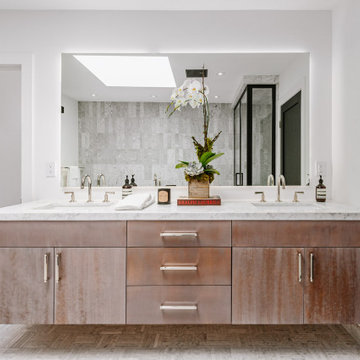
 Joel Reis Architecture and Real Estate Photography
Bathroom - mid-sized farmhouse master gray tile and marble tile bathroom idea in Los Angeles with recessed-panel cabinets, distressed cabinets, white walls, an undermount sink, marble countertops and white countertops
 Save home
For the best effect when looking for fabrics to furnish your house, it is best to use fabrics that have varying textures. This is the only way to avoid getting a flat and bland look. When furnishing, consider collecting different types of fabrics and then mixing them until you get a result you find appealing. Do not be afraid of trying out as many fabrics as possible. Remember it is only through carrying out trials that you will be able to identify the right color schemes as well as find what works best for your items or house. Voyage Maison share some tips to make the most of your soft furnishing.
When Choosing Fabrics, Consider Where You Want Them To Go
When selecting a fabric scheme, consider where you want the fabrics to go. If you look at the back of most fabrics, you will find that most manufacturers usually indicate the most suitable area where they should be placed such as on upholstery or for windows. You will also find that most fabrics usually come with labelled with their composition and rubs. Understanding the rubs on a fabric will help you know more about the durability of the material as well as the most suitable areas of use. The number of rubs on a fabric are typically found on little icons on the material or they can be indicated in the form of a number after a Martindale test has been carried out by the manufacturer. The number of rubs is the best way to know how to purpose a fabric. For example: • Fabrics with less than 10,000 rubs are most ideal for decorative uses • Fabrics with between 10,000-15,000 rubs are ideal for light domestic uses • Fabrics with between 15,000-25,000 rubs are ideal for general domestic uses • Fabrics with between 25,000-30,000 rubs are ideal for heavy duty uses When Choosing Fabrics For Furnishing, Consider Their Practicality and Maintenance Needs
It is best that you select your fabrics based on your existing needs while at the same time looking at the care that will be required to keep the material in prime condition. For example, if you have pets and kids, you should go for fabrics that can easily be wiped or cleaned. Most of the fabrics in the market today can be easily cleaned but you should ensure that you specify to your retailer that you need a material that is easy to clean when making a purchase. On finding your fabric of choice, you can also acquire Scotchgard – A strong fabric cover that repels most spills making cleaning of fabrics easier.
When selecting fabrics, you should also consider the orientation of the room where they will be used. This will help you pick the right material of fabric as well as select the right fabric color. For example, if your room has a southern orientation, light will be filtering into the room in such a way that it will not be prudent to use fabrics made of silk material for your cushions and windows.
Tips On How To Accentuate The Appeal Of a Room By Adding Throws & Cushions
In the market, you will find cushions and throws in all shapes, sizes and colors. These fittings can essentially be said to be the cherry on top of the cake when it comes to accentuating the décor in a room. After planning out the furnishings for the rest of the room, cushions and throws can help you brighten up a room and further, they can help you transform it entirely. For example, you can change the look of a room from formal to informal just by selecting the right cushions. You can also transform the look of a room to suit the season at hand, say from summer to winter by simply changing cushions and playing around with the fabric covers. You can also achieve different effects by changing the sizes of cushions and throws in a room. Changing cushions and fabrics to suit different occasions, moods or seasons is a great way to achieve your desired look without breaking the bank.
When selecting a fabric scheme, consider where you want the fabrics to go. If you look at the back of most fabrics, you will find that most manufacturers usually indicate the most suitable area where they should be placed such as on upholstery or for windows. You will also find that most fabrics usually come with labelled with their composition and rubs. Understanding the rubs on a fabric will help you know more about the durability of the material as well as the most suitable areas of use. The number of rubs on a fabric are typically found on little icons on the material or they can be indicated in the form of a number after a Martindale test has been carried out by the manufacturer. The number of rubs is the best way to know how to purpose a fabric. For example: • Fabrics with less than 10,000 rubs are most ideal for decorative uses • Fabrics with between 10,000-15,000 rubs are ideal for light domestic uses • Fabrics with between 15,000-25,000 rubs are ideal for general domestic uses • Fabrics with between 25,000-30,000 rubs are ideal for heavy duty uses When Choosing Fabrics For Furnishing, Consider Their Practicality and Maintenance Needs
It is best that you select your fabrics based on your existing needs while at the same time looking at the care that will be required to keep the material in prime condition. For example, if you have pets and kids, you should go for fabrics that can easily be wiped or cleaned. Most of the fabrics in the market today can be easily cleaned but you should ensure that you specify to your retailer that you need a material that is easy to clean when making a purchase. On finding your fabric of choice, you can also acquire Scotchgard – A strong fabric cover that repels most spills making cleaning of fabrics easier.
When selecting fabrics, you should also consider the orientation of the room where they will be used. This will help you pick the right material of fabric as well as select the right fabric color. For example, if your room has a southern orientation, light will be filtering into the room in such a way that it will not be prudent to use fabrics made of silk material for your cushions and windows.
Tips On How To Accentuate The Appeal Of a Room By Adding Throws & Cushions
In the market, you will find cushions and throws in all shapes, sizes and colors. These fittings can essentially be said to be the cherry on top of the cake when it comes to accentuating the décor in a room. After planning out the furnishings for the rest of the room, cushions and throws can help you brighten up a room and further, they can help you transform it entirely. For example, you can change the look of a room from formal to informal just by selecting the right cushions. You can also transform the look of a room to suit the season at hand, say from summer to winter by simply changing cushions and playing around with the fabric covers. You can also achieve different effects by changing the sizes of cushions and throws in a room. Changing cushions and fabrics to suit different occasions, moods or seasons is a great way to achieve your desired look without breaking the bank.
 Tile Doctor Ltd
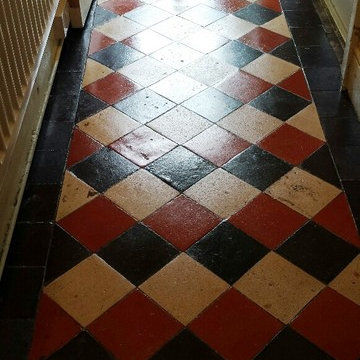
The pictures below were taken at a house in the town of Merthyr Tydfil, which is located not too far north of Cardiff. My client was keen to keep her very old Quarry tiled floor – which dated back to 1905 – intact. The floor had understandably seen a large amount of traffic in its lifetime, and was now in dire need of a professional restoration, including a thorough clean and seal.
First, I completed a survey of the area and provided my client with a quote. After completing many similar jobs in the past, I generally have a good idea of what the final result will look like. I passed on some images of a final result to my client, who was happy for me to begin my work.
On the first day, my first task was to take run some damp tests which were fine; it’s always good to know up front if there are likely to be any damp issues. Next I covered the floor with water to take the surface suction out and waited fifteen minutes before applying a cocktail of Tile Doctor NanoTech Heavy Build-Up cleaner mixed with Pro-Clean and Grout clean-up covering the whole floor. I then immediately starting to work the solution into the floor with a rotary machine fitted with a coarse black pad. The solution was then rinsed off with water which was then extracted with a wet vacuum as I worked. For stubborn areas I applied more of the previously mixed solution scrubbed into the floor with coarse wire wool by hand followed by further rinsing with water.
Each of the products used serves a particular purpose. Pro-Clean is a strong high-alkaline cleaner for natural stone, while NanoTech HBU is a particularly powerful cleaner that uses nano-sized particles to penetrate deep into the stone to get underneath and lift out ingrained dirt and stains. Grout Clean-Up, as the name implies, is a product for resolving grout related problems such as removing grout smears from tile surfaces aka grout haze.
After completing the clean I left the house for 48 hours, to leave enough time for the floor to dry completely in preparation for sealing. Upon my arrival back at the house I conducted some more damp tests to check that the floor was dry enough to seal using the previous readings as a benchmark. The results indicated that I was fine to proceed with the seal, so I applied a total of eight coats of Tile Doctor Seal & Go for durable protection. This was the product I recommended to my client as she wanted a nice, soft shine for her surface seal.
As you can see from the photos, the desired result was achieved to a high standard and needless to say my client was delighted with the transformation.
Julian Iancono
South East Wales


 Benham Design Concepts
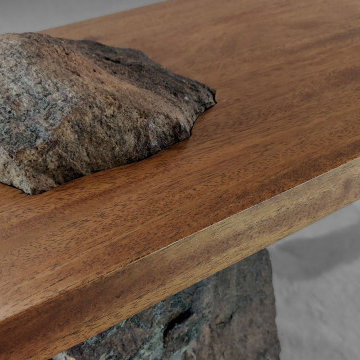
This meditation bench brings the outside in by featuring a stone as one of the legs to hold up the top, creating a great place to be alone with your thoughts and meditate.
This bench is balanced with a hollowed granite leg, ground out by hand with the aid of a diamond drill bit and an angle grinder to provide a more manageable weight.
I hand-carved a peek-a-boo opening in the mahogany seat to expose the granite for aesthetic interest while supporting the seat with a custom-fabricated metal bracket underneath for stability. The wooden leg is mortised securely through the top and wedged in place with walnut wedges. The supporting walnut arch spanning from one leg to the underside of the seat is one piece. The arch passes through a mortise in each of the cross braces, which are precisely spaced to provide artistic interest and balance. Each mortise was cut by hand with a mallet and chisel.
This silky-smooth bench was built without nails or screws and made from high-quality hardwood, richly-grained African mahogany that begs to be touched. The seat and one leg are African mahogany, and the wedges, arch, and cross braces are walnut. The beautifully placed granite leg is local Colorado granite with natural lichen. The rich reddish-brown mahogany against the subtle soft green color of the lichen provides a sense of stability and harmony.
The design inspiration for having the rock poke through the bench top came from an architect friend, who had a granite boulder craned in through the roof of a house and carved into a gas fireplace. The architect’s stories about how challenging the project was to integrate such an organic piece in an otherwise modern home got me thinking about how I could incorporate organic shapes into my furniture. The arch design came from one of my favorite hiking places in the Cascades, a bridge that spans across Multnomah Falls.
Since publishing this work, I have been told that the design is stupid as only one person can sit on the bench at a time. Those opinions are the beauty of art, as everyone interprets it differently, and not everyone will get its purpose. However, subconsciously, I think the design spoke well for itself, as its purpose is for one person to be alone and meditate. Its deeper meaning may not be obvious or understood by everyone. However, its design has at least set the stage as only one person can comfortably sit on it at a time.
This level of detail is indicative of my work. I try to create a single focal point to catch the viewer’s eye and draw them in. Then, once they get up close to a piece and start interacting with it, they will start to see all the additional details.
I like how the bench top is carefully carved so it sits around the stone and how the weight of the stone helps balance the piece. They start to understand how it was built as they see the joinery detail, of how the tenon comes through the top and is wedged in place.
 Benham Design Concepts
This meditation bench brings the outside in by featuring a stone as one of the legs to hold up the top, creating a great place to be alone with your thoughts and meditate.
This bench is balanced with a hollowed granite leg, ground out by hand with the aid of a diamond drill bit and an angle grinder to provide a more manageable weight.
I hand-carved a peek-a-boo opening in the mahogany seat to expose the granite for aesthetic interest while supporting the seat with a custom-fabricated metal bracket underneath for stability. The wooden leg is mortised securely through the top and wedged in place with walnut wedges. The supporting walnut arch spanning from one leg to the underside of the seat is one piece. The arch passes through a mortise in each of the cross braces, which are precisely spaced to provide artistic interest and balance. Each mortise was cut by hand with a mallet and chisel.
This silky-smooth bench was built without nails or screws and made from high-quality hardwood, richly-grained African mahogany that begs to be touched. The seat and one leg are African mahogany, and the wedges, arch, and cross braces are walnut. The beautifully placed granite leg is local Colorado granite with natural lichen. The rich reddish-brown mahogany against the subtle soft green color of the lichen provides a sense of stability and harmony.
The design inspiration for having the rock poke through the bench top came from an architect friend, who had a granite boulder craned in through the roof of a house and carved into a gas fireplace. The architect’s stories about how challenging the project was to integrate such an organic piece in an otherwise modern home got me thinking about how I could incorporate organic shapes into my furniture. The arch design came from one of my favorite hiking places in the Cascades, a bridge that spans across Multnomah Falls.
Since publishing this work, I have been told that the design is stupid as only one person can sit on the bench at a time. Those opinions are the beauty of art, as everyone interprets it differently, and not everyone will get its purpose. However, subconsciously, I think the design spoke well for itself, as its purpose is for one person to be alone and meditate. Its deeper meaning may not be obvious or understood by everyone. However, its design has at least set the stage as only one person can comfortably sit on it at a time.
This level of detail is indicative of my work. I try to create a single focal point to catch the viewer’s eye and draw them in. Then, once they get up close to a piece and start interacting with it, they will start to see all the additional details.
I like how the bench top is carefully carved so it sits around the stone and how the weight of the stone helps balance the piece. They start to understand how it was built as they see the joinery detail, of how the tenon comes through the top and is wedged in place.
 FMSProjects, Inc.
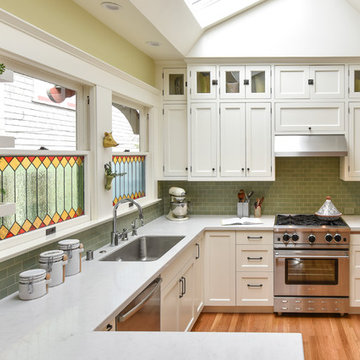
Latch hardware in upper cabinets.
Inspiration for a mid-sized craftsman u-shaped medium tone wood floor eat-in kitchen remodel in San Francisco with a single-bowl sink, shaker cabinets, white cabinets, quartz countertops, green backsplash, ceramic backsplash, stainless steel appliances and a peninsula
Inspiration for a mid-sized craftsman u-shaped medium tone wood floor eat-in kitchen remodel in San Francisco with a single-bowl sink, shaker cabinets, white cabinets, quartz countertops, green backsplash, ceramic backsplash, stainless steel appliances and a peninsula
 StudioBecker
Example of a trendy black tile, gray tile, white tile and pebble tile black floor bathroom design in San Francisco with flat-panel cabinets, black cabinets, white walls, an undermount sink, marble countertops and white countertops
 McCullough's Flooring
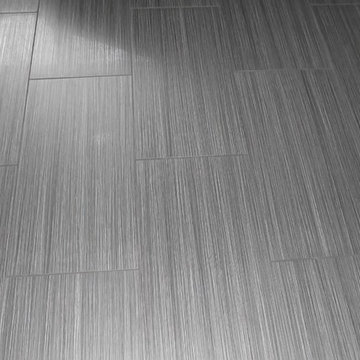
Gorgeous master bath finished with Dal-Tile's Fabrique porcelain tile in the color Noir Linen polished. Tile size is 12"x24" installed in a brick joint pattern. The floor boasts underfloor heating on a timed thermostat.
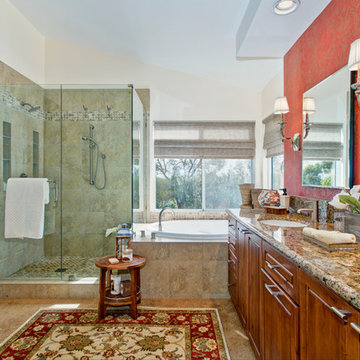
 CairnsCraft Design & Remodel
Great spacious bathroom with lot of amenities.
Photographer: Jon Upson
Large elegant master beige tile and porcelain tile drop-in bathtub photo in San Diego with an undermount sink, raised-panel cabinets, medium tone wood cabinets, granite countertops, beige walls and a two-piece toilet
Large elegant master beige tile and porcelain tile drop-in bathtub photo in San Diego with an undermount sink, raised-panel cabinets, medium tone wood cabinets, granite countertops, beige walls and a two-piece toilet

 KraftMaster Renovations
Details - Hand polished corners in natural marble
Photos by Blackstock Photography
Example of a large classic master gray tile and stone tile marble floor freestanding bathtub design in New York with an undermount sink, furniture-like cabinets, white cabinets, marble countertops, a two-piece toilet and white walls
Example of a large classic master gray tile and stone tile marble floor freestanding bathtub design in New York with an undermount sink, furniture-like cabinets, white cabinets, marble countertops, a two-piece toilet and white walls
1