Software
Houzz Logo Print
krista_nutter

Curious about meeting codes?

12 years ago
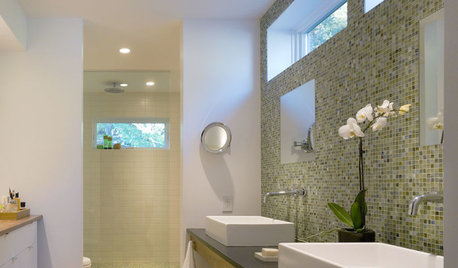
In my area - this would never pass code - having the shower so close to that light fixture above the vanity. They would require it to be a wet location fixture, which this doesn't look like one. I'm curious as to the specifics on that in this situation?
Modern Bathroom · More Info

Comments (6)

  • 12 years ago
    National Electrical Code
    410.10(D)
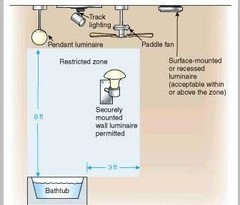
    (D) Bathtub and Shower Areas. No parts of cord- connected luminaires, chain-, cable-, or cord-suspended luminaires, lighting track, pendants, or ceiling-suspended (paddle) fans shall be located within a zone measured 900 mm (3 ft) horizontally and 2.5 m (8 ft) vertically from the top of the bathtub rim or shower stall threshold. This zone is all encompassing and includes the space directly over the tub or shower stall. Luminaires located within the actual outside dimension of the bathtub or shower to a height of 2.5 m (8 ft) vertically from the top of the bathtub rim or shower threshold shall be marked for damp locations, or marked for wet locations where subject to shower spray.

    International Residential Code
    E4003.11 Bathtub and shower areas.
    Cord-connected luminaires, chain-, cable-, or cord-suspended-luminaires, lighting track, pendants, and ceiling-suspended (paddle) fans shall not have any parts located within a zone measured 3 feet (914 mm) horizontally and 8 feet (2438 mm) vertically from the top of a bathtub rim or shower stall threshold. This zone is all encompassing and includes the space directly over the tub or shower. Luminaires within the actual outside dimension of the bathtub or shower to a height of 8 feet (2438 mm) vertically from the top of the bathtub rim or shower threshold shall be marked for damp locations and where subject to shower spray, shall be marked for wet locations

    http://publicecodes.cyberregs.com/icod/irc/2012/icod_irc_2012_40_par043.htm
  • 12 years ago
    Neither mentions anything about fixtures outside the shower. "Luminaires within the ACTUAL outside dimension of the bathtub or shower to a height of 8 feet (2438 mm) vertically from the top of the bathtub rim or shower threshold shall be marked for damp locations and where subject to shower spray, shall be marked for wet locations"

    If you are in the UK, it is slightly different.

    http://www.sycamorelightingltd.co.uk/bathroom-lighting-regulations-c38.html
  • 12 years ago
    Nope - I'm in Ohio and this definitely wouldn't fly. Keep in mind that local jurisdictions can add on to the IRC. My local code official pounced on: "and where subject to shower spray, shall be marked for wet locations" Because the shower curtain isn't fixed, the light fixture over the vanity could potentially be subject to shower spray. Being a shower curtain or moveable door makes the light fixture required to be labeled for wet locations. If it were a wall or fixed piece of glass at least as tall as the shower head, you could probably get away with it. Local codes can always vary - for example in my area, no open riser stairs are allowed, but across the river in KY, they are fine. In fact, here, I even had to drywall the underside of the stairs to create a fire separation between the main stair and basement stair below. I bring this up only because you wouldn't believe how many people come to me with a picture from a magazine or site like this and say, "I want this." and I have to tell them that it doesn't meet local codes. (It was like that for cable railing for a while - not allowed because it was horizontal and created a ladder effect. They have since stared allowing that though - thankfully.)
  • 12 years ago
    You asked for the specifics of the situation. It is not my problem if your local inspector can't read.

    Ohio does not use the IRC for electrical.

    The provisions of the National Electric Code, NFPA 70, as referenced in the Ohio Building Code as the same may be revised and adopted by the State of Ohio, shall be incorporated herein and shall govern the installation, testing and operation of the electrical systems of one-, two- and three-family dwellings and their accessory structures within this jurisdiction.

    Ohio building and electrical codes are STATE WIDE.
    Only the enforcement is local. Electrical inspectors have a state licence.
    There are NO amendments to 410.10(D) in Ohio.

    " Luminaires LOCATED WITHIN the ACTUAL OUTSIDE DIMENSION of the bathtub or shower to a height of 2.5 m (8 ft) vertically from the top of the bathtub rim or shower threshold shall be marked for damp locations, or marked for wet locations where subject to shower spray."
    is all one sentence. To try and use only the last few words is called TAKING A CODE OUT OF CONTEXT.
    By that logic, any fixture in the house could be subject to shower spray if you put a long enough hose on a hand held shower unit. These codes come with specific dimensions SPECIFICALLY to keep rouge inspectors from pulling this B.S. Local inspectors are not allowed to make up their own codes. They are JUST inspectors. The actual "Official" is at the state level in Ohio and governed by the legislature.

    In the July 1997 edition of CODES AND STANDARDS vol.17, num.7 published by Kelly P. Reynolds & Associates, Chicago, IL, Mr. Reynolds states:
    "If a code official, or any government agent, requires someone to do something that is more than the law requires, that can be interpreted as a violation of the U.S. Civil Rights Act of 1960. The Act (42 U.S.C. 1974) reinforces the Fourth Amendment of the United States Constitution (Bill of Rights) that protects from unlawful taking of private property. The courts have ruled that withholding permission to occupy property that complies with the law (code) is a civil rights violation. Triple damages may be awarded."
  • 12 years ago
    Usually, misunderstanding of the codes is due to the failure to grasp the subtle differences in the specific situation as it applies to the code.
    Here are the Ohio residential code amendments;

    http://publicecodes.cyberregs.com/st/oh/st/b4v06/st_oh_st_b4v06_3_sec011.htm?bu=OH-P-2011-000004

    Pay close attention to 311.2.2 and the word "Enclosed"
    Also, look at 311.5.3.3 "Open risers are permitted, PROVIDED......"

    If you are talking about something other than one or two family dwellings, then other codes come into play. I would either report the inspector to the state, or you should brush up on your code reading and understand the extenuating circumstances in your particular case.
Sponsored
Buckeye Basements, Inc.
Average rating: 5 out of 5 stars40 Reviews
Central Ohio's Basement Finishing ExpertsBest Of Houzz '13-'21