

square or round containers which is best
Which shape do plants prefer? Or does it matter. Im sure of course that most use round, becuse thats how most are made. And why do some plants like starting out in smaller containers, and then working their way up? That doesn't make sence to me. it seems that if a plant is going to get big and need room for roots, you should start them in a large container.
Comments (22)
 19 years ago
Well, a square container will hold about 27% more soil in the same amount of space as a round one, but I don't know that plants prefer one over the other.
For the greatest part, most of us depend on experience for direction in container size selection, and there are no rules, per se. You can grow very large and healthy plants in very small soil volumes of soil (witness bonsai) with attention to cultural needs (mainly watering) and you can also grow very small plants in very large containers if your soil is well-aerated and drains quickly. Plant vigor/growth rate, expected planting life, cultural conditions, and particularly soil choice all play a role in the selection of an appropriate size container. I will say that if you are going to err in container size selection, it will usually be easier to raise a reasonably healthy plant in a container that is too small than in a too large container, but even this supposition is soil-choice dependent.
Al
 19 years ago
The explanation of why we start plants out in smaller containers is quite simple: without a vigorous root system engaged in taking water from the potting soil into the plant, that potting medium stays soggy for long periods of time. That almost guarantees problems for a brand new root system. You see, roots need oxygen at all times, or they begin to die. Cell division demands oxygen.
Since the typical packaged potting medium tends to be fine textured (very peaty), it's all the more important to stick with smaller containers until root systems require more space.
However, as Al mentioned previously, if you build a very coarse textured potting medium, you can grow plants quite happily in an over-sized pot. But don't forget, filix, one more good reason to start out small is that it forces you to change the potting soil occasionally. Since all mixes tend to collapse after a while (month or years depending on the ingredients), it's good to have a reminder.
Your annual plants develop large root systems quickly, by the way, so planting them into the finished container size typically works just fine. It's the perennials, houseplants, and woody plants that need some consideration.
Related Professionals
San Antonio Landscape Architects & Landscape Designers · Lynchburg Landscape Architects & Landscape Designers · Des Moines Landscape Architects & Landscape Designers · Buffalo Landscape Architects & Landscape Designers · Tuscaloosa Landscape Contractors · Little Rock Landscape Contractors · New Braunfels Landscape Contractors · Pittsfield Landscape Contractors · Grand Rapids Landscape Contractors · Wheeling Landscape Contractors · Hot Springs Home Builders · Oxford Home Builders · Huron Home Builders · Napa Home Builders · Carson City Home Buildersfilix
Original Author19 years agoThankyou Both again for good info. Im soaking this up like a sponge. " even though Im kind of an old sponge :>)
filix
Original Author19 years agoI quess also by repotting from time to time gives one an chance to prune the roots. Like I think Al mentioned in one post. One thing Im trying to understand is this.If one plants say a clematis In a perfectly sized pot. However big it needs to be. You can add anyhting you need to make sure the roots,flowers,plants ect.. Get whatever they need. But when you plant the same clematis in a hole in the ground same size. You are not supposed to add anything to the soil. Except maybe some compost to the soil that was already there. Doesn't that give containers a pretty big advantage? Because as it was explaned to me, if you ammend the soil in the ground like your containers the roots will at some point reach the plain dirt. And not liking it. Maybe becoming pot bound. That makes sence to me. But if you just plant the clematis in the top soil that was there, with some compost in the soil or on top, How much o2 is getting to the roots? If containers do indeed have an advantage, why not just plant the container in the ground. Then you can ammend to your hearts content? Sorry if this seems a bit wordy. I type very slow.
- 19 years ago
But when you plant the same clematis in a hole in the ground same size. You are not supposed to add anything to the soil.
This is not correct. Soil can and should be amended to provide plants with the best growing conditions one can. Have you heard the saying 'build a $10 hole for a $2 plant'? (I am sure I am misquoting, but you get the idea.)
The only time you wouldn't want to bother amending the soil is for a tree that will form a root system larger than you care to dig out and amend. There the risk is hard, compacted soil outside the amended area may act like a container and the roots don't grow through it, but spiral around like they will in a container. If containers do indeed have an advantage, why not just plant the container in the ground. Then you can ammend to your hearts content?
You can put the container in the ground and in some cases people do. However, if your intent is to leave the plant in the ground year round then it serves no purpose. Folks often do this if they intend to take the plant inside for the winter.
The disadvantage to containers for clematis is that clematis do best with cool roots (or at least that is what the clematis gurus consistently tell me). An above ground container will get much hotter than the soil will. Even in my northern climate I plant clematis in the ground a couple inches lower than they were in the container I purchased them in and then mulch heavily. Not that I have that much experience with clematis, I only have 2.
I will say that the one I added last year did just fine in it's nursery pot in a shady spot until I planted it in the fall.
filix
Original Author19 years agoI know adding somthing like perlite to ground might not be a good idea. It just won't last. So somthing like turface that last a lomg time would make more sence. This is not correct. Soil can and should be amended to provide plants with the best growing conditions one can. Have you heard the saying 'build a $10 hole for a $2 plant.
Yes I have heard that saying. Some people disagree. I have always thought it made sence to amend. Maybe others will chime in. Maybe I should have started another thread.filix
Original Author19 years agoFirst I want to thankyou justa. I cant remember. I brought this subject up before here. Somone mentioned that alot of people used to amend the hole. But now most dig out the hole, save the soil, put the perenial in, replace soil and the put compost/leaf mold on top. Please excuse my many novice questions. Some people might just lurk here and read. But I like to just jump right in, at the risk of looking a bit green," Parden the pun" which I am :>) But its winter time here in maine, and its a good time to ask all my dumb questions now as I get ready for spring! Thankyou very much Justaguy. filix
 19 years ago
Me for one!! And a whole lot of other folks as well :-) Amending individual planting holes is NOT a recommended practice if one can avoid it. The primary reason for not amending planting holes is not that the soil will be excessively rich but rather that one will establish a different soil structure by amending the hole only. This interfers with the ability of water to drain through the soil. Everytime you alter the soil with amendments, you create interface issues between the amended soil and the unamended soil and this promotes drainage issues. It is far more desireable to amend an entire planting area, if necessary, before planting than it is to amend individual holes.
- 19 years ago
You beat me to it, Pam. ;o)
Whenever you amend the soil in the hole you prepared the new mixture will always be either wetter or drier than the surrounding, in situ soil - and that is not a good thing. Use the energy you might expend in building the perfect hole to improve the soil in the bed/garden. Even then, when you amend a bed/garden, you must be cognizant of drainage issues and take precautions that you are not creating a "bathtub effect" in slow-draining soils.
Al
- 19 years ago
justaguy...you can still use that old saying ($10) but think in terms of the SIZE of the hole, rather than all of the stuff that you add into it. No improvements should be added when planting hole by hole. This is true for trees, shrubs, and other plants.
HOWEVER! If you wish to prepare an entire bed all at once, then improvements would be appreciated, but not really needed.
filix, try not to compare apples with oranges. Most plants would far prefer to be planted into the ground. Even my hard-as-a-rock red clay soil grows stupendous annuals, perennials, and woody plants. That little pocket of soil is a part of a much larger SYSTEM that encompasses a huge area above, below, and laterally. That system works very well, where it is! Most natural soil systems provide ample oxygen, water, and dissolved elements within the top few inches of top soil, but only if left in place.
All we try to do when we grow something in a container is to provide it with bare essentials while it is being held hostage. To do so, we need to make sure that we take care of the physical structure first and foremost. The minute we put (from the ground) soil into a container, it becomes mud, no longer part of that huge working system.
So, each is a unique science in and of itself: 'in situ' growing and container growing. If we understand the differences, then we can become extremely successful at both.
While I'm thinking in terms of natural soil systems, here are a few things that we do that harm the system (in terms of plant growth): compaction from a huge variety of sources (foot paths, parking, equipment, etc.), over watering, repeated tilling, over fertilization, grade change (up or down).
filix
Original Author19 years agoI think Im begining to understand better. Let Me please ask your opinion Rhizo or anyone. My wife has an old flower bed along side our home. Its about 3' wide and 20' long. Bee balm and a few other things have been growing there for about ten years. They have been looking rather shaby. That bed was never amended. I was thinking this spring pull everything out and put all new plants in. I was planing on amending. But now maybe I won't. If you dont amend what would you do? " I realize that you cant say for sure because your not here" Would you just loosen up the soil and mulch the top with maybe leaf mold? This is very kind of all of you. filix
- 19 years ago
Bee balm and a few other things have been growing there for about ten years. They have been looking rather shaby.
They need to be dug up and divided every few years to look their best. That bed was never amended. I was thinking this spring pull everything out and put all new plants in. I was planing on amending. But now maybe I won't.
Whether to amend or not depends on the native soil and what you wish to grow. If you have sandy soil and the chosen plant does best in rich, moist soil you should amend. If you have heavy clay soil that stays wet a long time and you choose a plant that comes from a Mediterranean climate you should raise it an amend.
****
justaguy...you can still use that old saying ($10) but think in terms of the SIZE of the hole, rather than all of the stuff that you add into it. No improvements should be added when planting hole by hole. This is true for trees, shrubs, and other plants.I see the point, I was not thinking along the same lines. I don't have any plantings other than trees that aren't in beds.
While I understand the point being made, I have seen plants being grown in holes where the hole was large enough to accommodate the full grown root mass and only that planting area was amended (with peat for pH) and the shrubs are still kicking and bearing 25 years later.
The idea of soil 'interface' issues makes sense, but mostly in extreme situations where the native soil and the material in the hole are radically different. Adding 20% of something to native soil to alter it to better suit the plant isn't going to normally cause problems, but will be an improvement.
The proverbial swimming pool in clay soils seems a fairly extreme example given I have grown in clay soils my entire life. It only happens in the spring when the whole yard is a swimming pool ;-)
- 19 years ago
While I understand the point being made, I have seen plants being grown in holes where the hole was large enough to accommodate the full grown root mass and only that planting area was amended (with peat for pH) and the shrubs are still kicking and bearing 25 years later.
And we used to "paint" tree wounds also :-) Like any other field of study, new research and discoveries in horticulture have changed the way we garden over the years. Just because we "have always done it this way" doesn't necessarily translate to that being the best or preferred method. And without having grown those same exact shrubs in unamended planting holes in a similar situation how does one know that the unamended treatment may (and most likely would) result in more robust and widespreading root systems, resuting in larger and healthier shrubs? Roots do not reach a preordained size or mass and then stop growing - they will continue to grow and expand until the plant finally dies. An average established tree can have a root spread of a diameter of more than 300 feet. A planting hole that will "accomodate the full grown root mass" is something I'd like to see - who digs these massive excavations?
Justaguy, soil interface issues occur ANY time two different types of soil are in conjunction - it is the reason it is not recommended to layer gravel or shards at the bottom of container plantings. And gardening with clay soils myself, I can't tell you the number of times I've been called to clients' gardens to investigate problems with plants only to find the the plants suffering from root rots due to poor drainage in amended planting holes that retain water rather than allow the water to move naturally through the soil. These are not extreme situations - they are a lot more common than you seem to think or have experienced yourself.
I am not a huge fan of Linda Chalker-Scott - she's a bit extreme in many of her opinions, but she nails this one. And for further evidence you might want to investigate planting guidelines offered by the extension services and the land grant universities that support them - pretty much all of them have divorced themselves from the recommendation to amend individual planting holes for a variety of reasons but it boils down to plants perform better in unamended soils or the entire planting area has been amended.
Here is a link that might be useful: the myth of soil amendments
filix
Original Author19 years agoIm learning all the time. That was an interesting link. Thanks justa and gardengirl.I have heard you should do that to bee balm. But thats my wifes project and I let her alone. She asked me to help with that bed. So I will keep the soil right there. Turn it over and loose it a bit, separate the plants and top off the soil with leaf mold. I will not amend. It make me wonder though if you till or turn the soil you are allowing more air. Also giving looser soil for the roots to take off. This is kind of amending isn't it? Would this practice encourage the roots to stay in the tilled soil?
- 19 years ago
A consideration which no one has mentioned is containers that are exposed to high winds. Square containers are more stable than round ones under that condition.
- 19 years ago
Good point eldo!
Okay, I have learned alot from this thread, and I have been doing it all wrong! My question, and Felix I apologize for not starting a new thread, is how do you correct the problem without ripping everything out? I just planted new beds last summer, and ammended the holes as I went.
I also planted a shrub in another area that didn't have good drainage to start with, so I built up a mound using a mix native soil and ammendments. Now I'm thinking it's a goner due to the bathtub effect. How do I remedy the problem now?
- 19 years ago
Let's not jump the gun, hightalttransplant! People have been amending planting holes for a looooong time without knowing better, and plants have done fine. Not their best in the long run, perhaps, but fine. The important thing is that you go forward with your new knowledge and try things another way! You would do more harm to your plant by digging everything up and starting over again, I am certain of that. One test you can do is to gently tug on the trunks of your shrubs. If they feel firmly 'attached' to terra firma, I wouldn't worry too awfully much. You'll know you're in trouble if you pull one out of the ground like it was planted yesterday!!
It sounds rather like you created a small raised bed for the shrub planted in the poorly drained area. If high enough and if the area isn't a veritable swamp, your shrub is likely to be fine. Very wet sites should be attended to before planting, but sometimes small adjustments can work just fine.
As far as tilling goes: too much is never a good thing! This is especially true if your soil has a relatively high clay content in it. My personal rule of thumb for landscape beds (including annual and perennial plants) is that the beds get tilled and amended once. After that, I rely on earthworms and other living soil organisms to keep things stirred up and aerated. I apply organic mulches to the surface a couple of times a year, and they soon disappear. Tilling disrupts and destroys the natural root channels, worm tunnels, aggregation, etc.
The rules change if you're talking about strictly annual plantings, like a veggie garden.
filix
Original Author19 years agoNo problem hightaltransplant. I changed the thread myself. I started out with the shape of containers, to amending holes. :>)
 5 years ago
I'm not sure that all plants prefer a particular shape but I know from personal experience, that square pots with a single hole in the center don't drain as well as tapered bottom round pots with the same hole configuration. The water tends to sit in the corners somewhat indefinitely promoting root rot, particularly in plants like succulents that do best when their soil has dried out completely between watering. Your second question is somewhat related. If the pot is too big for the plant, when you water the pot thoroughly, there will be more water in the soil then the plant really needs. This excess moisture will sit in the pot keeping the soil damp for longer and potentially cause root rot. Root rot is caused by the roots being in contact with wet soil, not from the water itself. Hope this helps.
- 5 years ago
You're right, but not for the reasons stated. A round pot with a 6" diameter bottom holds considerably less soil than a square 6x6 pot - especially if the pot is shaped like a truncated cone. The surface area of a 6x6 circle is 28.26 sq in, compared to 36 sq " of the rectangular pot. When you plug a PWT ht of about 4" into the formula for the volume of a truncated cone vs a truncated sq pyramid, you'll see the square pyramid holds almost 40% more perched water or has 40% more soil in the bottom 4" of the pot, so it takes the perched water much longer to be used or evaporate.
I do appreciate the fact that the drain hole(s) should always be situated so they are through and through the lowest part of any pot, and it's true they often are not, but that's a minor consideration when considered against the fact most media that comes from bags support 3-6" or more of 100 % saturated soil at the pot's bottom.
Bonsai pots, whether or hand-made or from molds, often have reservoirs of water at the bottom of the pot that can't drain because they are lower/deeper than the drain hole so there is no pathway by which the water contained can flow to the drain.
The only time a pot can be too big for a plant, from the perspective of water management, is when the medium supports perched water. There is no such thing as over-potting, no matter how big the pot or small the plant, if the medium does not support water retention between the soil particles.
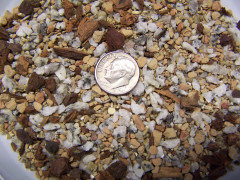
You could plant a radish or tree seed in a 55 gallon drum of the soil I grow in, above, w/o worry you've over-potted because there will always be an ample supply of air between soil particles due to the fact particles are too large to support anything but air between the particles.
Al

Catherine Zone 7b