Software
Houzz Logo Print
magagulus

Complex weed system in old vegetable plot

16 years ago

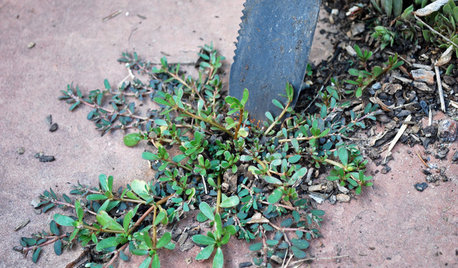
I've been searching and searching for some help on this but still have relatively no clue what I'm going to do. My husband and I purchased a house last year and I'm very excited to get started on the (too-long neglected) yard. There is a vegetable "garden," but by the looks of things, it hasn't been cultivated in years. I've been pulling up weeds left and right; some come up without a problem (annuals?) and others, well... Not so much. There are small vines all intertwined (or at least, they were), almost completely covering the ground until I pulled them up; they broke so unfortunately the roots are still in there, and upon doing some digging, I discovered the root system is ridiculous and I know it's going to be a big pain in the patootie to get every last bit out. They're a lot bigger in diameter than their above-ground vines, and they are strong as heck, plus they're all over the place, and they seem to go very deep.

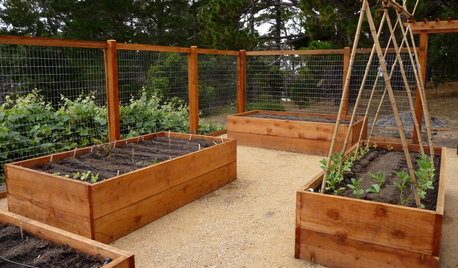
What are my options, here? We'll be doing raised beds, so my husband thinks if we dig down about a foot, sift the soil to get the roots out, and then put a liner down before putting back in the soil, that should be good enough (that, and the 12" the raised beds will provide, will give us a good 2' depth of clean soil for the veggies to grow). But I've yet to find a liner like that. I'm not above using a herbicide if need be, but can't find much good information on that, either, and I need to make sure it's not going to get into my food, of course.

Any help would be greatly appreciated... I want to get this under control now so that when it's finally warm enough to start planting, I can get to it!

Comments (10)

  • 16 years ago

    LORDY that sounds like a ton of work! Have you thought about just simply layering three or four heavy cardboard layers in the bottom of your raised beds and planting right on top of that mess??
    It would be really helpful if you could somehow figure out what, exactly, this weed might be...many weeds, even with huge root systems, will die out from the type of treatment I described, whereas a few others (my own blasted milkweed, for instance!) will probably make it through the apocalypse and I have no good idea for how to kill those darn things once and for all.

  • 16 years ago

    I have to agree with nycynthias and say that cardboard is the way to go. Those fibrous roots will, when the plants die, provide a great deal of organic matter in the soil which is a great thing indeed.

    My approach would be thus:

    - Cover the whole area with a thin layer of compost. If you can't get that much compost, manure, or a complete organic fertilizer will work. Then, take a very sharp spade and make some deep cuts in a random pattern. Ideally you would turn the soil over, but if that is too much work for the area, then just make some deep cuts and work the shovel back and forth. Get that compost/fertilizer incorporated. At this point, you are trying to break up the root network, introduce some oxygen and some organic matter.
    - Next, lay down three to four layers of newspaper, wetting each one with a spray hose as you put it down.
    - Then, over top of that, lay down a good thick layer of cardboard. Not knowing what weed it is, I can't say one or two layers, but one should do it, two would for sure.
    - Your raised bed will go right over top of that. Regardless of whether you are building a framed/enclosed bed, or simply "hilling" to create a rise, you are going to have to import soil. Get a good quality, local triple mix and incorporate the complete organic fertilizer used above.

    What is happening underneath all of the newspaper and cardboard? Well, the weeds will experience a boom in growth having their roots aerated and the soil fertilized. The stems will grow in an attempt to reach light. However, with that much weight on top of them and the thick layers of cardboard and newspaper, the stems will not penetrate (at least not most of them). Eventually, their tissue will blanch white in response to the lack of light, and the sugars and carbohydrates will break down fairly quickly. Eventually, the weeds will die and be eaten by a whole host of microbes and worms. All of that eating produces waste, and that waste is what we all want in our soil and does such a great job providing nutrients to the vegetables.

    Hope that helps.
    Michael

  • 16 years ago

    Is it bind weed? I would find out if I were you or you may be in for more problems later on. Bind weed is very noxious and probably would require chemicals to eradicate it, and belive me you want to eradicate it, if that is what it is, before you start to garden there. steve

  • 16 years ago

    I am one of the organic fundamentalists here, but even I can tell this is one of those rare cases where Roundup is best choice. The vines have enough force in the roots that even what I usually recommend (cardboard covered with wood chips) will not be enough. They will punch through.

    Start by preparing all your vegetable seedlings in pots, so you can plant as soon as feasible. This year your garden will have a slightly late start. When the weeds start vegetating, spray with Roundup. Wait one week, then cut, cover with cardboard, cover the cardboard with compost, and plant in the compost (you may have to punch holes in the cardboard, if the compost is less than 3 inches deep).

    That is not the whole story. You have a deep seed bank in there. That means

    1) you will have to continue adding seedless material until you have a good 4 inches of seed free soil. Here city compost is high quality (you will need no fertilizer in the first year), nearly seed free, and costs $7/cy. I am also the cheapest guy around here, but it is money well spent.

    2) Or, in beds where you will plant large plants, such as squash, pole beans, garlic, potatoes and tomatoes, you can cover the compost with wood chips and plant through the chips. You will not be able to direct seed small seeds for two years, but those beds will be weed free for two years also. One foot of wood chips becomes one inch of topsoil, so you can add a lot. Don't cover all beds unless you are prepared to go without radishes, lettuce and carrots for a few years.

    3) no tilling, ever. If you till, the seeds will come up and kill you.

    4) add some unfinished compost (manure or kitchen scraps), say 50 lbs per bed per year on top in the Fall. The worms will multiply and do all the tilling you need. Apply Roundup directly on the leaves (with a small paint brush) of those weeds that refuse to die.

    Get a soil test, too. Happy gardening.

  • 16 years ago

    I agree with your husband's idesa; Turn over, pick the roots as you go.
    Also use a gravel rake trying to fish out any remaining root pieces. screening the soil (1/2 by 1/3" mesh) could be excellent.
    Not just the roots but also chunky stones will be removed.

    I speak of experience about doing it myself. A started with an area
    with lots of blackberrie, dogfennels, horse nettles,
    young pine trees plus many more weeds and shrubs.
    Plus the soil was red clay mostly. But you are lucky that your
    spot has been a g.a.rden plot before.

  • 16 years ago

    It sure sounds like the very evil bind weed. Get out the weed killer cause that is all that will work. Those roots go for miles and break when you pull on them. I solarized a large plot a few years ago and that is the only stuff that didn't die. It's flowers look like morning glory. It is the cockroach of the garden.

  • 16 years ago

    Ya know, they framed the cathedrals without electronic calculators for the lofting, so I reckon we can conquer a few yards of weeds without chemical 'weedkillers'.

    Cardboard is a good plan. Also thick layers of newspapers.

  • 16 years ago

    Thank you all so much for your speedy replies. It's so wonderful to be able to have so many viewpoints regarding where to go with this. After a bit more research, it does indeed look like it could be bindweed. I've yet to see the plants in their non-dead/dormant state (just some thin, dry vines are all we have now), but whatever it is, it's going to be a real chore to get rid of. We've got some weed-killer as a last resort; I'm going to be trying everything else, first. My husband seems hell-bent on rigging up some sort of sifting device; I'll let you know if it works, but it's going to be one heck of a lot of dirt to be sifting through, trying to get all the roots out -- and while some of the roots are nice and big and won't fall through, others are wispy-thin and I worry this sifting business will be a whole lot of work for nothing... But I'm willing to try it. We also got some weed mats/liners that are meant to be placed above-ground... Do you think they'd help at all if we placed them underground -- about a foot deep? If not, we have tons of cardboard left over from when we moved, so we can certainly do that if need be. I refuse to let these stupid weeds win! I know there are people who have battled bindweed for years, but I've been looking forward to my garden for a long time. This is our first home, and gosh darn it, I'm going to make the most of it!

  • 16 years ago

    You go, girl. If you have the right attitude, you will win the war! You'll also be in fine physical shape for the victory dance!... :)

    You have really good advice above already. I would just say that I have found that ten sheet thicknesses of newspaper, placed with all edges overlapping will smother out virtually any weed. (On the other hand, I have not dealt with bind weed.) You don't say how deep your raised beds will be. If you choose to use the paper/cardboard route, the deeper the beds, the better your chance this will work. Do keep in mind, though, that you will want 3 foot paths between your beds and the weeds need to die there too. I'm pretty anti herbicide, but I would use Roundup in this case, since it kills the plant to the root. (Just my opinion.) Be sure to follow the label directions and be patient. You MUST wait the full 7 to 10 days to know how well it has worked. A second application is not a bad idea for such a bad boy as this.

    You don't list your zone. On future posts, that is a very helpful piece of info to supply. You'll get better advice. Best of luck to you. Set your mind to winning the weed war even if you have to delay planting till next year. We're all rooting for you!

  • 16 years ago

    Have you considered renting a roto-tiller for a day (x3), over the course of about 2 weeks?

    Till, let the stuff on top die off for a few days.
    Till again. Let the stuff on top die off again.
    Repeat.

    This should give you your top layer of good soil to work with, and you can pull it back to lay out that cardboard to keep the lower stuff in check if you wanted to use the cardboard.

    Corn gluten- while I haven't personally used it- is supposedly a good pre-emergent weed suppressor.

    Good luck!